

OBD-II Code P1265: Cylinder 5 Injector Circuit Fault
What P1265 means, why it triggers, and how to fix it
- Code P1265 flags a broken electrical circuit to the cylinder #5 fuel injector, ruling out mechanical or fuel pressure failures.
- On Ford 7.3L engines, the most common fix is replacing the Under Valve Cover (UVC) wiring harness and gasket, which fail from hot oil exposure.
- On Ford 6.0L Powerstrokes, test the Fuel Injector Control Module (FICM); a reading below 45 volts confirms a failing power supply requiring replacement.
- Limit driving to under 100 miles to prevent raw fuel from melting the catalytic converter, which adds $1,500 to $3,500 to the repair bill.
What Does P1265 Mean?
P1265 means the engine's computer (PCM or FICM) detects an open circuit for the cylinder #5 fuel injector. An 'open circuit' is a physical break in the electrical path, such as a cut wire or disconnected plug. Without this electrical signal, the injector cannot open and spray fuel, causing a 'dead miss' in cylinder #5.
Technical definition: Cylinder #5 High To Low Side Open. The Powertrain Control Module (PCM) or Fuel Injector Control Module (FICM) detects a break in the electrical circuit for the number 5 fuel injector. The 'high side' is the power feed from the module, and the 'low side' is the switched ground path completing the circuit.
Can I Drive With P1265?
Yes, But With Caution. You can drive, but limit trips to under 100 miles. The engine runs rough, lacks power, and burns excessive fuel. Continuing to drive with a misfiring cylinder dumps raw fuel into the exhaust, melting the catalytic converter and adding $1,500 to $3,500 to the repair cost. Drive only as far as necessary to reach a repair shop.
Common Causes
- Failed Under Valve Cover (UVC) Harness or Gasket (Very Common) — This is the most frequent cause on Ford 7.3L Powerstroke engines. 🎬 Watch: Expert troubleshooting for 7.3L injector circuit codes The wiring harness and its pass-through gasket connector are submerged in hot engine oil. The insulation becomes brittle and the connectors fail, causing an open circuit.
- Failed Fuel Injector Control Module (FICM) or Injector Driver Module (IDM) (Very Common) — This module sends the high-voltage signal to fire the injectors. A failure in the module's internal power supply or logic board is the primary cause of P1265 on the Ford 6.0L Powerstroke. Low battery voltage destroys FICM power supplies.
- Loose or Damaged Injector Connector (Duramax) (Common) — On GM Duramax engines, the connector at the injector itself loses terminal tension, causing an intermittent connection and setting injector circuit codes. This is routinely fixed with the 'ice pick trick' 🎬 See how to perform the Duramax ice pick repair or a replacement pigtail.
- Failed Fuel Injector Solenoid (Common) — The electronic solenoid coil on the fuel injector burns out and fails, creating an internal open circuit. This prevents the injector from opening even when it receives a proper electrical signal.
- Bent, Spread, or Corroded Main Connector Pins (Common) — The main engine harness connects to the valve cover gasket harness at a large, 42-pin connector on Ford Powerstrokes. The female pins spread apart, or the male pins corrode, creating a total loss of connection for one or more injectors.
- Damaged External Wiring Harness (Less Common) — The wiring harness between the FICM/IDM and the valve cover rubs against engine brackets or chassis components, wearing through the insulation and breaking the wire.
- Failed Powertrain Control Module (PCM) (Rare) — The main engine computer rarely causes a single injector fault, but it remains a possibility after exhaustively ruling out all wiring and module failures.
Symptoms
- Check Engine Light is on — The ECU triggers the Malfunction Indicator Lamp (MIL) immediately. On the 7.3L Powerstroke, a flashing 'Service Engine Soon' light occurs.
- Engine Misfire / Rough Idle — With cylinder #5 dead, the engine shakes, vibrates, and runs unevenly. This is highly noticeable at idle and low speeds.
- Significant Loss of Power — The vehicle feels noticeably weaker, struggles to accelerate, and loses speed on hills.
- Hard Starting When Cold — A classic symptom of a failing FICM on Ford 6.0L Powerstroke engines. The module cannot supply the required 48 volts to fire the injectors until it warms up.
- Excessive Exhaust Smoke — A failing FICM causes incorrect injector timing, leading to excessive white smoke (unburnt fuel) when cold. A dead cylinder also causes an overly rich condition in other cylinders, producing black smoke.
- Increased Engine 'Clatter' — The imbalance from the dead cylinder amplifies diesel clatter and creates abnormal knocking noises.
- Poor Fuel Economy — With one cylinder offline, overall engine efficiency plummets, increasing fuel consumption by up to 30%.
Diagnostic Flowchart
Tap your situation to follow the diagnostic path that matches what you're seeing on this code.
Common Fixes & Costs
- Replace Under Valve Cover (UVC) Harness and Gasket — Parts: $150-$300, Labor: $250-$400, ~2.5 hr book time (Intermediate)
- Repair or Replace Fuel Injector Control Module (FICM/IDM) — Parts: $200-$900, Labor: $150-$250, ~1.5 hr book time (Intermediate)
- Repair Injector Pigtail Connector (Duramax) — Parts: $30-$50, Labor: $100-$150, ~1.2 hr book time (Intermediate)
- Replace Fuel Injector — Parts: $200-$450, Labor: $250-$450, ~3 hr book time (Advanced)
DIY vs Professional
- Replace Under Valve Cover (UVC) Harness and Gasket — Beginner: No
Tools: Socket set, torque wrench, screwdrivers, gasket scraper, inch-pound torque wrench. - Repair or Replace Fuel Injector Control Module (FICM/IDM) — Beginner: Yes (Replacement); No (Repair)
Tools: Basic socket set, Torx drivers. For repair: soldering iron, electronic diagnostic tools. - Repair Injector Pigtail Connector (Duramax) — Beginner: No
Tools: Wire strippers, crimpers, heat shrink tubing, terminal tools. - Replace Fuel Injector — Beginner: No
Tools: Injector puller/installer, torque wrenches (ft-lb and in-lb), deep sockets, fuel line disconnect tool.
Used vs. New Parts: Buying Guide
When a used part is worth it: For complex electronic modules like a FICM/IDM, a professionally remanufactured unit with a warranty is a better value than a used part. Never buy used wiring harnesses, as they suffer from the same heat degradation as the failed part.
Donor-vehicle mileage cap: roughly under 60000 miles for the part to have meaningful remaining life.
Donor quality checklist:
- Prefer remanufactured FICM/IDM units from reputable suppliers over used ones.
- Verify part numbers exactly; running changes are common.
- Avoid buying used Under Valve Cover (UVC) harnesses; new aftermarket versions are affordable and reliable.
Decision logic:
- If The failed part is a wiring harness exposed to engine heat (e.g., UVC harness). → Always buy new. The cost savings of a used part are not worth the high risk of repeat failure.
- If The failed part is the FICM/IDM. → Buy a remanufactured unit with an upgraded power supply and a lifetime warranty.
- If The failed part is a single fuel injector. → Buy a new or high-quality remanufactured injector. A used injector is a last resort due to high labor replacement costs.
Warranty tradeoff: Used parts typically have a 30-day warranty. Remanufactured parts come with a 1-year to lifetime warranty. New OEM parts carry a 1-2 year warranty.
Worst-case if a used part fails: $500 - $1000 if a used part fails after installation, primarily due to repeated labor costs.
What Happens If You Wait — Timeline
- 0-100 miles: Check Engine Light illuminates. Engine develops a consistent misfire, causing a rough idle, noticeable vibration, and significant power loss. (MPG impact: 15-30%% · Added cost: $0-25 in wasted fuel)
- 100-500 miles: Unburnt fuel from the dead cylinder washes over the catalytic converter, causing it to run dangerously hot. Fuel economy plummets and the vehicle stalls at idle. (MPG impact: 30-50%% · Added cost: $25-100 in wasted fuel)
- 500-1,000 miles: The catalytic converter substrate melts and clogs from raw fuel superheating. Exhaust backpressure increases, restricting the vehicle to 40 mph. (MPG impact: 50%+% · Added cost: $1,500 - $3,500 (Catalytic converter replacement required))
- 1,000+ miles: A completely clogged catalytic converter creates extreme backpressure, burning exhaust valves. The engine fails to start or run. The vehicle is undrivable. (MPG impact: N/A (undrivable)% · Added cost: $3,500 - $7,000+ (Engine damage plus destroyed catalytic converter))
Cost of Not Fixing It
- Short-Term (0-100 miles): Severe rough running, poor fuel economy (up to 30% reduction), and significantly reduced power. Risk of stalling in traffic. (Added cost: Negligible, beyond increased fuel consumption.)
- Medium-Term (100-1,000 miles): Raw, unburnt fuel from the dead cylinder washes over the catalytic converter, causing it to overheat and melt internally. (Added cost: $1,500 - $3,500+)
- Long-Term (1,000+ miles): A clogged catalytic converter creates extreme exhaust backpressure, burning exhaust valves and destroying the engine. (Added cost: $3,500 - $7,000+)
Diagnosis Steps
- Read All Trouble Codes
Use an advanced OBD-II scanner to confirm P1265. Look for related codes. P1316 on a Ford indicates injector codes are stored in the IDM. P0611 points to a FICM performance issue.
Tools: Advanced OBD-II Scanner (Beginner) - Perform an Injector Buzz Test
Run an injector 'buzz test' using a capable scanner. This commands each injector solenoid to click rapidly. If cylinder #5 is silent or weak, it confirms an electrical fault in that specific circuit.
Tools: Advanced OBD-II Scanner (Intermediate) - Test FICM/IDM Voltage (Ford Powerstroke)
For a 6.0L, test the FICM voltage at the inspection port. With the key on, it must be 48V. A reading below 45V indicates a failing power supply. For a 7.3L, verify the IDM relay has solid power and ground.
Tools: Multimeter, Torx T20 driver (Intermediate) - Inspect External Wiring and Main Connectors
Visually inspect the wiring harness from the control module to the valve cover. On Fords, unplug the 42-pin connector and look for corroded, bent, or backed-out pins. On Duramax engines, check the injector connector for looseness.
Tools: Flashlight, inspection mirror (Beginner) - Test Resistance from the Main Connector
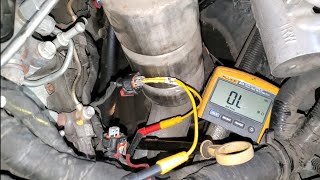
Disconnect the 42-pin connector and battery. Using a pinout diagram, measure resistance through the valve cover gasket and UVC harness toward the cylinder #5 injector. A good circuit reads 2.0 to 5.0 ohms. An infinite reading (OL) confirms an open circuit under the valve cover.
Tools: Multimeter, Pinout Diagram (Advanced) - Inspect the Under Valve Cover (UVC) Harness
Remove the valve cover for the bank with cylinder #5. Inspect the UVC harness and the injector connector. Look for burnt pins, loose connections, or brittle wires. This is the most common failure point on 7.3L Powerstroke and VW 1.9L TDI engines.
Tools: Socket set, screwdrivers, gasket scraper (Advanced) - Test the Injector Solenoid Directly
With the UVC harness unplugged, measure the resistance directly across the two terminals of the injector solenoid. A 7.3L Powerstroke should read 2.0-5.0 ohms. An infinite reading (OL) means the internal coil failed and the injector requires replacement.
Tools: Multimeter (Intermediate) - Check Live Data PIDs
Monitor Injector Pulse Width (IPW) on a scan tool. While the engine runs rough, an IPW value of 0 for cylinder #5 confirms the PCM shut down the injector due to an electrical fault, ruling out mechanical issues.
Tools: Advanced OBD-II Scanner (Advanced) - Analyze Injector Waveform
Use an oscilloscope to view the voltage and current pattern for the cylinder #5 injector circuit. An open circuit shows a voltage spike (110-115V on a 7.3L) with zero current flow, confirming the broken connection.
Tools: Oscilloscope, low-amp current probe, back-probe pins (Expert)
When This Code Triggers (Freeze-Frame Conditions)
- Engine Coolant Temp: 180-205°F (The fault is most often detected when the engine is fully warmed up, as heat exacerbates electrical connection issues.)
- Engine RPM: 1200-2500 RPM (The code sets during steady-state cruise or light acceleration, not typically at idle.)
- Engine Load: 25-70% (The fault occurs under moderate engine load, where the injector is consistently commanded on and off.)
- Vehicle Speed: 40-65 mph (Consistent with highway driving, where engine RPM and load are stable.)
Related Codes
- P1316 — Ford Specific. An informational code indicating injector codes are stored in the IDM/FICM. It appears alongside P1265 and clears once the root cause is fixed.
- P1275 — Indicates 'Cylinder 5 Injector Circuit Low' or a short circuit. While P1265 is a broken wire (open), P1275 is a wire touching ground (short) within the same circuit.
- P0205 — The generic OBD-II code for 'Cylinder 5 Injector Circuit Malfunction'. A vehicle sets P0205 if the fault doesn't meet the exact criteria for the manufacturer's P1265 code.
- P0611 — Means 'Fuel Injector Control Module Performance'. It appears alongside P1265 on Ford 6.0L engines when the FICM power supply fails to provide 48 volts.
Climate & Environmental Factors
- Cold Weather: Cold temperatures exacerbate FICM failures on the Ford 6.0L Powerstroke. A weak FICM power supply struggles to generate 48 volts when cold, leading to hard-starts and injector circuit codes.
- Heat Cycling: Engine heat and constant temperature cycles destroy UVC harnesses and VW injector harnesses. Hot engine oil makes wire insulation brittle and causes connectors to fail.
- Humidity / Moisture: High humidity causes corrosion on external connectors like the Ford 42-pin connector or IDM/FICM plugs, creating intermittent open circuits.
How to Talk to a Mechanic About This Code
Say this: "I have a P1265 code on my [Vehicle Make/Model], which is a cylinder 5 injector open circuit. I'd like to schedule a diagnostic starting with the most common electrical failure points. Please test the FICM/IDM voltage, perform an injector buzz test, and check the main harness connectors before quoting an injector replacement."
This directs the technician to perform a logical, cost-effective diagnosis, starting with simple electrical checks (harness, module) rather than immediately defaulting to the most expensive part (the injector).
Avoid saying:
- 'Just fix whatever's wrong'
- 'My check engine light is on, can you look at it?'
- 'Whatever you recommend'
Questions to ask before authorizing the repair:
- What were the specific results of the injector buzz test for cylinder 5?
- What was the FICM/IDM voltage reading with the key on and while cranking?
- Did you find a specific failure in the wiring, like a corroded pin or damaged harness, and can you show it to me?
- If you are recommending an injector replacement, what specific tests ruled out the wiring harness and control module?
- What is the warranty on the recommended parts and labor?
Where to Take It: Dealer vs Independent vs Chain
- Dealer:
Acceptable, but not the most cost-effective. They have the right tools but default to expensive assembly replacements.
Best for: Vehicles still under powertrain or emissions warranty, Complex manufacturer-specific software or security issues
Downsides: Highest labor rate (1.5-2x vs independent)., Quick to recommend expensive part replacements rather than pinpointing a smaller component failure. (Typical cost: +50% vs. baseline) - Independent Shop:
Best fit, provided it is a reputable diesel specialist shop. These shops see P1265 failures frequently and diagnose them efficiently.
Best for: Out-of-warranty diesel trucks (Ford Powerstroke, GM Duramax)., Shops specializing in diesel engines with extensive experience diagnosing these specific codes.
Downsides: Quality varies greatly. A general auto shop lacks the specific tools or experience. Vet shops carefully. (Typical cost: +0% vs. baseline) - Chain Shop:
AVOID. This code requires specialized diagnostic procedures (like an injector buzz test) beyond the scope of chain shops.
Best for: Simple, routine maintenance like oil changes, tires, and brakes.
Downsides: Technicians lack specialized training for complex diesel engine diagnostics., High pressure to meet sales targets leads to misdiagnosis and unnecessary parts replacement. (Typical cost: -10% vs. baseline)
When to Walk Away From the Repair
If the total estimated repair cost exceeds 40-50% of the truck's private-party market value, seriously consider selling it as-is.
- Car worth $12000, fix is $850: Fix it. This is a common and relatively inexpensive repair well below the threshold for a valuable truck.
- Car worth $15000, fix is $2800: Borderline. This suggests multiple system failures (e.g., FICM, multiple injectors, harness). Get a second opinion from a diesel specialist.
- Car worth $6000, fix is $2800: Walk away. The repair cost is nearly half the vehicle's value. It is not economically sound.
What Scan Tool You Need for This Code
Minimum: A tool with manufacturer-specific diagnostics capable of performing a Key On, Engine Off (KOEO) Injector Electrical Self-Test ('buzz test').
A basic $20 code reader only tells you the P1265 code exists. It cannot command the injector buzz test, read FICM/IDM voltage, or perform a cylinder contribution test. Without these functions, you are guessing at the cause.
Budget: FORScan software with OBDLink EX/MX+ Adapter (~$80) — For Ford vehicles, this is the most powerful budget option. It runs the injector buzz test, performs cylinder contribution tests, and monitors all Ford-specific PIDs like FICM voltage.
Mid-range: Foxwell NT510 Elite / Autel MaxiCheck MX808S (~$150-350) — These handheld scanners offer full bidirectional control, including injector buzz tests for Ford and GM/Duramax. They provide a dedicated solution without needing a laptop.
Professional: Autel MaxiCOM MK906BT / Launch X431 Series (~$500-1200) — Provides professional-level diagnostics, including oscilloscope integration to view injector waveforms, comprehensive data logging, and ECU coding capabilities.
Rent vs buy: Renting is not viable for this code. Free rental scanners at auto parts stores lack the essential bidirectional control (buzz test) needed for an accurate diagnosis. Buying a capable scanner is a mandatory investment.
How to Clear the Code After You Fix It
- Reconnect any disconnected components.
- Use a compatible OBD-II scan tool to select the 'Clear/Erase Codes' function.
- Perform a complete drive cycle to allow readiness monitors to run.
Drive cycle (~30 minutes): Start with a cold engine. Let idle for 3 minutes. Drive at a steady speed between 45-60 mph for 15 minutes. Perform gentle coast-down decelerations. Drive in stop-and-go city traffic for 10 minutes.
Readiness monitors affected: Catalyst Monitor, Misfire Monitor, Oxygen Sensor Monitor
Before emissions retest: drive at least 100 miles to fully set monitors.
Watch out for:
- Disconnecting the battery clears the code but resets all readiness monitors to 'Not Ready', guaranteeing an emissions test failure.
- If the electrical fault is not fixed, the code returns immediately when the ECU tests the injector circuit.
- Not driving under the correct variety of conditions prevents readiness monitors from completing.
Will This Fail Emissions / State Inspection?
Yes — this code typically fails an OBD-II emissions inspection.
- California: An illuminated Check Engine Light results in an automatic failure. After repairs, a full drive cycle must be completed to set all readiness monitors before a retest.
- New York: An active P1265 code causes the vehicle to fail the OBD-II emissions portion of the NYS inspection.
- Texas: In emissions-testing counties, an active Check Engine Light is an automatic failure. P1265 prevents the vehicle from passing.
Most Commonly Affected Vehicles
- Ford F-250/F-350 Super Duty (1999-2003) — Extremely common on the 7.3L Powerstroke. Almost always caused by a failed Under Valve Cover (UVC) harness or the pass-through valve cover gasket connector.
- Ford Excursion (2000-2003) — Shares the 7.3L Powerstroke engine with the Super Duty trucks and suffers from the exact same UVC harness and connector issues.
- Ford F-Series Super Duty (2003.5-2007) — Very common on the 6.0L Powerstroke. The primary suspect is a failing Fuel Injection Control Module (FICM) power supply, indicated by hard cold starts.
- Ford E-Series Vans (E-350/E-450) (1999-2003) — Utilizes the 7.3L Powerstroke and is highly susceptible to injector circuit codes from UVC harness failure.
- Chevrolet / GMC Silverado 2500/3500, Sierra 2500/3500 (2001-2007) — Occurs on Duramax diesel engines (LB7, LLY, LBZ). It points to a bad injector connector where terminals lose tension, fixable via the 'ice pick trick'.
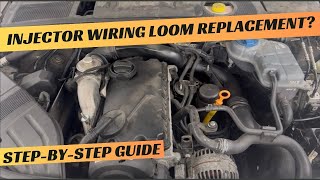
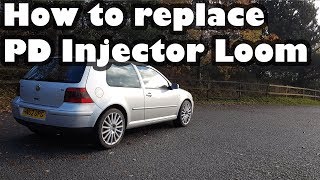
- Volkswagen Jetta, Golf, Passat, Beetle (1999-2006) — Common on 1.9L TDI PD engines. The cause is a faulty injector wiring harness inside the cylinder head (Part No. 038971600) that becomes brittle from heat.
- BMW X5 35d, 335d, 535d (2009-2018) — Seen on M57 and N57 diesels. Often caused by oil leaking from other sensors wicking down the wiring harness and contaminating the injector connector.
- Jeep Liberty CRD (2005-2006) — On some Chrysler/Jeep diesels, P1265 refers to a 'Glow Plug 3 Control Circuit Low' fault, not an injector issue. Verify the code definition for your specific vehicle.
Manufacturer-Specific Notes
- Ford: On the 7.3L, the cause is almost always the Under Valve Cover (UVC) harness. On the 6.0L, it is most frequently a failing FICM caused by weak batteries.
- General Motors (Chevrolet/GMC): On Duramax engines, injector circuit codes are caused by poor pin tension at the injector connector. The 'ice pick trick' is a widely practiced field repair to tighten these terminals.
- Volkswagen: On 1.9L TDI PD engines, the injector wiring harness sits inside the cylinder head. Constant exposure to hot oil degrades the wiring, causing intermittent open circuits.
- Chrysler/Jeep: On models like the Jeep Liberty CRD, P1265 is defined as 'Glow Plug 3 Control Circuit Low'. Always double-check the code definition for your specific vehicle.
Real Owner Stories
2002 Ford F-250 with 7.3L Powerstroke at 215K miles
The truck suddenly ran extremely rough with a flashing 'Service Engine Soon' light. A scanner pulled code P1265. The owner had replaced the valve cover gaskets and UVC harnesses 5 years prior.
What they tried:
- Performed a buzz test, confirming cylinder #5 was silent.
- Inspected the 42-pin connector and found no visible issues.
- Applied the 'fifty-cent mod' (wedging a shim under the UVC harness connector clip) as a test. The misfire immediately stopped.
Outcome: The temporary fix confirmed a poor connection at the Under Valve Cover (UVC) harness. The owner replaced the UVC harness and the valve cover gasket again for $220 in parts. The code cleared and did not return.
Lesson: On 7.3L Powerstrokes, the UVC harness is the highest probability cause, even if previously replaced. The 'fifty-cent mod' is a free diagnostic step to confirm a bad UVC connection before removing the valve cover.
2006 Ford F-350 with 6.0L Powerstroke at 125K miles
The owner experienced hard starting in cold weather, a rough idle, and a solid Check Engine Light with codes P1265 and P0611 (FICM Performance).
What they tried:
- The owner initially suspected a bad injector and received a $700 replacement quote.
- Tested the FICM voltage using a multimeter on the test point. Voltage was 42V with the key on, dropping to 37V during cranking.
- Discovered the truck had mismatched, old batteries, a known cause of FICM stress.
Outcome: The low voltage confirmed a failing FICM power supply. The owner purchased a Dorman FICM power supply repair kit for $200 and replaced both batteries. FICM voltage returned to a steady 48V, resolving all symptoms and codes.
Lesson: On a 6.0L Powerstroke, injector codes paired with P0611 point to a failing FICM, not the injector. Always test FICM voltage and battery health before replacing expensive injectors.
2005 Chevy Silverado 2500HD with LLY Duramax at 160K miles
The truck lost power on the freeway and entered 'limp mode'. A scan showed an open circuit code for injector #2 (similar to P1265).
What they tried:
- Performed the 'ice pick trick' to tighten the female terminals inside the injector connector. This fixed the problem for a month.
- Replaced the injector harness pigtail for cylinder #2. The problem returned a month later with multiple injector codes.
- Replaced the pigtail on cylinder #1, which permanently resolved the issue, even though codes never pointed specifically to #1.
Outcome: The root cause was a faulty injector connector, a common LLY Duramax issue. The permanent solution was splicing in a new connector pigtail for $35 in parts.
Lesson: For Duramax injector codes, the 'ice pick trick' is a valid temporary fix, but replacing the connector pigtail is the permanent repair. The electrical issue sometimes moves between cylinders, complicating diagnosis.
How to Prevent This Code From Triggering
- Load test batteries annually and replace in pairs (Annually, especially before winter) — On Ford 6.0L Powerstrokes, low battery voltage is the primary killer of the FICM. Weak batteries increase amperage draw, overheating the FICM's power supply.
- Periodically inspect external wiring harnesses and connectors (During every oil change) — Look for rubbing, chafing, or melting on the harness between the control module and valve covers. Apply dielectric grease to the 42-pin connector to prevent corrosion.
- Change fuel filters at recommended intervals (Every 10,000-15,000 miles) — Clean filters prevent contaminants from reaching the injectors, ensuring mechanical longevity and preventing internal solenoid stress.
- On 6.0L Powerstrokes, install the 'Blue Spring Kit' (Once) — Low fuel pressure (<45 psi) damages injectors. The 'Blue Spring' upgrade increases fuel pressure to a safe level, protecting injectors from premature failure.
Frequently Asked Questions
What does 'High to Low Side Open' actually mean?
Think of the injector circuit as a loop. The 'high side' is the power wire from the control module, and the 'low side' is the ground wire. 'Open' means a physical break in that loop—like a cut wire or disconnected plug—stopping electricity flow.
I replaced the injector and UVC harness on my 7.3L, but P1265 came back. What now?
If the internal parts are new, the fault lies externally. Inspect the 42-pin main engine connector for spread or corroded pins. Next, test circuit continuity from the IDM connector to the 42-pin connector to locate the broken wire.
How do I test the FICM voltage on my 6.0L Powerstroke?
Locate the FICM on the driver's side valve cover and remove the T20 Torx inspection cover. With the key 'ON' (engine off), touch a multimeter's red probe to the screw head closest to the driver's side and the black probe to the battery negative. A healthy FICM reads 48 volts; anything below 45V requires repair or replacement.
What is the 'fifty-cent mod' for a 7.3L Powerstroke?
This DIY diagnostic trick involves wedging a quarter under the plastic clip of the UVC harness connector to tighten a loose connection. If the misfire disappears after inserting the coin, it confirms the UVC harness or valve cover gasket requires replacement. It is a temporary test, not a permanent fix.
What is the 'ice pick trick' for a Duramax?
The female terminals inside a Duramax injector connector loosen over time, causing a poor electrical connection. The 'ice pick trick' uses a sharp tool to carefully bend and tighten these terminals for a snug fit. This restores the connection without buying new parts.
Can a bad FICM or IDM cause a single cylinder to misfire?
Yes. While a failing FICM power supply affects all injectors, the logic board has individual driver circuits for each cylinder. A single failed driver results in an open circuit code for just one cylinder, like P1265.
Is it better to repair or replace a failing FICM?
Repairing the FICM is more cost-effective and reliable than buying a new unit. The most common failure is the power supply board, which rebuilders upgrade with more robust components. Reputable companies offer these upgraded repairs with lifetime warranties for significantly less than dealer replacements.
Key Takeaways
- Code P1265 flags a broken electrical circuit to the cylinder #5 fuel injector, ruling out mechanical or fuel pressure failures.
- On Ford 7.3L engines, the most common fix is replacing the Under Valve Cover (UVC) wiring harness and gasket, which fail from hot oil exposure.
- On Ford 6.0L Powerstrokes, test the Fuel Injector Control Module (FICM); a reading below 45 volts confirms a failing power supply requiring replacement.
- Limit driving to under 100 miles to prevent raw fuel from melting the catalytic converter, which adds $1,500 to $3,500 to the repair bill.
Helpful Videos


The information in this article is provided for general reference and educational purposes only. Vehicle specifications, procedures, and part compatibility can vary by production date, trim level, and region. Always consult your vehicle's factory service manual and verify part numbers before purchasing or performing repairs. Safety-critical components such as airbags, seat belts, and braking systems should be installed by a qualified professional.
- 🎬 Helpful Videos
- What Does P1265 Mean?
- Can I Drive With P1265?
- Common Causes
- Symptoms
- Diagnostic Flowchart
- Common Fixes & Costs
- DIY vs Professional
- Used vs. New Parts: Buying Guide
- What Happens If You Wait — Timeline
- Cost of Not Fixing It
- Diagnosis Steps
- When This Code Triggers (Freeze-Frame Conditions)
- Related Codes
- Climate & Environmental Factors
- How to Talk to a Mechanic About This Code
- Where to Take It: Dealer vs Independent vs Chain
- When to Walk Away From the Repair
- What Scan Tool You Need for This Code
- How to Clear the Code After You Fix It
- Will This Fail Emissions / State Inspection?
- Most Commonly Affected Vehicles
- Manufacturer-Specific Notes
- Real Owner Stories
- 2002 Ford F-250 with 7.3L Powerstroke at 215K miles
- 2006 Ford F-350 with 6.0L Powerstroke at 125K miles
- 2005 Chevy Silverado 2500HD with LLY Duramax at 160K miles
- How to Prevent This Code From Triggering
- Frequently Asked Questions
- What does 'High to Low Side Open' actually mean?
- I replaced the injector and UVC harness on my 7.3L, but P1265 came back. What now?
- How do I test the FICM voltage on my 6.0L Powerstroke?
- What is the 'fifty-cent mod' for a 7.3L Powerstroke?
- What is the 'ice pick trick' for a Duramax?
- Can a bad FICM or IDM cause a single cylinder to misfire?
- Is it better to repair or replace a failing FICM?
- Key Takeaways
- 🎟️ Get 5% Off