

OBD-II Code P1261: Cylinder 1 Injector Circuit Fault
The Ultimate Guide to Diagnosing and Fixing P1261
- P1261 indicates a hard electrical short in the cylinder #1 injector circuit, not a mechanical fuel flow issue.
- Test the FICM voltage first on Ford 6.0L engines; a drop below 45V during cranking confirms a failing power supply, not a bad injector.
- Inspect the under-valve-cover wiring harness on VW TDI and GM LB7 engines, as hot oil degrades the insulation and causes direct shorts.
- Never replace the injector without testing its resistance first; readings outside the 0.2-1.5 ohm range confirm an internal short.
- Fix P1261 immediately to prevent unburnt fuel from destroying the catalytic converter, which adds $800 to $2,500 to your final repair bill.
What Does P1261 Mean?

P1261 means your vehicle's Powertrain Control Module (PCM) detects a serious electrical short circuit in the fuel injector circuit for cylinder #1. Specifically, the 'high' side (power supply) and the 'low' side (control/ground) are touching. This fault prevents the computer from controlling the injector, shutting down the cylinder and causing an immediate misfire.
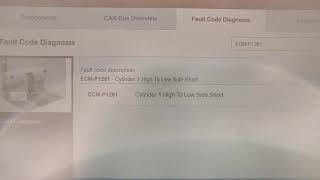
Technical definition: Cylinder #1 High To Low Side Short. The control module detects that the positive voltage supply wire and the computer-controlled ground wire for the cylinder #1 fuel injector are electrically connected, creating a short circuit.
Can I Drive With P1261?
Yes, But With Caution. You can drive for very short distances, but it is strongly discouraged. The engine runs rough, lacks power, and stalls. Continuing to drive allows raw, unburnt fuel from cylinder #1 to enter the exhaust, where it overheats and destroys the catalytic converter. This turns a moderate repair into a major one, adding $800 to $2,500 to the final bill.
Common Causes

- Faulty Fuel Injector Control Module (FICM) or Low Voltage (Very Common) — On diesel trucks, particularly 2003-2007 Ford Powerstrokes, a dedicated module provides the 48-volt signal to fire the injectors. The internal power supply fails, often accelerated by low battery voltage or a weak alternator, causing single or multiple injector shorts.
- Faulty Fuel Injector (Very Common) — The internal electronic coil windings short out due to heat and vibration. This is a primary failure point on high-mileage diesel engines.
- Damaged or Frayed Wiring Harness (Common) — Engine heat and vibration chafe the wiring against brackets, wearing away insulation. On VW TDI and Duramax LB7 engines, the harness section submerged in hot oil under the valve cover is the primary culprit.
- Water Intrusion or Corroded Connectors (Less Common) — Pressure washing the engine or driving through deep water forces moisture into injector harness connectors, creating an electrical bridge between pins. This is highly common on Subaru FA20 engines.
- Faulty PCM or Improper Grounding (Rare) — The internal driver circuit inside the PCM shorts out, or the main ECU ground bolt is loose. This requires exhausting all other electrical tests first.
Symptoms

- Rough Idle and Engine Misfire — The engine shakes, shudders, and runs unevenly because cylinder #1 is dead.
- Severe Lack of Power — The vehicle feels sluggish and struggles to accelerate, especially under load or when climbing hills.
- Engine Stalling — At idle or when coming to a stop, the imbalance from the dead cylinder causes the engine to stall completely.
- White or Black Exhaust Smoke — On diesel engines, a dead cylinder and faulty FICM lead to incomplete combustion, resulting in excessive smoke under acceleration.
- Strong Fuel Odor — You smell raw fuel from the exhaust as the PCM's fueling strategy is disrupted.
- Check Engine Light On & Limp Mode (also visible on scanner) — The MIL illuminates immediately, and the engine enters a reduced power state to protect the drivetrain.
Diagnostic Flowchart

Tap your situation to follow the diagnostic path that matches what you're seeing on this code.
Common Fixes & Costs
- Replace or Repair Fuel Injector Control Module (FICM) — Parts: $200-$600, Labor: $150-$300, ~1.5 hr book time (Intermediate)
- Replace Fuel Injector #1 — Parts: $200-$450, Labor: $200-$600, ~2.5 hr book time (Advanced)
- Repair or Replace Wiring Harness — Parts: $90-$250, Labor: $200-$500, ~2.5 hr book time (Professional)
- Replace Injector Connector Pigtail — Parts: $15-$50, Labor: $75-$150, ~1.0 hr book time (DIY)
DIY vs Professional
- Replace/Repair FICM (Ford 6.0L) — Beginner: Yes
Tools: Socket set, Torx bits. - Replace Injector Pigtail — Beginner: Yes
Tools: Wire cutters/strippers, crimping tool, heat shrink tubing. - Replace Under-Valve-Cover Harness (LB7/TDI) — Beginner: No
Tools: Socket set, torque wrench, gasket scrapers. - Replace Fuel Injector — Beginner: No
Tools: Socket set, torque wrench, fuel line disconnect tools, specialized injector pullers.
Used vs. New Parts: Buying Guide
When a used part is worth it: For major electronic modules like a FICM, a professionally remanufactured unit is superior to a new OEM part. Never buy used fuel injectors.
Donor-vehicle mileage cap: roughly under 50000 miles for the part to have meaningful remaining life.
Donor quality checklist:
- Verify remanufacturers perform complete disassembly and replace all wear items.
- Match part numbers exactly to avoid ECU programming issues.
- Avoid 'refurbished' parts that only receive cosmetic cleaning.
Decision logic:
- If The part is a fuel injector → Buy new or professionally remanufactured. Avoid used injectors.
- If The part is a FICM (Ford 6.0L) → Buy a remanufactured unit with an upgraded power supply.
- If The part is a wiring harness → Buy new. Used harnesses have the same heat and vibration damage.
Warranty tradeoff: Remanufactured parts often include a 1-year or lifetime warranty, far exceeding the 30-day warranty of salvage yard parts.
Worst-case if a used part fails: 500-1000
What Happens If You Wait — Timeline
- 0-1 week: Check Engine Light illuminates. Engine runs rough, shakes at idle, and loses significant power. (MPG impact: 10-25%% · Added cost: $0)
- 1 week - 2 months: Excessive vibration puts severe stress on engine mounts and exhaust hangers. Fuel economy plummets. (MPG impact: 15-30%% · Added cost: $50-200)
- 2-6 months: Inefficient combustion in the remaining cylinders raises exhaust temperatures, degrading the catalytic converter. (MPG impact: 15-30%% · Added cost: $800 - $2,500)
- 6+ months: The catalytic converter melts and clogs. The constant short overheats and destroys the driver IC inside the PCM or FICM. (MPG impact: 20-40%% · Added cost: $1,500 - $4,000+)
Cost of Not Fixing It
- Immediate (0-1 month): Significant drop in fuel economy (15-30%), rough engine operation, and guaranteed emissions test failure. (Added cost: 50-150)
- Short Term (1-6 months): Improper combustion causes the catalytic converter to overheat and fail. (Added cost: 1200-2800)
- Long Term (6+ months): A shorted injector driver overheats and destroys the PCM or FICM. (Added cost: 500-1500)
Diagnosis Steps

- Read Codes & Verify FICM Voltage (Ford 6.0L Specific)
Use an OBD-II scanner to confirm P1261. If diagnosing a Ford 6.0L, immediately check the FICM_MPWR PID. Voltage must be 47-49V with the key on and never drop below 45V during cranking. Readings below 45V confirm a failed FICM, not a bad injector.
Tools: Advanced OBD-II Scanner (Intermediate) - Perform an Injector Buzz Test
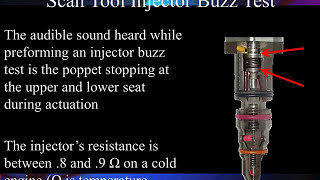
Use a bi-directional scan tool to command an injector buzz test. Listen for a sharp buzz from each injector. A silent cylinder #1 confirms the electrical fault is isolated to that specific circuit or injector.
Tools: Advanced Bi-Directional Scan Tool (Intermediate) - Perform a Detailed Visual Inspection
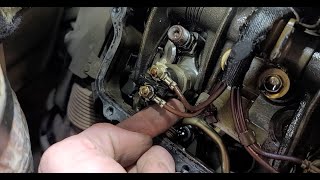
Inspect the wiring harness leading to the #1 injector for melting, chafing, or breaks. Check the connector for water entry or corrosion. On Duramax trucks, check where the harness passes the alternator bracket.
Tools: Flashlight, Inspection Mirror (Beginner) - Test Fuel Injector Resistance
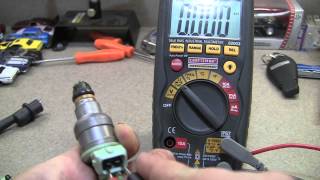
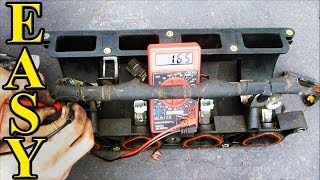
Disconnect the #1 injector and measure resistance across its terminals with a multimeter set to Ohms. Compare to OEM specs (typically 0.2-1.5 Ohms for diesels). A reading near zero confirms an internally shorted injector.
Tools: Multimeter (Intermediate) - Check Harness for Shorts to Ground or Power
With the injector and PCM disconnected, test for continuity between the harness wires and engine ground. Then, turn the key ON and probe the low-side pin for voltage. Any continuity to ground or voltage on the ground wire confirms a harness short.
Tools: Multimeter (Advanced) - Analyze Injector Pulse Width
Monitor the cylinder #1 injector pulse width using live data. A hard P1261 fault forces the PCM to command 0 ms. Erratic values prior to the code setting indicate an intermittent wiring short.
Tools: Advanced Scan Tool (Advanced) - Perform Injector Waveform Analysis
Use an oscilloscope and low-amp clamp. A shorted circuit shows an immediate, massive amperage spike with no inductive kick, definitively proving the short.
Tools: Automotive Oscilloscope, Low-Amp Clamp (Professional)
When This Code Triggers (Freeze-Frame Conditions)
- Engine Coolant Temp: 180-200°F (82-93°C) (The fault sets after the engine reaches full operating temperature, expanding wiring and exposing shorts.)
- Engine RPM: 1500-2500 RPM (The code triggers under steady-state cruise or light acceleration.)
- Engine Load: 30-60% (The fault appears when the engine is under a moderate, sustained load, such as climbing a slight grade.)
- Vehicle Speed: 45-65 mph (Consistent highway driving provides the stable operating conditions required for the ECU's circuit monitor to run.)
Related Codes
- P0301 — Cylinder 1 Misfire Detected. This is the direct symptom of P1261. Ignore P0301 and diagnose the P1261 electrical fault.
- P0201 — Injector Circuit/Open - Cylinder 1. P1261 is a 'short' (wires touching), while P0201 is an 'open' (broken wire or unplugged connector).
- P1262 - P1268 — Identical short codes for other cylinders. Multiple codes strongly point to a failing FICM or a widespread harness issue.
- P0611 — FICM Performance. If present with P1261 on a Ford, the FICM is definitively the problem.
Climate & Environmental Factors
- Cold Weather: Cold weather triggers P1261 on Ford 6.0L engines. Ford's 'inductive heating' strategy puts immense electrical load (up to 32 amps) on the FICM during cold starts, causing weak power supplies to fail instantly.
- High Humidity / Water Exposure: Pressure washing the engine bay forces moisture into injector harness connectors. The water creates a temporary bridge between the high and low side pins, causing a short circuit.
How to Talk to a Mechanic About This Code
Say this: "I have a P1261 code, indicating a cylinder 1 injector high-to-low side short. Please test the full circuit, check the injector resistance, inspect the wiring harness, and verify the FICM voltage during cranking before replacing any parts."
This directs the technician to perform a comprehensive electrical diagnosis, preventing them from simply replacing the most expensive part without confirming it is the point of failure.
Avoid saying:
- 'My truck is running rough, can you fix it?'
- 'My check engine light is on, I think it's an injector.'
- 'Just replace the #1 injector.'
Questions to ask before authorizing the repair:
- What was the ohm reading across the old injector's terminals?
- Did you find any shorts to ground or power in the wiring harness?
- What was the FICM voltage reading during a cold crank?
- Does the new injector need to be coded to the ECU?
- What is the warranty on the parts and labor?
Where to Take It: Dealer vs Independent vs Chain
- Dealer:
Best for: Vehicles under warranty, Complex European brands requiring proprietary injector coding, Diagnosing rare PCM failures
Downsides: Highest labor rates, Prefers replacing entire harnesses rather than repairing single wires (Typical cost: +50% vs. baseline) - Independent Shop:
Best fit. A reputable independent diesel specialist is highly familiar with common failure points like the Ford FICM or VW harness.
Best for: Out-of-warranty diesel trucks, Cost-effective diagnosis of FICMs and harnesses
Downsides: General auto shops lack diesel-specific knowledge., Must verify they have bi-directional scan tools. (Typical cost: +0% vs. baseline) - Chain Shop:
AVOID. The risk of an incorrect diagnosis for a specific electrical fault like P1261 is too high.
Best for: Not recommended for this repair.
Downsides: Technicians lack specialized training for complex electrical diagnostics., High risk of misdiagnosis and unnecessary parts replacement. (Typical cost: -10% vs. baseline)
When to Walk Away From the Repair
If the estimated repair cost exceeds 40-50% of the vehicle's private-party value, consider selling the vehicle as-is.
- Car worth $6000, fix is $2500: Borderline to Walk Away. Get a second opinion before authorizing.
- Car worth $15000, fix is $1200: Fix it. The repair cost is well below the threshold.
- Car worth $3500, fix is $1800: Walk away. The repair cost is over 50% of the truck's value.
What Scan Tool You Need for This Code
Minimum: A tool that reads manufacturer-specific codes and live data PIDs, specifically FICM voltage (FICM_MPWR) for Ford.
A basic $20 code reader cannot perform an injector buzz test or read critical live data like FICM voltage, which are essential for diagnosing this code.
Budget: FORScan with OBDLink Adapter (~$70) — Performs injector buzz tests and reads all Ford-specific PIDs like FICM voltage, making it extremely powerful for the price.
Mid-range: Foxwell NT510 Elite (~$180) — Provides bi-directional control to command an injector buzz test directly from the tool.
Professional: Autel MaxiCOM MK808S (~$450) — Offers full bi-directional control, live data graphing, and injector coding capabilities.
Rent vs buy: Buy. Rental scanners from auto parts stores lack the bi-directional 'buzz test' and FICM voltage monitoring capabilities needed for a proper diagnosis.
How to Clear the Code After You Fix It
- Reconnect battery if disconnected
- Use an OBD-II scan tool to clear all fault codes
- Perform a complete OBD-II drive cycle to allow readiness monitors to set
Drive cycle (~30 minutes): A generic drive cycle includes a cold start, a 3-minute idle, 10 minutes of steady highway driving at 55 mph, a coast-down without braking, and 15 minutes of mixed city driving.
Readiness monitors affected: Catalyst Monitor, Misfire Monitor, Oxygen (O2) Sensor Monitor
Before emissions retest: drive at least 100 miles to fully set monitors.
Watch out for:
- Clearing the code with a scanner does not reset the readiness monitors; the vehicle must be driven.
- The code returns immediately if the root electrical short is not repaired.
- Some vehicles require several hundred miles of driving for all monitors to become 'Ready'.
Will This Fail Emissions / State Inspection?
Yes — this code typically fails an OBD-II emissions inspection.
- California: An illuminated Check Engine Light is an automatic failure. All required readiness monitors must be set to 'Ready'.
- New York: A vehicle with an illuminated Check Engine Light automatically fails the emissions portion of the NYS inspection.
- Texas: In the 17 counties requiring emissions testing, an illuminated Check Engine Light is an automatic failure.
Most Commonly Affected Vehicles
- Ford F-250 / F-350 Super Duty (2003-2007) — The 6.0L Powerstroke is highly prone to this code from FICM failure. Always check FICM voltage first.
- Ford Excursion (2003-2005) — Shares the problematic 6.0L Powerstroke engine. FICM and injector failures are the primary causes.
- Ford E-Series Van (2004-2010) — Equipped with the 6.0L Powerstroke. Tight engine access makes diagnosis and repair difficult.
- Chevrolet / GMC Silverado / Sierra 2500/3500 (2001-2004) — The LB7 Duramax under-valve-cover injector harness (P/N 97207227) fails frequently. One harness connects two injectors.
- Volkswagen / Audi Jetta, Golf, Passat, A4 (2004-2008) — The 1.9L & 2.0L TDI PD engines suffer from a failed injector wiring loom inside the valve cover (P/N 038971600). Insulation flakes off in hot oil.
- Subaru WRX, Forester XT (2014-2018) — The FA20DIT engine throws this code after the engine bay is pressure washed, causing a short in the connector.
- BMW 3-Series, 5-Series, X5 (Diesel Models) (2005-2013) — Piezoelectric injector failure causes this code. Replacement requires an 'injector quantity adjustment' (IQA) code programmed into the ECU.
- Toyota / Subaru 86 / BRZ (2013-2020) — Sets P1261 due to a faulty direct injector or a poor ECU ground connection disturbed during clutch replacements.
Manufacturer-Specific Notes
- Ford: On 6.0L Powerstrokes, the FICM internal power supply fails, dropping voltage below the required 48V. Low battery voltage is the primary killer of FICMs.
- GMC / Chevrolet: On LB7 Duramax engines, P1261 indicates a fault in 'Group 1' (cylinders 1, 4, 6, 7). Multiple codes in this group point to a wiring issue under the valve cover.
- Volkswagen / Audi: On TDI PD engines, the injector wiring harness sits submerged in hot oil. The insulation becomes brittle and flakes off, causing direct shorts.
- Subaru: On FA20DIT engines, direct injectors seize in the cylinder heads due to corrosion, making replacement extremely difficult.
Real Owner Stories
2005 Ford F-250 6.0L Powerstroke with 160K miles
Truck was hard to start in cold weather and ran rough with white smoke. Set codes P1261 and P0611.
What they tried:
- Tested the FICM voltage at the test port on top of the module.
- Readings were 48V with key-on, but dropped to 38V during cranking.
Outcome: Owner purchased a FICM repair service for $350. Reinstalled the repaired FICM, and the truck started immediately with no codes.
Lesson: On a Ford 6.0L, always test the FICM voltage first. A voltage drop below 45V during cranking is a classic sign of a failing FICM power supply, and replacing injectors will not fix it.
2006 VW Jetta TDI with 195K miles
Car developed an intermittent misfire at low RPMs and set code P1261.
What they tried:
- Swapped the #1 injector with the #2 injector. The code P1261 remained, proving the injector was fine.
- Removed the valve cover to inspect the injector wiring harness.
Outcome: The insulation on the under-valve-cover harness was cracked and shorting against the cylinder head. Replaced the harness for $100, permanently fixing the misfire.
Lesson: On VW TDI PD engines, the under-valve-cover wiring harness is a primary failure point. If an injector code doesn't follow the injector when swapped, replace the harness.
2015 Subaru WRX with 75K miles
Check engine light came on with P1261 immediately after pressure washing the engine bay.
What they tried:
- Visually inspected the engine bay, focusing on the fuel injector connectors.
Outcome: The #1 fuel injector connector was wet inside. The owner dried it with compressed air, applied dielectric grease, and reconnected it. The codes cleared and did not return.
Lesson: If P1261 appears immediately after water exposure, dry the related electrical connectors before assuming a part has failed.
2003 GMC Sierra 2500HD (LB7 Duramax) with 210K miles
Truck had a persistent cylinder #1 misfire and P1261 code.
What they tried:
- Replaced the #1 fuel injector under the valve cover. The code returned.
- Inspected the main external wiring harness.
Outcome: The wiring harness chafed against the alternator mounting bracket, causing a short to ground. Repairing the damaged wires fixed the code.
Lesson: P1261 is a circuit fault. Thoroughly inspect the wiring harness for chafing before undertaking a labor-intensive injector replacement.
How to Prevent This Code From Triggering
- Maintain Healthy Batteries and Alternator (Annually) — Low battery voltage forces the FICM to work harder, generating excessive heat and destroying its internal power supply.
- Use High-Quality Diesel Fuel and Additives (Every Fill-up) — Additives that add lubricity prolong the life of the mechanical and electronic parts of the injector, reducing internal failure rates.
- Replace Fuel Filters (Every 10,000-15,000 miles) — Contaminants that bypass a failed filter damage the sensitive internal components of an injector, leading to electrical failure.
- Use Dielectric Grease on Connectors (When servicing) — Applying dielectric grease to connector seals prevents moisture intrusion and shorts, especially after engine washing.
- Avoid Prolonged Cranking (As needed) — Excessive cranking overheats and destroys the FICM. Diagnose hard starts immediately.
Frequently Asked Questions
What does 'High To Low Side Short' actually mean?
The 'high side' is the wire bringing constant power, and the 'low side' is the ground wire controlled by the computer. A 'short' means these two wires are touching, creating an electrical circuit that bypasses the injector. The computer immediately detects this and shuts the circuit down.
I replaced the injector but the code came back. What now?
The fault is in the wiring harness or the control module (FICM/PCM). You must perform electrical tests with a multimeter. Check the harness for chafing and test for a short-to-ground or short-to-power.
My car got this code after I washed the engine. What should I do?
Water has likely entered an electrical connector. Disconnect the #1 injector and main harness connectors, dry them thoroughly with compressed air, and apply dielectric grease. Clear the codes to see if the short is resolved.
Can I fix P1261 myself?
Basic connector checks are DIY-friendly, but replacing injectors or modules requires advanced tools. Diesel injector replacement often demands specialized pullers and ECU coding. Repairing a Ford 6.0L FICM with a pre-flashed board kit is a viable DIY alternative.
What is an injector buzz test?
An injector buzz test is a diagnostic function on an advanced scan tool that rapidly cycles each fuel injector. This produces an audible buzzing sound from a healthy injector. A silent injector confirms an electrical fault in that specific circuit.
Can a bad battery cause a P1261 code?
Yes, especially on Ford 6.0L Powerstroke engines. A weak battery forces the FICM to work harder to produce 48 volts. This prolonged strain destroys the FICM's internal power supply, triggering injector codes.
Will a fuel additive or injector cleaner fix a P1261 code?
No. P1261 is a purely electrical fault code indicating a short circuit. Fuel additives clean mechanical deposits but have no effect on electrical wiring or control modules.
Is cylinder #1 always at the front of the engine?
Cylinder #1 location depends entirely on the engine configuration. On a Chevy V8, it is the front driver's side, while on a Ford V8, it is the front passenger's side. Always consult a repair manual for your specific vehicle.
Key Takeaways
- P1261 indicates a hard electrical short in the cylinder #1 injector circuit, not a mechanical fuel flow issue.
- Test the FICM voltage first on Ford 6.0L engines; a drop below 45V during cranking confirms a failing power supply, not a bad injector.
- Inspect the under-valve-cover wiring harness on VW TDI and GM LB7 engines, as hot oil degrades the insulation and causes direct shorts.
- Never replace the injector without testing its resistance first; readings outside the 0.2-1.5 ohm range confirm an internal short.
- Fix P1261 immediately to prevent unburnt fuel from destroying the catalytic converter, which adds $800 to $2,500 to your final repair bill.
Helpful Videos

The information in this article is provided for general reference and educational purposes only. Vehicle specifications, procedures, and part compatibility can vary by production date, trim level, and region. Always consult your vehicle's factory service manual and verify part numbers before purchasing or performing repairs. Safety-critical components such as airbags, seat belts, and braking systems should be installed by a qualified professional.
- 🎬 Helpful Videos
- What Does P1261 Mean?
- Can I Drive With P1261?
- Common Causes
- Symptoms
- Diagnostic Flowchart
- Common Fixes & Costs
- DIY vs Professional
- Used vs. New Parts: Buying Guide
- What Happens If You Wait — Timeline
- Cost of Not Fixing It
- Diagnosis Steps
- When This Code Triggers (Freeze-Frame Conditions)
- Related Codes
- Climate & Environmental Factors
- How to Talk to a Mechanic About This Code
- Where to Take It: Dealer vs Independent vs Chain
- When to Walk Away From the Repair
- What Scan Tool You Need for This Code
- How to Clear the Code After You Fix It
- Will This Fail Emissions / State Inspection?
- Most Commonly Affected Vehicles
- Manufacturer-Specific Notes
- Real Owner Stories
- 2005 Ford F-250 6.0L Powerstroke with 160K miles
- 2006 VW Jetta TDI with 195K miles
- 2015 Subaru WRX with 75K miles
- 2003 GMC Sierra 2500HD (LB7 Duramax) with 210K miles
- How to Prevent This Code From Triggering
- Frequently Asked Questions
- What does 'High To Low Side Short' actually mean?
- I replaced the injector but the code came back. What now?
- My car got this code after I washed the engine. What should I do?
- Can I fix P1261 myself?
- What is an injector buzz test?
- Can a bad battery cause a P1261 code?
- Will a fuel additive or injector cleaner fix a P1261 code?
- Is cylinder #1 always at the front of the engine?
- Key Takeaways
- 🎟️ Get 5% Off