

OBD-II Code P1253: VTEC System Malfunction & Turbo Actuator Fault
What P1253 means, why it triggers, and how to fix it on Honda, Subaru, BMW, and more
- On Honda and Acura vehicles, P1253 indicates a VTEC system malfunction, which is resolved in 80% of cases by simply topping off or changing low, dirty engine oil.
- On Subaru, GM, and BMW models, P1253 flags a turbocharger wastegate or actuator fault, requiring immediate diagnosis to prevent a $2,000+ turbo replacement.
- Driving with P1253 triggers 'limp mode,' capping engine speed at 4,000 RPM and severely restricting acceleration, creating a safety hazard during highway merging.
- Replacing a clogged $20 VTEC solenoid filter screen fixes the majority of persistent P1253 codes on Honda 4-cylinder engines.
What Does P1253 Mean?

On Honda and Acura vehicles, P1253 means the engine control unit (ECU) detects a VTEC (Variable Valve Timing and Lift Electronic Control) system malfunction. VTEC uses oil pressure to switch camshaft profiles for optimal fuel economy and power. The code triggers when the system fails to engage or disengage. For Subaru, BMW, and GM, this code signifies turbocharger wastegate or actuator failures.
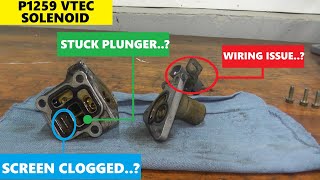
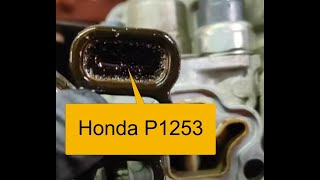
Technical definition: The SAE definition is manufacturer-specific. Honda/Acura: 'VTEC System Malfunction'. 🎬 Watch: A step-by-step guide to fixing Honda P1253 codes. Subaru/GM: 'Turbocharger Wastegate Solenoid B Range/Performance'. BMW: 'Turbocharger (TC) vane position actuator - open circuit'. Saab: 'Throttle Motor Full PWM in Open Direction During Cranking'.
Can I Drive With P1253?
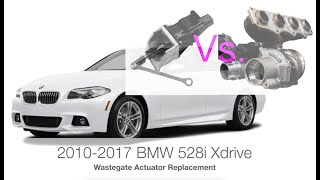
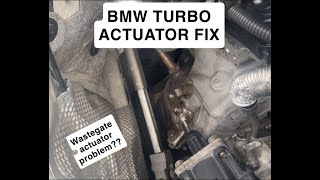
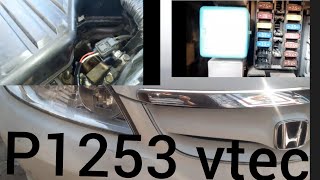
Yes, But With Caution. You can drive, but limit distances. The engine enters 'limp mode,' capping RPMs at 4,000 and severely reducing power, creating a safety hazard in traffic. On turbocharged vehicles (Subaru, BMW), ignoring the code causes abnormal boost levels, straining the turbocharger. 🎬 See how to check and replace a BMW wastegate actuator. On Honda/Acura, driving with a known oil pressure issue risks internal engine damage.
Common Causes

- Low, Dirty, or Incorrect Engine Oil (Very Common) — The VTEC system is hydraulic and requires clean oil at the exact manufacturer-specified viscosity and pressure. Low or sludged oil is the primary cause of this code.
- Clogged VTEC Solenoid Filter Screen (Very Common) — The gasket for the VTEC solenoid assembly includes a small mesh screen. This screen frequently clogs with engine sludge, restricting oil flow and preventing system operation. 🎬 Watch: How to troubleshoot VTEC problems and clean the screen.
- Faulty VTEC Oil Pressure Switch (Common) — This sensor tells the ECU if there is sufficient oil pressure to engage VTEC. A failed sensor sends a false signal, triggering the code even if pressure is adequate.
- Faulty VTEC Solenoid (Common) — The solenoid is an electronically controlled valve directing oil flow. It fails electrically (open/short circuit) or mechanically (stuck valve).
- Wiring or Connector Issues (Less Common) — The wiring harness or connectors for the VTEC solenoid or pressure switch become damaged, corroded, or loose. A loose pin causes intermittent faults.
- Mechanical Oil Starvation (Failing Pump or Damaged Pan) (Rare) — A dented oil pan restricting the pickup tube, worn crankshaft bearings, or a failing oil pump causes a systemic loss of oil pressure, preventing VTEC operation.
- Faulty Engine Control Unit (ECU) (Very Rare) — The driver circuit within the ECU that controls the VTEC system fails. Consider this only after exhaustively ruling out all wiring and mechanical issues.
Symptoms

- Engine Enters 'Limp Mode' (Power Loss) — The ECU limits engine speed to under 4,000 RPM to prevent damage. The vehicle stops accelerating past this point, feeling severely underpowered.
- Hesitation or Bogging at 2,000-4,000 RPM — On Honda/Acura vehicles, you feel a distinct hesitation around the RPM where the VTEC system is supposed to engage.
- Check Engine Light is On — The Malfunction Indicator Lamp (MIL) illuminates on the dashboard.
- Rough or Shaky Idle — A malfunctioning VTEC system or a faulty turbo wastegate contributes to a rough or unstable idle.
- Reduced Fuel Economy — Because the engine's valve timing is not optimized, the vehicle consumes more fuel than usual.
Diagnostic Flowchart
Tap your situation to follow the diagnostic path that matches what you're seeing on this code.
Common Fixes & Costs
- Engine Oil and Filter Change — Parts: $30-$70, Labor: $50-$120 (parts and labor), ~0.5 hr book time (DIY)
- Clean VTEC Solenoid Filter Screen and Replace Gasket — Parts: $10-$30, Labor: $80-$160 (parts and labor), ~1.0 hr book time (DIY)
- Replace VTEC Oil Pressure Switch — Parts: $25-$90, Labor: $110-$180 (parts and labor), ~0.7 hr book time (DIY)
- Replace VTEC Solenoid Assembly — Parts: $150-$280, Labor: $250-$450 (parts and labor), ~1.5 hr book time (Intermediate)
- Replace Turbocharger Boost Control Solenoid (Subaru/GM) — Parts: $90-$150, Labor: $180-$300 (parts and labor), ~1.0 hr book time (Intermediate)
Used vs. New Parts: Buying Guide
When a used part is worth it: A used OEM VTEC solenoid assembly from a low-mileage vehicle is a cost-effective alternative to a new aftermarket part, which has a high failure rate. It is a budget-conscious choice for older vehicles.
Donor-vehicle mileage cap: roughly under 80000 miles for the part to have meaningful remaining life.
Donor quality checklist:
- Verify the part is genuine OEM (e.g., stamped with 'Keihin' for Hondas).
- Match the part number exactly to your original part.
- Source from a reputable salvage yard with a warranty.
- Visually inspect for corrosion, cracks, or damaged connector pins.
Decision logic:
- If You want the highest reliability and to avoid repeat labor costs. → Buy a new OEM part. It is the most expensive but most reliable option.
- If Budget is the primary concern and you are comfortable with some risk. → A used OEM part is a better choice than a new aftermarket part.
- If The part is needed immediately and options are limited. → A new aftermarket part works, but be aware of widespread reports of premature failure.
Warranty tradeoff: Used parts typically offer a 30-90 day functional warranty. New aftermarket parts often have a 1-year warranty, but frequent failures make claims a hassle. New OEM parts carry the manufacturer's standard warranty.
Worst-case if a used part fails: $150-$400 if a used or aftermarket part fails shortly after installation, requiring repeat labor costs plus the cost of another replacement part.
Cost of Not Fixing It
- 0-1 Month: Persistent 'limp mode' with limited RPM, poor acceleration, and a 5-10% drop in fuel economy. Annoyance and safety risks in traffic are the primary costs. (Added cost: $20-$50 (in wasted fuel))
- 1-6 Months: Running rich degrades the catalytic converter on Hondas. On turbo models, continued operation with a faulty wastegate causes excessive stress on the turbocharger assembly. (Added cost: $500-$2,500 (potential turbo or catalytic converter damage))
- 6+ Months: If the root cause is low base oil pressure, ignoring it causes catastrophic internal engine wear, requiring engine replacement. A failed turbocharger from prolonged overboost sends debris into the engine. (Added cost: $3,000-$8,000+ (major engine or turbocharger replacement))
Diagnosis Steps
- Check Engine Oil Level and Condition
Park on a level surface and check the dipstick. If the oil is low, top it off. If it is dark, gritty, or overdue for a change, perform an oil and filter change immediately.
Tools: Rag, new engine oil (if needed) (Beginner) - Read the Code and Freeze Frame Data
Use an OBD-II scanner to confirm P1253 and view the manufacturer-specific definition. Analyze the freeze frame data to determine the exact RPM, speed, and temperature when the fault occurred.
Tools: OBD-II Scanner (Beginner) - Inspect and Clean the VTEC Solenoid Filter Screen
Remove the VTEC solenoid assembly (typically 3 bolts). Inspect the mesh screen on the gasket for sludge. Clean it with brake cleaner and a soft brush. Always install a new gasket.
Tools: 10mm socket set, brake cleaner, new gasket (Intermediate) - Inspect VTEC/Turbo System Wiring and Connectors
Visually inspect the wiring to the VTEC solenoid and pressure switch (Honda) or turbo wastegate solenoid (Subaru/GM). Look for frayed wires or oil contamination. Gently tug the connector wires to check for loose pins.
Tools: Flashlight (Beginner) - Test the VTEC Oil Pressure Switch (Honda/Acura)
With the engine off, disconnect the pressure switch. A multimeter set to continuity should read less than 1.0 Ohm across the switch terminals. With the engine running, it must show an open circuit. Test the harness connector with the key 'ON' to verify 12V power.
Tools: Multimeter (Intermediate) - Test the VTEC Solenoid (Honda/Acura)
Disconnect the solenoid connector. Measure resistance across the pins; it should read between 14 and 30 Ohms. Briefly apply 12V power to the solenoid to listen for a distinct mechanical 'click'.
Tools: Multimeter, 12V power source (Intermediate) - Pro Tip: Bench Test Turbo Boost Control Solenoid (Subaru/GM)
Measure resistance between the solenoid terminals. Apply low-pressure compressed air to the inlet port; no air should exit. Apply 12V power to the terminals; you should hear a click, and air must now flow freely from inlet to outlet.
Tools: Multimeter, low-pressure air source, 12V power source (Advanced) - Pro Tip: Active VTEC Oil Pressure Test (Honda/Acura)
Attach a mechanical oil pressure gauge to the VTEC pressure switch port. With the engine warm and held at 3,000 RPM, manually activate the VTEC solenoid using a 12V jumper wire. Pressure must jump above 57 psi (390 kPa).
Tools: Mechanical oil pressure gauge set, jumper wires (Advanced) - Test Mechanical Engine Oil Pressure
Connect a mechanical oil pressure gauge to the main engine block port. Compare readings to specifications (minimum 10 PSI at idle, 50 PSI at 3,000 RPM hot). Low pressure indicates a failing oil pump or worn bearings.
Tools: Mechanical oil pressure gauge set (Advanced) - Advanced: Scan Tool Live Data Analysis
Monitor VTEC-related PIDs. Watch the 'VTEC Solenoid' command switch from 'Off' to 'On' at the target RPM. The 'VTEC Pressure Switch' PID must change state simultaneously. If the solenoid is commanded on but the switch state remains unchanged, you have a confirmed hydraulic failure.
Tools: Advanced OBD-II Scan Tool (Advanced)
When This Code Triggers (Freeze-Frame Conditions)
- Engine Coolant Temp: 180-205°F (82-96°C) (The engine must be fully warmed up for the ECU to command VTEC operation.)
- Engine RPM: 2,500-4,500 RPM (The code sets when the ECU attempts to engage VTEC, occurring in this RPM range under load.)
- Engine Load: 30-70% (VTEC engagement is load-dependent; the fault logs during moderate acceleration or steady cruising.)
- Vehicle Speed: 40-60 mph (65-97 kph) (Corresponds to the RPM and load conditions common during city or highway driving.)
Related Codes
- P1259 — Also defined as 'VTEC System Malfunction'. On many Hondas, P1259 is the primary code, and P1253 is secondary. Diagnostically, they are identical; start by checking the oil.
- P2646 — Defined as ''A' Rocker Arm Actuator System Performance or Stuck Off'. More specific than P1253, pointing directly to a fault in the rocker arm oil pressure switch circuit.
- P0521 — Means 'Engine Oil Pressure Sensor/Switch Range/Performance'. Refers to the main engine oil pressure sensor. If present with P1253, it strongly suggests a base engine oiling problem (failing pump) rather than an isolated VTEC failure.
- P0011 — Means 'Camshaft Position 'A' Timing Over-Advanced'. Relates to the broader variable valve timing system. If both are present, it indicates a severe oil flow problem or a failure in the VTC actuator.
Climate & Environmental Factors
- Cold Weather: Extremely cold temperatures increase engine oil viscosity. Thicker oil flows too slowly on startup to build the hydraulic pressure required to actuate the VTEC system, triggering P1253.
How to Talk to a Mechanic About This Code
Say this: "I have a P1253 code. For my Honda: 'I confirmed the oil is clean and full. Please diagnose the VTEC solenoid, filter screen, and pressure switch circuit.' For Subaru/BMW: 'My scanner shows P1253 for the turbo wastegate actuator. Please test the actuator and wiring before quoting a full turbo replacement.'"
This signals you have done basic research and directs the mechanic to the most common, cheapest-to-fix causes first. It prevents them from immediately quoting an expensive replacement of the entire VTEC spool valve or turbocharger assembly.
Avoid saying:
- 'Just fix whatever's wrong'
- 'My check engine light is on, can you look at it?'
- 'Whatever you recommend'
Questions to ask before authorizing the repair:
- For Honda: Did you test the oil pressure directly at the VTEC switch port to confirm it is a hydraulic issue?
- For Honda: Can I see the old VTEC solenoid filter screen to check for sludge?
- For Subaru/BMW: Were you able to test the actuator/solenoid electrically and mechanically off the car?
- For BMW: Can the electronic actuator be replaced separately from the turbo, and is my VIN covered by the wastegate actuator warranty extension?
- Will you provide a written estimate with a clear breakdown of parts and labor costs?
Where to Take It: Dealer vs Independent vs Chain
- Dealer:
Recommended for BMW owners to check for warranty coverage first. For out-of-warranty Hondas, a dealer is unnecessary and overpriced for this common issue.
Best for: Vehicles under warranty (especially BMW's extended turbo actuator warranty)., Complex, manufacturer-specific electrical diagnostics that an independent shop has failed to solve.
Downsides: Highest labor rates, often 1.5-2x more than independent shops., More likely to recommend replacing an entire assembly (e.g., full turbo) instead of a smaller component. (Typical cost: +50% vs. baseline) - Independent Shop:
Best overall fit. For Honda/Acura, this is a routine repair for competent shops. For Subaru/BMW, a make-specific independent shop is the ideal choice for cost-effective diagnosis.
Best for: Out-of-warranty vehicles, especially common Honda/Acura models where P1253 is a well-known issue., Finding a specialist (e.g., a Subaru or European car expert) who diagnoses turbo-related codes cost-effectively.
Downsides: Quality and expertise vary widely. Vet shops based on reviews and ASE certifications., May not have immediate access to OEM parts like a dealership does. (Typical cost: +0% vs. baseline) - Chain Shop:
Acceptable ONLY for an oil change. AVOID for any further diagnostics on this code, as misdiagnosis is highly likely.
Best for: The most basic cause of P1253: an oil and filter change.
Downsides: Technician skill varies dramatically; they lack specific knowledge for VTEC or turbo diagnostics., High pressure to upsell services; may recommend unnecessary part replacements. (Typical cost: -10% vs. baseline)
When to Walk Away From the Repair
If the estimated repair cost exceeds 40-50% of the car's private-party value, it is time to seriously consider selling or trading it in.
- Car worth $3500, fix is $450: Fix it. A standard VTEC solenoid replacement is well below the threshold for a common vehicle like an older Honda Accord.
- Car worth $4000, fix is $2000: Borderline. This cost suggests a more serious issue like a failing oil pump or a turbo replacement. Get a second opinion before authorizing.
- Car worth $2500, fix is $2800: Walk away. The repair cost exceeds the vehicle's value. This points to a catastrophic failure like a worn-out engine.
What Scan Tool You Need for This Code
Minimum: A basic code reader that displays manufacturer-specific code definitions and freeze-frame data. This is essential to know if P1253 means a VTEC fault (Honda) or a turbo fault (Subaru/BMW).
A simple code reader cannot view live data PIDs, such as the VTEC pressure switch status or commanded solenoid state. This makes diagnosis a guessing game of replacing parts.
Budget: BlueDriver Pro or Ancel BD310 (~$100) — Connects to a smartphone app to display and graph live data. Watch engine RPM and see if the VTEC pressure switch PID changes state when the engine reaches the VTEC engagement point.
Mid-range: Foxwell NT510/NT680 or Autel MaxiCOM MK808S (~$150-400) — Offers bidirectional control. Command the VTEC or turbo wastegate solenoid to turn on/off directly from the scan tool, letting you hear it click and confirm electrical function.
Professional: Autel MaxiSys MS906Pro or TOPDON Phoenix Series (~$500-1200) — Provides full OEM-level bidirectional controls, faster processing, and advanced data graphing. Essential for professional shops diagnosing complex electrical faults.
How to Clear the Code After You Fix It
- Use an OBD-II scan tool to clear the fault code.
- Perform a complete drive cycle to reset readiness monitors.
- Check for pending or active codes after the drive cycle.
Drive cycle (~30 minutes): For Honda/Acura: Start with a cold engine. Idle for 2-3 minutes. Drive to a highway and accelerate moderately to 55 mph, holding that speed for 3-5 minutes. Coast without braking for at least 30 seconds. Perform 10-15 minutes of mixed city driving. Park and turn off the engine.
Readiness monitors affected: Catalyst Monitor, EVAP System Monitor, O2 Sensor Monitor
Before emissions retest: drive at least 100 miles to fully set monitors.
Watch out for:
- Clearing the code without fixing the underlying issue causes the code to return quickly.
- Taking the vehicle for an emissions test immediately after clearing the code results in a 'Not Ready' failure.
Will This Fail Emissions / State Inspection?
Yes — this code typically fails an OBD-II emissions inspection.
- California: An active P1253 code causes an automatic smog check failure. After repair, complete a full drive cycle to set all readiness monitors before retesting.
- New York: The NYS DMV vehicle inspection includes an OBD-II scan. An illuminated Check Engine Light for P1253 results in an automatic failure.
- Texas: In the 17 counties requiring emissions testing, an active P1253 code is an automatic failure.
Most Commonly Affected Vehicles
- Honda Accord (1997-2007) — Very common on 4-cylinder and V6 models. The 1997 models are known for loose pins in the VTEC solenoid wiring connector.
- Honda Civic (2001-2011) — Affects EX and Si models. On the 7th generation (2001-2005), a faulty VTEC oil pressure switch is a frequent cause.
- Honda CR-V (2002-2009) — The K-series engines are prone to this code if oil maintenance is neglected, causing a clogged solenoid screen.
- Acura RSX (2002-2006) — Both base and Type-S models use a K-series engine that triggers this code due to a failing solenoid or pressure switch.
- Acura TL (1999-2008) — Frequently cited on second and third-generation TL models, with causes ranging from low oil to faulty solenoids.
- Subaru WRX, Forester XT, Legacy GT (2006-2014) — Indicates 'Turbocharger Wastegate Solenoid B Range/Performance'. A common issue is a failed boost control solenoid or an incorrectly installed vacuum line restrictor pill.
- BMW 320d, 530d (E60/E61), X5 (E53) (2003-2007) — Indicates 'Turbocharger (TC) vane position actuator - open circuit'. Points to a failure of the electronic actuator (Part No. G-125, 6NW008412) controlling the turbo vanes.
- Volkswagen / Audi Various (2000-2008) — Means 'Fuel Consumption Signal Short To Ground', an electrical fault related to fuel system reporting, not VTEC or turbo issues.
Manufacturer-Specific Notes

- Honda / Acura: The VTEC system's reliance on oil pressure ties its health directly to oil maintenance. The filter screen integrated into the solenoid gasket is a major choke point and must be inspected during service.
- Subaru / General Motors: P1253 is defined as 'Turbocharger Wastegate Solenoid B Range/Performance'. This is a boost control issue caused by a faulty wastegate solenoid, vacuum leaks, or a bad turbo.
- BMW: P1253 indicates 'Turbocharger (TC) vane position actuator - open circuit'. A repair is often done by replacing just the actuator for under $300, though dealers may quote a $2,000 full turbocharger replacement.
- Saab: On the 9-3 and 9-5, P1253 means 'Throttle Motor Full PWM in Open Direction During Cranking'. This points to a failing electronic throttle body, causing a no-start condition and incorrect idle speed.
Frequently Asked Questions
Can I just clear the P1253 code and keep driving?
You can clear the code, but it returns within a few drive cycles until you fix the root cause. Ignoring it forces the engine into limp mode, reducing power and fuel economy.
Will using thicker oil fix a P1253 code?
No, it makes the problem worse. Always use the manufacturer-recommended oil viscosity. Thicker oil flows too slowly when cold, preventing the VTEC or turbo systems from reaching operating pressure.
I replaced the VTEC solenoid and pressure switch, but the code came back. What now?
First, verify the new parts are high-quality OEM, as cheap aftermarket sensors frequently fail out of the box. Second, meticulously inspect the wiring harness for hidden breaks or loose pins. Finally, perform a mechanical oil pressure test to rule out a failing oil pump.
Can a bad oil filter cause P1253?
Yes. A clogged or low-quality oil filter restricts oil flow and drops overall engine oil pressure. This pressure drop prevents the VTEC system from activating, triggering the code.
Is the VTEC solenoid the same as the VVT solenoid?
They perform similar functions but are not interchangeable. VTEC is Honda's specific system that changes valve lift and duration. VVT (Variable Valve Timing) is a general term for systems that adjust camshaft timing.
My P1253 code appeared right after an engine swap. What is the cause?
Post-swap codes usually stem from installation errors. Check for forgotten ground straps, which cause erratic electrical faults. Inspect the wiring harness near the VTEC or turbo components for pinched or broken wires.
How do I know if my P1253 code is for the VTEC system or something else?
The definition depends entirely on your vehicle's make and model. Use an OBD-II scanner that provides manufacturer-specific definitions. Alternatively, search the code alongside your specific vehicle make to find the exact system at fault.
Key Takeaways
- On Honda and Acura vehicles, P1253 indicates a VTEC system malfunction, which is resolved in 80% of cases by simply topping off or changing low, dirty engine oil.
- On Subaru, GM, and BMW models, P1253 flags a turbocharger wastegate or actuator fault, requiring immediate diagnosis to prevent a $2,000+ turbo replacement.
- Driving with P1253 triggers 'limp mode,' capping engine speed at 4,000 RPM and severely restricting acceleration, creating a safety hazard during highway merging.
- Replacing a clogged $20 VTEC solenoid filter screen fixes the majority of persistent P1253 codes on Honda 4-cylinder engines.
Helpful Videos



The information in this article is provided for general reference and educational purposes only. Vehicle specifications, procedures, and part compatibility can vary by production date, trim level, and region. Always consult your vehicle's factory service manual and verify part numbers before purchasing or performing repairs. Safety-critical components such as airbags, seat belts, and braking systems should be installed by a qualified professional.
- 🎬 Helpful Videos
- What Does P1253 Mean?
- Can I Drive With P1253?
- Common Causes
- Symptoms
- Diagnostic Flowchart
- Common Fixes & Costs
- Used vs. New Parts: Buying Guide
- Cost of Not Fixing It
- Diagnosis Steps
- When This Code Triggers (Freeze-Frame Conditions)
- Related Codes
- Climate & Environmental Factors
- How to Talk to a Mechanic About This Code
- Where to Take It: Dealer vs Independent vs Chain
- When to Walk Away From the Repair
- What Scan Tool You Need for This Code
- How to Clear the Code After You Fix It
- Will This Fail Emissions / State Inspection?
- Most Commonly Affected Vehicles
- Manufacturer-Specific Notes
- Frequently Asked Questions
- Can I just clear the P1253 code and keep driving?
- Will using thicker oil fix a P1253 code?
- I replaced the VTEC solenoid and pressure switch, but the code came back. What now?
- Can a bad oil filter cause P1253?
- Is the VTEC solenoid the same as the VVT solenoid?
- My P1253 code appeared right after an engine swap. What is the cause?
- How do I know if my P1253 code is for the VTEC system or something else?
- Key Takeaways
- 🎟️ Get 5% Off