

OBD-II Code P1234: Fuel Pump Driver Module Offline
The Ultimate 2024 Guide to What P1234 Means, Why It Triggers, and How to Fix It
- While P1234 definitions vary by brand, on Ford, Lincoln, and Mercury vehicles it specifically indicates a Fuel Pump Driver Module (FPDM) communication failure.
- Physical corrosion cracking the FPDM housing causes 80% of P1234 codes on 2004-2008 Ford trucks, while a melted Fuse 27 is the primary culprit for 2009-2014 F-150s.
- A P1234 code creates an immediate safety hazard, causing the engine to stall at highway speeds or fail to start entirely.
- Replacing a corroded FPDM takes less than 45 minutes using basic hand tools, and new replacement modules include rubber standoffs to permanently prevent future corrosion.
What Does P1234 Mean?

P1234 means the main engine computer (PCM) lost communication with the Fuel Pump Driver Module (FPDM). The FPDM is a dedicated microcomputer that controls the speed of your fuel pump. When communication drops, the PCM shuts down the fuel system as a precaution, triggering the check engine light. The FPDM enables a highly efficient returnless fuel system by precisely managing the fuel pump's voltage instead of running it at a constant full power.
Technical definition: While P1234 is not a universal SAE-defined code, Ford, Lincoln, and Mercury use it specifically for 'Fuel Pump Driver Module Disabled or Off-Line'. The Powertrain Control Module (PCM) continuously monitors a duty cycle feedback signal from the FPDM; losing this signal sets the code.
Can I Drive With P1234?
No — Do Not Drive. This code indicates a critical fuel delivery failure. Your vehicle will fail to start or stall without warning, including in highway traffic. This causes a complete loss of power and creates a major safety risk. Repair it immediately.
Common Causes


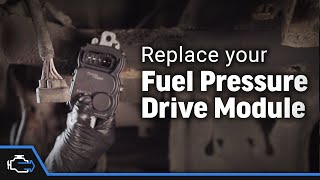
- Corroded or Cracked Fuel Pump Driver Module (FPDM) (Very Common) — On 2004-2008 Ford and Lincoln trucks, the FPDM's bare aluminum body mounts directly to the steel frame. This causes galvanic corrosion that cracks the housing, allowing water and road salt to destroy the internal circuit board. 🎬 Watch: How to replace a corroded FPDM with ChrisFix
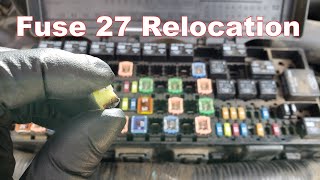
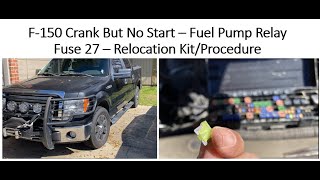
- Melted or Blown Fuel Pump Fuse (Fuse 27) (Common) — On 2009-2014 Ford F-150s, the fuel pump fuse (Fuse 27) uses contacts too small for the electrical current. This overheats and melts the fuse and fuse box slot, creating an open circuit. Ford TSB 15-0137 covers this documented design flaw. 🎬 See this full guide on installing the Fuse 27 relocation kit
- Poor FPDM Ground Connection (Common) — A corroded or loose ground wire for the FPDM causes intermittent operation. Without a solid ground, a functional module cannot operate. On F-150s, this ground point sits on the frame directly near the FPDM.
- Damaged Wiring or Corroded Connector (Common) — The wiring harness and electrical connector leading to the FPDM chafe or corrode due to severe under-vehicle element exposure.
- Failing Alternator / Low System Voltage (Less Common) — A failing alternator providing low voltage (under 12.5V) starves the FPDM and fuel pump for power under high engine load. The PCM incorrectly flags the FPDM as offline.
- Tripped Inertia Fuel Shutoff (IFS) Switch (Less Common) — The IFS switch cuts fuel system power during a collision. A sharp jolt from a pothole trips this switch, cutting power to the FPDM.
- Failing Fuel Pump (Rare) — A failing fuel pump draws excessive electrical current (over 7 amps). This overload damages the FPDM or repeatedly blows the fuel pump fuse.
- Faulty Powertrain Control Module (PCM) (Very Rare) — The PCM driver circuit sending the command signal to the FPDM fails. Consider this only after exhaustively testing all wiring and modules.
Symptoms
- Engine cranks but will not start — The starter turns the engine over normally, but it fails to fire because zero fuel is being delivered to the injectors.
- Engine stalls while driving — The engine runs normally and then suddenly shuts off without warning. It often restarts only after cooling down for 15 to 30 minutes.
- Severe hesitation or bucking under acceleration — Pressing the gas pedal causes the vehicle to jerk violently as the FPDM fails to command the correct fuel pressure at higher RPMs.
- Check Engine Light illuminates (also visible on scanner) — The PCM detects the communication loss and immediately illuminates the Malfunction Indicator Lamp (MIL). 🎬 Watch: Professional diagnostic steps for Ford fuel module codes
Diagnostic Flowchart

Tap your situation to follow the diagnostic path that matches what you're seeing on this code.
Common Fixes & Costs
- Replace the Fuel Pump Driver Module (FPDM) — Parts: $70-$160, Labor: $125-$250, ~0.6 hr book time (DIY)
- Relocate Fuel Pump Fuse (Ford TSB 15-0137) — Parts: $20-$40, Labor: $100-$200, ~0.8 hr book time (Intermediate)
- Clean or Repair FPDM Ground Connection — Parts: $5-$10, Labor: $50-$150, ~0.5 hr book time (DIY)
- Repair Damaged Wiring or Connector — Parts: $10-$50, Labor: $150-$400, ~2.5 hr book time (Intermediate)
- Replace the Fuel Pump Assembly — Parts: $700-$1200, Labor: $350-$500, ~3.2 hr book time (Professional)
Used vs. New Parts: Buying Guide
When a used part is worth it: Buying a used Fuel Pump Driver Module is never recommended. The most common failure is a design flaw causing galvanic corrosion. A used part from a donor vehicle carries the exact same flaw.
Donor-vehicle mileage cap: roughly under 20000 miles for the part to have meaningful remaining life.
Donor quality checklist:
- Always purchase a new OEM or high-quality aftermarket part.
- Ensure the new part includes rubber standoffs to prevent future corrosion.
Decision logic:
- If The part is a Fuel Pump Driver Module for a 2004-2008 Ford truck/SUV. → Always buy new. The redesigned part prevents the corrosion that causes failure.
- If The cost of a new OEM FPDM is less than $200. → Buy new. The minimal cost savings of a used part do not justify the high risk of being stranded.
Warranty tradeoff: Used parts offer a 30-day warranty at best. New aftermarket parts come with a 1-year to lifetime warranty. A new OEM part guarantees longevity.
Worst-case if a used part fails: $200-$500 (Cost of repeat labor, towing, and the new part you should have bought initially).
What Happens If You Wait — Timeline
- First Occurrence: Vehicle stalls once while driving, or has a single 'crank, no-start' event. It restarts after a few minutes. The P1234 code is stored. (MPG impact: 0%% · Added cost: $0)
- Days to Weeks: Intermittent stalling becomes frequent, often when the vehicle is hot. The driver experiences severe bucking under acceleration. The risk of being stranded is high. (MPG impact: 0-5%% · Added cost: $75-$250 (High risk of needing a tow).)
- Weeks to a Month: The vehicle is highly unreliable. Repeated cranking attempts drain the battery and strain the starter motor. (MPG impact: N/A% · Added cost: $275-$850 (Towing plus potential cost of a new battery or starter motor).)
- 1 Month+: Complete failure. The FPDM, fuse circuit, or wiring is completely open. The vehicle will not start under any circumstances. (MPG impact: N/A% · Added cost: $275-$850+)
Cost of Not Fixing It
- Immediate: High risk of being stranded. The engine stalls without warning in potentially dangerous situations like highway traffic. (Added cost: $75-$250+ (for towing).)
- Short Term (Days to Weeks): Repeated attempts to start a vehicle with no fuel delivery drains the battery and destroys the starter motor. (Added cost: $200-$600 (for new battery and starter).)
- Long Term: The vehicle becomes completely undrivable. Unlike performance codes, this communication failure prevents the engine from running entirely.
Diagnosis Steps

- Inspect the Fuel Pump Fuse (Focus on Fuse 27)
Locate the fuel pump fuse in the under-hood fuse box. For 2009-2014 F-150s, pull Fuse 27 and inspect the fuse and the plastic slot for any signs of melting, browning, or distortion. If melted, perform TSB 15-0137.
Tools: Owner's Manual, Fuse Puller (Beginner) - Check the Inertia Switch
Locate the Inertia Fuel Shutoff (IFS) switch (often in the passenger footwell or trunk). Ensure the button on top is pressed down. If it popped up, press it back down, clear the code, and test drive.
Tools: Owner's Manual (Beginner) - Visually Inspect the Fuel Pump Driver Module (FPDM)
Safely raise the rear of the vehicle. The FPDM sits on a frame crossmember above the spare tire. Unbolt the module and inspect its aluminum backplate. If it shows severe corrosion, swelling, or cracks, replace it immediately.
Tools: Jack and Jack Stands, Socket Set (Intermediate) - Inspect and Clean the FPDM Ground Point
Locate the dedicated ground wire bolt on the frame near the FPDM. Remove the bolt and use a wire brush to clean the wire terminal and the frame surface to shiny, bare metal. Re-secure tightly.
Tools: Socket Set, Wire Brush (Intermediate) - Check Charging System Voltage
With the engine running, use a multimeter to check voltage at the battery terminals. It must read between 13.2 and 14.8 volts. Voltage below 12.6V indicates a failing alternator triggering the P1234 code.
Tools: Multimeter (Beginner) - Test Power and Ground at the FPDM Connector
Unplug the FPDM. With the key ON and engine OFF, test Pin 5 (Power In) for battery voltage (12V). Test Pin 3 (Ground) for less than 1.0 ohm of resistance to the frame. Missing voltage indicates a blown fuse or bad relay; high resistance indicates a bad ground.
Tools: Multimeter, Back-Probes, Vehicle Wiring Diagram (Advanced) - Test Command and Feedback Signals
With the FPDM unplugged and key ON, check Pin 6 (Command Signal) for 1-5 volts from the PCM. Pin 1 is the feedback signal. Absence of a command signal indicates a broken wire between the PCM and FPDM.
Tools: Multimeter, Back-Probes, Vehicle Wiring Diagram (Advanced) - Bypass the FPDM to Test the Fuel Pump
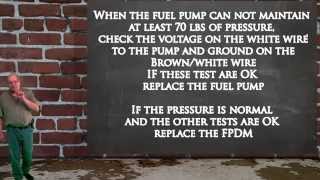
Use fused jumper wires to bypass the FPDM and send 12V directly to the fuel pump pins. If the pump hums and builds pressure, the pump is good and the FPDM is bad. Do this only briefly to avoid pump damage.
Tools: Fused Jumper Wires (Advanced) - Analyze Scan Tool Live Data
Monitor Fuel Pump Command (FP_COMM) and Fuel Pump Monitor (FPM) PIDs. During cranking, FP_COMM should show a percentage. If FP_COMM is active but FPM shows 0% and fuel pressure remains low, the FPDM is receiving the command but failing to execute it.
Tools: Advanced Bi-Directional Scan Tool (Advanced)
When This Code Triggers (Freeze-Frame Conditions)
- Engine State: Running (The fault is detected when the engine is running and the PCM expects a constant feedback signal from the FPDM.)
- Engine Coolant Temp: 175-210°F (Occurs after the vehicle reaches full operating temperature, as heat expands internal cracks in a failing module or poor connection.)
- RPM: 2000-4500+ (Triggers under moderate to heavy acceleration when fuel demand is highest, stressing the FPDM and its circuitry.)
- System Voltage: < 13.0V (while running) (Triggers if the alternator fails and system voltage drops, leaving insufficient power for the FPDM to operate and communicate.)
Related Codes
- P1233 — Another Ford-specific code for 'Fuel Pump Driver Module Offline'. It is functionally identical to P1234 and requires the exact same diagnostic procedure.
- U0109 — The generic SAE network code for 'Lost Communication With Fuel Pump Control Module'. If both are present, the root cause is identical: the PCM cannot communicate with the FPDM.
- P0191 — Means 'Fuel Rail Pressure Sensor Circuit Range/Performance'. A P1234 communication failure causes the PCM to receive illogical fuel pressure data, triggering P0191 as a secondary symptom.
- P0230 — Means 'Fuel Pump Primary Circuit Malfunction'. Points to the circuit powering the fuel pump relay or FPDM. A bad relay cuts power to the FPDM, causing P1234 to appear secondarily.
Climate & Environmental Factors
- High Humidity & Road Salt (Rust Belt / Coastal Regions): The single largest factor for FPDM failure on 2004-2008 Ford trucks. Moisture and road salt act as an electrolyte between the aluminum module and steel frame, dramatically accelerating galvanic corrosion until the case cracks.
- Hot Weather: High ambient temperatures exacerbate the 2009-2014 F-150 Fuse 27 issue by accelerating the overheating of the undersized fuse terminals. Heat also causes internal cracks in a failing FPDM to expand, triggering a stall.
How to Talk to a Mechanic About This Code
Say this: "I'm getting a P1234 code on my [Make/Model/Year] and it's stalling. Based on my research, please focus on testing the Fuel Pump Driver Module, its wiring, ground connection, and the associated fuse before looking at the fuel pump itself."
This signals that you are an informed customer. It directs the shop to the most likely causes, preventing an expensive diagnostic fishing expedition and establishing that you expect a targeted repair.
Avoid saying:
- 'My check engine light is on, can you look at it?'
- 'The car is acting weird, just fix whatever is wrong.'
- 'I think I need a new fuel pump.'
Questions to ask before authorizing the repair:
- How did you confirm the FPDM was the point of failure? Did you test for power, ground, and signal at the connector?
- Can you show me the old part and point out the corrosion or test results that prove it failed?
- If the problem is Fuse 27 on my F-150, are you performing the TSB relocation fix or just putting in a new fuse?
- What is the warranty on this specific repair, covering both parts and labor?
Where to Take It: Dealer vs Independent vs Chain
- Dealer:
A safe but expensive choice. Good for warranty work, but unnecessary for a common, out-of-warranty P1234 fix.
Best for: Vehicles still under powertrain warranty., Performing the official Ford TSB 15-0137 for the Fuse 27 relocation.
Downsides: Significantly higher labor rates than independent shops., Defaults to more expensive OEM parts. (Typical cost: +50% vs. baseline) - Independent Shop:
Best fit. The P1234 fault on Ford trucks is extremely well-known. A reputable independent mechanic diagnoses and repairs it efficiently without the dealership price tag.
Best for: Out-of-warranty vehicles, especially Fords with the common P1234 issue., Getting the best balance of cost and expertise.
Downsides: Quality varies; choose a shop with good reviews and ASE-certified technicians. (Typical cost: +0% vs. baseline) - Chain Shop:
Use with caution. Acceptable for a straightforward FPDM swap, but avoid for diagnosing an intermittent P1234.
Best for: Simple part replacement like swapping a visibly corroded FPDM if you cannot do it yourself.
Downsides: Technician skill varies dramatically; lacks the diagnostic depth to trace a wiring fault., High pressure to upsell a full fuel pump replacement when only a module is needed. (Typical cost: -10% vs. baseline)
When to Walk Away From the Repair
If the total estimated repair cost exceeds 40-50% of the car's private-party value, seriously consider selling or trading in the vehicle instead of repairing it.
- Car worth $8000, fix is $450: Fix it. The repair cost is well below the threshold and restores a critical function.
- Car worth $4000, fix is $1400: Borderline. The shop is quoting a full fuel pump replacement. Get a second opinion to confirm the FPDM isn't the true, cheaper cause.
- Car worth $2500, fix is $1400: Walk away. The repair cost is over 50% of the vehicle's value. It is not economically sensible to proceed.
What Scan Tool You Need for This Code
Minimum: A scanner that reads Ford-specific trouble codes and displays live data PIDs (Parameter IDs).
A $20 generic code reader only gives you the P1234 code. It cannot show crucial live data like Fuel Rail Pressure or Fuel Pump Command percentages required to pinpoint the failure.
Budget: BlueDriver Pro (~$100) — Connects to your smartphone to read Ford-specific codes and graph live data for key fuel system PIDs, confirming if fuel pressure is dropping out.
Mid-range: Autel MaxiCheck MX808S / XTOOL D7 (~$350-400) — Offers bidirectional control. You can command the fuel pump on/off directly from the tool to test the FPDM, relay, and pump itself, dramatically speeding up diagnosis.
Professional: Autel MaxiCOM MK808S-TS / MK906BT (~$500-1200) — Provides full bidirectional control, advanced functions, and access to all vehicle modules for OE-level diagnostic accuracy.
Rent vs buy: If this is a one-time diagnosis, borrow a basic scanner for free from an auto parts store. Buy a scanner only if you plan to do your own diagnostics regularly.
How to Clear the Code After You Fix It
- Use an OBD-II scan tool to clear the P1234 code.
- Perform a complete drive cycle to allow the vehicle's readiness monitors to run.
- Rescan the vehicle to confirm no codes have returned.
Drive cycle (~20 minutes): Cold start and idle for 3 minutes. Drive in stop-and-go traffic for 5 minutes. Accelerate to a steady 55 mph for 10 minutes on a highway. Safely decelerate to a stop and idle for 1 minute.
Readiness monitors affected: Comprehensive Component Monitor, Fuel System Monitor
Before emissions retest: drive at least 100 miles to fully set monitors.
Watch out for:
- Disconnecting the battery clears the code but resets all readiness monitors to 'Not Ready', causing an automatic emissions test failure.
- The code returns immediately if the root cause, such as a corroded ground wire, was not properly cleaned to bare metal.
Will This Fail Emissions / State Inspection?
Yes — this code typically fails an OBD-II emissions inspection.
- California: An active Check Engine Light results in an automatic smog check failure. For 2010+ vehicles, a stored Permanent Diagnostic Trouble Code (PDTC) causes a failure even if the light is off.
- New York: The NYS inspection includes an OBD-II scan. An illuminated Check Engine Light for P1234 causes an automatic failure.
- Texas: In emissions-testing counties, an illuminated Check Engine Light is an automatic failure. In safety-only counties, the underlying stalling issue fails the safety inspection.
Most Commonly Affected Vehicles
- Ford F-150 (2004-2008) — Extremely common due to the original FPDM design and frame mounting location causing severe galvanic corrosion. Replacement parts include rubber standoffs to prevent recurrence.
- Ford F-150 (2009-2014) — Highly prone to a melted fuel pump fuse (Fuse 27). Ford issued TSB 15-0137 with a relocation kit to fix this design flaw.
- Ford Expedition (2005-2008) — Shares the identical faulty FPDM design and frame mounting location as the F-150.
- Lincoln Navigator (2005-2008) — The Lincoln platform equivalent of the Expedition, suffering from the identical FPDM corrosion issue.
- Ford Explorer (2004-2010) — Uses a susceptible FPDM system, though often mounted inside the rear quarter panel rather than under the frame.
- Ford Mustang (2005-2010) — The FPDM is located in the trunk behind trim panels. It is less prone to corrosion but still fails electronically.
- Subaru Forester / Outback (Diesel) (2008-2015) — On Subaru EE20 diesel engines, P1234 indicates 'Fuel Pump Driver Module Off-Line' or a variation in fuel rail pressure.
- BMW 3 Series / 5 Series (1998-2006) — Indicates 'Fuel pump relay, primary circuit - signal low', pointing to a fault with the relay circuit rather than a separate driver module.
- Mitsubishi Galant / Eclipse (2004-2012) — Means 'Throttle Position Sensor (Sub) Plausibility', completely unrelated to the fuel system.
Manufacturer-Specific Notes
- Ford, Lincoln, Mercury: P1234 means 'Fuel Pump Driver Module Offline'. The primary cause is FPDM corrosion on 2004-2008 trucks or a melted Fuse 27 on 2009-2014 F-150s.
- General Motors (Chevrolet, GMC, Cadillac): P1234 means 'Injector Circuit Cylinder 5 Intermittent'. This is a completely different issue related to the wiring or fuel injector for a single cylinder.
- BMW / Mini: Points to a 'Fuel pump relay, primary circuit - low' or a steering angle sensor circuit fault, depending on the specific chassis.
- Mitsubishi: Means 'Throttle Position Sensor (Sub) Plausibility', indicating a throttle body issue, not a fuel pump problem.
- Polaris: On off-road vehicles like the RZR, P1234 is a 'Boost Reference Code' related to the turbocharger wastegate.
Real Owner Stories
2008 Ford F-150 experiences sudden, severe bucking on the highway.
While driving 300 miles from home, the truck began bucking violently under acceleration without a Check Engine Light. After cooling overnight, it ran fine until reaching operating temperature, then the issue returned.
Outcome: Replacing the FPDM in the parking lot fixed the issue immediately. The original module was severely corroded and cracked from being mounted to the steel frame.
Lesson: Severe bucking and stalling, even without a Check Engine Light, is a classic symptom of a failing FPDM on 2004-2008 F-150s. Live data showing fluctuating fuel rail pressure confirms the diagnosis.
2010 Ford F-150 has a long crank/no-start; owner misdiagnoses the fuel pump.
The truck cranked for 4-7 seconds before starting, or sputtered to life. The owner assumed the fuel pump was failing and replaced it.
Outcome: The actual problem was the #27 fuel pump fuse overheating and melting its slot. The owner performed the Ford TSB 15-0137 fuse relocation to permanently solve the condition.
Lesson: On a 2009-2014 F-150, always inspect Fuse 27 in the under-hood fuse box for melting before suspecting the fuel pump or FPDM.
2008 Shelby GT500 throws P1234 and loses power; owner suspects FPDM.
The car felt low on power, triggered a P1234 code, flashed a 'Charging System' message briefly, and shook on startup.
Outcome: The root cause was a weak alternator. A failing charging system starves the FPDM for power, causing it to malfunction and trigger communication codes under hard acceleration.
Lesson: If P1234 appears alongside charging system warnings, test the alternator before replacing fuel system components. A healthy alternator produces 13.2-14.8 volts while running.
How to Prevent This Code From Triggering
- Proactively replace the FPDM on 2004-2008 Ford trucks in rust-prone areas. (Once, around 100,000 miles or upon buying a used truck.) — The original part is guaranteed to fail from galvanic corrosion. Replacing it with the redesigned standoff part prevents you from being stranded.
- Perform the Fuse 27 relocation TSB on any 2009-2014 F-150. (Once, as a preventative measure before symptoms appear.) — The original fuse slot is too small and will eventually melt. The relocation kit moves the circuit to a robust fuse location, preventing a future no-start situation.
- Apply dielectric grease to the FPDM electrical connector. (Anytime the FPDM is replaced or inspected.) — Filling the connector with dielectric grease seals out moisture and road salt, preventing pin corrosion that leads to communication loss.
Frequently Asked Questions
Can I just replace the fuse if it's blown?
You can as a temporary measure, but if it blows again, the fuel pump is drawing too much current. On 2009-2014 F-150s, the fuse slot itself is defective, requiring the TSB 15-0137 relocation kit for a permanent repair.
My scan tool says P1234, but my car isn't a Ford. Can it mean something else?
Yes. P1234 is a manufacturer-specific code. For GM, it points to a cylinder 5 fuel injector circuit, while Mitsubishi uses it for throttle position sensor faults. Always verify the definition for your specific make and model.
I replaced the FPDM, but the P1234 code returned. What should I check next?
If a new FPDM fails to clear the code, the fault lies in the circuit. Clean the frame ground point to bare metal and inspect the wiring harness for hidden damage. If the wiring is intact, test the fuel pump itself, as a failing pump draws excessive current and damages the module.
What is a Fuel Pump Driver Module?
It is a microcomputer that takes commands from the main engine computer and precisely controls the voltage and speed of the fuel pump. This eliminates the need for a fuel return line and increases efficiency.
Why does the new FPDM part look different?
Newer replacement FPDMs include mounting bolts with rubber standoffs. These create an air gap between the module and the frame, preventing the direct metal-to-metal contact that caused the original galvanic corrosion.
My truck stalls but then restarts after a few minutes. Could this be the FPDM?
Yes. As a damaged FPDM overheats, internal cracks expand and break the circuit, causing a stall. After cooling off, the connection temporarily restores itself.
Is it safe to drive with a P1234 code?
No. The risk of the engine stalling at highway speeds or in intersections is extremely high, creating a severe safety hazard.
Where is the FPDM located?
On most Ford trucks and large SUVs, it mounts to a frame crossmember directly above the spare tire. On cars like the Mustang, it sits inside the trunk behind the trim panels.
Key Takeaways
- While P1234 definitions vary by brand, on Ford, Lincoln, and Mercury vehicles it specifically indicates a Fuel Pump Driver Module (FPDM) communication failure.
- Physical corrosion cracking the FPDM housing causes 80% of P1234 codes on 2004-2008 Ford trucks, while a melted Fuse 27 is the primary culprit for 2009-2014 F-150s.
- A P1234 code creates an immediate safety hazard, causing the engine to stall at highway speeds or fail to start entirely.
- Replacing a corroded FPDM takes less than 45 minutes using basic hand tools, and new replacement modules include rubber standoffs to permanently prevent future corrosion.
Helpful Videos


The information in this article is provided for general reference and educational purposes only. Vehicle specifications, procedures, and part compatibility can vary by production date, trim level, and region. Always consult your vehicle's factory service manual and verify part numbers before purchasing or performing repairs. Safety-critical components such as airbags, seat belts, and braking systems should be installed by a qualified professional.
- 🎬 Helpful Videos
- What Does P1234 Mean?
- Can I Drive With P1234?
- Common Causes
- Symptoms
- Diagnostic Flowchart
- Common Fixes & Costs
- Used vs. New Parts: Buying Guide
- What Happens If You Wait — Timeline
- Cost of Not Fixing It
- Diagnosis Steps
- When This Code Triggers (Freeze-Frame Conditions)
- Related Codes
- Climate & Environmental Factors
- How to Talk to a Mechanic About This Code
- Where to Take It: Dealer vs Independent vs Chain
- When to Walk Away From the Repair
- What Scan Tool You Need for This Code
- How to Clear the Code After You Fix It
- Will This Fail Emissions / State Inspection?
- Most Commonly Affected Vehicles
- Manufacturer-Specific Notes
- Real Owner Stories
- 2008 Ford F-150 experiences sudden, severe bucking on the highway.
- 2010 Ford F-150 has a long crank/no-start; owner misdiagnoses the fuel pump.
- 2008 Shelby GT500 throws P1234 and loses power; owner suspects FPDM.
- How to Prevent This Code From Triggering
- Frequently Asked Questions
- Can I just replace the fuse if it's blown?
- My scan tool says P1234, but my car isn't a Ford. Can it mean something else?
- I replaced the FPDM, but the P1234 code returned. What should I check next?
- What is a Fuel Pump Driver Module?
- Why does the new FPDM part look different?
- My truck stalls but then restarts after a few minutes. Could this be the FPDM?
- Is it safe to drive with a P1234 code?
- Where is the FPDM located?
- Key Takeaways
- 🎟️ Get 5% Off