

OBD-II Code P1225: Needle Lift Sensor / Throttle Position Sensor / Injector Circuit Malfunction
What P1225 means, why it triggers, and how to fix it
- Verify your specific vehicle's P1225 definition before buying parts, as it means a throttle position error on a 2010 Nissan but a cylinder 2 injector failure on a 2005 GM Duramax.
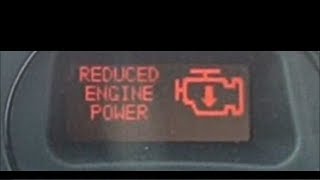
- Stop driving immediately if your vehicle enters 'Reduced Engine Power' mode, as unpredictable stalling in traffic poses a severe safety risk.
- Inspect the wiring harness for chafing or corrosion before replacing any sensors, as over 90% of GM Duramax P1225 codes are caused by the injector harness rubbing against the alternator bracket.
- Clean the throttle body using a $10 can of dedicated cleaner and perform an idle relearn procedure as your first diagnostic step for Nissan, Hyundai, and Kia vehicles.
- Test the Accelerator Pedal Position (APP) sensor's voltage sweep using a multimeter; a smooth increase from 0.5V to 4.5V confirms the sensor works, while sudden voltage drops indicate internal failure.
What Does P1225 Mean?

P1225 is a manufacturer-specific code, meaning its definition depends entirely on your vehicle's make. On Nissan and Hyundai, it indicates a throttle position error. On GM Duramax diesels, it flags a cylinder 2 fuel injector circuit failure. Regardless of the brand, the engine computer has detected a sensor signal outside its expected voltage range, which directly impacts engine performance.
Technical definition: The SAE/ISO definition of P1225 varies by manufacturer. Common definitions include: 'Closed Throttle Position Learning Value Excessively Low' (Nissan/Hyundai), 'Injector Circuit Cylinder 2 Intermittent' (GM), 'Cylinder 1 - Fuel Injector Circuit Short to Ground' (Volkswagen/Audi), and 'Spill Control Circuit Malfunction' (Toyota Diesel).
Can I Drive With P1225?
No — Do Not Drive. Stop driving immediately. The vehicle will enter a low-power 'limp mode' or stall unexpectedly, creating a severe safety hazard in traffic. Continuing to drive with a rich fuel mixture fault also destroys the catalytic converter, adding a $900 to $2,800 repair to your bill.
Common Causes

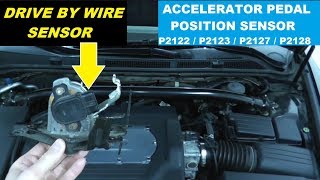
- Faulty Accelerator Pedal Position Sensor (APPS) (Very Common) — This sensor tells the engine computer how much power you want. It fails from internal wear, causing incorrect signals. It is the primary cause of 'Reduced Engine Power' mode on GM vehicles.
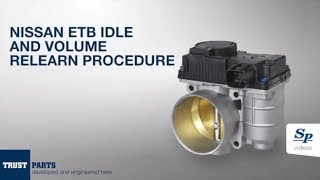
- Dirty or Failing Throttle Body (Common) — Carbon buildup makes the throttle plate stick, or the internal motor fails. This causes sensor readings to fall out of sync with the computer's expectations, triggering the code on Nissan and Hyundai models. 🎬 Watch: How to properly clean your Nissan throttle body.
- Damaged Wiring or Connectors (Common) — Wires leading to the pedal sensor, throttle body, or fuel injectors become corroded, frayed, or loose. On Duramax engines, the injector harness rubs and shorts against the alternator bracket. 🎬 See how to repair the Duramax injector wiring harness.
- Faulty Throttle Position Sensor (TPS) (Common) — Located on the throttle body, this sensor measures how far the throttle plate is open. It wears out internally, sending erratic voltage signals to the computer.
- Faulty Fuel Injector (GM/VW/Audi Specific) (Less Common) — On specific vehicles, this code points directly to an electrical problem within a fuel injector, such as an internal short or open coil circuit.
- Poor Ground Connection (Less Common) — A corroded or loose ground wire for the sensor circuit causes erratic voltage readings, triggering the code even if the sensor itself functions perfectly.
- Failing PCM or Software Glitch (Rare) — The Powertrain Control Module (PCM) software requires an update via a Technical Service Bulletin (TSB), or the PCM hardware itself has failed. Check this only after exhausting all other physical diagnostics.
Symptoms

- Check Engine Light is On — The Malfunction Indicator Lamp (MIL) illuminates immediately upon the computer detecting the out-of-range signal.
- Engine Goes into "Limp Mode" — The vehicle suddenly loses power and limits top speed. The dashboard displays a "Reduced Engine Power" message, common on GM vehicles.
- Poor or No Acceleration — The car feels sluggish, hesitates, or completely ignores the gas pedal because the computer receives incorrect throttle input signals.
- Engine Stalling — The engine stalls unexpectedly when coming to a stop or during sudden throttle changes due to an incorrect air-fuel mixture.
- Rough or High Idle — The engine idles erratically, too high, or too low because the computer cannot determine the correct closed-throttle position.
- Increased Fuel Consumption (also visible on scanner) — The PCM commands more fuel than necessary to compensate for faulty injector or throttle readings, destroying gas mileage.
Diagnostic Flowchart
Tap your situation to follow the diagnostic path that matches what you're seeing on this code.
Common Fixes & Costs
- Clean Throttle Body — Parts: $10-$20, Labor: $75-$150, ~0.8 hr book time (DIY)
- Replace Accelerator Pedal Position Sensor (APPS) — Parts: $70-$250, Labor: $75-$150, ~1 hr book time (DIY)
- Replace Throttle Body Assembly — Parts: $200-$600, Labor: $100-$250, ~1.5 hr book time (Intermediate)
- Repair or Replace Wiring Harness — Parts: $20-$300, Labor: $150-$500, ~2.5 hr book time (Advanced)
- Replace Fuel Injector (GM/VW/Audi) — Parts: $150-$500, Labor: $100-$300, ~2 hr book time (Intermediate)
Used vs. New Parts: Buying Guide
When a used part is worth it: For electronic parts like a throttle body, a used OEM part from a low-mileage vehicle is a cost-effective alternative to a new aftermarket part. It makes sense when the vehicle is older, the budget is tight, and a new OEM part exceeds $500.
Donor-vehicle mileage cap: roughly under 80000 miles for the part to have meaningful remaining life.
Donor quality checklist:
- Verify the donor vehicle's mileage; lower is mandatory for electronic components.
- Ensure the part number matches exactly to prevent compatibility issues.
- Buy from a reputable salvage yard offering at least a 90-day warranty.
Decision logic:
- If The part is a simple electronic sensor and a new high-quality aftermarket version is available for under $100. → Buy new for the better warranty and guaranteed compatibility.
- If The part is a complete throttle body assembly and the new OEM price is over $500. → A used OEM part is a reasonable gamble, provided it has a warranty.
- If The vehicle is over 10 years old or has more than 150,000 miles. → A used part is the most practical financial choice.
Warranty tradeoff: Used parts typically come with a 30-90 day functional warranty. New aftermarket parts offer a 1-year to limited lifetime warranty. New OEM parts carry a 1-2 year warranty but cost significantly more.
Worst-case if a used part fails: $200-$500 if a used part fails after the warranty period, requiring a second replacement and additional labor.
What Happens If You Wait — Timeline
- 0-1 month: Check Engine Light illuminates. You experience a slightly rough idle or a minor hesitation when accelerating from a stop. The issue is intermittent. (MPG impact: 0-5%% · Added cost: $0 - $30 in wasted fuel)
- 1-4 months: Symptoms become consistent. The vehicle sporadically enters 'Reduced Engine Power' or 'Limp Mode'. Stalling at stoplights occurs. Acceleration is noticeably sluggish. (MPG impact: 5-15%% · Added cost: $50 - $150 in wasted fuel)
- 4-9 months: The vehicle is unreliable and frequently enters limp mode, making highway driving unsafe. If the cause is a rich mixture, the catalytic converter consistently overheats, reducing its efficiency and melting the internal substrate. (MPG impact: 15-25%% · Added cost: $900 - $2,800 (catalytic converter replacement required))
- 9+ months: Complete catalytic converter failure (meltdown or clogging) causes severe exhaust blockage. This leads to a no-start condition or causes exhaust gases to back up, damaging exhaust valves or oxygen sensors. The car is undrivable. (MPG impact: 25-50%+% · Added cost: $1,500 - $4,000+ (includes catalytic converter, O2 sensors, and diagnostic labor))
Cost of Not Fixing It
- Immediate: Unpredictable stalling or entering 'limp mode' creates a severe safety risk in traffic. (Added cost: N/A)
- 0-3 months: Incorrect air/fuel mixture from a faulty sensor causes a 5-15% drop in fuel economy and failed emissions tests. (Added cost: $50 - $200 in wasted fuel)
- 3-12 months: Continuously running a rich fuel mixture overheats and destroys the catalytic converter. (Added cost: $900 - $2,800)
- 12+ months: Chronic misfires or improper combustion add extreme stress to ignition components and cause internal engine damage. (Added cost: $300 - $1,500+)
Diagnosis Steps

- Verify the Code Definition
Use your OBD-II scanner to confirm the exact definition of P1225 for your vehicle's make, model, and year. As a manufacturer-specific code, the meaning dictates your entire diagnostic path (e.g., Nissan throttle vs. GM injector).
Tools: OBD-II Scanner (Beginner) - Check for Other Trouble Codes
Scan for accompanying codes. Codes related to other throttle/pedal sensors (P2135, P0122) or injector circuits provide crucial context. Document them and clear the codes to see which return immediately.
Tools: OBD-II Scanner (Beginner) - Visual Inspection of Wiring and Grounds
Inspect the wiring harnesses and connectors for the component identified in Step 1. Look for broken wires, corrosion, or loose pins. On Duramax engines, inspect the injector harness where it rubs against the alternator bracket.
Tools: Flashlight, Inspection Mirror (Beginner) - Clean the Throttle Body
If the code definition points to a closed-position error (Nissan/Hyundai), remove the air intake tube and clean the throttle body bore and plate with dedicated cleaner and a soft cloth. Do not spray directly into electrical components.
Tools: Throttle Body Cleaner, Screwdriver/Ratchet, Rags (Intermediate) - Analyze Live Data with a Scan Tool
With the engine off and key on, view live data. Watch the Accelerator Pedal Position (APP) and Throttle Position (TP) readings. As you slowly press the gas pedal, values must increase smoothly. APP sensors range from ~0.7V at rest to ~4.5V at full press.
Tools: Advanced OBD-II Scanner (Intermediate) - Pro Tip: Test Sensor Voltage with a Multimeter
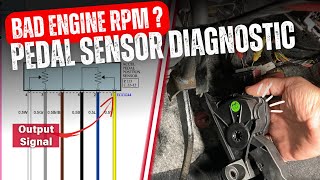
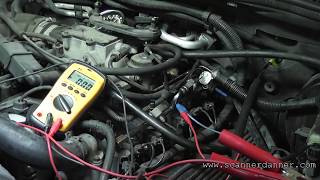
Back-probe the sensor connector. Verify a 5-volt reference signal and a good ground (less than 0.1V). Test the signal wire while operating the pedal; voltage must sweep smoothly from 0.5V to 4.5V. A sudden drop to 0V indicates a faulty sensor.
Tools: Digital Multimeter, T-pins, Wiring Diagram (Advanced) - Perform a Throttle Relearn Procedure
After cleaning or replacing the throttle body, perform a 'relearn' procedure to reset the idle and closed-throttle positions. Use a bidirectional scan tool or follow the manufacturer's specific sequence of key turns and pedal presses.
Tools: OBD-II Scanner (Bidirectional) (Intermediate) - Pro Tip: Test GM Injector Circuit Resistance
For GM Duramax P1225, disconnect the harness at Cylinder 2. Measure the resistance between the two terminals of the injector. A good injector reads less than 1.0 ohm. A reading significantly higher or 'OL' indicates a failed injector coil.
Tools: Digital Multimeter, Socket Set (Advanced) - Pro Tip: Test Toyota Spill Control Valve Resistance
For Toyota diesel P1225, disconnect the spill control valve on the injection pump. Measure the resistance between the two terminals. The specification is 1.0 to 2.0 ohms at 68°F (20°C). Readings outside this range indicate a faulty valve.
Tools: Digital Multimeter (Advanced) - Pro Tip: Use an Oscilloscope for Intermittent Faults
Connect an oscilloscope to the sensor's signal and ground wires. Operate the pedal multiple times. The pattern must be a clean, smooth ramp. Sharp vertical drops or noise in the waveform indicate an internal sensor failure a multimeter cannot catch.
Tools: Automotive Oscilloscope (Scope) (Advanced)
When This Code Triggers (Freeze-Frame Conditions)
- Engine Coolant Temp: 180-210°F (The fault triggers when the engine is fully warmed up and operating at normal temperature.)
- RPM: 1200-2500 (The code logs during steady-state cruising or light acceleration, rarely at idle or full throttle.)
- Engine Load: 20-50% (Occurs under moderate load conditions, consistent with standard city or highway driving.)
- Vehicle Speed: 30-60 mph (Logged during normal driving speeds, rather than during stop-and-go traffic.)
Related Codes
- P2135 — Indicates a correlation problem between Throttle/Pedal Position Sensors 'A' and 'B'. It appears with P1225 because the computer gets conflicting signals from two sensors in the same assembly.
- P0122 — A generic code for 'Throttle/Pedal Position Sensor 'A' Circuit Low Input.' It is a general version of the problem P1225 specifies.
- P0123 — The opposite of P0122, meaning the sensor circuit voltage is too high. Seeing this with P1225 strongly points to a sensor or wiring failure.
- P2138 — Indicates 'Throttle/Pedal Position Sensor/Switch D/E Voltage Correlation.' Seen on GM vehicles alongside P1125, it flags a mismatch between signals from the two sensors in the accelerator pedal assembly.
Climate & Environmental Factors
- High Humidity: Moisture penetrates sensor connectors and wiring, causing corrosion on terminals and leading to intermittent signals or short circuits. High humidity levels above 60% significantly increase the risk of corrosion.
- Cold Weather: Extreme cold causes plastic components in sensors and connectors to become brittle and crack. It increases electrical resistance in circuits, causing sensor readings to drift out of range. Moisture in the air intake freezes on the throttle plate, causing it to stick.
- Vibration: Constant engine vibration causes wire fatigue and failure at connection points. The GM Duramax issue with the injector harness rubbing on the alternator bracket is a direct result of vibration-induced failure.
How to Talk to a Mechanic About This Code
Say this: "I have a P1225 code on my [Make, Model] and I know the definition varies by brand. I'd like to book a diagnostic appointment. Please confirm the manufacturer's specific definition for my VIN and check for any related Technical Service Bulletins before testing components."
This signals you understand the code's complexity. It prevents the shop from making incorrect assumptions (like looking at the throttle on a Duramax) and directs them to perform foundational research first, saving diagnostic time and money.
Avoid saying:
- 'Just fix whatever's wrong'
- 'My check engine light is on, can you look at it?'
- 'Whatever you recommend'
Questions to ask before authorizing the repair:
- What is the specific definition of P1225 for my car, and what component does it point to?
- Can you show me the test results that prove the part failed (e.g., the voltage dropout on the scan tool, the chafed wire)?
- If the fix is cleaning the throttle body, have you already tried that and the relearn procedure?
- What is the warranty on the recommended parts and the labor for this repair?
Where to Take It: Dealer vs Independent vs Chain
- Dealer:
Best for: Vehicles under warranty, Complex manufacturer-specific issues (e.g., VW/Audi electrical, BMW throttle logic), Repairs covered by a known Technical Service Bulletin (TSB), like the GM Duramax injector harness.
Downsides: Charges the highest labor rate (1.5-2x independent shops)., Favors replacing an entire assembly over repairing a specific wire or connection. (Typical cost: +50% vs. baseline) - Independent Shop:
Best fit for most P1225 scenarios. A good independent shop with strong diagnostic skills offers the best balance of expertise and value. They perform targeted wiring repairs instead of full harness replacements.
Best for: Out-of-warranty vehicles where cost is a factor., Common P1225 variants with well-known fixes (e.g., Nissan throttle cleaning, Pontiac pedal sensor)., Electrical diagnosis, as they have more flexibility to trace wiring issues.
Downsides: Quality and diagnostic skill vary widely; check for ASE certification and reviews., Lacks immediate access to brand-specific TSBs. (Typical cost: +0% vs. baseline) - Chain Shop:
Not recommended for diagnosis. Due to the varied nature of P1225, a chain shop misdiagnoses the issue or defaults to replacing expensive parts without proper testing. Only use if you have already diagnosed a simple sensor failure yourself.
Best for: Simple, pre-diagnosed part replacements like an accelerator pedal sensor.
Downsides: Technician skill varies dramatically., High pressure to upsell leads to replacing parts unnecessarily., Not equipped for in-depth electrical diagnosis or manufacturer-specific relearn procedures. (Typical cost: -10% vs. baseline)
When to Walk Away From the Repair
If the estimated repair cost exceeds 40-50% of the car's Kelley Blue Book (KBB) private-party value, sell or trade in the vehicle instead of repairing it.
- Car worth $3000, fix is $450: Fix it. This repair for a common pedal sensor is well below the threshold and restores critical functionality.
- Car worth $8000, fix is $3500: Borderline. A quote this high (e.g., for a new ECU) approaches the 40-50% threshold. Get a second opinion from an independent shop before authorizing.
- Car worth $2500, fix is $1800: Walk away. The repair cost is over 70% of the car's value. It is not financially sensible to proceed.
What Scan Tool You Need for This Code

Minimum: A scanner that reads manufacturer-specific code definitions and displays live data streams, including graphing for sensor voltages (APP and TPS).
A basic $20 code reader only shows 'P1225' without the crucial manufacturer-specific definition. It cannot display the live sensor data needed to see voltage dropouts or glitches, which is essential for diagnosing sensor failures.
Budget: BlueDriver Pro or Autel AP200 (~$60-100) — These Bluetooth dongles connect to a smartphone app to provide manufacturer-specific code definitions, freeze-frame data, and live data graphing. This is sufficient to diagnose failing pedal/throttle sensors by watching their voltage sweep for dropouts.
Mid-range: Foxwell NT510 Elite or XTOOL D7 (~$160-350) — Adds bidirectional controls. This is critical for performing functions like an electronic throttle relearn procedure, which is a mandatory fix for P1225 on Nissan, Hyundai, and GM vehicles after cleaning or replacing the throttle body.
Professional: Autel MaxiCOM MK808 / MK906BT or Launch X431 series (~$500-1200) — Provides full, OEM-level bidirectional functions, advanced ECU coding, and faster processing for analyzing complex data streams. These are professional-grade tools for diagnosing difficult intermittent electrical faults or software-related issues.
Rent vs buy: For a one-time code read, auto parts stores offer free scanning services. However, since properly diagnosing P1225 requires analyzing live data or performing a relearn, buying a budget scanner (~$100) is a mandatory investment for any DIYer.
How to Clear the Code After You Fix It
- Use an OBD-II scan tool to clear the diagnostic trouble codes.
- Perform a complete drive cycle to allow the vehicle's computer to re-run its self-tests and confirm the fix.
Drive cycle (~30 minutes): A generic drive cycle includes a cold start (after sitting for 8+ hours), 2-3 minutes of idling, 10-15 minutes of steady highway driving (around 55 mph), followed by 10-15 minutes of stop-and-go city driving.
Readiness monitors affected: Catalyst Monitor, Oxygen (O2) Sensor Monitor, Evaporative System Monitor
Before emissions retest: drive at least 100 miles to fully set monitors.
Watch out for:
- Clearing the code does not fix the underlying mechanical or electrical fault; the code returns immediately.
- Failure to complete a full drive cycle leaves readiness monitors in a 'Not Ready' state, causing an automatic emissions test failure.
- Forgetting to perform a throttle relearn procedure after cleaning a throttle body causes the code to reappear.
Will This Fail Emissions / State Inspection?
Yes — this code typically fails an OBD-II emissions inspection.
- California: An illuminated Check Engine Light from a P1225 code is an automatic failure. All readiness monitors must be 'Ready', requiring 100+ miles of driving after a repair before re-testing.
- New York: The NYS DMV inspection includes an OBD-II scan. An active P1225 code causes an automatic failure of the emissions portion of the test.
- Texas: In the 17 counties requiring emissions testing, an active P1225 code causes a failure. If codes were recently cleared, the vehicle fails if too many readiness monitors are 'Not Ready'.
Most Commonly Affected Vehicles
- Nissan Rogue, Sentra, Murano, Frontier, Patrol (2004-2015) — Experiences P1225 related to the throttle position sensor learning value being too low, requiring throttle body cleaning and a relearn procedure.
- GM (Chevrolet/GMC) Silverado/Sierra with Duramax Diesel (LLY & LB7) (2001-2007) — P1225 means 'Injector Circuit Malfunction Cylinder 2.' The injector wiring harness rubs and shorts near the alternator bracket. GM released TSB 05-06-04-047B with a revised harness support bracket kit (P/N 98017958).
- Audi/Volkswagen A4, Jetta, Golf (TDI and gasoline) (2002-2008) — Relates to a fuel injector circuit shorting to ground (Cylinder 1). This requires checking the injector and its wiring, not the throttle.
- Toyota Caldina, Corolla (Diesel models) (1997-2007) — On diesel engines (3C-TE), P1225 indicates a 'Spill Control Circuit Malfunction' related to the injection pump, requiring specialized diagnosis.
- BMW Various models with M54/N52 engines (2001-2010) — P1225 is defined as 'Throttle Position (TP) Sensor, Bank 2 - High Input,' pointing to a fault in the electronic throttle body's internal sensor.
- Hyundai Elantra, Santa Fe, Sonata (2010-2018) — P1225 means 'Closed throttle position learning value is excessively low.' A throttle body cleaning and relearn procedure is the primary fix.
- Kia Optima, Sorento, Sportage (2011-2020) — Shares powertrain technology with Hyundai; P1225 relates to throttle body and pedal sensor issues. A throttle position sensor reset is required after cleaning.
- Pontiac Grand Prix (2004-2008) — Sets this code for accelerator pedal position sensor problems, leading to the 'Reduced Engine Power' message. Replacing the pedal assembly is the standard fix.
Manufacturer-Specific Notes
- Nissan: Defines P1225 as 'Closed Throttle Position Learning - Voltage Too Low.' The throttle plate isn't closing properly due to carbon buildup. A throttle body cleaning and relearn procedure fixes this.
- GM: On 2001-2007 Duramax diesel engines (LLY/LB7), P1225 is 'Injector Circuit Cylinder 2 Intermittent.' This points to the number 2 fuel injector wiring harness rubbing on the alternator bracket. TSB 05-06-04-047B addresses this.
- Toyota: On diesel models, P1225 is 'Spill Control Circuit Malfunction,' relating to the injection pump and requiring a spill control valve resistance test (1-2 Ohms).
- Volkswagen/Audi: Defines P1225 as 'Cylinder 1 - Fuel Injector Circuit Short to Ground.' This requires checking the injector and its wiring, completely ignoring the throttle system.
- Pontiac: GM issued Special Coverage Adjustment #14425 extending the warranty on the Accelerator Pedal Position (APP) sensor due to high failure rates, acknowledging a known weakness in the part.
Real Owner Stories
2006 Pontiac Grand Prix (~150k miles)
For years, the car intermittently entered 'Reduced Engine Power' mode, causing the engine to stall in traffic. The issue was inconsistent and hard to replicate.
What they tried:
- Replaced the accelerator pedal assembly multiple times, fixing the problem for about a year before it returned.
- Replaced the throttle body.
- Cleaned all related wiring and connectors.
Outcome: The owner battled the issue for four years. The active codes (P1125, P2120, P2125, P2138) all related to the Accelerator Pedal Position (APP) sensor. The root cause was a combination of poor-quality aftermarket replacement pedal sensors and a degrading wiring harness.
Lesson: If replacing a part like the APP sensor only provides a temporary fix, the root cause is elsewhere. Chasing the same code repeatedly indicates a persistent wiring issue (chafing/corrosion) or a reliance on low-quality aftermarket parts.
2008 Nissan Rogue
Check Engine Light illuminated with code P1225. The car had a slightly rough idle when cold but drove normally otherwise.
What they tried:
- Based on Nissan's specific P1225 definition ('Closed Throttle Position Learning Value Excessively Low'), the owner skipped sensor replacement and focused on the throttle body.
Outcome: The owner removed the air intake and cleaned significant carbon buildup from the throttle plate using throttle body cleaner. After reassembly, they performed a manual throttle relearn procedure. The code cleared, the idle smoothed out, and the issue never returned. Total cost was under $20.
Lesson: For Nissan, Hyundai, and Kia, P1225 almost always points to a dirty throttle body, not a failed sensor. Always start with a $20 cleaning and relearn procedure before spending hundreds on a new throttle body assembly.
2005 GMC Sierra 2500HD (LLY Duramax)
Truck suddenly ran rough with a definite engine misfire. A scan showed code P1225, defined as 'Injector Circuit Cylinder 2 Intermittent'.
What they tried:
- The owner initially suspected a failed #2 fuel injector.
- A forum search revealed a common design flaw: the injector wiring harness rubs against the alternator bracket, shorting the wires.
Outcome: Inspection confirmed the loom was worn through, damaging the insulation on the #2 injector wire. The owner repaired the wire, wrapped the harness in protective tape, and secured it away from the bracket. The misfire disappeared, avoiding a $500+ injector replacement.
Lesson: On GM Duramax diesels, P1225 is rarely the injector itself. It is a well-documented wiring harness issue. Always visually inspect the harness near the alternator bracket before condemning the fuel injector.
1999 Volkswagen Jetta (Gasoline)
The car cranked but would not start. It fired briefly when starting fluid was sprayed into the throttle body, proving a fuel delivery failure.
What they tried:
- Replaced the fuel pump relay, coil, plugs, and wires.
- A scan revealed P1225, P1226, P1227, and P1228, pointing to 'Injector Circuit Shorted to Ground' for all four cylinders.
Outcome: Four injectors failing simultaneously is statistically impossible. The cluster of codes pointed to a common power or ground issue in the harness. The actual problem was a systemic electrical short in the main engine wiring harness.
Lesson: When multiple related components fail simultaneously, the problem is in the shared wiring, a fuse, a relay, or the control module. Never replace individual parts when a cluster of circuit codes appears.
How to Prevent This Code From Triggering
- Clean the Throttle Body (Every 30,000-50,000 miles, or when the air filter is replaced.) — Prevents the buildup of carbon and oil vapors from the PCV/EGR systems. This buildup causes the throttle plate to stick, leading to incorrect sensor readings and triggering P1225 on brands like Nissan and Hyundai.
- Inspect and Secure Wiring Harnesses (During any under-hood maintenance (e.g., oil change, filter change).) — Vibration and heat cause wiring failure. Ensure harnesses are properly secured in their clips and are not rubbing against sharp metal edges or hot components. Use high-temperature cloth tape to protect vulnerable areas.
- Use Top Tier Detergent Gasoline (Every fill-up.) — High-quality fuels contain detergents that prevent carbon deposits from forming on fuel injector tips and inside the combustion chamber, preventing injector-related P1225 codes.
- Maintain the PCV and EGR Systems (Per manufacturer's schedule (typically inspect/test around 60,000-100,000 miles).) — A faulty PCV or EGR valve introduces excessive oil vapor and exhaust soot into the intake, accelerating carbon buildup on the throttle body.
- Perform an 'Italian Tune-Up' (Once a month.) — A few minutes of spirited driving with full-throttle acceleration (where safe and legal) increases air velocity through the intake, blowing out soft carbon deposits from the intake valves and throttle area before they harden.
Frequently Asked Questions
Is P1225 a serious code?
Yes, P1225 is a serious code. It severely limits engine power, prevents acceleration, and causes unexpected stalling. This makes the vehicle unsafe to drive in traffic, requiring immediate diagnosis.
What is the most common misdiagnosis for P1225?
The most common mistake is replacing a component without checking the wiring first. For example, replacing a $300 fuel injector when the actual problem is a frayed wire touching the engine block. Always perform a thorough visual inspection of the wiring harness before buying expensive parts.
Why does the meaning of P1225 change so much between car brands?
OBD-II codes are split into generic (P0) and manufacturer-specific (P1) groups. Automakers use P1 codes to define faults not covered by the generic list. This is why P1225 means a throttle issue on a Nissan but an injector issue on a GM vehicle.
Can I fix P1225 myself?
You can fix P1225 yourself if the cause is a dirty throttle body or an easily accessible accelerator pedal sensor. However, diagnosing the exact cause requires electrical testing with a multimeter. Replacing a throttle body also often requires a 'relearn' procedure using a bidirectional scan tool.
What's the difference between the accelerator pedal sensor and the throttle position sensor?
The Accelerator Pedal Position Sensor (APPS) connects to your gas pedal and reads how far you press it. The Throttle Position Sensor (TPS) mounts on the engine's throttle body and measures how far the throttle plate actually opens. They work together in modern drive-by-wire systems to control engine speed.
Why does my car go into 'Limp Mode' with this code?
Limp mode is a critical safety feature. When the computer receives unreliable signals from throttle or pedal sensors, it cannot safely control engine acceleration. It defaults to a low-power mode to prevent unintended acceleration and protect the engine, allowing you to safely pull over.
Will clearing the code make it go away?
Clearing the code with a scanner turns the check engine light off temporarily. However, the light returns as soon as the computer runs its self-test and detects the fault again. Clearing a code never fixes the underlying mechanical or electrical problem.
Can a bad gas cap cause P1225?
No, a bad gas cap does not cause a P1225 code. A loose or faulty gas cap triggers an Evaporative Emission (EVAP) system code, such as P0455 or P0457. P1225 is strictly related to throttle, pedal, or injector circuits.
Key Takeaways
- Verify your specific vehicle's P1225 definition before buying parts, as it means a throttle position error on a 2010 Nissan but a cylinder 2 injector failure on a 2005 GM Duramax.
- Stop driving immediately if your vehicle enters 'Reduced Engine Power' mode, as unpredictable stalling in traffic poses a severe safety risk.
- Inspect the wiring harness for chafing or corrosion before replacing any sensors, as over 90% of GM Duramax P1225 codes are caused by the injector harness rubbing against the alternator bracket.
- Clean the throttle body using a $10 can of dedicated cleaner and perform an idle relearn procedure as your first diagnostic step for Nissan, Hyundai, and Kia vehicles.
- Test the Accelerator Pedal Position (APP) sensor's voltage sweep using a multimeter; a smooth increase from 0.5V to 4.5V confirms the sensor works, while sudden voltage drops indicate internal failure.
Helpful Videos
![NISSAN Electronic Throttle Body [ETB] | EASY RE-LEARN Procedure](https://img.youtube.com/vi/hUlGxqylpCs/mqdefault.jpg)



The information in this article is provided for general reference and educational purposes only. Vehicle specifications, procedures, and part compatibility can vary by production date, trim level, and region. Always consult your vehicle's factory service manual and verify part numbers before purchasing or performing repairs. Safety-critical components such as airbags, seat belts, and braking systems should be installed by a qualified professional.
- 🎬 Helpful Videos
- What Does P1225 Mean?
- Can I Drive With P1225?
- Common Causes
- Symptoms
- Diagnostic Flowchart
- Common Fixes & Costs
- Used vs. New Parts: Buying Guide
- What Happens If You Wait — Timeline
- Cost of Not Fixing It
- Diagnosis Steps
- When This Code Triggers (Freeze-Frame Conditions)
- Related Codes
- Climate & Environmental Factors
- How to Talk to a Mechanic About This Code
- Where to Take It: Dealer vs Independent vs Chain
- When to Walk Away From the Repair
- What Scan Tool You Need for This Code
- How to Clear the Code After You Fix It
- Will This Fail Emissions / State Inspection?
- Most Commonly Affected Vehicles
- Manufacturer-Specific Notes
- Real Owner Stories
- 2006 Pontiac Grand Prix (~150k miles)
- 2008 Nissan Rogue
- 2005 GMC Sierra 2500HD (LLY Duramax)
- 1999 Volkswagen Jetta (Gasoline)
- How to Prevent This Code From Triggering
- Frequently Asked Questions
- Is P1225 a serious code?
- What is the most common misdiagnosis for P1225?
- Why does the meaning of P1225 change so much between car brands?
- Can I fix P1225 myself?
- What's the difference between the accelerator pedal sensor and the throttle position sensor?
- Why does my car go into 'Limp Mode' with this code?
- Will clearing the code make it go away?
- Can a bad gas cap cause P1225?
- Key Takeaways
- 🎟️ Get 5% Off