

OBD-II Code P1171: Fuel System Lean (And Other Meanings)
The ultimate guide to what P1171 means, why it triggers, and how to fix it for good.
- P1171 indicates a lean air-fuel mixture maxing out fuel trims at +25% or higher, meaning the engine has too much air and not enough fuel.
- Verify your specific vehicle's definition before repairing, as P1171 means a throttle body fault on VW/Audi models and a fuel pressure issue on Hyundai diesels.
- Perform an intake smoke test to find vacuum leaks, which account for the majority of P1171 codes, before replacing any expensive sensors.
- Analyze live Long-Term Fuel Trim (LTFT) data; if trims drop from +15% at idle to near 0% at 2,500 RPM, you have a confirmed vacuum leak.
- Stop driving within 100 miles to prevent extreme combustion temperatures from destroying your catalytic converter, a repair costing upwards of $1,500.
What Does P1171 Mean?

P1171 is a manufacturer-specific code. For brands like Land Rover and General Motors, the Engine Control Module (ECM) detects a 'lean' condition (too much air, not enough fuel). The computer maximizes long-term fuel trim (+25% or higher) to compensate, but still cannot achieve the proper mixture during acceleration.
Technical definition: The SAE/ISO definition varies by brand. For GM, Acura, and Land Rover, it means 'Fuel System Lean During Acceleration'. The ECM commands a rich mixture for power, but the upstream oxygen sensor reports a lean state. For VW/Audi, it indicates a 'Throttle Actuation Potentiometer' fault. For SAAB, it means 'Short Term Fuel Trim Max Value'. This guide focuses on the common lean condition.
Can I Drive With P1171?
Yes, But With Caution. You can drive with a P1171 code, but stop within a few hundred miles. A lean mixture increases combustion temperatures, damaging valves or pistons. Driving further risks overheating and destroying the catalytic converter, a repair costing between $1,500 and $2,500.
Common Causes

- Vacuum Leaks (Very Common) — Unmetered air entering the engine after the mass airflow sensor is the primary cause. Culprits include cracked vacuum hoses, leaking intake manifold gaskets, or dried-out fuel injector O-rings (a known Land Rover issue).
- Faulty Mass Airflow (MAF) Sensor (Common) — A dirty or failing MAF sensor under-reports the air entering the engine, causing the ECM to inject insufficient fuel. Aftermarket sensors frequently cause this code on European vehicles.
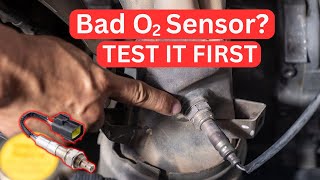
- Failing Upstream Oxygen (O2) Sensor (Common) — A biased or failing upstream O2 sensor sends incorrect data to the ECM, falsely reporting a lean mixture and preventing correct fuel adjustments.
- Low Fuel Pressure (Less Common) — A weak fuel pump, bad pressure regulator, or clogged fuel filter restricts gasoline volume. The injectors cannot supply the fuel the ECM requests, creating a genuine lean condition.
- Exhaust Leaks (Before O2 Sensor) (Less Common) — A leak in the exhaust manifold pulls outside air into the exhaust stream. The O2 sensor detects this oxygen, assumes the engine is lean, and commands excessive fuel.
- Low System Voltage (Rare) — A failing alternator dropping system voltage below 13V causes sensors and the fuel pump to behave erratically, triggering false lean codes.
Symptoms
- Check Engine Light is On — The ECM illuminates the Malfunction Indicator Lamp (MIL) immediately upon maxing out fuel trims.
- Poor Acceleration or Hesitation — The vehicle feels sluggish and lacks power during heavy acceleration when a rich mixture is required.
- Rough Idling — The engine runs unevenly, shakes, or surges while stopped at a light.
- Reduced Fuel Economy — The computer commands injectors to stay open longer to compensate for the lean condition, burning excess gas.
- Engine Misfires (also visible on scanner) — A lean mixture fails to ignite properly, triggering companion misfire codes like P0300.
Diagnostic Flowchart

Tap your situation to follow the diagnostic path that matches what you're seeing on this code.
Common Fixes & Costs
- Repairing a Vacuum Leak — Parts: $5-$50, Labor: $130-$350, ~1.5 hr book time (DIY)
- Replacing the Mass Airflow (MAF) Sensor — Parts: $100-$350, Labor: $65-$130, ~0.5 hr book time (DIY)
- Replacing an Upstream Oxygen (O2) Sensor — Parts: $50-$250, Labor: $130-$200, ~1.2 hr book time (Intermediate)
- Replacing the Fuel Pump — Parts: $200-$700, Labor: $350-$700, ~2.5 hr book time (Professional)
DIY vs Professional
- Repairing a Vacuum Leak (Hose) — Beginner:
Tools: Pliers, flashlight. - Replacing the MAF Sensor — Beginner:
Tools: Screwdriver or Torx driver set. - Replacing an Upstream O2 Sensor — Beginner:
Tools: O2 sensor socket set, ratchet, penetrating oil. - Replacing a Fuel Pump — Beginner:
Tools: Socket set, fuel line disconnect tools, brass punch.
Used vs. New Parts: Buying Guide
When a used part is worth it: Buying used is only recommended for high-cost mechanical components like an intake manifold. Never buy used electronic sensors (MAF, O2).
Donor-vehicle mileage cap: roughly under 60000 miles for the part to have meaningful remaining life.
Donor quality checklist:
- Verify the donor vehicle was not scrapped for an engine fire or flood.
- Match the OEM part number exactly.
Decision logic:
- If The part is an electronic sensor (MAF, O2). → Buy a new OEM part. The labor to replace a failed used sensor negates any savings.
- If The part is a mechanical component (intake manifold). → A used part from a low-mileage car is a reasonable option.
- If The part is a wear item (fuel pump, catalytic converter). → Buy new. Used parts carry a high risk of immediate failure.
Warranty tradeoff: Salvage yard parts have a 30-day warranty covering only the part. New OEM parts carry a 1-2 year warranty covering part and sometimes labor.
Worst-case if a used part fails: $200-$500 for repeat labor and diagnosis when a used sensor fails.
What Happens If You Wait — Timeline
- 0-1 month: Check Engine Light illuminates. Long Term Fuel Trims max out. Minor hesitation occurs. (MPG impact: 5-10%% · Added cost: $20-$50 in wasted fuel.)
- 1-4 months: Rough idle and poor acceleration become frequent. Sustained high combustion temperatures stress the catalytic converter. (MPG impact: 10-20%% · Added cost: $100-$250 in wasted fuel and spark plug fouling.)
- 4-8 months: The catalytic converter's internal substrate melts from excessive heat. The vehicle fails emissions tests. (MPG impact: 15-25%% · Added cost: $1,500-$2,500 for catalytic converter replacement.)
- 8+ months: Catastrophic failure. Extreme heat burns exhaust valves or damages piston crowns, requiring major engine repair. (MPG impact: 20-30%+% · Added cost: $2,500-$5,000+ for catalytic converter and engine repairs.)
Cost of Not Fixing It
- 0-1 Month: Noticeable drop in fuel economy (5-15%), poor acceleration, and stalling at idle. Guaranteed emissions test failure. (Added cost: $20-$60 per month in wasted fuel.)
- 1-6 Months: The lean mixture causes high combustion temperatures, damaging spark plugs and putting severe thermal stress on the catalytic converter. (Added cost: $100-$300 for spark plug replacement.)
- 6+ Months: Catastrophic failure of the catalytic converter due to prolonged overheating. Extreme heat burns exhaust valves and damages pistons. (Added cost: $1,500-$2,800 for catalytic converter replacement; $2,500+ for engine valve damage.)
Diagnosis Steps
- Check for Accompanying Trouble Codes
Read all stored codes. P1171 paired with P1174 (Bank 2) points to a global issue like a MAF sensor or large vacuum leak. P1171 paired with P030x indicates the lean condition is severe enough to cause misfires.
Tools: OBD-II Scanner (Beginner) - Analyze Live Fuel Trim Data
View Short-Term (STFT) and Long-Term (LTFT) fuel trims. If LTFT is high (+15% or more) at idle but drops near 0% at 2500 RPM, you have a vacuum leak. If trims remain high at all RPMs, suspect a fuel delivery or MAF sensor issue.
Tools: Advanced OBD-II Scanner with Live Data (Advanced) - Perform a Visual Inspection and Smoke Test
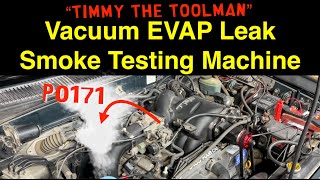
Visually inspect intake tubes and vacuum lines for obvious cracks. Next, force low-pressure smoke into the intake system with the engine off. Smoke escaping pinpoints leaking gaskets, hoses, or injector O-rings.
Tools: Flashlight, Automotive Smoke Machine (Intermediate) - Clean and Test the MAF Sensor
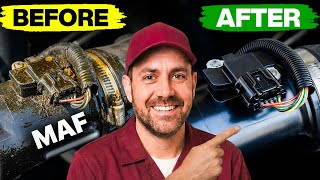
Spray the MAF sensor wire with dedicated cleaner. If the code returns, monitor the MAF reading in grams/second (g/s) on a scanner. The reading must increase smoothly with RPM. A 4-cylinder engine reads 2-4 g/s at idle; a V8 reads 4-7 g/s.
Tools: Screwdriver, MAF Sensor Cleaner, Advanced OBD-II Scanner (Beginner) - Test Fuel Pressure
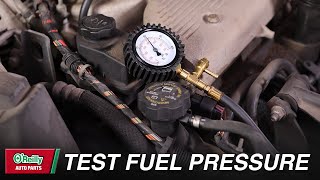
Connect a gauge to the fuel rail test port. Pressure must match manufacturer specs (e.g., 50-57 PSI for a Chevy Trailblazer). Low pressure confirms a weak pump or clogged filter.
Tools: Fuel Pressure Gauge (Intermediate) - Check Oxygen Sensor Live Data
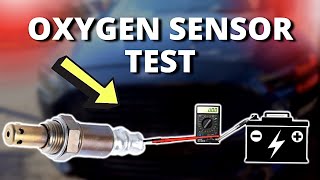
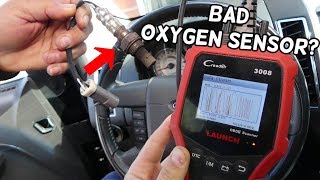
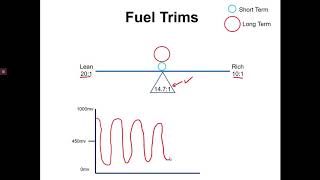
Graph the upstream O2 sensor voltage. A healthy sensor switches rapidly between 0.1V and 0.9V once per second. A sensor stuck below 0.45V is falsely reporting a lean condition and requires replacement.
Tools: Advanced OBD-II Scanner with Live Data (Advanced) - Diagnose VW/Audi Throttle Potentiometer
For VW/Audi models, P1171 is a throttle fault. Check Measured Value Block (MVB) 062 to observe throttle angle sensor readings. Repair the wiring harness per TSB 2018652 and perform a Throttle Body Adaptation.
Tools: VCDS (VAG-COM) Scan Tool, Multimeter (Advanced)
When This Code Triggers (Freeze-Frame Conditions)
- Engine Coolant Temp: 180-200°F (82-93°C) (The engine must be fully warmed up, ensuring the system is in closed-loop fuel control.)
- Engine Load: 25-60% (Sets under moderate engine load where the ECU expects a stable air-fuel ratio.)
- RPM: 1500-2500 RPM (Triggers under steady cruise or light acceleration, rarely at idle.)
Related Codes
- P1174 — The companion code for Bank 2. P1171 and P1174 together confirm a global engine issue like a faulty MAF sensor or large vacuum leak.
- P0171 — The generic OBD-II code for 'System Too Lean'. P1171 is the manufacturer-specific version, often indicating the lean condition happens specifically during acceleration.
- P0300 — Random Misfire. A severe lean condition prevents proper combustion. Fixing the P1171 vacuum leak resolves the P0300 code.
Climate & Environmental Factors
- Cold Weather: Cold temperatures cause rubber vacuum hoses and intake gaskets to contract, opening small cracks. These leaks seal themselves once the engine warms up, making the code intermittent.
- High Altitude: Less dense air at high altitudes pushes borderline issues (like a slightly dirty MAF sensor) past the ECU's acceptable threshold, triggering the code.
How to Talk to a Mechanic About This Code
Say this: "I have a P1171 code and need one hour of diagnostic time. Please check the long-term fuel trims and perform a smoke test for vacuum leaks before testing sensors."
Directs the mechanic to start with the most cost-effective diagnostic steps and prevents them from immediately suggesting expensive sensor replacements.
Avoid saying:
- 'My check engine light is on, can you look at it?'
- 'Just fix whatever's wrong.'
- 'I think it's the oxygen sensor.'
Questions to ask before authorizing the repair:
- What were the long-term fuel trim readings at idle and at 2,500 RPM?
- Did the smoke test show any leaks?
- If you suspect the fuel pump, what was the exact fuel pressure reading?
Where to Take It: Dealer vs Independent vs Chain
- Dealer:
Recommended for VW/Audi/Hyundai diesel. For other makes, use an independent shop.
Best for: Vehicles under warranty., VW/Audi or Hyundai diesel models where P1171 is not a standard lean code.
Downsides: Labor rates are 1.5x to 2x higher than independent shops. (Typical cost: +50% vs. baseline) - Independent Shop:
Best overall fit for the most common P1171 issues. Lower labor rates make them cost-effective.
Best for: Out-of-warranty vehicles., Diagnosing the common lean variant on GM, Land Rover, and Acura.
Downsides: Quality varies; vet the shop through ASE certifications. (Typical cost: +0% vs. baseline) - Chain Shop:
AVOID. They are highly likely to misdiagnose the issue or recommend unnecessary parts.
Best for: Routine maintenance like oil changes.
Downsides: High pressure to upsell unnecessary sensor replacements., Lack advanced diagnostic equipment. (Typical cost: -10% vs. baseline)
When to Walk Away From the Repair
If the estimated repair cost exceeds 50% of your car's Kelley Blue Book (KBB) value, consider selling the vehicle.
- Car worth $4000, fix is $2000: Borderline. Get a second opinion before authorizing.
- Car worth $12000, fix is $1800: Fix it. The repair cost is only 15% of the vehicle's value.
- Car worth $2500, fix is $1500: Walk away. The repair cost is 60% of the car's value.
What Scan Tool You Need for This Code
Minimum: A scanner that graphs live data, specifically Short-Term Fuel Trim (STFT), Long-Term Fuel Trim (LTFT), and O2 sensor voltage.
A $20 code reader cannot show live fuel trim data. Without live data, you cannot determine if the cause is a vacuum leak or a fuel delivery issue.
Budget: BlueDriver Pro (~$100) — Connects via Bluetooth to graph live data for fuel trims and O2 sensors, allowing you to diagnose vacuum leaks.
Mid-range: Foxwell NT510 Elite (~$200) — Offers manufacturer-specific diagnostics and bidirectional controls. Critical for VW/Audi to perform Throttle Body Adaptations.
Professional: Autel MaxiCOM MK808 (~$500) — Provides full bidirectional control to command the fuel pump on for testing, plus OE-level diagnostics.
Rent vs buy: Auto parts store rental scanners typically lack live data capability. Buying a tool like the BlueDriver Pro is required for DIY diagnosis.
How to Clear the Code After You Fix It
- Use an OBD-II scan tool to clear the P1171 code.
- Perform a complete OBD-II drive cycle to allow the readiness monitors to run.
- Re-scan the vehicle to ensure the code has not returned.
Drive cycle (~30 minutes): Cold start and idle for 3 minutes. Drive in stop-and-go traffic for 15 minutes. Drive at a steady highway speed (55-60 mph) for 20 minutes. Allow the vehicle to cool down completely.
Readiness monitors affected: Catalyst Monitor, Oxygen (O2) Sensor Monitor, Oxygen Sensor Heater Monitor
Watch out for:
- Disconnecting the battery clears the code but resets all readiness monitors to 'Not Ready', causing an automatic emissions test failure.
- The code returns immediately if the mechanical fault is not repaired.
Will This Fail Emissions / State Inspection?
Yes — this code typically fails an OBD-II emissions inspection.
- California: An active P1171 code is an automatic failure. A complete drive cycle must be performed to set all readiness monitors to 'Ready' before a retest.
- Texas: In the 17 counties requiring emissions testing, an illuminated Check Engine Light is an automatic failure. Clearing the code right before the test results in a 'Not Ready' failure.
Most Commonly Affected Vehicles
- Land Rover Discovery, Range Rover (1999-2004) — Extremely common, paired with P1174. Causes include intake manifold gaskets, leaking injector O-rings, or a cracked brake servo vacuum hose.
- Chevrolet Trailblazer, Aveo (2002-2011) — Points to a lean condition during acceleration. Caused by a dirty MAF sensor, clogged fuel filter, or vacuum leaks.
- Acura MDX, TL (2001-2008) — Defined as 'Fuel System Lean During Acceleration'. Causes include intake air leaks or a faulty fuel pressure regulator.
- Volkswagen / Audi Golf, Jetta, A4 (1999-2010) — Does NOT indicate a lean condition. Points to a 'Throttle Actuation Potentiometer' fault requiring wiring harness repair per TSB 2018652.
- Hyundai Santa Fe (Diesel) (2006-2012) — Indicates a fuel pressure problem ('Minimum Rail Pressure Exceeded'), pointing to the high-pressure fuel pump, not an air/fuel mixture issue.
- SAAB 9-3, 9-5 (1998-2005) — Code means 'Short Term Fuel Trim Max Value'. Often triggered by a faulty MAF sensor or leaking MAP sensor hoses.
Manufacturer-Specific Notes

- Volkswagen / Audi: P1171 is unrelated to fuel mixture. It indicates a fault with the Throttle Actuation Potentiometer. Diagnosis must focus on the electronic throttle control system.
- General Motors: Defines this code as 'Fuel System Lean During Acceleration'. The computer detects the lean condition specifically when it expects a rich mixture under power.
Real Owner Stories
2003 Land Rover Discovery II with P1171 & P1174
Owner had lean codes on both banks and STFT spiking to +25%. Replaced MAF twice with aftermarket parts, but codes persisted.
What they tried:
- Replaced MAF sensor with aftermarket unit.
- Replaced MAF with Bosch OEM unit.
- Performed smoke test.
Outcome: The owner discovered a vacuum leak from a reused upper intake gasket. The combination of both codes strongly pointed to a vacuum leak affecting both cylinder banks.
Lesson: When P1171 and P1174 appear together, the cause is a single issue affecting the whole engine. Never reuse gaskets on critical areas like the intake manifold.
2009 VW Jetta 2.0T with P1171
Vehicle intermittently went into limp mode with EPC light on. Dealership suggested replacing the ECU.
What they tried:
- Considered replacing throttle body.
- Dealership diagnostic.
Outcome: The owner found VW TSB 2018652 detailing high resistance in the wiring harness. Splicing in a new connector wiring kit fixed the issue.
Lesson: Verify the code definition for your specific vehicle. On a VW/Audi, P1171 is NOT a lean code. Chasing fuel system issues wastes time and money.
How to Prevent This Code From Triggering
- Use Top-Tier certified gasoline. (Every fill-up) — Top-Tier fuels contain detergent additives that prevent carbon deposits from clogging fuel injectors, ensuring a proper spray pattern.
- Replace upstream oxygen (O2) sensors. (Every 100,000 miles) — O2 sensors become 'lazy' with age, causing the ECU to make incorrect fuel adjustments that lead to lean conditions.
- Replace the engine fuel filter. (Every 30,000 miles) — A clogged fuel filter restricts fuel flow, starving the engine and creating a lean condition under high demand.
Frequently Asked Questions
What are the most common misdiagnosis mistakes for P1171?
The most common mistake is replacing sensors before performing a smoke test to rule out vacuum leaks. Ignoring fuel pressure tests also leads to unnecessary MAF replacements. Always verify the code's specific meaning for your vehicle make.
What should my fuel trims be with a P1171 code?
An active P1171 code pushes Long-Term Fuel Trim (LTFT) to its maximum positive limit, often +25% or higher. After a successful repair, trims return to a normal range between -10% and +10%.
Can an exhaust leak cause P1171?
Yes, an exhaust leak before the upstream oxygen sensor draws in outside air. The O2 sensor detects this false oxygen and commands the ECU to dump excess fuel, triggering the code.
The code P1171 appeared right after I cleaned my throttle body. What happened?
Cleaning removes carbon, changing the throttle plate's closed position. The engine computer no longer recognizes the idle baseline, triggering a code. Perform an 'Idle Air Volume Learn' procedure with a scan tool to fix this.
My P1171 code is intermittent. What should I check first?
Start by checking for temperature-sensitive vacuum leaks that open only when the engine bay is hot. Inspect MAF and O2 sensor wiring harnesses for loose or corroded pins. Finally, test the alternator, as fluctuating voltage causes erratic sensor readings.
Can I just clear the P1171 code and keep driving?
Clearing the code without fixing the root cause guarantees it will return within a few drive cycles. Ignoring it causes poor performance and permanently damages the catalytic converter.
Can a bad gas cap cause a P1171 code?
No, a loose gas cap does not cause a P1171 lean code. It triggers EVAP system codes like P0441 or P0455.
Key Takeaways
- P1171 indicates a lean air-fuel mixture maxing out fuel trims at +25% or higher, meaning the engine has too much air and not enough fuel.
- Verify your specific vehicle's definition before repairing, as P1171 means a throttle body fault on VW/Audi models and a fuel pressure issue on Hyundai diesels.
- Perform an intake smoke test to find vacuum leaks, which account for the majority of P1171 codes, before replacing any expensive sensors.
- Analyze live Long-Term Fuel Trim (LTFT) data; if trims drop from +15% at idle to near 0% at 2,500 RPM, you have a confirmed vacuum leak.
- Stop driving within 100 miles to prevent extreme combustion temperatures from destroying your catalytic converter, a repair costing upwards of $1,500.
Helpful Videos


The information in this article is provided for general reference and educational purposes only. Vehicle specifications, procedures, and part compatibility can vary by production date, trim level, and region. Always consult your vehicle's factory service manual and verify part numbers before purchasing or performing repairs. Safety-critical components such as airbags, seat belts, and braking systems should be installed by a qualified professional.
- 🎬 Helpful Videos
- What Does P1171 Mean?
- Can I Drive With P1171?
- Common Causes
- Symptoms
- Diagnostic Flowchart
- Common Fixes & Costs
- DIY vs Professional
- Used vs. New Parts: Buying Guide
- What Happens If You Wait — Timeline
- Cost of Not Fixing It
- Diagnosis Steps
- When This Code Triggers (Freeze-Frame Conditions)
- Related Codes
- Climate & Environmental Factors
- How to Talk to a Mechanic About This Code
- Where to Take It: Dealer vs Independent vs Chain
- When to Walk Away From the Repair
- What Scan Tool You Need for This Code
- How to Clear the Code After You Fix It
- Will This Fail Emissions / State Inspection?
- Most Commonly Affected Vehicles
- Manufacturer-Specific Notes
- Real Owner Stories
- 2003 Land Rover Discovery II with P1171 & P1174
- 2009 VW Jetta 2.0T with P1171
- How to Prevent This Code From Triggering
- Frequently Asked Questions
- What are the most common misdiagnosis mistakes for P1171?
- What should my fuel trims be with a P1171 code?
- Can an exhaust leak cause P1171?
- The code P1171 appeared right after I cleaned my throttle body. What happened?
- My P1171 code is intermittent. What should I check first?
- Can I just clear the P1171 code and keep driving?
- Can a bad gas cap cause a P1171 code?
- Key Takeaways
- 🎟️ Get 5% Off