

P1123 on 2011-2012 Dodge RAM 3500: Power Take Off System Error Guide
On 2011-2012 RAM 3500 trucks with the 6.7L Cummins, P1123 almost always points to a software issue in the engine computer (ECM/PCM). The fix is typically a software reflash performed by a Dodge dealer, as outlined in manufacturer Technical Service Bulletins.
- P1123 on a 2011-2012 Ram 3500 indicates an electronic control error with the Power Take Off (PTO) system.
- Before attempting any physical repairs, check with a dealer to see if your truck's computer software is up to date, as a simple reflash is the most common solution.
- The problem is almost never the PTO unit itself; it's an issue in the control circuit (software, wiring, relay, or sensor).
- This code does not affect the truck's ability to drive safely, but it will prevent you from using any PTO-powered equipment.
- Diagnosis and repair, especially the software update, are best left to a professional with the correct tools and information.
What's Unique About the 2011-2012 Dodge RAM 3500
This code is exclusive to RAM 3500 models (and their 4500/5500 platform mates) equipped with the optional PTO prep package (sales code LBN), which is common on these heavy-duty work trucks. For the 2011-2012 model years specifically, this code was frequently triggered by a software glitch rather than a physical part failure. Chrysler (now Stellantis) acknowledged this by issuing Technical Service Bulletins (TSBs) #18-012-13 and #18-013-13, which instruct dealers to reprogram the engine control module (ECM) with updated software to resolve the false error.
Diagnostic Flowchart
Tap your situation to follow the diagnostic path that matches what you're seeing on this vehicle.
Symptoms You May Notice
- Check Engine Light is on
- Power Take Off (PTO) system will not engage
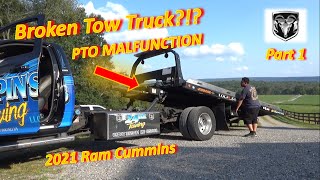
- PTO system engages but then disengages unexpectedly, often after about 30 seconds, with the PTO indicator light flashing. 🎬 Watch: Troubleshooting a PTO that shuts off after 20-30 seconds.
- A message related to PTO service may appear on the instrument cluster (EVIC).
- Engine RPM may not increase when the PTO switch is activated.
- Replacing the PTO engagement switch on the dashboard. This switch simply sends a request signal to the PCM; it's rarely the cause of a 'monitor control error'.
- Replacing the entire PTO unit. The code points to a control and monitoring circuit error, not a mechanical failure of the PTO itself.
Most Likely Causes
- Outdated Powertrain Control Module (PCM) Software 🔴 High Probability Manufacturer TSBs #18-012-13 (for 2012) and #18-013-13 (for 2011) directly call out this code as being resolved by a software update. This was a known glitch from the factory.
How to confirm: A Dodge dealer or a shop with a wiTECH scan tool can check the current software calibration level of the PCM and compare it to the latest version available. The TSBs specify that wiTECH release 13.03 or higher is needed for the 2012 model flash.
Typical fix: Reprogramming (flashing) the PCM with the updated software version. The TSB outlines specific steps, including connecting a battery charger to maintain stable voltage during the flash.
Est. part cost: $0 - Wiring Harness or Connector Issue 🟡 Medium Probability The wiring for the PTO system runs along the chassis and transmission, where it is exposed to heat, moisture, and vibration. Upfitter modifications can also introduce wiring faults. A common failure point is the feedback circuit from the PTO pressure switch to the Vehicle System Interface Module (VSIM).
How to confirm: Visually inspect the wiring harness between the PCM, Transmission Control Module (TCM), Vehicle System Interface Module (VSIM), and the PTO unit itself. Check for chafed wires, loose pins, or corrosion in connectors. A Ram Body Builder troubleshooting guide points to a specific dark blue wire with a pink tracer that can break near the auxiliary fuse box. Another critical check is for a missing ground signal on circuit W708 (orange/brown) at the VSIM, which will cause the PTO to time out after 30 seconds.
Typical fix: Repairing the damaged section of the wire or cleaning/replacing the affected connector. In some cases, owners and technicians bypass a faulty pressure switch feedback circuit by permanently grounding the signal wire (W708, an orange wire with a brown stripe) at the VSIM to satisfy the computer.
Est. part cost: $10-$50 - Faulty PTO Relay or Solenoid ⚪ Low Probability The relay that activates the PTO solenoid can fail over time, though it's less common than software or wiring issues for this specific code.
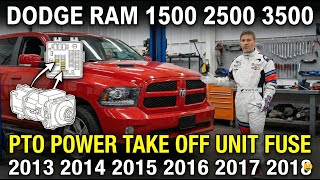
How to confirm: Using a multimeter, a technician can test the PTO relay (often labeled Relay 07 in the auxiliary Power Distribution Center) 🎬 Watch: How to find and fix PTO fuse and relay issues. and the activation signal from the TCM. The PTO solenoid on the transmission can also be tested for proper resistance and operation. A good coil should read between 7 and 9 ohms.
Typical fix: Replacing the failed PTO relay or the PTO engagement solenoid.
Est. part cost: $20-$150
Rare But Worth Checking
- Faulty Vehicle System Interface Module (VSIM): The VSIM acts as a bridge for upfitter equipment. It monitors the PTO's status via a pressure switch and reports it to the other modules. A failure in this module can disrupt PTO operation and trigger codes. On 2013-2015 models, a known issue could cause the VSIM to 'lock up', which could be temporarily fixed by unplugging its five connectors for a minute to reset it. While this TSB (08-108-15) is for later models, a similar VSIM failure is possible on 2011-2012 trucks.
- Faulty Powertrain Control Module (PCM): While a software glitch is common, an internal hardware failure of the PCM is a rare but possible cause. This is usually the last item to be considered after all other possibilities are exhausted. A voltage spike from the PTO circuit could potentially damage the ECM if a protective diode is not present, an issue addressed for later models in TSB 08-121-19.
- Aftermarket Engine Tuning ('Delete' Tunes): If the vehicle has an aftermarket tune to bypass emissions systems, the tuner may not have correctly accounted for the PTO feedback signal logic. This can cause the PTO to engage and then shut off after 30 seconds, triggering the P1123 code. The fix requires modifying the aftermarket tune, which is outside the scope of standard dealer repairs.
Diagnosis Steps
- Verify the code with a professional OBD-II scanner that can read manufacturer-specific codes.
- Check for any available Technical Service Bulletins (TSBs) related to P1123 for your vehicle's VIN. TSBs #18-012-13 and #18-013-13 are highly relevant.
- If TSBs indicate a software update is available, have a dealer or qualified shop check the current PCM calibration and flash it to the latest version if needed. This is the most likely fix.
- If the software is up to date, perform a thorough visual inspection of the wiring harness and connectors for the PTO system, focusing on the connections at the transmission, VSIM, and PCM.
- Using a scan tool with live data capability, monitor the status of the PTO pressure switch and PTO request switch while attempting to engage the system. The PCM expects to see a change in the pressure switch status when the PTO is commanded on.
- Consult the Ram Body Builder's Guide for PTO troubleshooting. It suggests checking for a grounded W708 wire (orange/brown) at the VSIM, which confirms the PTO pressure feedback circuit is complete. If this signal is missing, the PTO will time out.
- Test the PTO engagement request switch to ensure it is sending a ground signal to the PCM when pressed.
- Test the PTO relay and the command signal from the TCM to the relay.
- If all wiring and relays are functional, further diagnostics on the Vehicle System Interface Module (VSIM) and the PCM may be necessary.
Parts You'll Likely Need
- PCM Reflash (Software Update) — This is not a physical part, but a service. It is the most common fix documented by the manufacturer in TSBs for this specific code on these model years.
OEM price range: $150-$250
Aftermarket price range: N/A - PTO Diode Jumper Harness
(OEM #68496218AA)— On some RAM trucks, a missing or faulty diode in the PTO circuit can cause voltage spikes that lead to errors or even damage the ECM. A related TSB for 2019 models (08-121-19) addresses this with a jumper harness. While this TSB is for a later model year, the principle of protecting the ECM from voltage spikes from the PTO solenoid is relevant and highlights a potential failure mode.
Trusted brands: Mopar
OEM price range: $25-$50
Aftermarket price range: N/A
Related Codes That Often Appear With This One
- U010E — Lost Communication With Diesel Exhaust Fluid Control Unit. This code is listed in the same TSBs (#18-012-13, #18-013-13) as P1123, confirming they can both be caused by the same PCM software issue and resolved with the same reflash.
- P2609 — Intake Air Heater System Performance. Also listed in the TSBs, indicating a potential software-related fault that can be fixed with the same PCM reflash.
- P061A — ETC Level 2 Torque Performance. Another code mentioned in the TSBs for the 2011-2012 RAM 3500 that points to a required PCM software update.
- P2453 — Diesel Particulate Filter Pressure Sensor A Circuit Performance. This is another code explicitly mentioned in TSB #18-012-13 as being addressed by the software update.
Technical Service Bulletins (TSBs) & Recalls
- 18-012-13: FLASH: Diagnostic and System Enhancements. For 2012 Ram 3500/4500/5500 Cab Chassis models, this TSB involves reprogramming the ECM to fix unnecessary MIL illumination for P1123 and a host of other codes.
- 18-013-13: FLASH: Diagnostic and System Enhancements. For 2011 Ram 3500/4500/5500 Cab Chassis models, this TSB is the equivalent of the 2012 version, calling for a PCM reflash to resolve P1123 and other false codes.
Platform-Specific Known Issues
- A known software issue covered by TSB #18-012-13 (for 2012 models) and #18-013-13 (for 2011 models) causes false P1123 codes. The official fix is a PCM reflash.
- The PTO system on the automatic transmission is turbine-driven, not engine-driven. This means it only works in park (stationary) or while moving above ~7 mph (mobile mode), and is not suitable for applications requiring PTO power at a crawl.
Mechanic-Grade Diagnostic Values
- PTO Solenoid Coil Resistance — expected: 7 to 9 Ohms. Failure: An open circuit (infinite resistance) indicates a burned-up coil. A reading outside the expected range indicates a faulty coil.
Hidden / Shadow Codes Worth Checking
- P1123-00: On later model years, the code may be displayed with a 2-digit symptom byte (e.g., -00 for 'No Sub Type Information'). This doesn't change the diagnosis for the primary code but is the format used in dealer-level documentation. (see via Professional scan tools or the dealer wiTECH tool.)
Scan Tool Commands That Help
- wiTECH or equivalent professional scanner: Live Data Monitoring — To diagnose the PTO system, monitor specific Parameter IDs (PIDs) to see what the computer is seeing in real-time. Key PIDs include 'PTO Switch Value', 'PTO Pressure Switch', 'PTO State', and 'Mobile PTO Enable'. This allows a technician to verify if the dash switch request is received and if the pressure switch feedback is changing state when the PTO is commanded on.
- wiTECH (Dealer Tool): Enable/Disable PTO Feature — If the PTO feature was inadvertently turned off during other service, a dealer tool is required to re-enable it in the vehicle's configuration.
Wiring & Ground Locations
- Vehicle System Interface Module (VSIM) — Under the driver's side dashboard, located on the instrument panel just forward of the park brake release lever.. The VSIM is the hub for upfitter connections. It monitors the PTO pressure switch feedback signal. A failure in the VSIM or its wiring is a primary cause of P1123.
- Circuit W708 (Orange wire with Brown stripe) — Found on the brown connector of the VSIM. This wire must be connected to a chassis ground for the PTO to run continuously.. This is the most common cause of the '30-second timeout' symptom. If the VSIM does not see a ground signal on this wire after the PTO is engaged, it assumes a fault and shuts the system down, logging P1123. Technicians warn not to confuse it with circuit W500, a brown wire with an orange tracer, which controls the headlamp 'wig-wag' feature.
- Auxiliary Power Distribution Center (PDC) Wiring — Located behind the driver's side battery.. A Ram troubleshooting guide notes that a broken dark blue wire with a pink tracer can be found under this fuse box, causing PTO issues. This is a classic 'hidden' wiring break that won't be found by testing components alone.
- PTO Relay (Relay 07) — Located in the auxiliary Power Distribution Center (PDC).. This is the relay that the Transmission Control Module (TCM) grounds to send 12V power to the PTO solenoid. It can be tested or swapped for diagnosis.
Real Owner Repair Stories
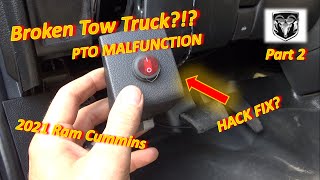
- Pine Hollow Auto Diagnostics video & user comments (2021 Ram 5500 (newer model, but demonstrates identical system logic)) — PTO engages, RPMs increase, but the system shuts off after about 20-30 seconds with a flashing PTO light and code P1123.
❌ Tried (didn't work) Clearing codes (code returned immediately upon next PTO cycle).
✅ What actually fixed it The diagnostic process revealed the core issue: the PCM was not receiving the expected feedback signal from the PTO pressure switch via the VSIM. The technician demonstrated testing the switch, confirming it worked, and then tracing the wiring to find a break in the signal wire between the switch and the VSIM. A separate user confirmed this exact symptom occurs when an aftermarket 'delete' tune is installed, as the tuning software often fails to properly account for the PTO feedback logic, causing the computer to trigger the timeout and code.
OEM Part Supersession History
N/A→68496218AA— To prevent voltage spikes in the PTO circuit that can damage the ECM.
Heads up: This is a PTO Diode Jumper Harness kit released under TSB 08-121-19 for 2019 models. While not original to 2011-2012 trucks, it addresses a known failure mode (ECM damage) and could be a relevant preventative repair if persistent electrical issues are suspected.
Model Year Variations Within This Range
- 2011 vs 2012: While the cause and fix are the same (PCM reflash), the manufacturer issued separate Technical Service Bulletins for each model year: TSB #18-013-13 for 2011 and TSB #18-012-13 for 2012.
- Post-2012: The physical location of the under-dash connectors for PTO upfitting was altered starting with the 2013 model year, though the circuit functions remained largely the same.
Helpful Videos

We Have This Part in Stock


The information in this article is provided for general reference and educational purposes only. Vehicle specifications, procedures, and part compatibility can vary by production date, trim level, and region. Always consult your vehicle's factory service manual and verify part numbers before purchasing or performing repairs. Safety-critical components such as airbags, seat belts, and braking systems should be installed by a qualified professional.
- Dodge RAM 3500:
- 🎬 Helpful Videos
- 🛍️ Shop This Part
- What's Unique About the 2011-2012 Dodge RAM 3500
- Diagnostic Flowchart
- Symptoms You May Notice
- Most Likely Causes
- Rare But Worth Checking
- Diagnosis Steps
- Parts You'll Likely Need
- Related Codes That Often Appear With This One
- Technical Service Bulletins (TSBs) & Recalls
- Platform-Specific Known Issues
- Mechanic-Grade Diagnostic Values
- Hidden / Shadow Codes Worth Checking
- Scan Tool Commands That Help
- Wiring & Ground Locations
- Real Owner Repair Stories
- OEM Part Supersession History
- Model Year Variations Within This Range
- 🎟️ Get 5% Off