

OBD-II Code P1121: Throttle/Pedal Position Sensor Circuit Problem
What P1121 means, why it triggers, and how to fix it
- P1121 is a manufacturer-specific code; always verify your car's exact definition before buying parts, as it means completely different things for a Ford versus a Toyota.
- On most non-hybrid vehicles, P1121 indicates a failing Throttle Position Sensor (TPS) or Accelerator Pedal Position (APP) sensor, requiring a $115 to $275 replacement.
- For 2004-2009 Toyota Prius models, P1121 almost exclusively means a stuck Coolant Flow Control Valve, a $300 to $500 repair unrelated to the throttle.
- Stop driving if your vehicle enters 'limp mode' or stalls; ignoring a throttle fault risks a dangerous loss of power in traffic.
- Start diagnosis by graphing live TPS voltage on an OBD-II scanner and inspecting intake hoses for vacuum leaks before replacing any sensors.
What Does P1121 Mean?

P1121 is a manufacturer-specific code, meaning its definition changes entirely depending on your car brand. Most commonly, it means your car's Engine Control Unit (ECU) receives conflicting signals from the sensors measuring gas pedal position or engine throttle opening. The computer sees a mismatch between commanded acceleration and actual throttle position. For example, the ECU detects high voltage from the throttle sensor when it expects low voltage.
Technical definition: The official SAE/OBD-II definition for P1121 varies by manufacturer. Common definitions include: 'Throttle Position (TP) Sensor Circuit Intermittent High Voltage' (GM), 'Throttle Position (TP) Sensor Inconsistent with Mass Air Flow (MAF) Sensor' (Ford), 'Accelerator Pedal Position (APP) Sensor Range/Performance Problem' (Toyota/Lexus), 'Electric Throttle Control Actuator' (Nissan), and 'Neutral Position Switch Circuit Low/High Input' (Subaru). Always verify the specific definition for your vehicle's make and model.
Can I Drive With P1121?
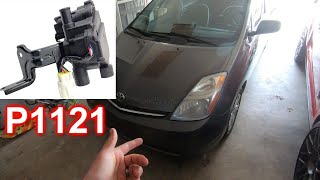
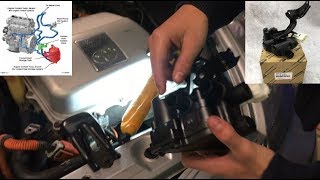
Yes, But With Caution. You can drive short distances, but we strongly advise against it. Your engine will often stall, hesitate, or enter a reduced-power 'limp mode', creating a safety hazard in traffic. For the Toyota Prius, ignoring this code overheats hybrid components, resulting in multi-thousand-dollar repairs. 🎬 Watch: How to replace the Prius coolant flow valve. Continued driving on conventional vehicles destroys the catalytic converter over time due to unburned fuel.
Common Causes

- Faulty Throttle Position Sensor (TPS) (Very Common) — The sensor on the throttle body that reports throttle plate angle is failing or sending erratic signals. This is the most frequent cause for GM, Honda, and older Ford vehicles. 🎬 See this Ford throttle position sensor replacement guide.
- Wiring, Connector, or Ground Issues (Very Common) — The wires routing to the TPS, APP, or MAF sensors are damaged, loose, or suffer from corroded pins. A loose ground connection also causes the intermittent voltage spikes that trigger this code.
- Dirty or Sticking Throttle Body (Common) — Carbon buildup inside the throttle body causes the throttle plate to stick. This prevents smooth operation, forcing the sensor's reading out of sync with the computer's expected values. 🎬 Watch: How to clean your throttle body the right way.
- Faulty Accelerator Pedal Position (APP) Sensor (Common) — On modern drive-by-wire vehicles, the sensor assembly attached to the gas pedal fails to accurately report how far you press the pedal.
- Vacuum Leaks or MAF Sensor Issues (Common) — A cracked intake hose lets unmeasured air into the engine, or a dirty Mass Airflow (MAF) sensor misreports incoming air. This creates a data conflict with the TPS, triggering P1121 specifically on Ford vehicles.
- Blown Electronic Throttle Fuse (Uncommon) — A blown fuse in the Electronic Throttle Control System (ETCS) circuit cuts power to the sensors, immediately triggering this code and limp mode.
- Failing Engine Control Unit (ECU/PCM) (Rare) — The engine's main computer fails internally and misinterprets sensor signals. Rule out all sensors and wiring before replacing the ECU.
Symptoms

- Check Engine Light On — The Malfunction Indicator Lamp (MIL) illuminates immediately upon detecting the fault.
- Hesitation, Stumbling, or Surging — The vehicle bogs down, jerks, or suddenly surges forward without changes in pedal pressure.
- Reduced Engine Power ('Limp Mode') — The ECU restricts engine power and limits speed to prevent drivetrain damage.
- Poor or Rough Idle — The engine idles erratically, surges up and down, or stalls completely at stops.
- Cruise Control Inoperative — The ECU disables cruise control as a safety precaution, especially on Subarus where P1121 indicates a neutral safety switch fault.
- Increased Fuel Consumption — Incorrect throttle and fuel calculations force the engine to run rich, wasting fuel.
Diagnostic Flowchart

Tap your situation to follow the diagnostic path that matches what you're seeing on this code.
Common Fixes & Costs
- Replace Throttle Position Sensor (TPS) — Parts: $40-$150, Labor: $75-$125, ~1 hr book time (DIY)
- Replace Toyota Coolant Flow Control Valve — Parts: $70-$200, Labor: $150-$300, ~1.8 hr book time (Intermediate)
- Clean Throttle Body — Parts: $10-$15, Labor: $75-$150, ~0.7 hr book time (DIY)
- Replace Accelerator Pedal Position (APP) Sensor — Parts: $60-$250, Labor: $50-$175, ~1 hr book time (Intermediate)
- Repair Damaged Wiring or Connectors — Parts: $5-$50, Labor: $100-$300+, ~2 hr book time (Professional)
DIY vs Professional
- Replace Throttle Position Sensor (TPS) — Beginner: Yes
Tools: Basic hand tools (screwdriver set, socket set). - Clean Throttle Body — Beginner: Yes, with caution.
Tools: Throttle body cleaner, soft rags, basic hand tools. - Replace Accelerator Pedal Position (APP) Sensor — Beginner: Yes.
Tools: Basic socket set. - Replace Toyota Coolant Flow Control Valve — Beginner: No, intermediate DIYers only.
Tools: Socket set, cable-operated hose clamp pliers, drain pan, funnels. - Repair Damaged Wiring or Connectors — Beginner: No.
Tools: Digital multimeter, wire strippers, crimpers, soldering iron, heat shrink tubing, wiring diagrams.
Used vs. New Parts: Buying Guide
When a used part is worth it: Buy used only for expensive assemblies like an Accelerator Pedal Position (APP) sensor on an older, high-mileage vehicle. Never buy used for inexpensive standalone sensors or labor-intensive parts like the Prius coolant valve.
Donor-vehicle mileage cap: roughly under 80000 miles for the part to have meaningful remaining life.
Donor quality checklist:
- Verify the part is from a low-mileage vehicle not scrapped for a related failure.
- Check for pin corrosion, especially on rust-belt vehicles.
- Match the OEM part number exactly.
Decision logic:
- If The part is a simple sensor (e.g., standalone TPS) and a new aftermarket part is under $100 → Buy new. The minimal savings aren't worth the risk of premature failure.
- If The part is an expensive assembly (e.g., APP sensor) on a vehicle over 150K miles → A used part from a low-mileage donor is an acceptable risk.
- If The labor cost to replace the part is high (e.g., Prius coolant valve) → Buy a new OEM part to avoid paying $300 in labor twice when the used part fails.
Warranty tradeoff: Salvage yards offer 30-90 day warranties. New aftermarket parts offer 1-year to lifetime warranties. New OEM parts carry 12-month/12,000-mile warranties.
Worst-case if a used part fails: $200-$600 if a used part fails, requiring repeat labor and a second replacement part.
What Happens If You Wait — Timeline
- 0-1 month: Check Engine Light illuminates. You experience occasional hesitation or a slightly rough idle. On a Prius, the cabin heater blows cold air. (MPG impact: 0-5%% · Added cost: $0-50 in wasted fuel)
- 1-3 months: The vehicle frequently enters 'limp mode' with severely reduced power. Stalling at idle becomes common. Fuel economy drops noticeably. (MPG impact: 5-15%% · Added cost: $50-150 in wasted fuel)
- 3-6 months: Incorrect air/fuel mixtures overheat the catalytic converter. The vehicle becomes unsafe to drive due to unpredictable stalling in traffic. (MPG impact: 10-20%% · Added cost: $1200-$2800 for catalytic converter replacement.)
- 6+ months: Catastrophic failure. Prius hybrid inverters overheat due to the malfunctioning coolant valve. Conventional cars suffer complete catalytic converter meltdown. (MPG impact: 15-25%+% · Added cost: $3000-$7000+ for hybrid component or exhaust system replacement.)
Cost of Not Fixing It
- 0-1 month: Noticeable 5-15% drop in fuel economy, unpredictable acceleration, and stalling. On a Prius, the cabin heater fails. (Added cost: Negligible, but poses a severe safety risk.)
- 1-6 months: On non-hybrid vehicles, a persistent rich fuel mixture overheats and melts the catalytic converter. (Added cost: $1200-$2800)
- 6+ months: On a Toyota Prius, ignoring the coolant valve fault overheats the inverter and hybrid system components, causing catastrophic failure. (Added cost: $3000-$7000+)
Diagnosis Steps
- Read Code and Freeze Frame Data
Use an OBD-II scanner to confirm P1121. Review the 'freeze frame' data to see exact engine conditions (RPM, load, temp) when the fault occurred, guiding your road test.
Tools: OBD-II Scanner (Beginner) - Perform a Visual Inspection of Wiring and Intake
Inspect the wiring harnesses for the TPS, APP, and MAF sensors. Look for melted plastic, green corrosion, or backed-out pins. Check all rubber intake hoses between the air filter and engine for cracks causing vacuum leaks.
Tools: Flashlight (Beginner) - Analyze Live Sensor Data
Graph the TPS and APP sensor voltage using a live-data scanner. With the key on and engine off, slowly press the gas pedal. Voltage must rise smoothly from ~0.5V to ~4.5V without spikes or dropouts.
Tools: OBD-II Scanner with Live Data (Intermediate) - Clean the Throttle Body
Remove the air intake tube. Use dedicated throttle body cleaner and a soft rag to remove carbon buildup from the throttle plate and bore. Do not force electronic throttle plates open by hand.
Tools: Screwdriver/ratchet set, Throttle Body Cleaner, Rags (Intermediate) - Test Sensor and Wiring with a Multimeter
Disconnect the sensor. Verify a stable 5V reference from the ECU and near 0V on the ground pin. Back-probe the signal wire with the sensor connected; wiggle the harness while watching the multimeter to expose intermittent wiring shorts.
Tools: Digital Multimeter, Vehicle-specific wiring diagram, Back-probe pins (Advanced) - Test Prius Coolant Flow Control Valve (Toyota Only)
Use a bidirectional scanner to command the valve to positions 'WATER FLW VLV3, 4, or 5'. Measure voltage at the ECM connector. If voltage doesn't change according to the commanded position, the valve is dead.
Tools: Advanced OBD-II Scanner, Digital Multimeter, Service Manual (Advanced) - Perform a Throttle Body Relearn Procedure
After cleaning or replacing throttle components, reset the ECU's baseline idle values. This requires a specific sequence of key turns and pedal presses outlined in your service manual, or a bidirectional scanner.
Tools: OBD-II Scanner or Service Manual (Intermediate)
When This Code Triggers (Freeze-Frame Conditions)
- Engine Coolant Temp: 175-210°F (Engine at normal operating temperature)
- RPM: 700-2500 (Idle or steady-state cruise)
- Engine Load: 20-50% (Light to moderate throttle application)
- Vehicle Speed: 0-60 mph (Varies; occurs frequently at idle or during stop-and-go city driving)
Related Codes
- P1120 — A companion code. On a Toyota Prius, P1120 sets alongside P1121 to confirm a coolant flow control valve failure.
- P1122 — The direct opposite of P1121 on many vehicles. P1121 indicates intermittent HIGH voltage (short to power), while P1122 indicates LOW voltage (short to ground).
- P2135 — Indicates the two redundant sensors within the TPS or APP assembly disagree. If present with P1121, the sensor assembly has physically failed and must be replaced.
- P0122 — The generic OBD-II code for 'TPS Circuit Low Input'. If present with P1121, it points to a severely erratic sensor or complex wiring short.
- P0101 — Means 'MAF Circuit Range/Performance'. When paired with P1121 on a Ford, it guarantees a vacuum leak between the MAF and throttle body.
Climate & Environmental Factors
- Cold Weather: On a Toyota Prius, a failing coolant flow control valve (P1121) prevents the cabin heater from blowing hot air. On Fords, cold temperatures shrink rubber intake hoses, worsening vacuum leaks that trigger the code.
- High Humidity / Moisture: Moisture penetrates brittle sensor connectors, corroding electrical pins and causing the intermittent voltage drops that trigger P1121.
How to Talk to a Mechanic About This Code
Say this: "I have a P1121 code and I know it's manufacturer-specific. For my [Your Car's Make/Model], I believe it relates to [mention 'the throttle/pedal sensor circuit' or 'the Prius coolant flow valve']. I'd like a diagnosis that starts by checking sensor live data and wiring integrity before replacing parts."
This proves you understand the code's complexity. It prevents the mechanic from immediately replacing an expensive throttle body and forces them to check for cheaper root causes like bad wiring, dirty components, or vacuum leaks.
Avoid saying:
- 'Just fix whatever's wrong'
- 'My check engine light is on, can you look at it?' (Invites upsells)
- 'I need a new throttle sensor.' (Never diagnose for them; describe symptoms and the code).
Questions to ask before authorizing the repair:
- Did you graph the sensor voltage to check for dropouts or glitches?
- For a Ford, did you check for vacuum leaks from the intake boot and PCV hoses?
- For a Prius, did you confirm the coolant flow valve is stuck and the system is properly bled?
- Is this repair for the sensor only, or the entire throttle body/pedal assembly?
- Will a throttle body 'relearn' procedure be required after the repair?
Where to Take It: Dealer vs Independent vs Chain
- Dealer:
Best for: Vehicles under warranty., Complex manufacturer quirks (Toyota Prius coolant valve, Subaru neutral switch) where independent shops misinterpret generic definitions.
Downsides: Highest labor rates., Defaults to replacing entire expensive assemblies instead of cleaning components. (Typical cost: +50% vs. baseline) - Independent Shop:
Excellent for common throttle faults. For Prius or Subaru, ensure the shop has specific experience with those makes.
Best for: Out-of-warranty vehicles with common TPS/APP sensor faults., Owners with a trusted mechanic skilled in electrical diagnostics.
Downsides: Diagnostic tool capabilities vary widely., May lack experience with Prius or Subaru quirks, leading to misdiagnosis. (Typical cost: +0% vs. baseline) - Chain Shop:
Avoid for diagnostics. Acceptable only for straightforward sensor swaps if you are certain of the root cause.
Best for: Simple part replacements where you already confirmed the diagnosis (e.g., swapping an external TPS).
Downsides: Technician skill varies dramatically., High pressure to upsell unnecessary throttle body replacements. (Typical cost: -10% vs. baseline)
When to Walk Away From the Repair
If the estimated repair cost exceeds 40% of the car's Kelley Blue Book (KBB) private-party value, consider selling the car as-is or trading it in.
- Car worth $4000, fix is $750: Fix it. The cost is well below the 40% threshold and restores drivability.
- Car worth $3000, fix is $1400: Walk away. The repair approaches 50% of the car's value.
- Car worth $8000, fix is $3500: Walk away. This cost indicates a major consequential failure (like a Prius inverter). Get a second opinion, but it is rarely economical.
What Scan Tool You Need for This Code
Minimum: A scanner that reads and graphs live sensor data for the TPS and APP sensors.
A $20 code reader only displays P1121. It cannot graph live voltage data as you press the pedal, which is mandatory to determine if the sensor is faulty or if the issue is wiring/vacuum related.
Budget: Ancel BD310 or XTOOL A30M (~$70) — Connects to a smartphone to graph live TPS/APP data. Sufficient for diagnosing common P1121 causes on non-hybrid vehicles.
Mid-range: Foxwell NT510 Elite or Innova 5610 (~$180) — Adds bidirectional controls. Crucial for the Prius, as it commands the coolant flow valve open/closed for testing. Performs throttle relearn procedures.
Professional: Autel MaxiCOM MK808S / MK900 (~$450-600) — Offers full bidirectional control, extensive vehicle coverage, and performs all active tests and relearn procedures for any make.
Rent vs buy: If this is a one-time repair, borrow a scanner from AutoZone for free. Buy a scanner only if you perform DIY diagnostics multiple times a year.
How to Clear the Code After You Fix It
- Use an OBD-II scan tool to clear the P1121 code.
- Ensure the fuel tank is between 30% and 70% full.
- Perform a complete OBD-II drive cycle to allow readiness monitors to run.
Drive cycle (~30 minutes): 1) Cold start and idle for 3 minutes. 2) Drive in city traffic with normal accelerations for 15 minutes. 3) Drive at a steady 55 mph for 10 minutes. 4) Allow the vehicle to cool down completely.
Readiness monitors affected: Catalyst (CAT) monitor, Evaporative System (EVAP) monitor, Oxygen (O2) Sensor monitor
Before emissions retest: drive at least 100 miles to fully set monitors.
Watch out for:
- Clearing the code without repairing the fault guarantees the Check Engine Light returns.
- Failing to complete the drive cycle leaves readiness monitors 'incomplete', causing an automatic emissions test failure.
Will This Fail Emissions / State Inspection?
Yes — this code typically fails an OBD-II emissions inspection.
- California: An illuminated Check Engine Light is an automatic smog check failure. A specific drive cycle must be completed post-repair to set readiness monitors.
- New York: NYS inspections include an OBD-II scan. An active P1121 code results in immediate failure.
- Texas: In emissions-testing counties, an active P1121 code causes the vehicle to fail inspection.
Most Commonly Affected Vehicles
- Toyota Prius (2004-2009) — P1121 almost exclusively means 'Coolant Flow Control Valve Position Sensor Stuck', a hybrid cooling system issue unrelated to the throttle. Toyota issued TSB EG001-08 for this exact failure.
- Ford Expedition, Ranger, Focus (1998-2010) — Defined as 'TPS Inconsistent with Mass Air Flow Sensor'. Caused equally by a failing TPS or a vacuum leak from a cracked intake boot/PCV hose.
- General Motors Chevrolet Silverado, GMC Sierra (2000-2007) — Defined as 'TP Sensor Circuit Intermittent High Voltage', indicating a faulty sensor or wiring short.
- Nissan Pathfinder, Maxima, Altima (1998-2008) — Defined as 'Electric Throttle Control Actuator' malfunction. The internal throttle body motor fails, requiring complete assembly replacement.
- Honda Civic, Accord (1992-2006) — Defined as 'TP Sensor Signal Lower Than Expected'. The TPS can often be purchased and replaced separately from the throttle body.
- Subaru Outback, Legacy, Impreza (1997-2010) — Defined as 'Neutral Position Switch Circuit'. Causes erratic idle and disables cruise control. Highly common after aftermarket alarm installations.
- Hyundai Terracan (2003-2006) — Relates to an 'APS PWM Output Circuit Malfunction', pointing to the Accelerator Pedal Sensor (APS) failing to communicate with the ECU.
- Kia Sportage, Various Models (1999-2009) — Defined as 'Pedal Position Sensor A Circuit Range', pointing directly to a fault with the accelerator pedal assembly.
Manufacturer-Specific Notes

- Toyota (especially Prius): P1121 does NOT relate to the throttle. It means 'Coolant Flow Control Valve Position Sensor Stuck'. Driving with this fault overheats the complex hybrid cooling system.
- Nissan / Infiniti: P1121 means 'Electric Throttle Control Actuator'. The motor inside the electronic throttle body fails, requiring replacement of the entire throttle body assembly.
- Subaru: P1121 indicates a 'Neutral Position Switch Circuit' failure. It causes erratic idle, stalling when put in gear, and disables cruise control.
- Ford: Defined as 'TPS Inconsistent with MAF Sensor'. A vacuum leak from a cracked PCV hose triggers this code just as frequently as a bad TPS.
- General Motors (GM): GM issued Special Coverage Program 14516 for millions of vehicles regarding the related P2135 code, extending throttle body warranties to 10 years/120,000 miles due to identical TPS failures.
Real Owner Stories
2006 Toyota Prius at 182K miles
Check Engine Light illuminated with code P1121. A generic auto parts store scan falsely pointed to a throttle issue.
What they tried:
- Researched the Prius-specific definition, identifying the 'Coolant Flow Control Valve' as the culprit.
- Sourced an independent mechanic to avoid high dealership labor rates.
Outcome: The owner replaced the 3-way coolant control valve (Part 16670-21010), permanently clearing the code.
Lesson: For a Gen 2 Prius, P1121 almost always means a failed coolant flow control valve, not a throttle issue. Generic code readers routinely misdiagnose this.
2002 Ford Expedition 5.4L at 120K miles
In sub-20°F weather, the engine held a high idle and the transmission refused to shift out of first gear, eventually throwing P1121.
What they tried:
- Identified the Ford definition: 'TPS Inconsistent with MAF Sensor'.
- Tested the TPS with a multimeter, finding erratic voltage sweeps.
- Removed the TPS and confirmed it physically stuck internally.
Outcome: Replacing the faulty TPS restored smooth voltage sweeps, fixed the high idle (dropping it from 1500 to 750 RPM), and resolved the transmission shifting issue.
Lesson: On Fords, a failing TPS causes severe drivability and transmission issues. Testing sensor voltage confirms the diagnosis before firing the parts cannon.
2009 Toyota Prius at 95K miles
P1121 returned repeatedly even after replacing the coolant control valve. The owner ignored it until the car blew ETCS fuses and refused to start.
What they tried:
- Replaced blown fuses, then replaced the coolant control valve again.
- Flushed the coolant system and calibrated the throttle position system.
- Bled the cooling system completely to remove air pockets.
Outcome: The code persisted due to an intermittent wiring harness short that blew the fuses when the A/C ran.
Lesson: If P1121 returns on a Prius after replacing the valve and thoroughly bleeding the coolant, the root cause is an electrical short in the wiring harness.
2000 Subaru Outback Automatic
P1121 triggered immediately after a shop installed an aftermarket car alarm.
What they tried:
- Identified the Subaru definition: 'Neutral Position Switch Circuit'.
- Traced the alarm wiring based on forum advice.
Outcome: The alarm installer incorrectly tapped into the neutral switch circuit. Rewiring the alarm cleared the code.
Lesson: On Subarus, P1121 relates to the neutral position switch. If it appears after electrical work, improper wiring is the guaranteed culprit.
How to Prevent This Code From Triggering
- Clean the Throttle Body (Every 75,000 miles or if idle becomes rough) — Removes carbon buildup that causes the throttle plate to stick, preventing the mechanical binding that triggers P1121.
- Inspect and Clean Electrical Connectors (During routine maintenance, especially in humid or winter climates) — Prevents moisture and road salt from corroding sensor pins, stopping the intermittent voltage drops that trigger circuit codes.
- Maintain Coolant Levels (Toyota Prius) (Check every 10,000 miles; replace per schedule) — Coolant lubricates the Gen 2 Prius coolant flow control valve. Low coolant causes the valve to stick, immediately triggering P1121.
Frequently Asked Questions
Can I just replace the Throttle Position Sensor to fix P1121?
Replacing the TPS fixes the issue on many cars, but it is not guaranteed. The root cause is often damaged wiring, a vacuum leak, or a dirty throttle body. Always test the sensor voltage before buying parts.
What does 'limp mode' mean?
Limp mode is a safety feature where the ECU intentionally limits engine power and speed. It activates when throttle sensors fail to prevent unintended acceleration or drivetrain damage.
My scanner says P1121 is a throttle sensor, but my car is a Prius. Which is right?
Your Prius-specific definition is correct. Generic scan tools display the wrong definition for Toyota hybrids. On a 2004-2009 Prius, P1121 exclusively refers to a failed 'Coolant Flow Control Valve'.
How much does it cost to fix code P1121?
Costs depend on the root cause. A throttle body cleaning runs $100-$150, while replacing a throttle position sensor costs $115-$275. On a Toyota Prius, replacing the coolant flow control valve averages $300-$500 at a repair shop.
Will clearing the code make it go away?
Clearing the code turns off the Check Engine Light temporarily, but it returns immediately once the ECU detects the fault again. You must repair the underlying mechanical or electrical issue.
I replaced the part my code pointed to, but the P1121 code came back. What now?
If a new part fails to clear the code, the issue lies in the wiring harness or ECU. For a Prius, a returning code means air is trapped in the cooling system and requires proper bleeding.
Can a low coolant level cause a P1121 on a Prius?
Yes. Coolant lubricates the Gen 2 Prius coolant flow control valve. Low coolant causes the valve to stick, triggering P1121. Always check coolant levels before replacing the valve.
What is a throttle body relearn procedure?
After servicing the electronic throttle body, the ECU must relearn the sensor's baseline values for idle and closed throttle. This requires a specific sequence of key turns and pedal presses outlined in your service manual.
Key Takeaways
- P1121 is a manufacturer-specific code; always verify your car's exact definition before buying parts, as it means completely different things for a Ford versus a Toyota.
- On most non-hybrid vehicles, P1121 indicates a failing Throttle Position Sensor (TPS) or Accelerator Pedal Position (APP) sensor, requiring a $115 to $275 replacement.
- For 2004-2009 Toyota Prius models, P1121 almost exclusively means a stuck Coolant Flow Control Valve, a $300 to $500 repair unrelated to the throttle.
- Stop driving if your vehicle enters 'limp mode' or stalls; ignoring a throttle fault risks a dangerous loss of power in traffic.
- Start diagnosis by graphing live TPS voltage on an OBD-II scanner and inspecting intake hoses for vacuum leaks before replacing any sensors.
Helpful Videos



The information in this article is provided for general reference and educational purposes only. Vehicle specifications, procedures, and part compatibility can vary by production date, trim level, and region. Always consult your vehicle's factory service manual and verify part numbers before purchasing or performing repairs. Safety-critical components such as airbags, seat belts, and braking systems should be installed by a qualified professional.
- 🎬 Helpful Videos
- What Does P1121 Mean?
- Can I Drive With P1121?
- Common Causes
- Symptoms
- Diagnostic Flowchart
- Common Fixes & Costs
- DIY vs Professional
- Used vs. New Parts: Buying Guide
- What Happens If You Wait — Timeline
- Cost of Not Fixing It
- Diagnosis Steps
- When This Code Triggers (Freeze-Frame Conditions)
- Related Codes
- Climate & Environmental Factors
- How to Talk to a Mechanic About This Code
- Where to Take It: Dealer vs Independent vs Chain
- When to Walk Away From the Repair
- What Scan Tool You Need for This Code
- How to Clear the Code After You Fix It
- Will This Fail Emissions / State Inspection?
- Most Commonly Affected Vehicles
- Manufacturer-Specific Notes
- Real Owner Stories
- 2006 Toyota Prius at 182K miles
- 2002 Ford Expedition 5.4L at 120K miles
- 2009 Toyota Prius at 95K miles
- 2000 Subaru Outback Automatic
- How to Prevent This Code From Triggering
- Frequently Asked Questions
- Can I just replace the Throttle Position Sensor to fix P1121?
- What does 'limp mode' mean?
- My scanner says P1121 is a throttle sensor, but my car is a Prius. Which is right?
- How much does it cost to fix code P1121?
- Will clearing the code make it go away?
- I replaced the part my code pointed to, but the P1121 code came back. What now?
- Can a low coolant level cause a P1121 on a Prius?
- What is a throttle body relearn procedure?
- Key Takeaways
- 🎟️ Get 5% Off