

OBD-II Code P1116: Engine Coolant Temperature (ECT) Sensor Circuit Issue
What P1116 means, why it triggers, and how to fix it
- Verify your vehicle's specific P1116 definition using a professional scanner, as it indicates an ECT sensor fault on Fords but an O2 sensor issue on VWs.
- Check your engine coolant level and inspect the sensor connector for green corrosion before buying parts, as these free checks solve a large percentage of P1116 codes.
- Diagnose a Gen 2 Toyota Prius (2004-2009) by focusing on the Coolant Heat Storage (CHS) system, specifically the 3-way valve or tank sensor, rather than the main engine ECT sensor.
- Graph the ECT sensor's live data from a cold start to catch intermittent voltage drops or spikes that a standard multimeter test will miss.
What Does P1116 Mean?
P1116 is a manufacturer-specific code indicating the Powertrain Control Module (PCM) is receiving an erratic, intermittent, or unstable signal from the Engine Coolant Temperature (ECT) sensor. The computer uses this sensor to monitor engine heat, adjusting fuel mixture, idle speed, and cooling fans accordingly. When the signal falls outside the expected range during a self-test, the computer triggers the Check Engine Light.
Technical definition: The SAE/OBD-II definition for P1116 varies by manufacturer. The most common definition is "Engine Coolant Temperature (ECT) Sensor Signal Unstable or Intermittent" or "ECT Sensor Out of Self-Test Range". This means the PCM detected rapid voltage fluctuations or out-of-bounds voltage (e.g., outside 0.3-3.7v on Fords) during a self-test. For other makes, this code points to entirely different systems, such as the oxygen sensor heater circuit (Audi/VW), mass air flow sensor (BMW), or boost pressure sensor (Hyundai).
Can I Drive With P1116?
Yes, But With Caution. You can drive with this code active, but do not exceed 50-100 miles. An incorrect temperature reading causes the engine to run overly rich, damaging the catalytic converter over time—a repair costing $1,500 or more. The most significant risk is failing to detect a true overheating event, leading to severe engine damage like a blown head gasket, which costs $1,500 to over $3,000 to fix.
Common Causes

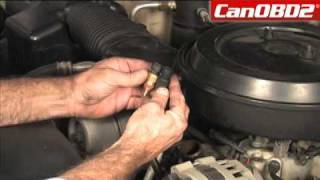
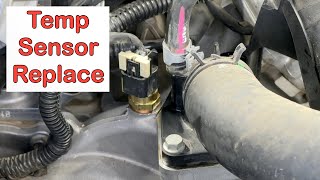
- Faulty Engine Coolant Temperature (ECT) Sensor (Very Common) — The sensor itself is the most frequent point of failure. 🎬 Watch this walkthrough on replacing a faulty ECT sensor. It degrades over time, causing it to send incorrect or intermittent signals.
- Damaged or Corroded Wiring/Connector (Common) — Heat, vibration, and moisture cause corrosion on the pins (especially a green crusty buildup) or damage to the wires, leading to a poor or intermittent connection.
- Low Engine Coolant Level or Air in the System (Common) — If the coolant level is too low or contains air pockets, the sensor reads air temperature instead of coolant temperature, resulting in erratic signals.
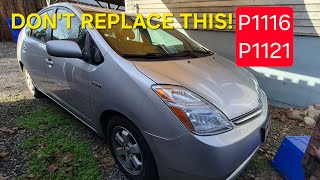
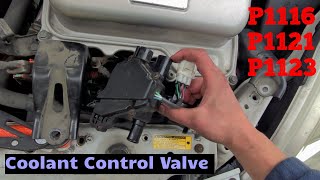
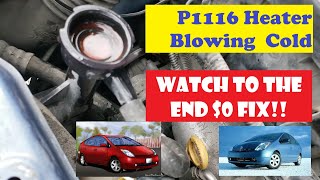
- Failing Coolant System Component (Prius Specific) (Common) — On Toyota Prius models with a Coolant Heat Storage (CHS) system, a failing three-way coolant valve, CHS water pump, or CHS pump relay prevents proper coolant flow, triggering P1116. 🎬 See how to fix P1116 on a Toyota Prius.
- Stuck or Faulty Thermostat (Less Common) — A thermostat stuck open or closed causes the engine to warm up too slowly or overheat. This makes the PCM flag the ECT sensor's readings as illogical.
- Incorrect Coolant or Contamination (Uncommon) — Using the wrong coolant type or having old, contaminated coolant leads to corrosion that damages the sensor or its electrical connector pins.
- Failing 12V Battery (Rare) — A weak 12-volt battery provides unstable voltage to sensors and modules, leading to erroneous intermittent sensor readings.
- Faulty Powertrain Control Module (PCM) (Very Rare) — The internal circuit that reads the ECT sensor signal can fail, but all other possibilities must be exhausted before suspecting the PCM.
Symptoms

- Check Engine Light is On — This is the first and often only symptom the driver notices.
- Erratic or Incorrect Temperature Gauge — The dashboard temperature gauge reads incorrectly, fluctuates wildly, shows no reading, or pegs at hot or cold.
- Engine Overheating or Running Too Cool — If cooling fans fail to activate due to a bad signal, the engine overheats. If the PCM thinks the engine is always hot, it runs the fans constantly, overcooling the engine.
- Poor Fuel Economy — The engine runs rich (too much fuel) because the PCM thinks the engine is cold, drastically reducing gas mileage.
- Rough Idle or Difficulty Starting — The engine is hard to start when cold or idles erratically because the PCM cannot set the correct fuel mixture.
- Inconsistent HVAC Performance — Cabin heat fails to work correctly if the system believes the engine isn't warm enough to provide hot coolant to the heater core.
- Erratic Live Data Readings (scan-tool only — no driver-felt sign) — On a scan tool, the ECT sensor data shows sudden spikes, drops, or values that do not change smoothly with engine temperature.
Diagnostic Flowchart
Tap your situation to follow the diagnostic path that matches what you're seeing on this code.
Common Fixes & Costs
- Replacing the Engine Coolant Temperature (ECT) Sensor — Parts: $20-$80, Labor: $75-$225, ~0.8 hr book time (DIY)
- Topping Off or Flushing Engine Coolant and Bleeding the System — Parts: $25-$50, Labor: $120-$250, ~1.2 hr book time (DIY)
- Repairing ECT Sensor Wiring or Replacing Connector Pigtail — Parts: $10-$50, Labor: $100-$250, ~1.5 hr book time (Intermediate)
- Replacing the Thermostat — Parts: $20-$70, Labor: $150-$350, ~1.8 hr book time (Intermediate)
- Replacing Prius Coolant Heat Storage (CHS) components (e.g., 3-way valve) — Parts: $90-$150, Labor: $200-$400, ~2.5 hr book time (Pro)
- Professional Diagnosis — Parts: $0, Labor: $150-$200, ~1.0 hr book time (Pro)
Used vs. New Parts: Buying Guide
When a used part is worth it: Buying a used ECT sensor rarely makes sense. The savings are minimal ($10-$20) and you risk getting a degraded part. New sensors are affordable and warrantied.
Donor-vehicle mileage cap: roughly under 40000 miles for the part to have meaningful remaining life.
Donor quality checklist:
- For expensive assemblies like a Prius CHS tank, verify the donor part number matches exactly.
- Ensure the used part includes at least a 30-day warranty.
Decision logic:
- If The part is the ECT sensor itself → Buy new. The part is low-cost and critical.
- If The part is a costly assembly (e.g., Prius CHS Tank) → A used part from a low-mileage vehicle is a cost-effective option.
Warranty tradeoff: Used parts offer a 30-90 day warranty on the part only. New aftermarket sensors have a 1-year to lifetime warranty.
Worst-case if a used part fails: $150-$300 if a used part fails, requiring repeat labor costs.
What Happens If You Wait — Timeline
- 0-1 month: Check Engine Light illuminates. The PCM defaults to a rich fuel mixture. You experience rougher cold starts and a 5-10% drop in fuel economy. (MPG impact: 5-10%% · Added cost: $15-$50 in wasted fuel)
- 1-4 months: The rich fuel mixture overwhelms the catalytic converter. Unburned fuel raises the converter's internal temperature, beginning to melt its ceramic substrate. (MPG impact: 10-15%% · Added cost: $50-$150 in wasted fuel, plus initial catalyst stress.)
- 4-8 months: Catalytic converter damage becomes significant, triggering a P0420 code. The engine feels sluggish, and the exhaust smells like rotten eggs. (MPG impact: 15-20%% · Added cost: $1200-$2500 for catalytic converter replacement.)
- 8+ months: Catastrophic failure risk is high. If a true overheat occurs and the gauge fails to report it, you suffer a blown head gasket or warped cylinder head. (MPG impact: 20-25%% · Added cost: $1500-$4000+ for head gasket repair and new catalytic converter.)
Cost of Not Fixing It
- 0-1 month: Decreased fuel economy by 5-15% as the engine runs rich. Potential for difficult cold starts. (Added cost: $20-$60 in wasted fuel)
- 1-6 months: The rich fuel mixture overheats and damages the catalytic converter, leading to a P0420 code. (Added cost: $1200-$2800 for catalytic converter replacement)
- 6+ months: Severe risk of engine damage. Failing to report a true overheating event leads to a blown head gasket. (Added cost: $1500-$4000+ for head gasket or engine repairs)
Diagnosis Steps
- Verify Code Definition and Check Freeze Frame Data
Use an OBD-II scanner to confirm the manufacturer-specific definition of P1116 for your vehicle. Analyze freeze frame data to see engine conditions (coolant temp, RPM, speed) when the code set to determine if it happened on a cold start or while driving.
Tools: OBD-II Scanner (Beginner) - Check Engine Coolant Level and Condition
With the engine COLD, check the coolant level in the reservoir and radiator. Low coolant is a primary cause. Verify the coolant is the correct type and free of rust or sludge.
Tools: Flashlight (Beginner) - Visual Inspection of Sensor and Wiring
Inspect the ECT sensor's electrical connector and wiring. Look for green corrosion, frayed wires, or a loose connection. Follow the harness to check for chafing or heat damage.
Tools: Flashlight (Beginner) - Analyze Live Data with Graphing Scanner
Graph the ECT sensor reading from a cold start. The graph must show a smooth upward curve. Sudden spikes or drops indicate a problem. Perform a 'wiggle test' by shaking the sensor connector to induce a glitch, confirming an intermittent connection.
Tools: OBD-II Scanner with Live Data Graphing (Intermediate) - Test the Thermostat
Start the cold engine and feel the upper radiator hose. It should stay cool for several minutes, then get hot suddenly as the thermostat opens (around 180-200°F). If it warms slowly from the start, the thermostat is stuck open.
Tools: Infrared thermometer or bare hands (Intermediate) - Test the ECT Sensor with a Multimeter (Resistance)
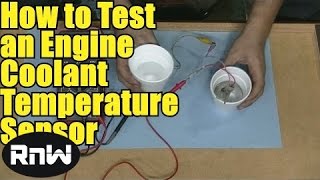
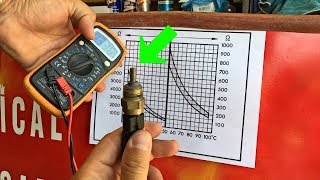
Disconnect the sensor. Measure resistance (Ohms) and compare to a vehicle-specific chart. At 68°F (cold), resistance is high (2,000-3,000 Ω). At 176°F (hot), resistance drops (250-350 Ω). An 'OL' (open) reading means the sensor is dead.
Tools: Multimeter, Vehicle-specific resistance chart (Intermediate) - Check the Circuit for Voltage and Ground (KOEO)
Disconnect the sensor and turn the ignition 'On' (engine off). Test the reference wire pin; it must read a steady 5 volts from the PCM. Test the ground wire pin for continuity to ground (near 0 ohms). Missing voltage indicates a wiring problem.
Tools: Multimeter (Advanced) - Test the Live Signal Voltage
Back-probe the sensor's signal wire with the engine running. On a cold engine, voltage is high (2.8V-3.5V). As it warms up, voltage drops smoothly (0.5V-1.3V). Erratic jumps indicate a fault.
Tools: Multimeter with back-probe pins (Advanced) - Perform a Voltage Drop Test
Connect the black multimeter lead to the battery negative and the red lead to the ground pin on the connected ECT sensor (engine running). A reading above 100mV (0.1V) indicates excessive resistance in the ground circuit due to corrosion.
Tools: Multimeter (Advanced) - Use an Oscilloscope for Intermittent Faults
Connect an oscilloscope to the signal wire. A good sensor produces a clean voltage line. Glitches, dropouts, or 'noise' appearing when wiggling wires definitively prove a circuit or sensor fault.
Tools: Oscilloscope (Advanced)
When This Code Triggers (Freeze-Frame Conditions)
- Engine Coolant Temp: -40°F to 215°F (Triggers on startup if the sensor reading is illogical (e.g., reads hot on a cold engine) or during warm-up if the temperature fluctuates erratically.)
- RPM: 0 (Key On) or 650-2500 (Detected during the initial key-on self-test before the engine starts, or while driving at various engine speeds.)
- Engine Load: Any (Independent of engine load; relates to sensor circuit stability rather than performance under load.)
- Vehicle Speed: Any (Appears at any speed, often triggered by vibration or temperature changes affecting a poor electrical connection.)
Related Codes
- P0115 — The generic code for 'ECT Sensor Circuit Malfunction'. P1116 provides more detail, such as 'Signal Intermittent'.
- P0117 — Indicates 'ECT Circuit Low Input' (a short to ground). P1116 indicates an intermittent signal. A frayed wire occasionally shorting triggers P1116 before failing completely and setting P0117.
- P0118 — Indicates 'ECT Circuit High Input' (an open circuit). A loose connector fluctuating wildly triggers P1116. If the wire breaks completely, it sets P0118.
- P0128 — Indicates the engine failed to reach operating temperature, usually due to a stuck-open thermostat. If present with P1116, the thermostat is the culprit.
Climate & Environmental Factors
- Cold Weather: Sensor resistance peaks when cold, making intermittent wiring connections more likely to trigger a voltage spike. On some Subarus, using a block heater confuses the ECU and triggers P1116, requiring a software update.
- High Humidity / Moisture: Moisture accelerates corrosion on connector pins and wiring, a primary cause of intermittent signals. Jaguar models are particularly susceptible to this.
How to Talk to a Mechanic About This Code
Say this: "I have a P1116 code on my [Year/Make/Model]. I've checked the coolant level and it's full. I'd like to book a diagnostic appointment to determine if the cause is the sensor, the wiring, or something else. Can you check the live data from the ECT sensor for glitches before recommending a part replacement?"
This shows you are informed and guides the mechanic toward proper diagnosis (checking live data) instead of just replacing the most common part.
Avoid saying:
- 'Just fix whatever's wrong'
- 'My check engine light is on, can you look at it?'
- 'Whatever you recommend'
Questions to ask before authorizing the repair:
- Did you see the temperature signal drop out or spike on the scan tool's live data graph?
- Did you inspect the connector for corrosion and test the wiring for a stable 5-volt reference?
- If replacing the thermostat or sensor, does the estimate include the cost to bleed the cooling system?
- What is the warranty on the parts and labor?
Where to Take It: Dealer vs Independent vs Chain
- Dealer:
Best for: Vehicles under warranty, Manufacturer-specific quirks like a Toyota Prius CHS system or a Subaru software update., Complex electrical diagnostics.
Downsides: Highest labor rate., May recommend replacing an entire assembly when a smaller component suffices. (Typical cost: +50% vs. baseline) - Independent Shop:
Best fit for most common vehicles. However, for a Gen 2 Prius or a Subaru with a block heater, a dealer or hybrid-specialist is a better choice.
Best for: Out-of-warranty vehicles with common ECT-related P1116 codes., Standard repairs like sensor replacement, thermostat replacement, or coolant flushes.
Downsides: Quality varies widely; vet shops based on reviews and ASE certifications., May lack specific tools for brand-specific systems like the Prius CHS. (Typical cost: +0% vs. baseline) - Chain Shop:
Use with caution. Acceptable if you are certain only a sensor replacement is needed. Avoid for initial diagnosis of an intermittent P1116 code.
Best for: Simple, clear-cut part replacements if you have already performed the diagnosis yourself.
Downsides: Technician skill and diagnostic equipment are inconsistent., High pressure to upsell services., Not equipped to diagnose intermittent electrical faults effectively. (Typical cost: -10% vs. baseline)
When to Walk Away From the Repair
If the estimated repair cost exceeds 50% of the car's private-party value, consider selling or trading it in.
- Car worth $4500, fix is $800: Fix it. This repair is well below the 50% threshold and is critical for engine health.
- Car worth $3000, fix is $1600: Walk away. The repair cost is over half the car's value.
- Car worth $7000, fix is $3200: Borderline. This represents a major failure (e.g., head gasket damage). Get a second opinion before proceeding.
What Scan Tool You Need for This Code
Minimum: A scanner that reads manufacturer-specific code definitions and graphs live data, especially Engine Coolant Temperature (ECT).
A $20 reader only shows 'P1116'. It won't tell you if it means 'ECT sensor' on your Ford or 'O2 Sensor' on a VW. Crucially, it cannot graph live data to spot intermittent signal drops.
Budget: BlueDriver Pro Scan Tool (~$99) — Connects to your smartphone and provides manufacturer-specific definitions and live data graphing to watch the ECT sensor's reading.
Mid-range: Foxwell NT510 Elite / Innova 5610 (~$150) — These handheld units offer dedicated screens and faster live data. The Innova 5610 tests components like EV batteries, useful for hybrid owners.
Professional: Autel MaxiCOM MK808S (~$400) — Offers full-system diagnostics and bi-directional control, allowing you to command specific modules to run tests (e.g., cycle the Prius CHS pump).
Rent vs buy: If this is a one-time fix, borrow a scanner for free from an auto parts store. Buy a scanner only if you plan to do your own diagnostics more than once a year.
How to Clear the Code After You Fix It
- Use an OBD-II scan tool to clear the P1116 trouble code.
- Ensure the fuel tank is between 1/4 and 3/4 full.
- Perform a complete drive cycle to allow readiness monitors to reset.
Drive cycle (~30 minutes): Cold start and idle for 2-3 minutes. Drive in mixed city/highway conditions for 15-20 minutes. Allow the vehicle to cool down completely.
Readiness monitors affected: Comprehensive Component Monitor, Catalyst Monitor, Oxygen (O2) Sensor Monitor
Before emissions retest: drive at least 50 miles to fully set monitors.
Watch out for:
- Clearing the code resets all readiness monitors to 'Not Ready', causing an automatic emissions test failure.
- The code returns immediately if the underlying mechanical or electrical fault is not repaired.
Will This Fail Emissions / State Inspection?
Yes — this code typically fails an OBD-II emissions inspection.
- California: An active P1116 code is an automatic failure. You must complete a drive cycle to set all readiness monitors to 'Ready' before re-testing.
- New York: An illuminated Check Engine Light results in an automatic failure of the emissions inspection.
- Texas: An active P1116 code causes an automatic failure. After clearing, you can have at most one monitor 'Not Ready' to pass.
Most Commonly Affected Vehicles
- Ford Focus, Fiesta, Mondeo (1998-2010) — P1116 means the ECT sensor signal was out of range during a self-test. Corrosion on the cylinder head connector is a very common failure point.
- Toyota Prius (Gen 2) (2004-2009) — P1116 is almost always related to the Coolant Heat Storage (CHS) system. Common causes include the CHS tank temp sensor, a stuck three-way coolant valve, or a failed CHS pump.
- General Motors (Chevy, GMC, Cadillac) Silverado, Sierra, Tahoe (2000-2010) — Defined as 'ECT Signal Unstable or Intermittent', pointing directly to a failing sensor or wiring issue.
- Honda Civic, Accord (2006-2012) — Defined as 'ECT Sensor 1 Circuit Range/Performance Problem'. Some 2006-2009 Civics had cracked engine blocks leaking coolant, leading to ECT codes.
- Hyundai / Kia Accent, Elantra, Sonata (2000-2012) — For turbocharged models, P1116 is defined as 'Boost Pressure Sensor Malfunction', an entirely different issue. Verifying the code definition is critical.
- Jaguar X-Type, S-Type (2002-2008) — Defined as 'ECT Sensor Circuit Intermittent'. Moisture intrusion causes corrosion on gold-plated connector pins.
- Subaru WRX, STI, Legacy (2015-2020) — Per TSB #11-201-21, using an accessory block heater confuses the ECM logic during cold starts. The fix requires a dealer ECM update, not a part replacement.
Manufacturer-Specific Notes

- Ford: Defines P1116 as 'ECT Sensor Out of Self-Test Range'. The PCM checks if the reading is plausible during startup tests.
- General Motors: Defines the code as 'ECT Signal Unstable or Intermittent', pointing directly to a fluctuating signal rather than an out-of-range one.
- Toyota: On the Gen 2 Prius, P1116 is tied to the Coolant Heat Storage System (CHS tank sensor, 3-way valve, or pump), not the main engine ECT sensor.
- Audi/Volkswagen: P1116 means 'HO2S Sensor Heater Circuit Open', pointing to a fault in the pre-catalytic converter oxygen sensor, unrelated to cooling.
- Hyundai: Can indicate a 'Boost Pressure Sensor Malfunction' on turbo models.
- Subaru: Using an engine block heater confuses the ECM during cold starts, triggering the code. The fix is a software update.
Real Owner Stories
2008 Toyota Prius at 119k miles with recurring P1116
Check Engine Light appeared only when turning the car on. No overheating or drivability issues noticed.
What they tried:
- Mechanic replaced the coolant temperature sensor; code returned.
- Mechanic replaced the coolant control valve; code returned.
- Dealer replaced a leaking water pump and the entire Coolant Heat Storage (CHS) tank assembly. Code returned after a long drive.
Outcome: The owner spent thousands replacing multiple parts without a permanent fix. The issue was intermittent and only occurred on cold soak.
Lesson: On a Gen 2 Prius, P1116 is a complex code. Throwing parts at it is expensive and ineffective. The problem is often intermittent and related to wiring or the ECU's evaluation of temperature changes during a cold start.
2008 Toyota Prius with P1116 misdiagnosis
P1116 code appeared. Coolant level was slightly low, topped off, but the code returned.
What they tried:
- A specialist diagnosed a failing 12V battery as the cause and replaced it. The code returned the next day.
Outcome: Replacing the 12V battery did not solve the P1116 code. The owner wasted money on an unrelated repair.
Lesson: While a failing battery causes electrical gremlins, it is rarely the primary cause for P1116. Always follow standard diagnostic procedures (check sensor, wiring, coolant level) first.
2009 Gen 2 Prius at 135k miles with multiple warning lights
Master warning light, Check Engine Light, and High Coolant Temperature lights came on intermittently at low speeds.
What they tried:
- Owner used an OBD2 scanner which suggested replacing the CHS tank temperature sensor.
Outcome: Forum members advised that the combination of an overheating warning with P1116 strongly suggests a real cooling system problem (low coolant or air) rather than an electrical fault.
Lesson: When P1116 is accompanied by a high-temperature warning, address the cooling system's health first. Check the radiator coolant level and bleed the system of air before replacing sensors.
How to Prevent This Code From Triggering
- Perform coolant flushes at recommended intervals. (Every 3-5 years or 30,000-100,000 miles depending on coolant type.) — Old coolant becomes acidic, causing corrosion on sensor tips and electrical connector pins, leading to signal failure.
- Apply dielectric grease to sensor connectors. (Whenever a sensor is replaced or disconnected.) — Dielectric grease seals out moisture and oxygen, preventing metal pins from corroding—the primary defense against intermittent electrical faults.
- Use only the manufacturer-specified type of coolant. (Every time you top off or flush the system.) — Mixing coolant types causes gelling and blockages. Incorrect chemistry accelerates corrosion of sensors and cooling components.
- Periodically inspect sensor wiring and connectors. (During routine maintenance like oil changes.) — Catching frayed wires or cracked insulation early prevents intermittent signals from triggering codes.
Frequently Asked Questions
What is the most common misdiagnosis for a P1116 code?
The most common mistake is assuming P1116 means the same thing on all cars. On a Ford, it indicates an ECT sensor fault, but on a VW it points to an O2 sensor, and on a Hyundai, a boost sensor. On the Gen 2 Toyota Prius, mechanics often mistakenly replace the main engine ECT sensor instead of the correct Coolant Heat Storage tank sensor.
I replaced the ECT sensor, but the P1116 code came back. What now?
If a new sensor fails to fix the problem, thoroughly inspect the wiring and connector for damage or corrosion. Check for a stable 5V reference and ground, ensure the coolant is full and properly bled, and test the thermostat. On a Prius, investigate the CHS pump and 3-way valve.
Where is the Engine Coolant Temperature (ECT) sensor located?
The ECT sensor screws directly into the engine block, cylinder head, or thermostat housing to maintain direct contact with the coolant. It features a two- or three-wire electrical connector. On a Gen 2 Prius, the specific sensor for P1116 sits on the coolant heat storage tank under the driver-side headlamp.
Can I replace the ECT sensor myself?
Yes, this is a straightforward DIY repair for most vehicles. Let the engine cool completely, partially drain the coolant, swap the sensors quickly to minimize fluid loss, and then top off and bleed the cooling system.
Can a bad thermostat cause P1116 but not P0128?
Yes. A thermostat that fails intermittently or regulates temperature poorly causes the ECT sensor readings to appear erratic to the PCM, triggering P1116 before meeting the conditions for a P0128 code.
How do I bleed the air from a Prius cooling system to fix P1116?
Bleeding a Gen 2 Prius is complex due to its separate engine and CHS loops. It requires putting the car in 'Inspection Mode' to force the engine to run and manually jumping the CHS pump relay to purge air. Using a spill-free funnel on the radiator is highly recommended.
Why does my P1116 code only appear in cold weather?
The ECT sensor's resistance peaks when cold, making intermittent wiring connection issues more apparent and likely to trigger a voltage spike. On some Subarus, using a block heater in cold weather triggers the code due to a software glitch requiring a dealer update. On a Prius, the CHS system activates more frequently in cold weather, exposing underlying faults.
Key Takeaways
- Verify your vehicle's specific P1116 definition using a professional scanner, as it indicates an ECT sensor fault on Fords but an O2 sensor issue on VWs.
- Check your engine coolant level and inspect the sensor connector for green corrosion before buying parts, as these free checks solve a large percentage of P1116 codes.
- Diagnose a Gen 2 Toyota Prius (2004-2009) by focusing on the Coolant Heat Storage (CHS) system, specifically the 3-way valve or tank sensor, rather than the main engine ECT sensor.
- Graph the ECT sensor's live data from a cold start to catch intermittent voltage drops or spikes that a standard multimeter test will miss.
Helpful Videos

The information in this article is provided for general reference and educational purposes only. Vehicle specifications, procedures, and part compatibility can vary by production date, trim level, and region. Always consult your vehicle's factory service manual and verify part numbers before purchasing or performing repairs. Safety-critical components such as airbags, seat belts, and braking systems should be installed by a qualified professional.
- 🎬 Helpful Videos
- What Does P1116 Mean?
- Can I Drive With P1116?
- Common Causes
- Symptoms
- Diagnostic Flowchart
- Common Fixes & Costs
- Used vs. New Parts: Buying Guide
- What Happens If You Wait — Timeline
- Cost of Not Fixing It
- Diagnosis Steps
- When This Code Triggers (Freeze-Frame Conditions)
- Related Codes
- Climate & Environmental Factors
- How to Talk to a Mechanic About This Code
- Where to Take It: Dealer vs Independent vs Chain
- When to Walk Away From the Repair
- What Scan Tool You Need for This Code
- How to Clear the Code After You Fix It
- Will This Fail Emissions / State Inspection?
- Most Commonly Affected Vehicles
- Manufacturer-Specific Notes
- Real Owner Stories
- 2008 Toyota Prius at 119k miles with recurring P1116
- 2008 Toyota Prius with P1116 misdiagnosis
- 2009 Gen 2 Prius at 135k miles with multiple warning lights
- How to Prevent This Code From Triggering
- Frequently Asked Questions
- What is the most common misdiagnosis for a P1116 code?
- I replaced the ECT sensor, but the P1116 code came back. What now?
- Where is the Engine Coolant Temperature (ECT) sensor located?
- Can I replace the ECT sensor myself?
- Can a bad thermostat cause P1116 but not P0128?
- How do I bleed the air from a Prius cooling system to fix P1116?
- Why does my P1116 code only appear in cold weather?
- Key Takeaways
- 🎟️ Get 5% Off