

OBD-II Code P1107: Manifold Pressure Sensor Circuit Low Voltage
What P1107 means, why it triggers, and how to fix it
- Code P1107 indicates the Manifold Absolute Pressure (MAP) sensor voltage is intermittently dropping below 0.5 volts, causing the engine computer to miscalculate the air-fuel mixture.
- On 2004-2012 GM trucks like the Colorado and Canyon, a broken wire near the MAP sensor connector causes 90% of P1107 codes, requiring a $25 pigtail replacement rather than a new sensor.
- Driving with an active P1107 code forces the engine to run rich, which destroys a $1,500 catalytic converter within 1 to 3 months if left unaddressed.
- For 1998-2012 Honda models, P1107 points to a failed Barometric Pressure (BARO) sensor located inside the Powertrain Control Module (PCM), requiring a complete PCM replacement.
What Does P1107 Mean?

P1107 means your Powertrain Control Module (PCM) detects the Manifold Absolute Pressure (MAP) sensor voltage intermittently dropping too low. The MAP sensor measures engine load; a bad signal forces the computer to calculate the wrong fuel and ignition timing, instantly degrading engine performance.
Technical definition: P1107 is a manufacturer-specific code defined by General Motors as 'MAP Sensor Circuit Intermittent Low Voltage'. The PCM registers an erratic signal dropping below 0.5 volts. On Hondas, it refers to the Barometric Pressure (BARO) sensor. On Subaru and Volkswagen, it points to entirely different emissions or heater circuits.
Can I Drive With P1107?
Yes, But With Caution. You can drive in the short term, but it is not recommended. Expect rough idling, hesitation, and a 10-20% drop in gas mileage. Continuing to drive with an incorrect air-fuel mixture overheats the catalytic converter, causing an $800 to $2,500 failure within months.
Common Causes

- Damaged Wiring or Corroded Connector (Very Common) — Wires break inside the insulation near the MAP sensor connector due to engine vibration and heat. Corrosion on the connector pins also blocks the signal, making this the leading cause on GM vehicles.
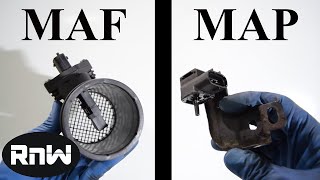
- Faulty Manifold Absolute Pressure (MAP) Sensor (Common) — The sensor fails internally and sends an incorrect voltage signal to the computer. While common, test the wiring first to avoid 🎬 Watch: A quick guide on how to test a MAP sensor unnecessary replacement.
- Vacuum Leaks (Common) — Cracked vacuum hoses or a flattened MAP sensor O-ring create a vacuum leak directly at the sensor. This causes erratic pressure readings the PCM interprets as a circuit fault.
- Poor Electrical Ground (Less Common) — A loose or corroded ground wire for the sensor circuit causes unstable voltage readings.
- Contamination of MAP Sensor Port (Less Common) — Carbon buildup or oil from the PCV system clogs the intake manifold port. This dampens the sensor's ability to read pressure changes.
- Faulty Powertrain Control Module (PCM) (Rare) — The internal circuit reading the MAP signal fails. On Hondas where the BARO sensor is integrated into the PCM, P1107 directly indicates a required PCM replacement.
Symptoms
- Rough Idle or Stalling — The engine runs erratically, shakes at idle, or stalls because it receives the wrong amount of fuel.
- Engine Hesitation or Stumbling — When you press the gas pedal, the car hesitates and loses power because the PCM cannot accurately calculate engine load.
- Reduced Fuel Economy — The PCM defaults to a richer fuel mixture to protect the engine, wasting gas and lowering your MPG by 10-20%.
- Hard Starting — The engine is difficult to start, especially when cold, due to the incorrect air-fuel mixture.
- Check Engine Light is On (also visible on scanner) — The PCM illuminates the Malfunction Indicator Lamp (MIL) immediately after detecting the voltage drop.
Diagnostic Flowchart

Tap your situation to follow the diagnostic path that matches what you're seeing on this code.
Common Fixes & Costs
- Repair or Replace MAP Sensor Wiring Pigtail — Parts: $15-$80, Labor: $100-$250, ~1.0 hr book time (Intermediate)
- Replace Manifold Absolute Pressure (MAP) Sensor — Parts: $50-$150, Labor: $50-$80, ~0.5 hr book time (DIY)
- Repair Vacuum Leak — Parts: $5-$100, Labor: $100-$300, ~1.5 hr book time (Intermediate)
- Clean MAP Sensor and Port — Parts: $10-$20, Labor: $25-$75, ~0.5 hr book time (DIY)
- Replace Powertrain Control Module (PCM) — Parts: $500-$1200, Labor: $150-$300, ~2.0 hr book time (Advanced)
Used vs. New Parts: Buying Guide
When a used part is worth it: Buying a used MAP sensor rarely makes sense. New aftermarket sensors cost $20-$60, while a used sensor carries a high risk of failure. A used wiring pigtail should never be considered. A used PCM is the only viable used part for this code.
Donor-vehicle mileage cap: roughly under 40000 miles for the part to have meaningful remaining life.
Donor quality checklist:
- Source used PCMs from low-mileage vehicles not scrapped for electrical issues.
- Match the OEM part number exactly.
- Avoid parts from online marketplaces lacking a return policy.
Decision logic:
- If The part is a MAP sensor or wiring pigtail. → Always buy new. The cost savings are minimal and not worth the risk of a comeback.
- If The required fix is a PCM (for Honda BARO fault). → A used, tested PCM from a reputable salvage yard is cost-effective, but requires professional programming.
Warranty tradeoff: Used parts offer a 30-90 day warranty. New aftermarket parts come with a 1-year to limited lifetime warranty. OEM parts provide the best guarantee at the highest cost.
Worst-case if a used part fails: $150-$300 if a used sensor fails after installation, requiring repeat diagnosis and labor.
What Happens If You Wait — Timeline
- 0-1 month: Intermittent check engine light. Subtle hesitation during acceleration and a slightly rough idle. No major drivability issues yet. (MPG impact: 3-5%% · Added cost: $0-$20 in wasted fuel.)
- 1-3 months: Check Engine Light stays on permanently. Rough idle becomes consistent, and engine stumbling is frequent. The PCM defaults to a rich fuel mixture. (MPG impact: 5-15%% · Added cost: $50-$100 in wasted fuel.)
- 3-6 months: The constant rich fuel mixture overheats the catalytic converter. Unburned fuel ignites inside the converter, melting the internal ceramic substrate. (MPG impact: 10-20%% · Added cost: $100-$200 in wasted fuel, plus high risk of imminent converter damage.)
- 6+ months: Catalytic converter substrate melts and clogs, creating a major exhaust restriction. The engine has severe power loss and stalls frequently. The converter is destroyed. (MPG impact: 20-30%+% · Added cost: $800-$2,500 for catalytic converter replacement.)
Cost of Not Fixing It
- 0-1 month: Noticeable drop in fuel economy, rough idle, engine hesitation, and a failed emissions test. (Added cost: $20-$60 per month in wasted fuel.)
- 1-6 months: The engine runs rich, causing the catalytic converter to overheat from unburned fuel, leading to internal melting and failure. (Added cost: $800-$2,500 for catalytic converter replacement.)
- 6+ months: Prolonged rich conditions foul spark plugs, dilute engine oil with excess fuel, and destroy oxygen sensors. (Added cost: $300-$1000 for replacing spark plugs, O2 sensors, and addressing engine wear.)
Diagnosis Steps
- Scan for Codes and Review Freeze Frame Data
Use an OBD-II scanner to confirm P1107 is present and check for related codes (e.g., P0106, P0107, P0300). Review the freeze frame data to see the exact engine RPM and load when the code triggered.
Tools: OBD-II Scanner (Beginner) - Conduct a 'Wiggle Test'
With the engine idling, gently wiggle the wiring harness and connector for the MAP sensor. If the engine's idle changes, stumbles, or stalls, you have an intermittent fault in the wiring. This is the most crucial test for GM vehicles.
Tools: None (Beginner) - Perform a Visual Inspection
Inspect the MAP sensor, its electrical connector, and all vacuum hoses. Look for cracked hoses, loose connections, or green/white corrosion on the wiring pins.
Tools: Flashlight (Beginner) - Test MAP Sensor with Live Data
Using a scan tool, monitor the MAP sensor voltage. With Key On, Engine Off (KOEO), it reads near 4.5V at sea level. At a warm idle, it shows high vacuum (1.0-1.8V). If the readings are stuck or drop out sharply, the sensor or circuit is faulty.
Tools: Advanced OBD-II Scanner (Intermediate) - Test the Electrical Circuit with a Multimeter
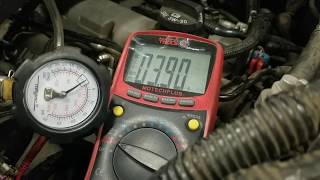
Backprobe the MAP sensor connector with the key on, engine off. Verify a 5-volt reference wire (4.8V-5.2V), a ground wire (under 100mV), and a signal wire (around 4.5V). Missing voltage indicates a wiring issue tracing back to the PCM.
Tools: Multimeter, Backprobe Kit (Advanced) - Perform a Voltage Drop Test on Ground Circuit
With the engine running, place the red multimeter lead on the MAP sensor's backprobed ground wire and the black lead on the negative battery terminal. A reading above 0.1 volts (100mV) indicates excessive resistance in the ground path.
Tools: Multimeter, Backprobe Kit (Advanced) - Check for Vacuum Leaks
With the engine running, spray short bursts of brake cleaner or use a smoke machine around the intake manifold and MAP sensor base. A change in engine RPM or visible smoke pinpoints a leak.
Tools: Smoke machine or brake cleaner (Intermediate) - Inspect and Clean the MAP Sensor
Remove the MAP sensor and inspect the port for carbon buildup or oil. Clean the sensor carefully with dedicated MAF/MAP sensor cleaner. Never use brake cleaner.
Tools: MAP/MAF Sensor Cleaner, Basic Hand Tools (DIY) - [PRO TIP] Analyze the Signal with an Oscilloscope
Graph the MAP sensor's signal wire. A faulty sensor or wiring issue shows up as sharp dropouts or 'glitches' in the waveform during a wiggle test. This definitively catches intermittent electrical problems.
Tools: Automotive Oscilloscope, Backprobe Kit (Professional)
When This Code Triggers (Freeze-Frame Conditions)
- Engine Coolant Temp: 180-200°F (The fault sets when the engine is fully warmed up and operating in closed-loop fuel control.)
- RPM: 1500-2500 (The intermittent drop in voltage is captured during steady-state cruise or light acceleration, not at idle.)
- Engine Load: 30-60% (Corresponds to part-throttle, steady-speed driving where the PCM expects a stable MAP sensor signal.)
- Vehicle Speed: 35-55 mph (Triggered during city or highway cruising speeds, consistent with the RPM and load conditions.)
Related Codes
- P0107 — P0107 is the generic code for a consistently low MAP voltage. P1107 indicates the voltage drops out intermittently. Fixing the root cause of P1107 automatically resolves P0107.
- P0106 — P0106 indicates erratic MAP performance. The intermittent low signal from the P1107 fault makes the sensor's overall output seem irrational to the PCM. Fix P1107 first.
- P0300 — Incorrect MAP data causes the PCM to miscalculate fuel and spark timing, leading directly to engine misfires (P0300). Resolving P1107 clears the misfire code.
- P0129 — Triggered alongside P1107 on Hondas where the code relates to the BARO sensor. The PCM sees a signal impossibly low for the current altitude.
Climate & Environmental Factors
- Altitude: Altitude directly lowers the baseline MAP sensor reading. At sea level, the reading is 101 kPa (4.5V). This decreases by 1 kPa for every 328 feet of elevation gain. Technicians must account for this lower baseline to avoid misdiagnosing a normal high-altitude reading as a low-voltage fault.
- Humidity and Temperature Cycles: High humidity and road salt accelerate corrosion on connector pins, increasing electrical resistance. Extreme engine heat cycles make wire insulation brittle, allowing engine vibrations to snap the internal copper wires—the exact cause of this code on GM trucks.
How to Talk to a Mechanic About This Code
Say this: "I have a P1107 code and I'd like to schedule a diagnostic. On my vehicle, I understand this is often a wiring issue near the MAP sensor connector. Please start by testing the circuit, including a wiggle test, before recommending a new sensor. [For Hondas: 'I understand this code points to the BARO sensor inside the PCM, so please confirm that before checking external parts.']"
This signals you've done your research and directs the technician to the most likely, cheapest fix first. It prevents them from immediately replacing an expensive sensor when the problem is a simple broken wire.
Avoid saying:
- 'Just fix whatever's wrong'
- 'My check engine light is on, can you look at it?'
- 'My car is running rough, I think it needs a new sensor.'
Questions to ask before authorizing the repair:
- Did you perform a wiggle test on the wiring harness, and what was the result?
- What were the voltage readings for the 5V reference, ground, and signal wires at the MAP sensor connector?
- Can you show me the broken wire or the corroded connector that you found?
- If you are recommending a new sensor, how did you rule out a wiring or vacuum leak issue?
- What is the warranty on this specific repair, including both parts and labor?
Where to Take It: Dealer vs Independent vs Chain
- Dealer:
Best for: Vehicles still under powertrain or emissions warranty., Complex manufacturer-specific quirks, like a suspected internal PCM failure on a Honda., When you need access to proprietary diagnostic tools.
Downsides: Highest labor rates, often 1.5x to 2x an independent shop., Defaults to replacing a larger assembly (like the whole PCM) instead of a targeted repair. (Typical cost: +50% vs. baseline) - Independent Shop:
Best fit for most P1107 scenarios. An experienced independent tech knows about the common GM wiring failure, saving you money on diagnostics and parts.
Best for: Out-of-warranty vehicles, especially GM trucks with the well-known wiring issue., Straightforward sensor replacements or vacuum leak repairs., Building a long-term relationship with a trusted mechanic.
Downsides: Shop quality and diagnostic skill vary widely. Vet shops based on ASE certifications., May not have specialized tools for PCM programming. (Typical cost: +0% vs. baseline) - Chain Shop:
Avoid for initial diagnosis. They are likely to replace the sensor without properly diagnosing the more common wiring issue, leading to a comeback.
Best for: Simple, clear-cut part replacements like a MAP sensor if you have already diagnosed it yourself.
Downsides: Technician skill varies dramatically; ill-equipped for in-depth electrical diagnosis., High pressure to upsell services., Unaware of specific TSBs or manufacturer quirks. (Typical cost: -10% vs. baseline)
When to Walk Away From the Repair
If the estimated repair cost exceeds 40-50% of the car's private-party value, seriously consider selling or trading it in.
- Car worth $4000, fix is $300: Fix it. A wiring or sensor replacement is a small fraction of the car's value.
- Car worth $4000, fix is $1500: Borderline. This is likely a PCM replacement on a Honda. Get a second opinion before authorizing.
- Car worth $2500, fix is $1500: Walk away. The repair cost is over 50% of the car's value. It is not a sound financial decision.
What Scan Tool You Need for This Code
Minimum: A scanner that reads and graphs live data, specifically the MAP sensor voltage (PID).
A basic $20 code reader only shows the P1107 code. It cannot show the live voltage from the sensor. Without seeing the voltage drop out in real-time during a wiggle test, you are guessing between a bad wire, a bad sensor, or a vacuum leak.
Budget: BlueDriver Pro (~$100) — Connects to your smartphone and graphs the MAP sensor's live voltage data. Crucial for performing a 'wiggle test' and confirming an intermittent wiring problem.
Mid-range: Foxwell NT510 Elite or Innova 5610 (~$150) — Offers robust live data graphing and recording capabilities. Saves freeze-frame data and offers manufacturer-specific PIDs.
Professional: Autel MaxiCOM MK808 (~$500) — Provides full bidirectional control, OEM-level diagnostics, and advanced data logging. The professional's choice for diagnosing complex issues like PCM failures.
Rent vs buy: Auto parts stores offer a loaner tool program where you pay a refundable deposit. Ensure the loaned scanner supports live data viewing.
How to Clear the Code After You Fix It
- Use an OBD-II scan tool to clear the diagnostic trouble codes (DTCs).
- Perform a complete OBD-II drive cycle to allow the readiness monitors to run and complete.
- Rescan the vehicle to ensure P1107 and related codes have not returned.
Drive cycle (~30 minutes): A generic drive cycle includes a cold start (engine temp below 122°F), a 3-minute idle, 15 minutes of mixed city/highway driving at steady speeds around 55 mph, and one coast-down from 55 mph to 20 mph without braking.
Readiness monitors affected: Catalyst Monitor, O2 Sensor Monitor, Evaporative System (EVAP) Monitor
Before emissions retest: drive at least 100 miles to fully set monitors.
Watch out for:
- Disconnecting the battery clears the code but resets all readiness monitors, causing an immediate emissions test failure.
- The code returns immediately if the underlying broken wire was not properly spliced.
- Failing to meet specific drive cycle conditions (e.g., fuel level between 15-85%) prevents monitors from setting.
Will This Fail Emissions / State Inspection?
Yes — this code typically fails an OBD-II emissions inspection.
- California: An active P1107 code causes an automatic failure. After repair, a full drive cycle must be completed to set all required readiness monitors before a re-test.
- New York: The NYS DMV inspection includes an OBD-II scan. An illuminated Check Engine Light and a stored P1107 code is an automatic failure.
- Texas: In counties requiring emissions testing, a vehicle with an active P1107 code fails the OBD portion of the state inspection.
Most Commonly Affected Vehicles
- Chevrolet Colorado (2004-2012) — Extremely common issue caused by broken wires inside the harness near the MAP sensor connector (GM TSB #PIP4409E). The fix is a wiring pigtail (ACDelco PT2781), not the sensor.
- GMC Canyon (2004-2012) — Shares the identical wiring harness failure noted in TSB #PIP4409E.
- Hummer H3 (2006-2010) — Covered under TSB #PIP4409E for the exact same MAP sensor wiring failure.
- Chevrolet Silverado 1500 (1999-2013) — The wiring harness to the MAP sensor is a frequent failure point. The 'wiggle test' is highly effective for diagnosis.
- Honda Accord, Civic, Pilot (1998-2012) — P1107 refers to 'Barometric Pressure (BARO) Sensor Circuit Low Voltage'. The BARO sensor is integrated inside the PCM, requiring costly PCM replacement.
- Hyundai Sonata, Santa Fe (2006-2014) — Defines the code as 'MAP Sensor Circuit Intermittent Low'. The cause is usually a faulty sensor, a flattened sealing O-ring, or a vacuum leak.
- Subaru Impreza, Forester, Legacy (2005-2014) — P1107 has a completely different meaning: 'Secondary Air Injection Diagnosis Solenoid Circuit Malfunction', related to the emissions system, not the MAP sensor.
Manufacturer-Specific Notes
- General Motors (Chevrolet, GMC, Hummer): P1107 almost always indicates a broken wire inside the MAP sensor harness, not a failed sensor. GM issued TSB #PIP4409E acknowledging this exact issue. A 'wiggle test' is mandatory before replacing parts.
- Honda / Acura: P1107 means 'Barometric Pressure (BARO) Sensor Circuit Low Voltage'. Because the BARO sensor is permanently sealed inside the PCM, a faulty PCM is the standard cause and requires replacement.
- Subaru: P1107 is completely unrelated to manifold pressure. It indicates a 'Secondary Air Injection Diagnosis Solenoid Circuit Fault'.
- Volkswagen / Audi: P1107 means 'Heated Oxygen Sensor (HO2S) Bank 2, Sensor 1 Heater Circuit Short to B+'. This requires testing the O2 sensor heater circuit, not the MAP sensor.
Real Owner Stories
2008 Chevy Colorado at 115K miles - The Classic Misdiagnosis
Check Engine Light came on with codes P1107, P0106, and P0300. Engine idled rough, stumbled on acceleration, and stalled at stoplights.
What they tried:
- Replaced the MAP sensor ($75 part) - code returned within a day.
- Cleaned the throttle body - no change.
- Checked for vacuum leaks with brake cleaner - found none.
Outcome: Performed a 'wiggle test' on the wiring harness near the MAP sensor. The engine immediately stalled. Found a broken wire inside the insulation two inches from the connector. Repaired with an ACDelco PT2781 pigtail ($25 part). Codes cleared permanently.
Lesson: On GM trucks, always perform the 'wiggle test' before replacing the MAP sensor. The problem is almost always the wiring harness (TSB #PIP4409E).
2007 Honda Accord at 140K miles - The Unusual Root Cause
P1107 code appeared with no other codes. Car ran fine but had a slightly rough idle and dropping fuel economy.
What they tried:
- Shop A replaced the MAP sensor; code returned.
- Shop B diagnosed a vacuum leak and replaced hoses; code returned.
- Owner researched Honda forums and learned P1107 means 'BARO Sensor Circuit Low'.
Outcome: Took the car to a Honda specialist. They confirmed the BARO sensor, integrated inside the PCM, failed. The fix was a replacement PCM programmed to the vehicle. Total cost: $1,200.
Lesson: P1107 is highly manufacturer-specific. For Hondas, it points to an internal PCM fault. Consult a specialist before replacing external sensors.
2011 Hyundai Sonata at 95K miles - A Straightforward Fix
Check Engine Light on, code P1107. Intermittent rough idle in traffic, but otherwise drove normally.
What they tried:
- Visually inspected the MAP sensor area and found no issues.
- Used a scan tool to monitor live MAP sensor voltage. Noticed voltage occasionally dipped below 0.5V at idle.
Outcome: Given the intermittent nature and a passed wiggle test, the owner replaced the MAP sensor. A new sensor ($60 part) and O-ring resolved the issue permanently.
Lesson: For Hyundai/Kia, using a scan tool to watch live data confirms if the sensor itself is glitching after ruling out wiring and vacuum leaks.
How to Prevent This Code From Triggering
- Periodically Inspect and Secure Wiring Harnesses (Every oil change) — Engine vibration and heat break wires. Ensure the MAP sensor harness is secured away from hot exhaust parts and sharp edges. Use zip ties to protect vulnerable sections.
- Use High-Quality, Top-Tier Gasoline (Every fill-up) — Detergents prevent carbon buildup in the intake manifold, reducing the chance of the MAP sensor port becoming clogged with deposits.
- Clean Connectors When Exposed (During any related maintenance) — Disconnect the connector, spray it with electrical contact cleaner, and apply dielectric grease. This repels moisture and prevents corrosion.
- Address Engine Misfires Immediately (As needed) — Misfires from bad plugs cause the engine to run rich, leading to carbon fouling of the MAP sensor port. Fixing the root misfire protects all sensors.
- Maintain Engine Grounds (Every 30,000 miles) — A poor engine ground causes unstable voltage across sensors. Check that main engine-to-chassis ground straps are clean and tight.
Frequently Asked Questions
What is the difference between code P1107 and P0107?
P0107 is a generic code for a consistently low MAP voltage (under 0.5V). P1107 is manufacturer-specific and indicates the voltage drops out intermittently. Fixing the intermittent P1107 fault automatically resolves the P0107.
What is the most common mistake when diagnosing P1107?
The most common mistake is replacing the MAP sensor without testing the wiring harness. Broken wires cause this code frequently, especially on GM vehicles. Always perform a 'wiggle test' on the wiring before buying parts.
My car has P1107 but also a code for the oxygen sensor. Which do I fix first?
Always diagnose and repair the P1107 code first. A faulty MAP signal forces the engine to calculate the wrong air-fuel mixture, which triggers secondary oxygen sensor codes. Fixing the MAP circuit usually clears the O2 codes.
Can I just clean my MAP sensor to fix P1107?
Cleaning the MAP sensor port with a dedicated electronic cleaner resolves the code if carbon buildup is blocking the pressure reading. However, P1107 is an electrical circuit code, meaning wiring damage or internal sensor failure is much more likely. Never use brake cleaner, as it destroys the sensor.
Is it safe to drive my car with code P1107 active?
You can drive short distances, but expect poor engine performance and stalling. Continuing to drive forces the engine to run rich, dumping unburned fuel into the exhaust. This destroys the catalytic converter within months, adding up to $2,500 to your repair bill.
How much does it cost to fix code P1107?
A simple wiring pigtail repair costs between $115 and $330 at a shop. Replacing the MAP sensor averages $100 to $230 for parts and labor. If the code requires a PCM replacement, like on older Hondas, expect to pay over $1,000.
What is a BARO sensor and how does it relate to P1107?
The Barometric Pressure (BARO) sensor measures atmospheric pressure to help the engine calculate load. On many Honda models, the BARO sensor is permanently sealed inside the engine computer (PCM). If a Honda throws P1107 for a BARO fault, you must replace the entire PCM.
Key Takeaways
- Code P1107 indicates the Manifold Absolute Pressure (MAP) sensor voltage is intermittently dropping below 0.5 volts, causing the engine computer to miscalculate the air-fuel mixture.
- On 2004-2012 GM trucks like the Colorado and Canyon, a broken wire near the MAP sensor connector causes 90% of P1107 codes, requiring a $25 pigtail replacement rather than a new sensor.
- Driving with an active P1107 code forces the engine to run rich, which destroys a $1,500 catalytic converter within 1 to 3 months if left unaddressed.
- For 1998-2012 Honda models, P1107 points to a failed Barometric Pressure (BARO) sensor located inside the Powertrain Control Module (PCM), requiring a complete PCM replacement.
Helpful Videos

The information in this article is provided for general reference and educational purposes only. Vehicle specifications, procedures, and part compatibility can vary by production date, trim level, and region. Always consult your vehicle's factory service manual and verify part numbers before purchasing or performing repairs. Safety-critical components such as airbags, seat belts, and braking systems should be installed by a qualified professional.
- 🎬 Helpful Videos
- What Does P1107 Mean?
- Can I Drive With P1107?
- Common Causes
- Symptoms
- Diagnostic Flowchart
- Common Fixes & Costs
- Used vs. New Parts: Buying Guide
- What Happens If You Wait — Timeline
- Cost of Not Fixing It
- Diagnosis Steps
- When This Code Triggers (Freeze-Frame Conditions)
- Related Codes
- Climate & Environmental Factors
- How to Talk to a Mechanic About This Code
- Where to Take It: Dealer vs Independent vs Chain
- When to Walk Away From the Repair
- What Scan Tool You Need for This Code
- How to Clear the Code After You Fix It
- Will This Fail Emissions / State Inspection?
- Most Commonly Affected Vehicles
- Manufacturer-Specific Notes
- Real Owner Stories
- 2008 Chevy Colorado at 115K miles - The Classic Misdiagnosis
- 2007 Honda Accord at 140K miles - The Unusual Root Cause
- 2011 Hyundai Sonata at 95K miles - A Straightforward Fix
- How to Prevent This Code From Triggering
- Frequently Asked Questions
- What is the difference between code P1107 and P0107?
- What is the most common mistake when diagnosing P1107?
- My car has P1107 but also a code for the oxygen sensor. Which do I fix first?
- Can I just clean my MAP sensor to fix P1107?
- Is it safe to drive my car with code P1107 active?
- How much does it cost to fix code P1107?
- What is a BARO sensor and how does it relate to P1107?
- Key Takeaways
- 🎟️ Get 5% Off