

OBD-II Code P1104: Mass Airflow Sensor Ground Malfunction and Other Meanings
The Ultimate Guide to What P1104 Means, Why It Triggers, and How to Fix It for Good
- P1104 is a 'chameleon' code; its meaning changes drastically between manufacturers. For Ford/Hyundai it's often a MAF ground, for VW an O2 sensor, and for Toyota a throttle body issue.
- Before replacing any parts, always try the cheapest and easiest fix first: cleaning the MAF sensor with dedicated cleaner and checking the air filter.
- The problem is often in the circuit, not the sensor. Meticulously inspect the wiring, connector, and especially the ground connection before spending money on a new MAF sensor.
- Ignoring this code is risky. It can lead to stalling in traffic and can cause expensive damage to your catalytic converter over time.
What Does P1104 Mean?

The P1104 code is a manufacturer-specific code, meaning its definition changes depending on your vehicle. Most commonly, particularly for brands like Ford and Hyundai, it signifies that the car's Engine Control Module (ECM) has detected an erratic or improper voltage signal from the Mass Airflow (MAF) sensor's ground circuit. The MAF sensor is critical for measuring the amount of air entering the engine, allowing the ECM to inject the correct amount of fuel. When the ground signal is faulty, the ECM loses its stable reference point for the sensor's reading, leading to an incorrect air-fuel ratio and a host of driveability problems.
Technical definition: The most prevalent formal definition for P1104 is 'Mass Airflow (MAF) Sensor Ground Malfunction.' This indicates the Powertrain Control Module (PCM) has detected abnormal voltage fluctuations or a loss of signal on the MAF sensor's ground wire. However, this code is a prime example of why vehicle-specific definitions are crucial. For instance, on many Volkswagen/Audi vehicles, it points to an O2 sensor issue; on Toyotas, it indicates a throttle body problem; and on some Chrysler models, it relates to the turbocharger wastegate.
Can I Drive With P1104?
Yes, But With Caution. Yes, but it's a gamble. Short trips to a repair shop are generally feasible, but your engine may stall unexpectedly, hesitate, or surge, creating a significant safety hazard in traffic. Prolonged driving (over 100-200 miles) with a faulty MAF signal can cause the engine to run excessively rich or lean. This can lead to overheating and irreversible damage to the catalytic converter—a repair that can cost between $800 and $2,500. It's best to address the issue promptly to avoid escalating repair costs and ensure safety.
Common Causes

- Dirty or Contaminated Mass Airflow (MAF) Sensor (very_common) — This is the leading cause. Oil vapors from the crankcase ventilation system or excessive oil from an aftermarket air filter can bake onto the sensor's hot wire, insulating it and preventing accurate airflow measurement.
- Faulty or Damaged MAF Sensor Wiring or Connectors (common) — The wiring harness leading to the MAF sensor is exposed to engine heat and vibration. Wires can become brittle, frayed, or corroded, and connector pins can loosen, interrupting the critical ground or signal connection to the computer.
- Dirty or Clogged Engine Air Filter (common) — A severely clogged air filter restricts airflow, causing the MAF sensor to send readings that are lower than the PCM expects for a given engine load, which can be misinterpreted as an erratic signal.
- Vacuum Leaks (common) — A leak in the air intake hose, vacuum lines, or intake manifold gasket after the MAF sensor allows 'unmetered' air into the engine. This extra air isn't measured by the sensor, creating a discrepancy between the MAF reading and the O2 sensor readings, which can trigger a variety of codes, including P1104.
- Failed Mass Airflow (MAF) Sensor (less_common) — While less common than contamination, the sensor's internal electronics can fail. This is more likely on older, high-mileage vehicles.
- Water Intrusion and Corrosion (uncommon) — On some vehicles, like older Subarus, water leaking from a bad cowl seal or clogged drains can drip directly onto the ECU/PCM or its connectors, causing corrosion and erratic signals that can manifest as a P1104 code, even if the MAF sensor and its wiring are perfectly fine.
- Clogged Fuel Filter or Weak Fuel Pump (uncommon) — In some diagnostic systems, insufficient fuel delivery can cause the engine to run lean. The PCM may misinterpret this lean condition, which is detected by oxygen sensors, as a fault with the air metering system, leading to a MAF-related code.
- Faulty Air Flow Control Valve Actuator (rare) — On certain vehicles, P1104 points to a problem with an Air Flow Control Valve position sensor, not the main MAF sensor. This valve, which helps manage intake airflow, can get stuck or its position sensor can fail.
- Faulty Powertrain Control Module (PCM) (very_rare) — This is the least likely cause. The PCM itself can fail, but this should only be considered after every other possibility—from the sensor to the wiring—has been meticulously tested and ruled out.
Symptoms
- Check Engine Light is On — This is often the first and sometimes the only indication of a problem.
- Rough Idle or Stalling — The engine may idle erratically, shake, or shut off completely when you come to a stop, as the ECM struggles to maintain a stable air-fuel mixture.
- Poor Acceleration and Hesitation — The vehicle may feel sluggish, stumble, or jerk when you press the accelerator, especially under load.
- Reduced Fuel Economy — An incorrect air-fuel mixture forces the engine to work inefficiently, leading to a noticeable drop in your miles per gallon (MPG).
- Engine Surging — You might feel the engine speed up and slow down intermittently without any change in your foot pressure on the gas pedal.
- Black Smoke from Exhaust — If the faulty sensor signal causes the engine to run too rich (too much fuel), unburnt fuel can exit the tailpipe as black smoke.
- Difficulty Starting — A hard-start or no-start condition can occur if the MAF signal is completely absent or so far out of range that the ECM cannot establish a proper mixture for ignition.
Diagnosis Steps

- Check for Other Codes and Review Freeze Frame Data
Use a quality OBD-II scanner to check for any other stored codes. P1104 often appears with fuel trim (P0171/P0174) or other MAF codes (P0101, P1100-P1103). Pro Tip: Immediately analyze the 'Freeze Frame' data. This snapshot shows you the engine's vital statistics (RPM, speed, engine temp, etc.) at the exact moment the code was triggered, which can provide crucial clues about the cause.
Tools: OBD-II Scanner (beginner) - Inspect the Air Intake System and Filter
Perform a thorough visual inspection of the entire air intake tract from the air filter box to the throttle body. Look for cracked hoses, loose clamps, or disconnected PCV lines. Remove the air filter; if it's dirty enough to block light, replace it.
Tools: Flashlight, Basic hand tools (beginner) - Visually Inspect the MAF Sensor and Wiring
Locate the MAF sensor. Unplug its connector and inspect for corrosion, moisture, or bent/loose pins. Carefully examine the wiring harness for any signs of chafing, melting, or cracking, paying extremely close attention to the ground wire.
Tools: Flashlight (beginner) - Clean the MAF Sensor
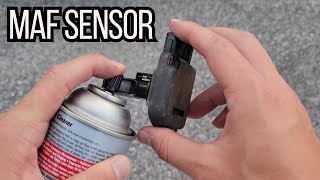
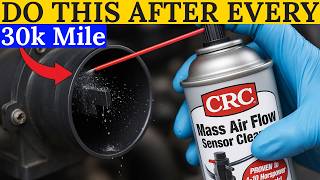
Carefully remove the MAF sensor from its housing. Generously spray the sensor's delicate wires or plates with a dedicated MAF sensor cleaner. **Crucially, do not touch the sensor elements with anything.** Let it air dry completely for at least 30 minutes before reinstalling. Never use brake cleaner or carburetor cleaner, as they can destroy the sensor. 🎬 Watch: A simple guide to cleaning your MAF sensor safely.
Tools: MAF Sensor Cleaner, Screwdriver/Socket set (beginner) - Test for Vacuum Leaks with a Smoke Test
While spraying flammable liquids can sometimes find leaks, the safest and most effective method is a smoke test. A smoke machine fills the intake system with low-pressure smoke, which will visibly pour out of any leak points, making them easy to identify. 🎬 Watch: How to find vacuum leaks quickly using a smoke machine.
Tools: Smoke machine (intermediate) - Test the MAF Sensor's Ground Circuit
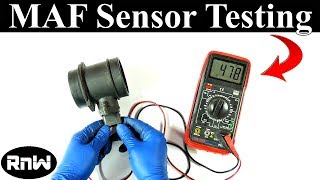
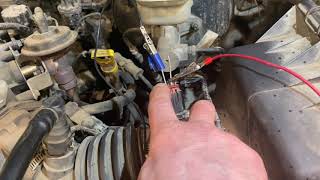
Using a multimeter set to DC volts, connect the positive lead to the MAF sensor's ground wire at the connector (back-probing) and the negative lead to the battery's negative terminal. With the key on and engine running, you should see a very low voltage reading, ideally less than 0.1 volts (100mV). A reading higher than this indicates high resistance or a poor ground connection, which is the root of a 'Ground Malfunction' code. 🎬 See how to test a MAF sensor without a wiring diagram.
Tools: Multimeter, Vehicle-specific wiring diagram (advanced) - [PRO TIP] Analyze Live Sensor Data
Using an advanced scan tool, view the live data stream for the MAF sensor. At idle, a typical 4-cylinder engine should read between 2-4 grams/second (g/s), while a V6 or V8 might read 4-7 g/s. As you smoothly increase engine RPM to 2500, this value should increase steadily to 15-25 g/s or more with no dropouts or glitches. A sensor that is stuck on one value or responds erratically is faulty. Also, compare the MAF reading to the MAP sensor reading (if equipped) to see if they correlate as expected.
Tools: Advanced OBD-II Scanner with Live Data (advanced) - [PRO TIP] Test MAF Signal and Voltage
With the engine running, use a multimeter to back-probe the MAF signal wire. At idle, the voltage should be stable, typically between 0.5V and 1.0V. When you snap the throttle, the voltage should rise sharply to 3.5V-4.5V and then return smoothly. Any reading that is stuck, erratic, or doesn't respond indicates a problem. For digital MAF sensors, you would measure frequency (Hz) which should increase smoothly with RPM, from around 2,000-3,000 Hz at idle to over 7,000 Hz at higher RPMs.
Tools: Multimeter, Vehicle-specific wiring diagram (advanced) - [PRO TIP] Test MAF Sensor Resistance (When Applicable)
Some older MAF sensors have an Intake Air Temperature (IAT) sensor built-in whose resistance can be tested. With the sensor unplugged, use a multimeter set to Ohms (Ω) to measure resistance between the IAT pins. A typical reading is around 2,000-3,000 Ω at room temperature (~70°F/21°C). This value should decrease as the sensor warms up. An open (infinite resistance) or shorted (zero resistance) reading indicates a faulty sensor. Note: This test is not applicable to all MAF sensor types.
Tools: Multimeter, Vehicle-specific wiring diagram, Service manual with resistance chart (advanced) - [PRO TIP] Test Fuel Pressure
If MAF and vacuum issues are ruled out, check fuel pressure. Connect a fuel pressure gauge to the fuel rail's service port. With the Key On, Engine Off (KOEO), pressure should be within the manufacturer's specification (e.g., 40-60 PSI for many Ford models). At idle, the pressure might drop slightly. If pressure is low, it could indicate a weak fuel pump or clogged filter, causing a lean condition that the PCM might misinterpret as a MAF fault.
Tools: Fuel pressure gauge, Service manual with pressure specs (advanced) - [PRO TIP] Test MAF Signal with an Oscilloscope
For intermittent issues that are hard to catch, a lab scope is the ultimate diagnostic tool. Connect the scope to the MAF signal wire and ground. You can view the sensor's voltage or frequency pattern in real-time. A good digital MAF sensor will show a clean, square wave that increases in frequency with airflow. A good analog sensor will show a smooth DC voltage that rises with airflow. Any hash, noise, or sudden dropouts in the pattern indicate a failing sensor or a wiring integrity problem.
Tools: Oscilloscope, Wiring diagram (professional)
Common Fixes & Costs
- Clean the Mass Airflow (MAF) Sensor — Parts: $10-$20, Labor: $75-$125 (includes diagnostic time) (diy)
- Replace the Engine Air Filter
— Parts: $15-$75, Labor: $0 (DIY)
(diy)
2005 Ford Focus: OEM YS4Z-9601-CC (Alt: Carquest: 83017, Fram: CA9030, K&N: 33-2212)
2015 Hyundai Sonata: OEM 28113-C1100 (Alt: Fram: CA11116, STP: SA10881, K&N: 33-5057)
2020 Chevy Silverado 5.3L: OEM 84121217 (Alt: ACDelco: A3246C, Fram: CA12404, WIX: WA10942) - Replace the Mass Airflow (MAF) Sensor
— Parts: $120-$400 (OEM), $50-$150 (Aftermarket), Labor: $50-$150
(intermediate)
2005 Ford Focus: OEM Motorcraft AFLS-132 (3L3Z-12B579-BA) (Alt: Delphi: AF10134, Bosch: 0280218063, Walker: 245-1108)
2015 Hyundai Sonata: OEM Hyundai 28164-2G700 (Alt: Walker: 245-1580, Delphi: AF10670, Duralast: DL-3147)
2020 Chevy Silverado 5.3L: OEM GM 23262343 / ACDelco 12711405 (Alt: Walker: 245-1664, Standard Motor Products: MAS0526, Holstein: 2MAF0001) - Repair Damaged Wiring or Connector
— Parts: $20-$60 (for a pigtail connector), Labor: $100-$300+
(professional)
2005 Ford Focus: OEM Motorcraft WPT-1241 (Alt: Dorman: 645-183, Standard Motor Products: S2371) - Repair Vacuum Leaks — Parts: $5-$100 (for hoses or gaskets), Labor: $100-$250 (intermediate)
Most Commonly Affected Vehicles
- Ford Focus (2000-2007) — The definition is 'MAF ground malfunction.' The wiring pigtail connector is a known failure point; the insulation becomes brittle and cracks, causing a short or open in the ground circuit. Always inspect this connector first.
- Chevrolet / GMC Silverado, Sierra (2019-2021) — While often showing the related P1101 code, these trucks are subject to Technical Service Bulletin (TSB) #21-NA-149. It details a wiring harness that can chafe against the driver's side shock tower, causing MAF sensor errors. This is a prime example of a wiring issue mimicking a sensor failure.
- Toyota / Lexus Camry, RAV4, ES250, NX250 (2018-2025) — On these modern Toyota/Lexus models, P1104 means 'Safety Processor Throttle Shutdown.' It is completely unrelated to the MAF sensor. The cause is often a dirty electronic throttle body, a failing throttle motor, or even an improperly placed floor mat interfering with the accelerator pedal.
- Hyundai / Kia Sonata, Elantra, Optima, Forte (2011-2019) — For these manufacturers, P1104 typically aligns with the common 'Mass Air Flow Sensor Circuit Ground' definition. Diagnosis should follow the standard MAF troubleshooting path.
- Subaru Legacy, Outback, Impreza (1995-2005) — On many older Subarus, P1104 is defined as 'Engine Torque Control Signal Circuit Malfunction.' This is often caused by wiring issues or a faulty ECU, frequently related to water damage from clogged cowl drains leaking onto the passenger-side floorboard where the ECU is located. Some models also fall under extended warranties for CVT issues that can cause stalling, a symptom sometimes confused with MAF problems.
- Volkswagen / Audi Jetta, Golf, A4, TT (1999-2010) — P1104 indicates 'Bank 1, Sensor 2 Voltage Too Low / Air Leak.' This code points to a problem with the downstream (post-catalytic converter) oxygen sensor, not the MAF sensor. The cause could be a failing O2 sensor, an exhaust leak, or a wiring issue to that sensor.
- Jaguar S-Type, X-Type (2000-2008) — The definition is 'Mass Air Flow Sensor Circuit Ground.' These vehicles are known for vacuum leaks from aged plastic and rubber components in the intake system, as well as issues with the MAF sensor connector.
- BMW 3-Series (E90) (2006-2011) — On some BMWs, P1104 can refer to a 'differential pressure sensor' fault related to the intake manifold, which is a different component from the MAF sensor. This highlights the critical need for a model-specific code definition.
Manufacturer-Specific Notes

- Toyota / Lexus: P1104 means 'Safety Processor Throttle Shutdown.' The issue is with the electronic throttle body, not the MAF sensor. The problem could be a dirty throttle body, a failing throttle motor, or even an improperly placed floor mat holding the gas pedal down slightly.
- Volkswagen / Audi: On many VW and Audi models, P1104 indicates 'Bank 1, Sensor 2 Voltage Too Low / Air Leak.' This points to a problem with the post-catalytic converter oxygen sensor, often caused by a failing sensor or an exhaust leak. It is unrelated to the MAF sensor.
- Chrysler / Dodge / Jeep / Mitsubishi: For these brands, P1104 often means 'Turbocharger Wastegate Solenoid Malfunction,' a completely different system related to boost control. Diagnosing the MAF sensor would be a waste of time and money.
- Subaru: On older models, P1104 is 'Engine Torque Control Signal Circuit Malfunction.' This is frequently a wiring or ECU issue, sometimes caused by water damage to the ECU, and has nothing to do with the MAF sensor itself. Some 2010-2015 models have an extended warranty on the CVT transmission for issues causing stalling, which could be misdiagnosed as a MAF problem. Additionally, some 2019 Ascent models had a recall (WRK-21) for a CVT issue causing loss of power.
- Ford: On many Ford vehicles, P1104 specifically points to a 'MAF ground malfunction.' Technicians often check the wiring pigtail connector first, as the insulation is known to become brittle and fail, causing an open or short in the ground wire.
- General Motors (Chevrolet/GMC): While not always a P1104, related MAF codes like P1101 on newer trucks are often caused by a known wiring harness issue (TSB 21-NA-149) where the harness rubs against a bracket near the shock tower, causing a short.
Related Codes
- P0100 — This code means 'MAF Circuit Malfunction.' It is a more general code indicating a problem in the MAF circuit. If you have P1104 ('Ground Malfunction') along with P0100, it strongly suggests the issue is electrical rather than a dirty sensor.
- P0101 — This code, 'MAF Circuit Range/Performance,' means the sensor's readings are illogical compared to other sensors like the Throttle Position Sensor (TPS) and MAP sensor. A bad ground (P1104) can cause the erratic performance that triggers P0101. Fix the P1104 issue first.
- P1100-P1103 — This range of manufacturer-specific codes is also related to the MAF sensor. They often appear with P1104 and point to different aspects of the MAF sensor's performance being out of specification (e.g., intermittent signal, low input). P1104 specifically implicates the ground circuit as the likely source.
- P0171 and P0174 — These codes mean 'System Too Lean' for Bank 1 and Bank 2. A faulty MAF sensor that under-reports airflow will cause the PCM to inject too little fuel, creating a lean condition. If you have P1104 with these codes, the MAF system is the prime suspect. If you only have P0171/P0174, the cause is more likely a vacuum leak, but a faulty MAF is still a possibility.
DIY vs Professional
- Clean the MAF Sensor — Beginner:
Tools: Screwdriver/socket set, MAF sensor cleaner spray. - Replace the Engine Air Filter — Beginner:
Tools: None or basic hand tools (for the airbox clips/screws). - Replace the MAF Sensor — Beginner:
Tools: Screwdriver/socket set, possibly security Torx bits. - Repair Vacuum Leaks — Beginner:
Tools: Flashlight, hose clamp pliers. For diagnosis: smoke machine (professional) or propane torch/carb cleaner/soapy water (DIY). - Repair Damaged Wiring or Connector — Beginner:
Tools: Multimeter, wiring diagrams, wire strippers, crimpers, heat shrink, soldering iron (recommended).
Climate & Environmental Factors
- High Humidity / Salt Belt Regions: Accelerates corrosion on wiring, connectors, and especially the MAF ground point on the chassis or engine block. This increases electrical resistance, which can directly trigger a P1104 ground malfunction code.
- Extreme Cold: Wiring insulation can become brittle and crack, particularly on older vehicles. Engine movement and vibration can then cause the exposed wire to short to ground or break entirely, leading to an open circuit. This is a common failure mode for the MAF connector pigtail on affected Fords.
- High Altitude: At higher altitudes, the air is less dense. The MAF sensor will correctly report lower air mass, and the PCM should adjust fuel trims accordingly. While high altitude itself doesn't cause P1104, it can exacerbate existing problems. A marginally faulty sensor or a small, undetected vacuum leak might be pushed outside of the PCM's acceptable range, triggering a P0101 or related lean code alongside P1104.
Frequently Asked Questions
I replaced my MAF sensor and the P1104 code came back. What now?
This is a classic diagnostic mistake. The code P1104 often points to the *circuit*, not the sensor. The root cause is likely a poor ground connection, a damaged wire, or a loose pin in the connector. You must diagnose the circuit as described in the steps above; simply replacing parts is an expensive way to guess.
Can a bad ground wire really cause all these MAF sensor problems?
Absolutely. The PCM reads the MAF sensor's signal by comparing it to a ground reference. If that ground reference is unstable or has high resistance (over 0.1 volts), the entire signal becomes unreliable and nonsensical to the PCM, even if the MAF sensor is working perfectly.
What happens if I ignore a P1104 code?
Ignoring a P1104 code will lead to persistent poor engine performance, terrible fuel mileage, and a failed emissions test. In the worst-case scenario, running too rich or lean for an extended period can destroy your catalytic converter, turning a relatively minor repair into a multi-thousand-dollar one.
Can I just unplug my MAF sensor to see if it's the problem?
Unplugging the MAF sensor forces the car into a 'limp mode,' where it uses pre-programmed fuel tables instead of sensor readings. If the engine runs better when unplugged, it's a strong indicator that the MAF sensor is providing bad data. However, this is only a temporary diagnostic trick and not a fix. Driving this way long-term is not recommended.
Is it better to clean or replace the MAF sensor?
Always try cleaning it first. A can of dedicated MAF sensor cleaner is about $15 and the process is simple. Only replace the sensor if cleaning fails to solve the problem AND you have confirmed the wiring and ground connection are good.
How much does a shop charge to diagnose a Check Engine Light?
Most shops charge a diagnostic fee, which typically covers 1 to 1.5 hours of labor. This can range from $125 to over $250, depending on the shop's labor rate. This fee pays for a technician's time to properly diagnose the root cause, which is far more involved than simply reading the code with a free scanner.
Why does the P1104 code definition change so much between car brands?
Standard OBD-II codes (starting with P0) are universal. Codes starting with P1, like P1104, are manufacturer-specific. Automakers are free to use these codes to designate unique issues on their specific systems. This is why it's absolutely critical to use a scanner that provides the correct definition for your exact make, model, and year.
Helpful Videos




The information in this article is provided for general reference and educational purposes only. Vehicle specifications, procedures, and part compatibility can vary by production date, trim level, and region. Always consult your vehicle's factory service manual and verify part numbers before purchasing or performing repairs. Safety-critical components such as airbags, seat belts, and braking systems should be installed by a qualified professional.
- 🎬 Helpful Videos
- What Does P1104 Mean?
- Can I Drive With P1104?
- Common Causes
- Symptoms
- Diagnosis Steps
- Common Fixes & Costs
- Most Commonly Affected Vehicles
- Manufacturer-Specific Notes
- Related Codes
- DIY vs Professional
- Climate & Environmental Factors
- Frequently Asked Questions
- I replaced my MAF sensor and the P1104 code came back. What now?
- Can a bad ground wire really cause all these MAF sensor problems?
- What happens if I ignore a P1104 code?
- Can I just unplug my MAF sensor to see if it's the problem?
- Is it better to clean or replace the MAF sensor?
- How much does a shop charge to diagnose a Check Engine Light?
- Why does the P1104 code definition change so much between car brands?
- 🎟️ Get 5% Off