

P1101 on 2012-2017 Chevrolet Sonic: Intake Airflow Causes and Fixes
On the 2012-2017 Chevy Sonic, especially with the 1.4L Turbo engine, P1101 is almost always caused by a failed PCV system, most commonly a ruptured diaphragm in the valve cover. This creates a vacuum leak, causing a rough idle and hissing noise. The root cause is often a missing check valve in the intake manifold, which must be inspected. Replacing the valve cover assembly is the typical fix, costing around $70-$150 for the part.
- For a 2012-2017 Sonic with the 1.4L Turbo engine, a P1101 code is most likely caused by a failed PCV system, not a bad MAF sensor.
- Listen for a hissing noise at idle. This is a tell-tale sign of a ruptured PCV diaphragm inside the valve cover, the most common failure.
- The fix is usually to replace the entire valve cover assembly, which is a DIY-friendly job for many.
- Always check for the small orange PCV check valve inside the intake manifold; if it's missing, it must be addressed.
- This code is often accompanied by P0171 (System Too Lean), confirming the presence of a vacuum leak.
What's Unique About the 2012-2017 Chevrolet SONIC

The Chevrolet Sonic, particularly the 1.4L Turbo model, shares its engine with the Chevy Cruze, Trax, and Buick Encore, and is notorious for a specific PCV (Positive Crankcase Ventilation) system failure that directly causes the P1101 code. The failure is a chain reaction: a small orange check valve in the intake manifold can dislodge and get ingested by the engine. Without this valve, the PCV system is exposed to turbo boost pressure, which quickly ruptures a rubber diaphragm located inside the valve cover. This ruptured diaphragm creates a massive vacuum leak, triggering the P1101 code. Unlike many cars where P1101 might point to a simple MAF sensor cleaning, on the Sonic it's highly probable the issue is this well-documented PCV system flaw.
🎬 Watch: A complete guide to diagnosing and solving these PCV issues.Diagnostic Flowchart

Tap your situation to follow the diagnostic path that matches what you're seeing on this vehicle.
Symptoms You May Notice

- Check Engine Light is on.
- Rough, surging, or erratic idling.
- Loud hissing, whistling, or sucking sound from the engine bay, especially at idle.
- Reduced engine power and sluggish acceleration.
- Engine stalling when stopped or at low speeds.
- Decreased fuel economy.
- Difficulty removing the oil filler cap or dipstick while the engine is running due to strong vacuum.
- Oil leaks from engine seals (in advanced cases of PCV failure, as noted in TSB 20-NA-047).
- Immediately replacing the MAF sensor without checking the PCV system first. On the 1.4L Turbo engine, the PCV system is a much more likely culprit.
- Replacing the valve cover without first checking for the presence of the orange check valve in the intake manifold. If the check valve is missing, the new valve cover will fail again in a very short time.
Most Likely Causes

- Ruptured PCV Diaphragm in Valve Cover 🔴 High Probability This is the most common failure on the 1.4L Turbo engine. The rubber diaphragm inside the valve cover tears, creating a large, unmetered vacuum leak. This is often a secondary failure caused by a missing check valve in the intake manifold.
How to confirm: With the engine running, listen for a distinct hissing sound. Place your finger over the small square hole on the circular part of the valve cover; if the hissing stops and strong suction is felt, the diaphragm is torn. You can also try to remove the oil dipstick; a chugging sound or the engine wanting to die confirms high crankcase vacuum.
Typical fix: Replace the entire camshaft/valve cover assembly. The diaphragm is not sold separately by GM, though some aftermarket repair kits exist. CRITICAL: You must inspect the intake manifold check valve before replacing the cover.
Est. part cost: $70-$150 - Missing or Clogged PCV Check Valve in Intake Manifold 🔴 High Probability This is the root cause of most P1101 issues. A small, orange, rubber non-return valve inside the intake manifold can become brittle, dislodge, and get ingested by the engine. This allows turbo boost pressure into the crankcase, which then destroys the diaphragm in the valve cover.
How to confirm: Remove the PCV hose from the top of the intake manifold. Look down into the port with a flashlight. You should see the small orange 'nipple' or check valve. If you only see a dark, empty hole, the valve is missing.
Typical fix: If the valve is missing, the intake manifold must be replaced to restore the check valve function. Alternatively, some owners install an external check valve kit (e.g., from CruzeKits.com) as a more permanent solution. 🎬 See how to install an affordable external check valve fix. Simply replacing the valve cover without addressing this will cause the new cover to fail again quickly.
Est. part cost: $100-$200 (for a new manifold) or $50-$80 (for an external kit) - Other Vacuum Leaks 🟡 Medium Probability Hoses and gaskets can become brittle over time. A common source is a cracked PCV pipe between the intake manifold and turbocharger inlet, as noted in TSB PI0907C.
How to confirm: Perform a smoke test by introducing smoke into the intake system and watching for where it escapes. Pay close attention to all PCV hoses, the intake manifold gaskets, and the throttle body seal.
Typical fix: Replace the specific leaking hose, gasket, or seal. The PCV pipe part number is 55568267.
Est. part cost: $15-$60 - Contaminated or Faulty Mass Airflow (MAF) Sensor ⚪ Low Probability While less common than PCV issues on this car, oil from an over-oiled aftermarket air filter or dirt from a poorly sealed airbox can contaminate the sensor. This is often misdiagnosed as the primary cause when the real issue is the PCV system.
How to confirm: Remove the sensor and inspect the sensing elements for dirt, oil, or debris. You can try cleaning it with dedicated MAF sensor cleaner. 🎬 Watch this walkthrough on fixing the P1101 code on the 1.4L. If cleaning doesn't work, monitor its readings with a scan tool; they may be erratic or out of range.
Typical fix: Clean the sensor with MAF sensor cleaner. If the problem persists, replace the MAF sensor.
Est. part cost: $10 (cleaner) or $60-$120 (new sensor)
Rare But Worth Checking
- Dirty Throttle Body: Heavy carbon buildup can disrupt airflow enough to cause this code. It's an easy and cheap thing to check and clean before replacing more expensive parts.
- Improperly Installed Air Filter or Housing: An air filter that is not seated correctly or a cracked airbox can allow unmetered air in. Aftermarket Cold Air Intakes (CAI) with different tubing diameters can also trigger P1101 without a proper tune.
Diagnosis Steps
- Scan for any other codes. Codes like P0171 and P0106 strongly point towards the common PCV failure.
- With the engine running at idle, listen for a loud hissing or whistling sound from the top of the engine.
- If a hissing is heard, confirm a ruptured valve cover diaphragm by carefully placing a finger over the square PCV hole on the valve cover to feel for strong suction.
- As another confirmation, pull the oil dipstick out slightly while the engine is running. If the engine stumbles or makes a chugging sound, it confirms excessive crankcase vacuum.
- CRITICAL STEP: Remove the PCV hose from the intake manifold and look inside the port for the presence of the small orange check valve. If it is missing, the intake manifold must be replaced or an external kit installed.
- If no obvious PCV failure is found, use a scan tool to monitor throttle position at warm idle with A/C off. Per TSB PI0907C, a reading below 7% suggests an unmetered air leak that needs to be found.
- Inspect all intake air ducts and PCV hoses between the air filter housing and the engine for cracks, loose connections, or damage.
- If no obvious leaks are found, perform a smoke test to identify any hidden vacuum leaks.
- Inspect and clean the throttle body and the Mass Airflow (MAF) sensor using dedicated cleaners.
- If oil leaks are present with P1101, consider following the diagnostic steps in TSB 20-NA-047, which involves measuring crankcase pressure to check for a blocked internal PCV orifice in the intake manifold.
Parts You'll Likely Need
- Camshaft Valve Cover
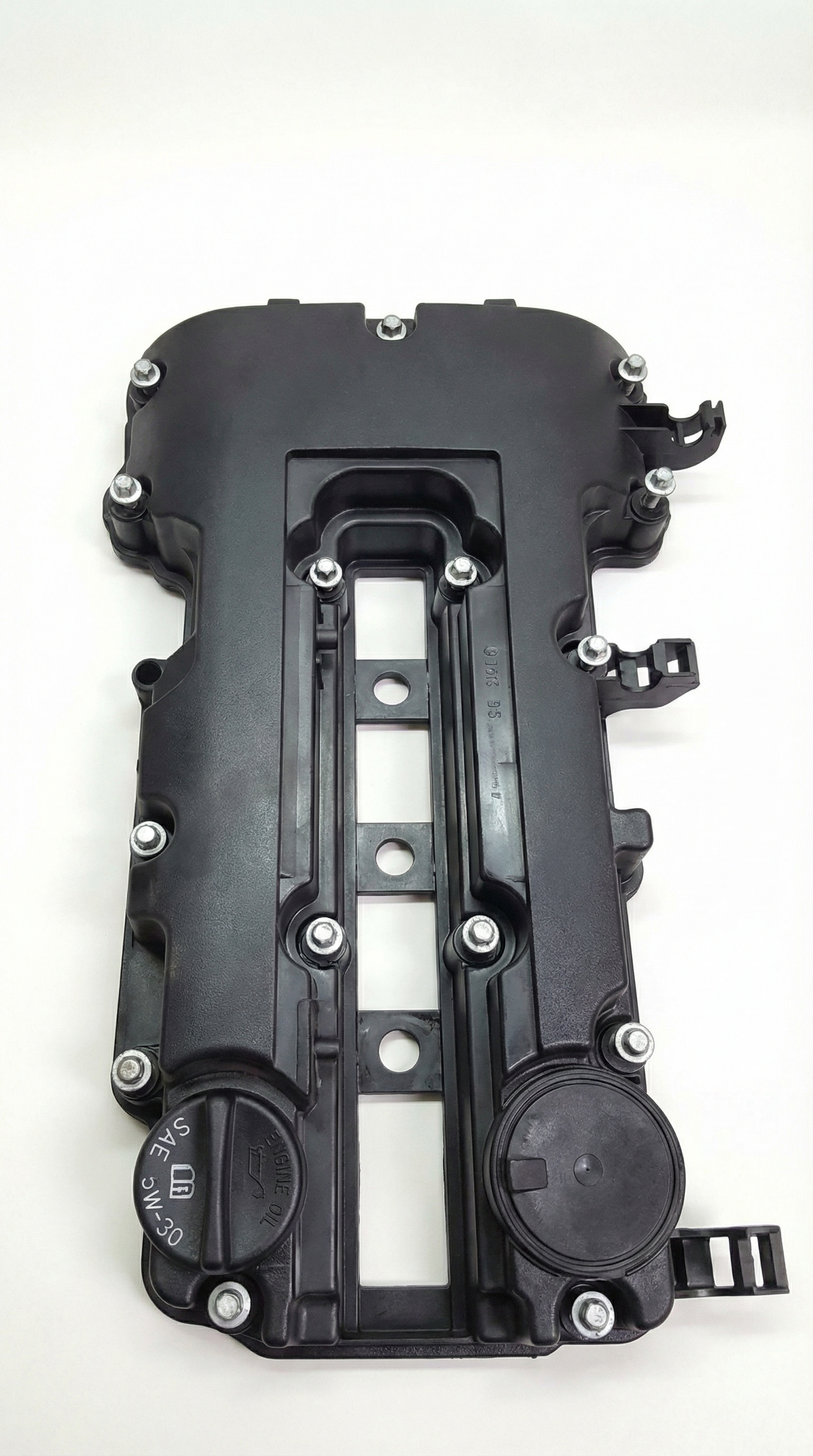
(OEM #25198874 (supercedes 55573746))— This is the most common fix for the 1.4L Turbo engine, as it contains the integrated PCV diaphragm that frequently ruptures, causing a massive vacuum leak and the P1101 code.
Trusted brands: ACDelco (OEM), Dorman (P/N: 264-968)
OEM price range: $120-$180
Aftermarket price range: $70-$110 - Intake Manifold
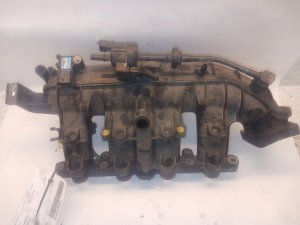
(OEM #55573171)— Needed if the internal orange PCV check valve has been dislodged and ingested by the engine. Replacing the manifold restores this critical valve. Failure to do so will cause repeat failure of the new valve cover.
Trusted brands: ACDelco (OEM), Dorman
OEM price range: $150-$250
Aftermarket price range: $100-$180 - PCV Fix Kit (External)
Related Codes That Often Appear With This One
- P0171 — System Too Lean (Bank 1). This code is almost always present with P1101 because the underlying cause is a massive vacuum leak from the PCV system, which allows unmetered air into the engine, creating a lean condition.
- P0106 — Manifold Absolute Pressure (MAP) Sensor Performance. A faulty PCV system causes erratic pressure in the intake manifold, which can also trigger a MAP sensor code. The combination of P1101, P0171, and P0106 is very common for this failure.
- P0496 — EVAP Flow During Non-Purge Condition. An owner complaint filed with the NHTSA reported this code alongside P1101, suggesting a systemic vacuum or pressure issue. A faulty purge valve can also contribute to vacuum leaks.
Technical Service Bulletins (TSBs) & Recalls
- PI0907C — Check Engine Light On with DTC P1101 Set — This bulletin addresses DTC P1101 when normal diagnostics don't resolve it. It instructs technicians to check the throttle position angle at idle (should be 8-12%). A reading below 7% indicates unmetered air. It points to a faulty PCV pipe with a back pressure valve open at the turbocharger inlet as a potential cause. The fix is to replace the PCV pipe (Part No. 55568267). (2016-10-10)
- 20-NA-047 — Front or Rear Crankshaft Oil Leak, Malfunction Indicator Lamp (MIL) Illuminated - DTC P1101 Set — This TSB connects P1101 with front or rear crankshaft oil leaks. It identifies the cause as a plugged PCV orifice inside the intake manifold, leading to excessive crankcase pressure that pushes oil past the seals. The diagnostic procedure involves measuring crankcase pressure; if it's too high, the intake manifold must be replaced. (2020-03-12)
- N202299080 (Special Coverage) — Special Coverage Adjustment - Camshaft Cover — GM issued a special coverage program, similar to an extended warranty, for the camshaft cover on certain 2012-2014 Sonic models (among others). This extends the warranty for this specific failure to 10 years or 120,000 miles, recognizing the high failure rate of the PCV diaphragm. (2020-07)
Platform-Specific Known Issues
- The PCV system on the 1.4L Turbo engine is a known weak point. The design flaw begins with the check valve in the intake manifold, which fails and leads to the destruction of the diaphragm in the valve cover.
- GM has issued multiple Technical Service Bulletins (PI0907C, 20-NA-047) and even a Special Coverage Adjustment (N202299080) extending the warranty on the camshaft cover to 10 years/120,000 miles for some model years due to the high failure rate.
Mechanic-Grade Diagnostic Values
- Mass Airflow (MAF) Sensor at idle — expected: 2-7 g/s, with a rule-of-thumb being close to the engine displacement (e.g., ~1.4 g/s for 1.4L engine). One source specifies 4.0-5.5 g/s for a healthy 1.4L.. Failure: A reading significantly lower than expected (e.g., 2.1-3.2 g/s) indicates an unmetered air leak downstream or a faulty sensor.
- Mass Airflow (MAF) Sensor at 2500 RPM — expected: 15-25 g/s.. Failure: Readings that are sluggish to respond or fail to reach the expected range indicate a problem.
- Long-Term and Short-Term Fuel Trims (LTFT/STFT) — expected: Within +/- 10% at idle.. Failure: Consistently high positive values (e.g., +25% or higher) confirm the engine is compensating for a massive unmetered air (vacuum) leak.
- Manifold Absolute Pressure (MAP) Sensor Voltage (KOEO) — expected: Approximately 4.7V to 5.0V (reading atmospheric pressure).. Failure: Voltage near zero or significantly below 4.5V with the key on and engine off points to a wiring or sensor issue.
- Manifold Absolute Pressure (MAP) Sensor Voltage at Idle — expected: Drops to around 1.0V to 2.0V due to engine vacuum.. Failure: Voltage that does not drop significantly from the KOEO reading suggests a massive vacuum leak or a faulty sensor.
Hidden / Shadow Codes Worth Checking
- P1101-00: The '-00' suffix indicates a standard P1101 fault without any manufacturer-specific sub-faults or symptom bytes. It is the generic identifier for 'Intake Air Flow System Performance'. (see via Standard OBD-II scanner.)
Scan Tool Commands That Help
- GDS2 or other professional scan tool: Live Data Monitoring — This is the most critical function for diagnosing P1101. Monitor MAF (g/s), MAP (Voltage), and Short/Long Term Fuel Trims. Comparing the actual MAF reading to the expected value and seeing high positive fuel trims is the primary way to confirm an unmetered air leak.
- GDS2 or other professional scan tool: Throttle/Idle Learn Reset — This function should be performed after cleaning or replacing the throttle body to reset learned idle and airflow values. Failure to do so can sometimes cause persistent idle issues even after the physical repair is complete.
Wiring & Ground Locations
- G104, G105, G107 — G104 is on the radiator support. G105 is under the battery tray on the frame rail. G107 is on the lower left rear of the engine block.. A GM Preliminary Information bulletin (PIC5879) specifically advises inspecting grounds G100 through G107 for looseness or contamination when diagnosing various electrical complaints. Poor grounds for the ECM or its sensors can cause erratic readings that may trigger a P1101.
- G101 — Located at the front of the engine, lower block area.. This ground is reported to serve the Engine Control Module (ECM) and the Mass Air Flow (MAF) sensor. A poor connection here could directly cause incorrect MAF sensor readings.
Real Owner Repair Stories
- YouTube channel 'Fixing With Friends' (Buick Encore 1.4L Turbo (same engine/PCV system as Sonic)) — P1101 code, lack of boost.
❌ Tried (didn't work) Replaced valve cover assembly, Installed an external PCV fix kit, Cleaned the throttle body, Replaced the MAF sensor with a new Bosch unit
✅ What actually fixed it The final fix was replacing a cracked intercooler pipe (GM Part #42698921). The crack was likely only opening under boost pressure, causing a discrepancy between measured and expected airflow that a static smoke test might miss. - Sonic Owners Forum user 'jpc' (Chevrolet Sonic 1.4L Turbo) — PCV code, lean code (P0171), and a squealing noise at low RPM.
❌ Tried (didn't work) Replaced the PCV valve (likely part of an external kit).
✅ What actually fixed it The user found the PCV port in the cylinder head itself was completely clogged with carbon buildup. The fix was to physically clear the clog and replace the intake manifold gasket, which had been damaged.
"I Checked Everything" — The Actual Cause
- A crack in a turbocharger intercooler pipe may not leak during a low-pressure smoke test but can open up under boost. This creates a significant air leak after the MAF sensor but before the cylinders, causing the ECM to see a mismatch between measured airflow and what's calculated from other sensors, triggering P1101.
- An internally clogged PCV orifice inside the cylinder head will not present as a leak during a smoke test. However, it completely blocks the intended PCV path, causing crankcase pressure issues and forcing unmetered air to be drawn from other places (like seals or the oil cap), leading to a lean condition and P1101.
When the Usual Fixes Don't Work
- While the vast majority of P1101 codes on the 1.4L Turbo engine are caused by the well-documented PCV system failure (valve cover diaphragm and/or intake manifold check valve), there are confirmed cases where these parts were replaced without resolving the issue. In one such case, the ultimate cause was a cracked intercooler pipe, which created an air leak only under boost pressure. In another, a completely clogged PCV port in the cylinder head itself was the root cause. These instances highlight the need to look beyond the most common failure point if the initial, standard repair does not work.
OEM Part Supersession History
55573746→25198874— Likely an updated design to improve durability of the internal PCV diaphragm or materials.
Model Year Variations Within This Range
- 2012-2017: While the Chevrolet Sonic received a facelift for the 2017 model year, it continued to use the same Gen 1 1.4L (LUV) port-injected turbo engine throughout the 2012-2020 model years. This is an important distinction, as the Chevrolet Cruze switched to a new Gen 2 1.4L direct-injected engine in 2016. Therefore, engine-specific parts and procedures for a 2016+ Cruze may not apply to a 2016+ Sonic.
Helpful Videos

Used OEM Parts in Stock
New Aftermarket Parts Available


The information in this article is provided for general reference and educational purposes only. Vehicle specifications, procedures, and part compatibility can vary by production date, trim level, and region. Always consult your vehicle's factory service manual and verify part numbers before purchasing or performing repairs. Safety-critical components such as airbags, seat belts, and braking systems should be installed by a qualified professional.
- Chevrolet SONIC:
- 🎬 Helpful Videos
- 🛍️ Shop This Part
- What's Unique About the 2012-2017 Chevrolet SONIC
- Diagnostic Flowchart
- Symptoms You May Notice
- Most Likely Causes
- Rare But Worth Checking
- Diagnosis Steps
- Parts You'll Likely Need
- Related Codes That Often Appear With This One
- Technical Service Bulletins (TSBs) & Recalls
- Platform-Specific Known Issues
- Mechanic-Grade Diagnostic Values
- Hidden / Shadow Codes Worth Checking
- Scan Tool Commands That Help
- Wiring & Ground Locations
- Real Owner Repair Stories
- "I Checked Everything" — The Actual Cause
- When the Usual Fixes Don't Work
- OEM Part Supersession History
- Model Year Variations Within This Range
- 🎟️ Get 5% Off