

P1101 on 2021-2022 Buick Encore: Causes and Fixes for Airflow Faults
On a 2021-2022 Buick Encore, code P1101 is almost always caused by unmetered air entering the engine, not a bad sensor. The most common culprits are PCV system failures, starting with a failed check valve in the intake manifold which then causes the valve cover diaphragm to rupture. Other causes include cracked intake hoses or, less commonly, crankshaft seal leaks caused by the PCV failure. A smoke test is the most effective way to find the leak.
- P1101 on a 2021-2022 Encore is a code for an air intake system performance issue, almost always caused by a vacuum leak.
- Do not immediately replace the MAF sensor. The most common cause is a failure in the PCV system, specifically the diaphragm in the valve cover.
- A simple diagnostic test is to try and remove the oil cap while the engine is running; strong resistance indicates a failed PCV diaphragm.
- Check all intake hoses between the turbo and the throttle body for cracks or loose connections, as this is another common leak point.
- A smoke test is the most reliable method to find the exact source of the air leak.
What's Unique About the 2021-2022 Buick ENCORE

The 1.4L turbocharged engine (LUV/LE2 family) used in the Encore and its platform mates (Chevy Cruze, Sonic, Trax) has a well-documented, systemic PCV (Positive Crankcase Ventilation) design flaw that directly causes the P1101 code. The failure sequence typically begins when a small, orange check valve inside the intake manifold degrades and fails, sometimes getting ingested by the engine. This allows pressurized turbo boost to enter the crankcase, which quickly ruptures the PCV diaphragm located inside the valve cover, creating a massive vacuum leak. While GM has issued TSBs like #20-NA-047 linking P1101 to crankcase pressure issues, the root cause is this cascade of PCV component failures.
Diagnostic Flowchart

Tap your situation to follow the diagnostic path that matches what you're seeing on this vehicle.
Symptoms You May Notice

- Check Engine Light is on
- Reduced engine power or sluggish acceleration
- Rough or unstable idle
- Loud whistling or hissing noise from the engine bay, especially at idle.
- Poor fuel economy
- Strong vacuum suction when trying to remove the oil filler cap with the engine running.
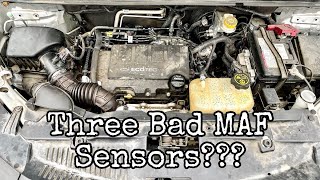
- Replacing the MAF sensor without diagnosing the root cause. The P1101 code on this engine is most often caused by a vacuum leak from the PCV system, and a new MAF sensor will not fix it. 🎬 See how one owner diagnosed and fixed the P1101 code.
- Replacing only the valve cover without inspecting the intake manifold. If the internal check valve in the manifold has failed, the new valve cover diaphragm will rupture again in a short amount of time.
Most Likely Causes

- Failed PCV System (Valve Cover Diaphragm and/or Intake Manifold Check Valve) 🔴 High Probability The 1.4L turbo engine has a known design flaw where the PCV check valve in the intake manifold fails, allowing boost pressure into the crankcase, which then ruptures the diaphragm in the valve cover. This is the most common cause of P1101.
How to confirm: With the engine running, listen for a loud hissing sound from the valve cover. Try to remove the oil filler cap; if a very strong vacuum holds it on, the PCV diaphragm has failed. Visually inspect the PCV port on the intake manifold; if the small orange check valve is missing, the manifold has failed and is the root cause.
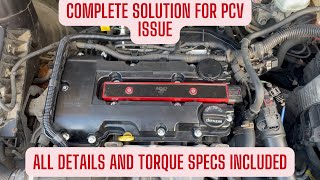
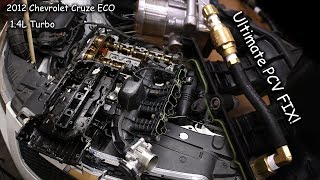
Typical fix: The correct repair is to replace BOTH the intake manifold (if the check valve is missing) and the valve cover assembly. Replacing only the valve cover will result in a repeat failure. Some owners opt for an aftermarket PCV bypass kit from sources like 'CruzeKits' as a more permanent solution. 🎬 Watch: How to install a permanent PCV bypass kit fix.
Est. part cost: $170-$600 - Leaking or Poorly Seated Charge Air Cooler (CAC) Hose 🟡 Medium Probability TSB #18-NA-333 specifically calls out a poorly seated charge air cooler outlet hose at the throttle body as a cause for P1101 and a whistling noise. These rubber/plastic hoses can also crack from age and heat cycles.
How to confirm: Visually inspect the flexible intake hoses between the intercooler and throttle body. Check for visible cracks, tears, or loose clamps. A smoke test is the definitive way to find a leak in this area if it's not visually obvious.
Typical fix: Reseat the hose and tighten the clamp. If the hose is cracked or damaged, it must be replaced. One owner found a crack in the intercooler pipe (GM Part Number 42698921) was the sole cause of their P1101 code after trying other fixes.
Est. part cost: $0-$120 - Crankshaft Oil Seal Leak (Caused by PCV Failure) ⚪ Low Probability TSB #20-NA-047 directly links P1101 to front or rear crankshaft oil leaks. This is not a primary cause, but a severe consequence of a failed PCV system creating excessive crankcase vacuum (pulling seals in) or pressure (pushing seals out).
How to confirm: Visually inspect for significant oil leaks at the front of the engine (behind the main pulley) or between the engine and transmission. This diagnosis is best confirmed by a professional after testing crankcase pressure as outlined in the TSB.
Typical fix: Replace the leaking crankshaft seal. This is a labor-intensive job. Crucially, the underlying PCV system fault MUST be repaired first, or the new seal will fail again.
Est. part cost: $20-$80 (plus significant labor) - Dirty or Faulty Mass Airflow (MAF) Sensor ⚪ Low Probability While a common cause on other vehicles, for the Encore it's often a symptom. Oil vapor drawn through the intake from a failed PCV system can contaminate the MAF sensor's delicate elements, causing incorrect readings.
How to confirm: Remove the MAF sensor from the intake tube and inspect the sensitive wires for a film of dirt or oil. It can be tested with a diagnostic scanner by observing airflow readings at idle and under load.
Typical fix: Clean the sensor with dedicated MAF sensor cleaner spray. Do not touch the sensor wires. If cleaning doesn't resolve the issue and the sensor is confirmed faulty, replace it, but only after confirming there are no vacuum leaks.
Est. part cost: $15-$150
Rare But Worth Checking
- Plugged PCV Orifice in Camshaft Cover: TSB #20-NA-047 also describes a scenario where a small, fixed PCV orifice (Part No. 12641875) in the camshaft cover can become clogged. This causes excessive *positive* crankcase pressure, which can also set P1101 and push out crankshaft seals. This is the opposite of the vacuum leak scenario but produces similar secondary results.
- Incorrect Air Cleaner Housing: TSB #PIP5240F mentions that some vehicles may have been fitted with the wrong air cleaner housing from the factory, which can cause airflow calculation errors and trigger P1101, often with P0171.
- Wiring Harness Issue: TSB #21-NA-016, which applies to the related Encore GX, notes that a poor crimp in the engine harness can skew sensor data and set P1101. While for a different model, it highlights the possibility of an electrical fault.
Diagnosis Steps
- Check for Technical Service Bulletins (TSBs) related to P1101 for your specific vehicle, paying close attention to #20-NA-047, #18-NA-333, and #PIP5240F.
- With the engine idling, listen for a distinct hissing or whistling noise from the engine bay, particularly around the valve cover.
- Perform the definitive PCV check: With the engine idling, carefully try to remove the oil cap. If it's held on by a strong vacuum, the PCV diaphragm in the valve cover has failed. This confirms a major vacuum leak.
- CRITICAL STEP: Remove the engine cover and the PCV hose from the intake manifold. Using a flashlight, look inside the port on the intake manifold for a small, orange, circular check valve. If it is missing, the intake manifold MUST be replaced along with the valve cover.
- Visually inspect the entire air intake system from the air filter box to the throttle body. Look for cracked hoses, loose clamps, or disconnected lines, paying special attention to the charge air cooler hoses.
- If no obvious leaks are found, perform a smoke test. This involves feeding low-pressure smoke into the intake system to easily visualize where unmetered air is escaping.
- If no leaks are found, test crankcase pressure using a manometer as described in TSB #20-NA-047 to check for excessive positive pressure, which would point to a clogged PCV orifice instead of a vacuum leak.
- As a final, less likely step, remove and inspect the MAF sensor for contamination. Clean it with dedicated MAF sensor cleaner spray. Do not touch the sensor elements.
Parts You'll Likely Need
- Valve Cover with PCV Diaphragm
(OEM #25198874, 55573746 (superseded by 25203036))— This is the most common failure point leading to P1101 on the 1.4L engine. The integrated PCV diaphragm tears, creating a large vacuum leak. It is almost always damaged as a result of a failed intake manifold check valve.
Trusted brands: ACDelco, Dorman (P/N: 264-968)
OEM price range: $150-$250
Aftermarket price range: $50-$150 - Intake Manifold — Required if the internal, non-serviceable PCV check valve has failed and is missing from its port. Replacing only the valve cover will lead to a repeat failure of the new cover's diaphragm.
Trusted brands: ACDelco, Dorman
OEM price range: $250-$400
Aftermarket price range: $150-$250 - Charge Air Cooler Outlet Hose
(OEM #42698921)— Can become cracked or poorly seated at the throttle body, causing a significant air leak that triggers P1101, as noted in TSB #18-NA-333 and confirmed by owner repairs.
Trusted brands: ACDelco
OEM price range: $80-$120
Aftermarket price range: $40-$70
Related Codes That Often Appear With This One
- P0171 — System Too Lean (Bank 1). An unmetered air leak that causes P1101 also allows extra, unmeasured air into the engine, creating a lean air/fuel mixture that the oxygen sensor detects.
- P0106 — Manifold Absolute Pressure (MAP) Sensor Performance. The large, unmetered vacuum leak from a failed PCV system causes MAP sensor readings to be out of their expected range, often triggering this code along with P1101 and P0171.
- P0300 — Random/Multiple Misfire Detected. A severe lean condition caused by the vacuum leak can lead to unstable combustion and misfires, particularly at idle.
Technical Service Bulletins (TSBs) & Recalls

- 20-NA-047: MIL Illuminated with DTC P1101 Set, related to crankshaft oil leaks.
- 18-NA-333: MIL on, whistle noise at startup, DTC P1101 set, related to a poorly seated air hose.
- PIP5240F: MIL on with DTC P0171 and/or P1101, related to an incorrect air cleaner housing.
Platform-Specific Known Issues
- TSB #20-NA-047: Crankcase Pressure and Oil Leaks: This key bulletin addresses P1101 when accompanied by crankshaft oil leaks. It details two failure modes: 1) Excessive NEGATIVE pressure (vacuum) from a ruptured PCV diaphragm pulling seals inward. 2) Excessive POSITIVE pressure from a clogged PCV orifice in the camshaft cover pushing seals outward. It provides procedures for testing crankcase pressure to determine the cause.
- TSB #18-NA-333: Whistle Noise and CAC Hose: Identifies a whistle noise and P1101 code caused by a poorly installed or loose Charge Air Cooler (CAC) outlet hose at the throttle body, creating a boost/vacuum leak.
- Sequential PCV System Failure: The most critical issue for this platform is the chain-reaction failure. The check valve in the intake manifold fails first, which then over-pressurizes the crankcase under boost, rupturing the weaker diaphragm in the valve cover. This creates the vacuum leak that sets code P1101. Repairing one part without the other leads to repeat failures.
Mechanic-Grade Diagnostic Values
- Mass Air Flow (MAF) Sensor at hot idle — expected: ~1.4 g/s (should roughly match engine displacement in liters). Failure: A reading significantly less than 1.4 g/s at hot idle, combined with a near-zero throttle opening percentage, strongly suggests a large vacuum leak (like a torn PCV diaphragm).
- Long Term Fuel Trim (LTFT) at idle — expected: Within +/- 10%. Failure: Sustained positive values of +20% or higher indicate the ECM is adding significant fuel to compensate for unmetered air from a vacuum leak.
- Manifold Absolute Pressure (MAP) Sensor Voltage at Key On, Engine Off (KOEO) — expected: ~4.0-4.9 Volts (reflecting atmospheric pressure). Failure: Voltage significantly different from the expected range can indicate a faulty sensor or wiring issue.
- Manifold Absolute Pressure (MAP) Sensor Voltage at idle — expected: ~1.0-2.0 Volts. Failure: Voltage that is stuck high and does not drop from the KOEO reading indicates a massive vacuum leak or a faulty sensor.
- Mass Air Flow (MAF) Sensor Voltage at Key On, Engine Off (KOEO) — expected: Near 0 Volts. Failure: A reading that is significantly above zero or fluctuating with the engine off points to a faulty MAF sensor or a wiring/ground issue.
Hidden / Shadow Codes Worth Checking
- P1101-00: The '-00' suffix indicates the standard P1101 fault without any additional manufacturer-specific sub-faults or symptom bytes. It does not provide deeper diagnostic information beyond the primary code definition. (see via Most standard OBD-II scanners)
Wiring & Ground Locations
- G101 — Located at the lower front of the engine block.. This is a primary ground for the Engine Control Module (ECM) and the Mass Air Flow (MAF) sensor. A poor connection here can cause erratic sensor readings, leading to incorrect airflow calculations and triggering a P1101 code.
- G103 — Located at the left rear of the engine compartment on the cowl, above the brake booster.. This ground serves the Body Control Module (BCM) and the Data Link Connector (DLC). A fault here can cause communication issues with scan tools or other modules that interact with the ECM. A service bulletin mentions ensuring G103 has a clean and tight connection when diagnosing various electronic issues.
Real Owner Repair Stories
- YouTube channel 'Fixing the Infamous GM / Chevy P1101 MAF Code on my Buick Encore 1.4L' (Buick Encore w/ 1.4L EcoTec engine) — Check Engine Light with code P1101, apparent lack of boost.
❌ Tried (didn't work) Replaced valve cover and installed an aftermarket PCV bypass kit ('CruzeKits')., Cleaned the throttle body., Replaced the MAF sensor with a new Bosch unit., Replaced O-rings on the oil cap and dipstick.
✅ What actually fixed it The final fix was replacing a cracked intercooler hose (GM Part Number: 42698921). The owner stated that proper diagnosis (like a smoke test) would have found this first, but they tried all the common internet fixes before finding the actual air leak. - YouTube channel 'DadsGarage Diagnostic Specialist' (2016 Chevy Cruze 1.8L (Similar airflow logic)) — Check engine light with P1101, engine runs funny at times.
❌ Tried (didn't work) Initial diagnosis focused on common PCV and vacuum leak issues.
✅ What actually fixed it The root cause was a cheap, poorly-fitting aftermarket air filter that was not sealing correctly in the airbox. This allowed unmetered air to bypass the filter and caused the MAF sensor to read inaccurately. Replacing it with a proper-fitting filter resolved the code. - ScannerDanner Forum (2019 Buick Encore 1.4L Turbo) — P1101 and P0171, fuel trims maxed out at idle.
❌ Tried (didn't work) Initial thought was a ruptured PCV diaphragm in the valve cover.
✅ What actually fixed it The technician confirmed strong vacuum at the valve cover, but upon inspecting the intake manifold's PCV port, found the orange check valve was missing. The final diagnosis was that the vehicle needed both a new intake manifold and a new valve cover.
OEM Part Supersession History
55573746→25198874— Part number consolidation and potential minor revisions by the manufacturer.
Heads up: Some parts suppliers list 25198874 as being replaced by 25209141, while others show the reverse or include both in a chain. It is critical to verify the latest part number with a GM dealer using the vehicle's VIN before ordering.25198874→25209141— Standard part evolution and updates by GM.
Heads up: This appears to be the latest number in the supersession chain for the valve cover.
Model Year Variations Within This Range
- 2021 vs 2022: For the standard Buick Encore (not the GX), there were no significant changes to the 1.4L Turbo engine or its related air intake/PCV systems between the 2021 and 2022 model years. The engine received a power bump to 155 hp for 2021, which carried over to 2022, but the underlying architecture and failure points for code P1101 remain identical.
Helpful Videos

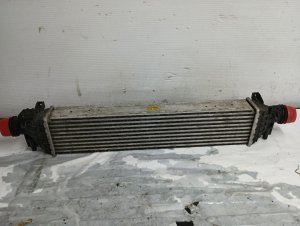
Used OEM Parts in Stock

New Aftermarket Parts Available



The information in this article is provided for general reference and educational purposes only. Vehicle specifications, procedures, and part compatibility can vary by production date, trim level, and region. Always consult your vehicle's factory service manual and verify part numbers before purchasing or performing repairs. Safety-critical components such as airbags, seat belts, and braking systems should be installed by a qualified professional.
- Buick ENCORE:
- 🎬 Helpful Videos
- 🛍️ Shop This Part
- What's Unique About the 2021-2022 Buick ENCORE
- Diagnostic Flowchart
- Symptoms You May Notice
- Most Likely Causes
- Rare But Worth Checking
- Diagnosis Steps
- Parts You'll Likely Need
- Related Codes That Often Appear With This One
- Technical Service Bulletins (TSBs) & Recalls
- Platform-Specific Known Issues
- Mechanic-Grade Diagnostic Values
- Hidden / Shadow Codes Worth Checking
- Wiring & Ground Locations
- Real Owner Repair Stories
- OEM Part Supersession History
- Model Year Variations Within This Range
- 🎟️ Get 5% Off