

OBD-II Code P1100: Mass Air Flow (MAF) Sensor Signal Problem
The Ultimate Guide to What P1100 Means, Why It Triggers, and How to Fix It for Good
- P1100 indicates an intermittent signal from the Mass Air Flow (MAF) sensor, meaning the engine computer occasionally loses track of incoming air volume.
- Spend $10 on dedicated MAF sensor cleaner and 15 minutes cleaning the sensor wires before buying a $200 replacement part.
- Inspect the MAF wiring harness for pushed-out pins or chafed wires, as P1100 specifically flags an intermittent electrical connection rather than a hard failure.
- Verify your vehicle's specific P1100 definition; while Ford and Mazda use it for MAF issues, Toyota uses it for a Barometric Pressure (BARO) sensor fault.
- Fix P1100 within 1 to 2 months to prevent a rich fuel mixture from destroying your catalytic converter, which costs upwards of $1,500 to replace.
What Does P1100 Mean?

The P1100 code means your car's Powertrain Control Module (PCM) receives an erratic or intermittent signal from the Mass Air Flow (MAF) sensor. The MAF sensor measures the amount and density of air entering the engine. The PCM uses this data to calculate the precise fuel needed for efficient combustion. When this signal drops out, the engine cannot maintain the proper air-to-fuel ratio, causing immediate performance problems.
Technical definition: P1100 is a manufacturer-specific Diagnostic Trouble Code (DTC) indicating the Mass Air Flow (MAF) sensor signal is intermittent or falls outside expected calibrated limits during a self-test. It points to a fault within the air intake system or the sensor's electrical circuit preventing accurate airflow measurement. On certain Toyota models, this code points to a Barometric Pressure (BARO) sensor circuit malfunction.
Can I Drive With P1100?
Yes, But With Caution. You can drive short distances, but it is not recommended for long periods. Ignoring the issue causes poor engine performance, higher fuel consumption, and expensive engine damage. Specifically, running a rich or lean mixture destroys your catalytic converter, a repair costing between $1,000 and $4,000.
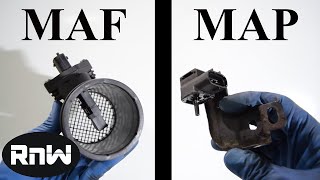
🎬 Watch: How to fix the P1100 code using two simple DIY methods.Common Causes

- Dirty or contaminated Mass Air Flow (MAF) sensor (Very Common) — Over time, the MAF sensor's delicate sensing elements get coated with dirt, oil, or debris. This coating insulates the sensor, preventing accurate airflow measurement and triggering the code. 🎬 See how to identify symptoms and properly clean your MAF sensor.
- Faulty MAF sensor wiring or connectors (Common) — Damaged wires, a loose electrical connector, or pushed-out pins interrupt the signal to the computer, causing it to drop out intermittently. This is a frequent point of failure often misdiagnosed as a bad sensor.
- Vacuum leaks (Common) — Cracked or disconnected vacuum hoses allow unmetered air to enter the engine after the MAF sensor. This throws off the air-fuel mixture, causing a conflict with sensor readings and triggering the code.
- Dirty or clogged engine air filter (Common) — A severely clogged air filter restricts the volume of air reaching the engine. This causes the MAF sensor to send readings the PCM interprets as illogical for a given engine speed.
- Defective Mass Air Flow (MAF) sensor (Less Common) — While cleaning solves many problems, the sensor itself fails electronically. The internal components break or degrade over time, requiring a full replacement.
- Blown fuse for MAF sensor circuit (Rare) — The MAF sensor circuit is protected by a fuse. If this fuse blows, the sensor loses power, causing an immediate fault code. This is a critical check before replacing parts.
- Dirty or faulty throttle body (Rare) — Heavy carbon buildup on the throttle body restricts airflow or causes the throttle plate to stick, leading to erratic airflow and sensor readings.
- Clogged catalytic converter or restricted exhaust (Rare) — If the exhaust system is restricted, air cannot flow efficiently through the engine. This backup causes unusual pressure and flow readings at the intake, incorrectly flagging the MAF sensor.
- Faulty Powertrain Control Module (PCM/ECU) (Very Rare) — The engine computer itself fails, incorrectly processing the signal from a perfectly good MAF sensor. This is more common in specific vehicles where Technical Service Bulletins (TSBs) mandate ECU software updates.
Symptoms

- Check Engine Light is on — The most obvious sign is an illuminated Malfunction Indicator Lamp (MIL) on your dashboard.
- Rough idle and stalling — The engine stutters, shakes, or stalls unexpectedly when the car is stopped or in neutral.
- Reduced power and surging — The car feels sluggish, hesitates on acceleration, or experiences sudden power losses and gains at steady speeds.
- Worse fuel economy — The engine runs inefficiently due to the incorrect air-fuel mixture, causing you to use significantly more gas.
- Black smoke from the exhaust — This indicates the engine is running too rich (too much fuel for the amount of air), a direct result of a bad MAF reading.
Diagnostic Flowchart
Tap your situation to follow the diagnostic path that matches what you're seeing on this code.
Common Fixes & Costs
- Cleaning the Mass Air Flow (MAF) Sensor — Parts: $10-$20, Labor: $50-$100, ~0.5 hr book time (DIY)
- Replacing the Engine Air Filter
— Parts: $20-$60, Labor: $0-$20, ~0.2 hr book time
(DIY)
Ford Focus (2000-2012): OEM YS4Z-9601-CC, 8S4Z-9601-A (Alt: Motorcraft FA-1688, Fram CA8969, Bosch 5121WS)
Mazda 3 (2004-2013): OEM LF50-13-Z40A-9U (Alt: STP SA8755, K&N 33-2293)
Toyota Corolla (1999-2009): OEM 17801-22020, 17801-YZZ05 (Alt: Denso 143-2095, Fram CA9482, Purolator A35567) - Repairing MAF Sensor Wiring or Connector — Parts: $10-$50, Labor: $100-$250, ~1.5 hr book time (Professional)
- Replacing a cracked or disconnected vacuum hose — Parts: $10-$50, Labor: $100-$200, ~1.5 hr book time (Intermediate)
- Replacing the Mass Air Flow (MAF) Sensor
— Parts: $150-$400, Labor: $75-$150, ~0.5 hr book time
(Intermediate)
Ford Focus (2.0L, 2008-2011): OEM 3L3Z-12B579-BA (Alt: Hitachi MAF0012, Walker 245-1108, SKP SK2451108 ($30-$75))
Mazda 3 (2.3L, 2007-2013): OEM L3K9-13-215-9U (Alt: Denso 197-6020, Walker 245-1138, Spectra Premium MA273 ($40-$150))
Toyota Corolla (1.8L, 2000-2008): OEM 22204-22010, 22204-0D030 (Alt: Denso 197-6020, Delphi AF10141, Walker 245-1085 ($50-$120))
DIY vs Professional
- Cleaning the MAF Sensor — Beginner: Yes
Tools: Screwdriver/socket set, dedicated MAF Sensor Cleaner spray, safety glasses. - Replacing the Engine Air Filter — Beginner: Yes
Tools: Usually none, but sometimes a screwdriver or socket set is needed to open the airbox. - Replacing the MAF Sensor — Beginner: Yes, with caution.
Tools: Screwdriver/socket set, new MAF sensor. - Finding a Vacuum Leak — Beginner: Partially.
Tools: Flashlight (for visual inspection). Professional tools include a smoke machine.
Used vs. New Parts: Buying Guide
When a used part is worth it: A used OEM MAF sensor from a low-mileage vehicle is a cost-effective option for older, high-mileage vehicles where the cost of a new OEM part is prohibitive.
Donor-vehicle mileage cap: roughly under 70000 miles for the part to have meaningful remaining life.
Donor quality checklist:
- Verify the donor vehicle was not scrapped for engine or emissions-related problems.
- Visually inspect the sensor for physical damage and ensure the internal sensing wires are intact and clean.
- Match the part number exactly. Sensors that look identical are often calibrated differently.
Decision logic:
- If The cost of a new, high-quality aftermarket sensor (e.g., Bosch, Denso) is less than 50% more than a used OEM part. → Buy the new aftermarket part for its warranty and reliability.
- If The vehicle is over 10 years old or has more than 150,000 miles and the budget is the primary concern. → A used OEM part is an acceptable risk, but understand it has a limited remaining lifespan.
- If The part is for a performance or newer vehicle where precise readings are critical. → Always buy a new OEM or OEM-supplier part. Cheap aftermarket sensors cause persistent performance issues.
Warranty tradeoff: Used parts from junkyards typically have a 30-90 day warranty at best, and often 'no returns' on electronic parts. New aftermarket parts usually offer a 1-year to limited lifetime warranty. New OEM parts carry a 1-year manufacturer warranty.
Worst-case if a used part fails: $150-$300 if the used part is faulty or fails shortly after installation, requiring repeat diagnostic time and labor, plus the cost of another replacement part.
What Happens If You Wait — Timeline
- 0-2 weeks: Check Engine Light is on with code P1100. The fault is intermittent, so there are often no noticeable driving symptoms. (MPG impact: 0-3%% · Added cost: $0)
- 2 weeks - 3 months: The intermittent fault becomes more frequent. Driver notices occasional rough idle, slight hesitation on acceleration, and a minor drop in fuel economy. (MPG impact: 3-8%% · Added cost: $30-$90 in wasted fuel)
- 3-8 months: The engine consistently runs rich or lean. Spark plugs begin to foul, and oxygen sensors become contaminated, leading to reduced performance and more codes. The catalytic converter is under constant stress from overheating (rich mix) or high NOx (lean mix). (MPG impact: 8-15%% · Added cost: $250-$600 (risk of needing new O2 sensors and spark plugs, plus significant fuel waste))
- 8+ months: Catastrophic failure of the catalytic converter substrate. The internal honeycomb melts from being constantly bathed in raw fuel, causing a major exhaust blockage. The car has severe power loss, and the converter replacement is mandatory. (MPG impact: 15-25%% · Added cost: $1,500-$3,500 (catalytic converter replacement, plus likely O2 sensors and spark plugs))
Cost of Not Fixing It
- 0-1 Month: Noticeable drop in fuel economy (5-15%), rough idling, and hesitation during acceleration. (Added cost: $20-$60 per month in wasted fuel.)
- 1-6 Months: Increased risk of fouling spark plugs and oxygen sensors due to an improper air-fuel mixture. The engine runs consistently rich, causing black smoke and poor performance. (Added cost: $200-$500 for spark plug and O2 sensor replacement.)
- 6+ Months: Catastrophic failure of the catalytic converter. A continuous rich condition causes the converter to overheat and melt internally, leading to a major exhaust restriction and severe power loss. (Added cost: $1,200-$2,800 for catalytic converter replacement.)
Diagnosis Steps

- Inspect and Replace the Engine Air Filter
Remove the engine air filter and check its condition. A filter that is black and clogged with dirt must be replaced. This simple step is sometimes the sole cause of the problem.
Tools: Screwdriver or socket set (depending on vehicle) (Beginner) - Visually Inspect the Air Intake System
Thoroughly inspect the entire air intake path. Look for a disconnected air intake boot, loose clamps, or visible cracks in the ducting between the air filter box and the throttle body. Ensure the MAF sensor is securely mounted.
Tools: Flashlight (Beginner) - Inspect and Clean the MAF Sensor
Locate the MAF sensor in the intake tube. Unplug its electrical connector, remove the sensor, and inspect the small wires inside. Clean them carefully using ONLY dedicated MAF sensor cleaner spray. Never touch the sensor elements. Allow it to air dry completely before reinstalling.
Tools: Screwdriver/socket set, MAF sensor cleaner spray (Beginner) - Inspect MAF Sensor Wiring and Connector
With the sensor unplugged, closely inspect the electrical connector for corrosion, bent or pushed-out pins, or loose wires. Gently wiggle the harness to see if the connection feels secure. A poor electrical connection is a frequent cause of an intermittent signal.
Tools: Flashlight, Electrical contact cleaner (Intermediate) - Check for a Blown Fuse
Consult your vehicle's owner's manual to locate the fuse for the MAF sensor circuit. Visually inspect the fuse to see if it has blown and replace it if necessary. This quick check saves hours of diagnostic time.
Tools: Fuse puller or needle-nose pliers (Beginner) - Check Live Data PIDs with a Scan Tool
Connect an OBD-II scan tool and view live data. At idle, the MAF sensor PID should read approximately 2-7 g/s for a 4-cylinder engine, increasing smoothly as you raise the RPM. An erratic MAF reading that drops to zero when you tap the sensor confirms a faulty sensor or connector.
Tools: OBD-II Scan Tool with Live Data capability (Advanced) - Test for Vacuum Leaks
With the engine running, listen for hissing sounds around the intake manifold and vacuum hoses. For a precise diagnosis, use a smoke machine to feed low-pressure smoke into the intake system, revealing the exact location of hard-to-see leaks.
Tools: Smoke machine or careful listening (Intermediate) - Pro Tip: Test MAF Sensor Voltage with a Multimeter
Back-probe the MAF sensor connector to check for a good ground and reference voltage. Start the engine. At idle, the signal wire reads between 0.5V and 1.0V. As you smoothly increase RPM to 2500, voltage increases steadily to 2.0V or higher. Sudden drops indicate a wiring issue.
Tools: Digital Multimeter, Back-probe kit (Advanced) - Pro Tip: Advanced MAF Signal Analysis with an Oscilloscope
Connect an oscilloscope to the MAF signal and ground wires. A healthy analog sensor shows a smooth voltage line rising with RPM. Look for 'dropouts' (signal suddenly drops to zero) as you wiggle the wiring harness. These visual anomalies are conclusive evidence of an intermittent failure.
Tools: Oscilloscope, Back-probe kit (Professional) - Advanced: Rule Out Fuel System Issues
Symptoms of a bad MAF sensor are sometimes mimicked by a fuel delivery problem. Connect a fuel pressure gauge to the fuel rail. Pressure should remain stable at idle. Low or fluctuating fuel pressure indicates a problem with the fuel pump or regulator, not the MAF sensor.
Tools: Fuel Pressure Gauge, Service Manual (Advanced)
When This Code Triggers (Freeze-Frame Conditions)
- Engine Coolant Temp: 180-200°F (The engine has reached full operating temperature.)
- RPM: 1500-2500 (The fault occurs during steady-state cruising or light acceleration, not typically at idle or full throttle.)
- Engine Load: 20-50% (The engine is under a moderate load, consistent with highway cruising or climbing a slight incline.)
- Vehicle Speed: 40-65 mph (The code frequently sets when driving at a constant highway speed.)
Related Codes
- P0101 — This code means 'Mass Air Flow (MAF) Circuit Range/Performance'. P1100 signifies the signal is intermittent or dropping out completely. P0101 means the signal is present but is not what the PCM expects for a given engine RPM and load.
- P0171 and P0174 — These codes mean 'System Too Lean' for Bank 1 and Bank 2. They appear alongside P1100 because a faulty MAF sensor under-reports airflow, causing the PCM to inject too little fuel. A vacuum leak causes all three codes.
- P1101, P1102, P1103, P1104 — These manufacturer-specific codes provide detail about how the MAF sensor signal fails. P1101 means 'Out Of Self Test Range', P1102 'Lower Than Expected', P1103 'Higher Than Expected', and P1104 'Ground Malfunction'. P1100 is a generic 'intermittent' fault in this family.
- P0100 — This code indicates a 'Mass Airflow (MAF) Circuit Malfunction,' meaning a general problem with the circuit, such as a complete loss of signal. P1100 is more specific, pointing to an intermittent or unstable signal.
Climate & Environmental Factors
- High Humidity: Excessive moisture condenses on the MAF sensor during temperature swings. This interferes with the sensor's ability to measure air mass and causes temporary corrosion on connector pins, triggering an intermittent fault.
- Extreme Cold: In very cold weather, plastic and rubber components in the air intake system become brittle and crack, causing vacuum leaks. Wiring insulation becomes stiff and cracks if disturbed, leading to intermittent electrical connections.
- High Altitude: At higher altitudes, the air is less dense. If the MAF sensor is borderline faulty, the larger-than-usual adjustments required for high altitude operation push its readings outside the expected range, triggering the code.
How to Talk to a Mechanic About This Code
Say this: "I have a P1100 code, which I understand is for an intermittent MAF circuit. Before we assume the sensor is bad, I'd like to authorize one hour of diagnostic time to specifically check for common causes like vacuum leaks with a smoke test, and to graph the live MAF sensor data to look for signal dropouts while checking the wiring harness."
This signals you've done your research and prevents a shop from immediately replacing an expensive sensor without proper diagnosis. It directs them to perform the exact tests needed to find an intermittent electrical fault or vacuum leak, which are common, cheaper fixes.
Avoid saying:
- 'Just fix whatever's wrong'
- 'My check engine light is on, can you look at it?' (too vague — invites upsell)
- 'I think I need a new mass airflow sensor.' (Don't diagnose for them, ask them to test your theory)
Questions to ask before authorizing the repair:
- Did you graph the MAF sensor's live data (voltage or g/s) and see it drop out when wiggling the harness?
- What were the long-term fuel trim percentages? Were they high, indicating a vacuum leak?
- Did you perform a smoke test to rule out intake leaks?
- Can you provide a printout or photo of the freeze-frame data?
- What is the warranty on this specific repair, and does it cover both parts and labor?
Where to Take It: Dealer vs Independent vs Chain
- Dealer:
Best for: Vehicles still under powertrain or emissions warranty., Vehicles with manufacturer-specific code definitions (e.g., Toyota's 'BARO circuit' or VW's 'O2 heater' meaning for P1100)., Complex electrical issues where access to Technical Service Bulletins (TSBs) is critical.
Downsides: Typically the highest labor rate., Recommends replacing an ECU when a simpler wiring fix or reflash suffices. (Typical cost: +50% vs. baseline) - Independent Shop:
Best fit for most common vehicles. A trusted independent shop with strong diagnostic skills is the ideal choice for a standard P1100 fault involving the MAF sensor, wiring, or a vacuum leak.
Best for: Out-of-warranty vehicles with common P1100 definitions (e.g., Ford/Mazda 'MAF Intermittent')., Owners looking for a better value on diagnostics and repair., Shops specializing in diagnostics or automotive electrical work.
Downsides: Quality varies widely; vet shops based on reviews and ASE certifications., Lacks access to the latest manufacturer TSBs or proprietary diagnostic software. (Typical cost: +0% vs. baseline) - Chain Shop:
Use with caution. Acceptable for replacing the MAF sensor *after* you have a definitive diagnosis from another source. AVOID for the initial diagnosis of a P1100 code.
Best for: Simple, confirmed fixes like an air filter replacement or MAF sensor cleaning.
Downsides: Technician skill varies dramatically; lacks experience with intermittent electrical faults., High pressure to sell parts leads to replacing the MAF sensor without proper diagnosis. (Typical cost: -10% vs. baseline)
When to Walk Away From the Repair
If the estimated repair cost exceeds 40-50% of the car's current private-party value (check Kelley Blue Book), it's time to seriously consider selling the car as-is or trading it in.
- Car worth $4000, fix is $2000: Borderline. The repair is 50% of the car's value. Get a second opinion before authorizing, and consider selling as-is.
- Car worth $12000, fix is $1800: Fix it. The repair cost is only 15% of the vehicle's value, which is well below the walk-away threshold.
- Car worth $2500, fix is $1500: Walk away. The repair is 60% of the car's value. It is not economically sensible to proceed with this repair.
What Scan Tool You Need for This Code
Minimum: A scanner with Live Data streaming and graphing capabilities.
A basic $20 code reader only tells you the P1100 code is present. It cannot display the live MAF sensor signal needed to spot the intermittent dropouts that trigger the code. Without live data graphing, you are blindly guessing between a faulty sensor, a wiring problem, or a vacuum leak.
Budget: BlueDriver Pro (~$119) — Connects to your smartphone via Bluetooth. It reads and clears codes, provides freeze-frame data, and most importantly, graphs live data from the MAF sensor so you visually confirm an intermittent signal.
Mid-range: Foxwell NT510 Elite (~$179) — A powerful handheld unit offering OE-level diagnostics for a specific manufacturer. It provides advanced live data, access to manufacturer-specific codes, and bidirectional controls to test components directly.
Professional: Autel MaxiCOM MK808BT (~$550) — A professional-level tablet scanner. It offers comprehensive all-system diagnostics, a wide range of service functions, and full bidirectional control to run active tests on nearly any component.
Rent vs buy: For a one-time diagnosis, use AutoZone's Loan-A-Tool program. You pay a deposit equal to the tool's cost, and get a full refund when you return it within 90 days. Buy a scanner only if you plan on performing your own diagnostics multiple times a year.
How to Clear the Code After You Fix It
- Use an OBD-II scan tool to clear the diagnostic trouble code.
- Disconnect the negative battery terminal for 15-30 minutes to reset the ECU's learned fuel trims.
- Perform a complete OBD-II drive cycle to allow readiness monitors to run.
Drive cycle (~20 minutes): Start the engine from cold and let it idle for 2-3 minutes. Drive in mixed city/highway conditions, including several minutes of steady-state cruising between 40-60 mph. Perform several smooth accelerations and decelerations. Allow the vehicle to cool down completely and repeat if necessary.
Readiness monitors affected: Catalyst (CAT) monitor, Oxygen (O2) Sensor monitor, Fuel System Monitor
Before emissions retest: drive at least 50 miles to fully set monitors.
Watch out for:
- Clearing the code without fixing the root cause results in the code returning immediately.
- Disconnecting the battery clears the code but resets all readiness monitors to 'Not Ready', causing an automatic emissions test failure.
- Not driving the vehicle long enough or under the right conditions after a repair leaves monitors 'Not Ready'.
Will This Fail Emissions / State Inspection?
Yes — this code typically fails an OBD-II emissions inspection.
- California: An active P1100 code causes an automatic failure of the smog check. After repairs, a full OBD-II drive cycle must be completed to set all readiness monitors to 'Ready' before passing a re-test.
- New York: The New York State vehicle inspection includes an OBD-II scan. An illuminated Check Engine Light from a P1100 code is an automatic failure.
- Texas: In counties requiring emissions testing, an active P1100 code results in an immediate inspection failure. After clearing the code, you must complete a drive cycle, as Texas allows for only one 'Not Ready' monitor on model year 2001 and newer vehicles.
Most Commonly Affected Vehicles
- Ford Focus, Fiesta, Mondeo, Ranger (1998-2012) — These models are frequently cited with P1100, defined as 'MAF Circuit Intermittent Voltage Input'. Testing the wiring harness and sensor signal is a primary diagnostic step.
- Mazda 323, 626, MX-5, Premacy (1995-2008) — On these vehicles, P1100 specifically means 'MAF Intermittent', making the sensor and its connector the primary suspects for diagnosis.
- Toyota Corolla, Camry, RAV4, Yaris (1999-2009) — On many Toyotas, P1100 refers to a 'BARO Sensor Circuit Malfunction'. Since most models lack a separate BARO sensor, the fault lies with the MAF/MAP sensor or the ECU itself.
- Honda Civic, Accord, CR-V (1996-2011) — These models experience MAF sensor issues triggering P1100, leading to rough idling and power loss. A blown ACG fuse is a known cause on models like the CR-V.
- Nissan Micra, Primera, Almera, X-Trail (2000-2012) — Commonly affected by P1100, with issues tracing back to a dirty MAF sensor or problems in the intake system like vacuum leaks.
- BMW 3-Series (E46, E90), Z4 (2000-2013) — P1100 points to a MAF sensor issue on models like the 335i and cars with the N46 engine, often traced to a faulty connector or the sensor itself.
- Hyundai Accent, Elantra, Santa Fe, Tucson, Sonata (2001-2013) — The definition varies; on a 2004 Sonata it indicates a 'Manifold Absolute Pressure (MAP) Sensor Circuit Malfunction'. TSBs exist for ECU updates to address incorrect codes.
- Volkswagen Group (VW, Audi, SEAT) Ibiza, Golf, A3 (2005-2015) — On some VW Group vehicles, P1100 means an 'O2 Sensor Heater Circuit Malfunction (Bank 1, Sensor 2)'. This is unrelated to the MAF sensor and requires a different diagnostic approach.
Manufacturer-Specific Notes
- Ford: P1100 specifically means 'Mass Air Flow Sensor Circuit Intermittent', pointing directly to a connection, wiring, or sensor issue. Check for Technical Service Bulletins (TSBs) as harness repairs are a common fix.
- Toyota/Lexus: Often defines P1100 as 'BARO Sensor Circuit Malfunction'. This code usually points back to a problem with the MAF/MAP sensor or the main computer (ECU). A TSB exists for some models regarding an ECU reflash to correct faulty logic.
- Mazda: Similar to Ford, Mazda defines P1100 as 'MAF Intermittent', making the sensor and its wiring the first place to check.
- GM (Chevrolet, GMC, etc.): P1100 is not a commonly used code. Related faults are indicated by codes like P1106 and P1107, pointing to intermittent high or low voltage in the Manifold Absolute Pressure (MAP) sensor circuit.
- Subaru: P1100 has a completely different meaning: 'Short to GND in Light System Communication Bus Malfunction'. This is an electrical/network issue and is NOT related to the MAF sensor or engine performance.
Real Owner Stories
2004 Ford Focus 2.0L ZETEC with P1100
Check Engine Light came on, but the car ran fine. A scan revealed code P1100 (MAF Circuit Intermittent).
What they tried:
- Visually inspected the MAF wiring harness for damage.
- Used a scan tool to monitor MAF voltage while wiggling the harness and tapping the sensor.
- Observed voltage dropping below the 0.23v threshold intermittently on the scan tool's graph, confirming an intermittent fault.
Outcome: The owner swapped the new aftermarket Delphi MAF sensor with an old OEM sensor they had saved. The intermittent voltage drops disappeared, and the code did not return after clearing.
Lesson: Even a brand new aftermarket sensor is sometimes faulty. If you experience an intermittent code, use a scan tool's live data or oscilloscope feature to confirm if the signal is dropping out before assuming other causes.
2010 Toyota Vitz 1KR-FE with P1100 & P1589
Check Engine Light appeared after an engine replacement. Scanned codes showed P1100 (BARO Sensor Malfunction) and other codes.
What they tried:
- Replaced the MAF sensor with a new one (same part number) - the light remained.
- Swapped the MAF sensor with the one from the old engine - the light still remained.
- Researched and found that for this model, the BARO sensor is integrated into the ECU.
Outcome: The owner ordered a replacement ECU with a matching part number. The diagnosis pointed to a faulty ECU as the root cause, not the MAF sensor itself.
Lesson: Always verify the manufacturer-specific definition of P1100. On many Toyotas, it points to a BARO sensor circuit, which is often part of the ECU. Replacing the MAF sensor in this case will not fix the problem.
2016 Honda CR-V with P1100
Vehicle had an intermittent P1100 code, with no obvious symptoms.
What they tried:
- Checked the air filter, which was clean.
- Cleaned the MAF sensor, but the code returned.
- Inspected the wiring and connector, which appeared fine.
Outcome: After further research, the owner checked the fuse box and discovered a blown 10-amp ACG (alternator) fuse (Fuse #2). Replacing the fuse resolved the P1100 code.
Lesson: Don't forget the simple checks. The MAF sensor circuit is protected by a fuse. A quick visual inspection of the fuse box, guided by the owner's manual, saves hours of diagnostic time and prevents unnecessary parts replacement.
How to Prevent This Code From Triggering
- Replace engine air filter at recommended intervals (Every 15,000-30,000 miles, or as specified by the manufacturer.) — A clean air filter is the first line of defense, preventing dirt and debris from reaching and contaminating the delicate MAF sensor elements.
- Clean the MAF sensor periodically (Every 30,000 miles or during every other air filter change.) — Using a dedicated MAF sensor cleaner removes minor oil and dust buildup before it becomes thick enough to insulate the sensor and cause an intermittent signal.
- Perform regular visual inspections of the intake system (Every oil change.) — Periodically checking for cracks in plastic intake tubes and deteriorated rubber vacuum hoses allows you to catch potential vacuum leaks before they become severe enough to trigger a code.
- Use high-quality, OEM-spec air filters (Every filter change.) — Avoid cheap or over-oiled aftermarket air filters. Poorly fitting filters let dirty air bypass them, while excess oil from oiled filters aerosolizes and coats the MAF sensor, leading to failure.
Frequently Asked Questions
Can I fix a P1100 code myself?
Yes, in many cases. Common fixes like cleaning the MAF sensor or replacing the engine air filter are beginner-level tasks. You can perform these at home with basic tools and a $10 can of dedicated MAF sensor cleaner.
How much does it cost to fix a P1100 code?
A simple DIY fix like cleaning the sensor costs under $20. A professional diagnostic runs $150 to $180 for labor. A full repair ranges from $25 for a new air filter to over $400 for a MAF sensor replacement at a dealership.
What is the first thing to check for a P1100 code?
Always start with a visual inspection of the air intake system. Check the engine air filter for dirt and inspect the air intake hose for cracks or loose connections. These free checks often reveal the exact source of the problem.
Will cleaning the MAF sensor definitely fix the P1100 code?
Not always, but it is a highly effective first step. If the sensor's internal electronics have failed, or if the problem is a vacuum leak or wiring issue, cleaning will not solve the problem. However, it resolves the issue frequently enough to be worth trying.
Does the P1100 code clear itself?
No. After repairing the underlying fault, you must manually clear the code from the PCM using an OBD-II scan tool. If you do not fix the root cause, the Check Engine Light returns immediately.
What happens if I ignore the P1100 code?
Ignoring it leads to a poor driving experience, including stalling and sluggish acceleration. Over time, running with an incorrect air-fuel mixture causes expensive damage to other components. Most notably, the catalytic converter overheats and fails, costing thousands to replace.
Can a vacuum leak cause a P1100 code?
Yes. A vacuum leak allows unmetered air to enter the engine, conflicting with the MAF sensor's data. The PCM detects this discrepancy and triggers a P1100 code, often alongside lean codes like P0171.
Does a new air filter help prevent this code?
Yes. Regularly replacing your engine air filter ensures clean air reaches the MAF sensor. This prevents the buildup of dirt and oil contaminants that cause inaccurate readings and trigger the code.
What are common misdiagnosis pitfalls for P1100?
A frequent mistake is replacing the MAF sensor without testing it or checking for simpler causes like vacuum leaks. Technicians must rule out dirty air filters and wiring issues first. Another pitfall is ignoring the manufacturer-specific definition, as P1100 means a BARO sensor fault on Toyotas.
Key Takeaways
- P1100 indicates an intermittent signal from the Mass Air Flow (MAF) sensor, meaning the engine computer occasionally loses track of incoming air volume.
- Spend $10 on dedicated MAF sensor cleaner and 15 minutes cleaning the sensor wires before buying a $200 replacement part.
- Inspect the MAF wiring harness for pushed-out pins or chafed wires, as P1100 specifically flags an intermittent electrical connection rather than a hard failure.
- Verify your vehicle's specific P1100 definition; while Ford and Mazda use it for MAF issues, Toyota uses it for a Barometric Pressure (BARO) sensor fault.
- Fix P1100 within 1 to 2 months to prevent a rich fuel mixture from destroying your catalytic converter, which costs upwards of $1,500 to replace.
Helpful Videos
![How to Fix P1100 Engine Code in 3 Minutes [2 DIY Methods / Only $7.66]](https://img.youtube.com/vi/U13aZHT7XNk/mqdefault.jpg)

The information in this article is provided for general reference and educational purposes only. Vehicle specifications, procedures, and part compatibility can vary by production date, trim level, and region. Always consult your vehicle's factory service manual and verify part numbers before purchasing or performing repairs. Safety-critical components such as airbags, seat belts, and braking systems should be installed by a qualified professional.
- 🎬 Helpful Videos
- What Does P1100 Mean?
- Can I Drive With P1100?
- Common Causes
- Symptoms
- Diagnostic Flowchart
- Common Fixes & Costs
- DIY vs Professional
- Used vs. New Parts: Buying Guide
- What Happens If You Wait — Timeline
- Cost of Not Fixing It
- Diagnosis Steps
- When This Code Triggers (Freeze-Frame Conditions)
- Related Codes
- Climate & Environmental Factors
- How to Talk to a Mechanic About This Code
- Where to Take It: Dealer vs Independent vs Chain
- When to Walk Away From the Repair
- What Scan Tool You Need for This Code
- How to Clear the Code After You Fix It
- Will This Fail Emissions / State Inspection?
- Most Commonly Affected Vehicles
- Manufacturer-Specific Notes
- Real Owner Stories
- 2004 Ford Focus 2.0L ZETEC with P1100
- 2010 Toyota Vitz 1KR-FE with P1100 & P1589
- 2016 Honda CR-V with P1100
- How to Prevent This Code From Triggering
- Frequently Asked Questions
- Can I fix a P1100 code myself?
- How much does it cost to fix a P1100 code?
- What is the first thing to check for a P1100 code?
- Will cleaning the MAF sensor definitely fix the P1100 code?
- Does the P1100 code clear itself?
- What happens if I ignore the P1100 code?
- Can a vacuum leak cause a P1100 code?
- Does a new air filter help prevent this code?
- What are common misdiagnosis pitfalls for P1100?
- Key Takeaways
- 🎟️ Get 5% Off