

OBD-II Code P1009: Variable Valve Timing (VVT) System Malfunction
What P1009 means, why it triggers, and how to fix it
- P1009 is a manufacturer-specific code that almost exclusively affects Honda and Acura vehicles, indicating a failure in the Variable Valve Timing Control (VTC) system to advance camshaft timing.
- Check your engine oil immediately; over 50% of P1009 codes are triggered by low, dirty, or incorrect viscosity oil starving the hydraulic VTC system.
- Listen for a distinct rattling noise on cold startups, which strongly indicates a failing VTC actuator or a stretched timing chain requiring immediate attention.
- If an oil change fails to clear the code, inspect and clean the VTC strainer screen and test the VTC oil control solenoid, which typically costs under $200 to replace.
- Never ignore P1009 if it appears alongside code P0341, as this combination guarantees a stretched timing chain that causes catastrophic engine damage costing upwards of $3,000.
What Does P1009 Mean?

P1009 is a manufacturer-specific code primarily affecting Honda and Acura vehicles. It indicates a malfunction in the Variable Valve Timing Control (VTC) system. The Powertrain Control Module (PCM) has detected that the intake camshaft's actual position fails to match the commanded position, meaning the engine cannot properly advance valve timing.
Technical definition: For Honda/Acura: Variable Valve Timing Control (VTC) Advance Malfunction. For BMW: Valvetronic Sensor Circuit Fault. For Volkswagen/Audi: Air Mass Meter 1/2 Implausible Signal.
Can I Drive With P1009?
Yes, But With Caution. You can drive short distances, but continued operation risks catastrophic engine damage. You will experience poor performance, reduced fuel economy, and stalling. Some vehicles enter 'limp mode,' capping RPMs at 3,000. Ignoring this code—especially if accompanied by a startup rattle—causes the timing chain to stretch or jump a tooth. In interference engines like Honda's K-series, this results in piston-to-valve collision, turning a $200 sensor fix into a $4,000 engine replacement.
Common Causes

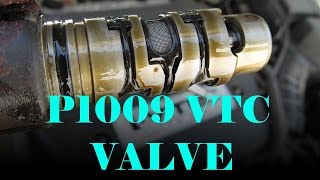
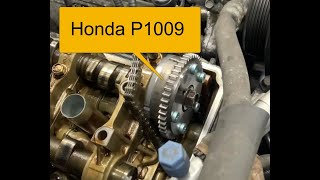
- Low or Dirty Engine Oil (Very Common) — The VTC system relies on oil pressure to adjust timing. Low, old, incorrect viscosity, or sludge-contaminated oil cannot generate the required pressure. This is the definitive leading cause of P1009. 🎬 Watch: A complete guide to fixing the VTC advance malfunction.
- Clogged VTC Oil Control Solenoid or Strainer (Very Common) — Sludge and debris clog the VTC solenoid or its protective filter screen, restricting oil flow and causing the internal valve to stick.
- Stretched Timing Chain (Common) — Timing chains stretch over time, altering the base timing between the crankshaft and camshafts. The VTC system cannot compensate for this physical deviation. This is highly common on high-mileage Honda K-series engines.
- Faulty VTC Oil Control Solenoid (Common) — The electronic VTC solenoid fails internally. It gets stuck, suffers an electrical short, or its internal plunger seizes, preventing proper oil pressure routing.
- Failing Timing Chain Tensioner (Less Common) — The hydraulic timing chain tensioner weakens, allowing chain slack. This causes incorrect timing readings and distinct rattling noises on startup.
- Damaged or Corroded Wiring/Connectors (Less Common) — The wiring harness or connector for the VTC solenoid chafes or corrodes, causing a loss of signal from the PCM.
- Faulty VTC Actuator (Rare) — The mechanical VTC actuator gear on the camshaft seizes or fails to hold oil pressure.
- Incorrect PCM Software (Rare) — On specific models (like 2005-2009 Honda CR-Vs), overly sensitive PCM software incorrectly interprets normal VTC operation as a fault, requiring a dealer software update (TSB 08-089).
Symptoms

- Engine Rattling Noise on Startup — A distinct rattling or ticking sound lasting 1-3 seconds on a cold start indicates a failing VTC actuator or a stretched timing chain. This requires immediate attention.
- Rough Idle or Stalling — The engine runs unevenly, surges, or shuts off at stops because the valve timing is stuck in an advanced position unsuitable for low-speed operation.
- Reduced Engine Performance — The vehicle feels sluggish, lacks passing power, and enters 'limp mode,' capping engine speed at 3,000 RPM to prevent internal damage.
- Increased Fuel Consumption — Incorrect valve timing destroys engine efficiency, dropping fuel economy by 10% to 20%.
- Check Engine Light On (also visible on scanner) — The PCM logs the fault and illuminates the Malfunction Indicator Lamp (MIL). On Hondas, the VSA (Vehicle Stability Assist) light automatically illuminates as a secondary precaution.
Diagnostic Flowchart

Tap your situation to follow the diagnostic path that matches what you're seeing on this code.
Common Fixes & Costs
- Engine Oil and Filter Change — Parts: $30-$80, Labor: $50-$100, ~0.5 hr book time (DIY)
- Clean or Replace VTC Solenoid Strainer/Filter — Parts: $10-$30, Labor: $75-$175, ~1.2 hr book time (Intermediate)
- Replace VTC Oil Control Solenoid — Parts: $100-$250, Labor: $50-$150, ~0.8 hr book time (Intermediate)
- Replace Timing Chain, Tensioner, and Guides — Parts: $350-$900, Labor: $800-$2,100, ~9.5 hr book time (Professional)
- PCM Software Update — Parts: $0, Labor: $100-$200, ~1 hr book time (Professional)
DIY vs Professional
- Engine Oil and Filter Change — Beginner:
Tools: Wrench, oil filter wrench, drain pan, funnel. - Clean or Replace VTC Solenoid/Strainer — Beginner:
Tools: Socket set, torque wrench, brake cleaner. - Replace Timing Chain, Tensioner, and Guides — Beginner:
Tools: Extensive professional tool set, harmonic balancer tool, timing chain specific tools. - PCM Software Update — Beginner:
Tools: Manufacturer-specific diagnostic and programming tool.
Used vs. New Parts: Buying Guide
When a used part is worth it: For electronic components like the VTC solenoid, a used OEM part from a low-mileage vehicle is a cost-effective alternative to a cheap aftermarket part. For mechanical wear items like a timing chain, buying used is never recommended.
Donor-vehicle mileage cap: roughly under 60000 miles for the part to have meaningful remaining life.
Donor quality checklist:
- Verify the donor vehicle was not scrapped for engine failure.
- Match the part number exactly; Honda frequently updates parts.
- Inspect solenoid screens for tears or metal shavings indicating internal engine damage.
Decision logic:
- If The part is a timing chain, tensioner, or guide. → Always buy new OEM or a high-quality aftermarket kit. The failure risk is too high.
- If The part is a VTC solenoid and the budget is tight. → A used OEM part is more reliable than a cheap new aftermarket part.
- If The part is a VTC actuator (the cam gear itself). → Buy new OEM. Used actuators suffer from the exact same wear and sludge issues you are trying to fix.
Warranty tradeoff: Salvage yard parts have a 30-90 day warranty. New aftermarket parts range from 1 year to lifetime. New OEM parts carry a 1-year warranty.
Worst-case if a used part fails: $200-$400 if a used solenoid fails. $3000+ if a used timing component fails and destroys the engine.
What Happens If You Wait — Timeline
- 0-1 month: Code P1009 sets. Often triggered by low oil. No other symptoms are present, or a slight rough idle occurs. (MPG impact: 0-5%% · Added cost: $0 (if fixed with an oil change))
- 1-4 months: Sluggish acceleration and a drop in fuel economy. The VTC solenoid sticks intermittently. A faint rattling noise begins on cold starts. (MPG impact: 5-10%% · Added cost: $50-$150 in wasted fuel, plus VTC solenoid replacement ($150-$400).)
- 4-8 months: The startup rattle becomes loud and consistent, indicating a stretching timing chain. Code P0341 appears. The chain is at risk of skipping a tooth. (MPG impact: 10-15%% · Added cost: $1,200-$3,000 (timing chain replacement is required).)
- 8+ months: Catastrophic failure. The timing chain skips multiple teeth. The pistons collide with the valves, destroying the cylinder head. The engine will not run. (MPG impact: 100% (vehicle is inoperable)% · Added cost: $4,000-$8,000+ (cost of engine replacement).)
Cost of Not Fixing It
- 0-1 month: Reduced fuel economy (10-20% drop), sluggish performance, and potential stalling. (Added cost: $20-$60 in wasted fuel)
- 1-6 months: Continued operation with a rattling noise causes the timing chain to stretch further and skip a tooth, resulting in severe misfires. (Added cost: $1200-$3000 (for timing chain replacement))
- 6+ months: Catastrophic engine failure. The timing chain jumps multiple teeth, causing pistons to collide with valves and destroying the engine. (Added cost: $4000-$8000+ (for engine replacement))
Diagnosis Steps
- Check Engine Oil Level and Condition
Pull the dipstick and verify the oil level is between the 'full' and 'add' marks. If the oil is black, gritty, or low, perform an immediate oil and filter change. Low oil pressure is the primary trigger for this code.
Tools: Rag or paper towel (Beginner) - Scan for Accompanying Codes
Use an OBD-II scanner to check for other codes. The presence of P0341 (Camshaft Position Sensor) alongside P1009 confirms a mechanical timing issue, specifically a stretched timing chain.
Tools: OBD-II Scanner (Beginner) - Check for Technical Service Bulletins (TSBs)
Verify if your vehicle requires a software update. For example, 2005-2009 Honda CR-Vs have a known PCM software flaw (TSB 08-089) that falsely triggers P1009.
Tools: Internet access, vehicle VIN (Beginner) - Inspect and Clean the VTC Strainer
Locate the VTC strainer screen (usually behind the power steering pump on Honda K-series engines). Remove it, inspect for sludge, and clean it thoroughly with brake cleaner. A clogged strainer starves the VTC actuator of oil.
Tools: Socket set, brake cleaner, rags (Intermediate) - Test the VTC Oil Control Solenoid (Electrical & Mechanical)
Disconnect the solenoid and measure resistance across its pins with a multimeter (typically 5-20 Ohms; check your manual). Infinite resistance means an open coil; near zero means a short. Next, apply 12V directly to the terminals; you must hear a sharp click as the plunger moves. If it fails either test, replace it.
Tools: Multimeter, 12V power source, jumper wires, socket set (Intermediate) - Perform VTC System Test with a Bi-Directional Scan Tool
Use a professional scan tool to command the VTC solenoid to advance timing while holding the engine at 3,000 RPM. Monitor 'Commanded Cam Angle' vs. 'Actual Cam Angle'. If they do not match, you have a confirmed hydraulic or mechanical failure.
Tools: Bi-directional OBD-II Scan Tool (Professional) - Inspect Timing Chain and Tensioner
Remove the valve cover and set the engine to Top Dead Center (TDC). If the camshaft timing marks do not align perfectly, the timing chain is stretched. Check the hydraulic tensioner; excessive rod extension confirms chain wear.
Tools: Advanced mechanic's tool set, service manual (Advanced) - Check Engine Oil Pressure
Remove the oil pressure switch and connect a mechanical gauge. Verify base oil pressure meets manufacturer specs (e.g., 10 PSI at idle, 50 PSI at 3,000 RPM). Low base pressure prevents the VTC system from operating.
Tools: Oil pressure gauge kit, socket set (Professional) - Check VTC Oil Passages for Blockages
If the solenoid, strainer, and chain are perfect, sludge is blocking the internal cylinder head oil passages. This requires significant engine teardown to clean.
Tools: Advanced mechanic's tool set, air compressor (Professional)
When This Code Triggers (Freeze-Frame Conditions)
- Engine Coolant Temp: 180-200°F (fully warmed up)
- RPM: 1500-3000 (cruise / light acceleration)
- Engine Load: 25-60% (The PCM is commanding a change in cam timing)
- Vehicle Speed: 35-60 mph (steady highway driving)
Related Codes
- P0011 — Generic code for 'A' Camshaft Position - Timing Over-Advanced. P1009 is Honda's more sensitive, manufacturer-specific version of this code. Seeing both confirms a persistent VTC fault.
- P0341 — Camshaft Position Sensor 'A' Circuit Range/Performance. Seeing P0341 alongside P1009 guarantees a mechanical timing issue, specifically a stretched timing chain.
- P2646 — 'A' Rocker Arm Actuator System Performance. Relates to the VTEC system. Because both VTC and VTEC rely on oil pressure, seeing either code mandates an immediate oil and filter check.
Climate & Environmental Factors
- Cold Weather: Engine oil thickens at low temperatures. This increased viscosity slows the hydraulic response of the VTC actuator during a cold start. The PCM detects the camshaft is not advancing quickly enough and triggers P1009. Using the manufacturer-specified winter oil viscosity (e.g., 0W-20) is mandatory.
How to Talk to a Mechanic About This Code
Say this: "I have a P1009 code on my Honda. I've confirmed the oil level is correct. I'd like a diagnostic that starts with the cheapest causes. Please test the VTC solenoid and inspect the strainer before quoting a timing chain replacement."
This establishes a logical diagnostic path (oil -> solenoid -> timing chain) and protects you from being sold a $2,000+ job when a $200 fix suffices.
Avoid saying:
- 'My check engine light is on, can you look at it?'
- 'My car is making a funny noise.'
- 'Just fix whatever is wrong, I trust you.'
Questions to ask before authorizing the repair:
- Did you test the VTC solenoid's resistance and function, and was the strainer screen clogged?
- If you recommend a timing chain, can you show me the timing mark alignment or tensioner extension proving the chain is stretched?
- Does the timing chain quote include the chain, tensioner, all guides, and a new VTC actuator?
- Will you use OEM or aftermarket parts, and what is the warranty?
Where to Take It: Dealer vs Independent vs Chain
- Dealer:
Best for: Vehicles under warranty., Repairs covered by a Technical Service Bulletin (TSB), like a PCM software update., Complex electrical diagnostics.
Downsides: Highest labor rates, often 1.5-2x an independent shop., May recommend a full timing chain kit when only the VTC actuator is needed. (Typical cost: +50% vs. baseline) - Independent Shop:
Best fit for most P1009 scenarios. A good independent Honda specialist handles everything from the oil change to the timing chain replacement cost-effectively.
Best for: Out-of-warranty vehicles where cost is a major factor., Common P1009 repairs like VTC solenoid replacement or a full timing chain service.
Downsides: Quality varies greatly; vet shops for ASE certifications and Honda expertise., Cannot perform manufacturer-specific PCM software updates. (Typical cost: +0% vs. baseline) - Chain Shop:
Acceptable ONLY for an oil change. AVOID for any further diagnosis. They are ill-equipped for complex timing repairs.
Best for: The simplest fix: an engine oil and filter change.
Downsides: Technicians lack specific experience for a timing chain job., High pressure to upsell services; frequently misdiagnose the issue. (Typical cost: -10% vs. baseline)
When to Walk Away From the Repair
If the estimated repair cost exceeds 40-50% of the car's private-party value, seriously consider selling or trading it in.
- Car worth $8000, fix is $3000: Borderline. The repair is ~38% of the car's value. Get a second opinion and assess the car's overall health before proceeding.
- Car worth $12000, fix is $1500: Fix it. The repair cost is well below the threshold and is a reasonable investment.
- Car worth $3500, fix is $2800: Walk away. The repair cost is 80% of the car's value. It is not a sound financial decision.
What Scan Tool You Need for This Code
Minimum: A code reader that displays engine live data PIDs (Parameter IDs).
A basic $20 scanner only gives you the code. To diagnose P1009, you must view live data to check if 'Commanded Cam Angle' matches 'Actual Cam Angle'.
Budget: BlueDriver Pro (~$100) — Connects via Bluetooth. Reads P1009, clears it, and graphs live data PIDs for commanded vs. actual cam angle. Sufficient for a DIYer to confirm a VTC performance issue.
Mid-range: Autel MaxiCOM MK808S (~$350-400) — A tablet scanner with bi-directional control. Performs an 'Active Test' to command the VTC solenoid on and off, allowing you to hear it click and confirm mechanical function without removal.
Professional: Autel MaxiSys MS906 Pro (~$1200+) — Offers full OEM-level diagnostics, guided VTC system tests, and checks software versions for TSB compliance. Essential for a shop.
Rent vs buy: Auto parts stores offer free code reading, but their tools lack live data. Buying at least a budget pick like the BlueDriver is highly recommended to avoid wasting money on incorrect parts.
How to Clear the Code After You Fix It
- Use an OBD-II scan tool to clear the P1009 code.
- Perform the Honda-specific drive cycle to reset readiness monitors.
- Check for pending or confirmed codes after the drive cycle.
Drive cycle (~30 minutes): Begin with a cold start (engine off for at least 1 hour). Idle for 2.5 minutes with A/C on. Accelerate to 55 mph at half throttle and hold for 3 minutes. Coast down to 20 mph without braking. Accelerate again to 55-60 mph at 3/4 throttle and hold for 5 minutes. Coast down again.
Readiness monitors affected: Catalyst Monitor, Evaporative System (EVAP) Monitor, Oxygen (O2) Sensor Monitor
Before emissions retest: drive at least 100 miles to fully set monitors.
Watch out for:
- Disconnecting the battery clears the code but resets all readiness monitors, guaranteeing an immediate smog test failure.
- The code returns immediately if the underlying mechanical or oil-related issue is not fixed.
- Not having the fuel tank between 1/4 and 3/4 full prevents the EVAP monitor from running.
Will This Fail Emissions / State Inspection?
Yes — this code typically fails an OBD-II emissions inspection.
- California: An illuminated Check Engine Light is an automatic failure. After repairs, a full drive cycle must be completed to set all readiness monitors before a re-test.
- New York: A vehicle with an active Check Engine Light automatically fails the emissions portion of the NYS inspection.
- Texas: In the 17 counties requiring emissions testing, an illuminated Check Engine Light is an automatic failure.
Most Commonly Affected Vehicles
- Honda CR-V (2005-2014) — Highly prone to P1009. 2005-2009 models require a PCM software update (TSB 08-089). 2012-2014 models suffer from defective VTC actuators causing chain stretch.
- Honda Accord (2003-2012) — The 2.4L K-series engine frequently develops clogged VTC strainers and stretched timing chains at higher mileage.
- Honda Civic (2006-2015) — 1.8L and 2.4L (Si) engines experience P1009 due to malfunctioning VVT oil control valves and stretched timing chains.
- Acura TSX (2004-2014) — Equipped with the 2.4L K-series engine, these models commonly report faulty VTC solenoids and stretched timing chains leading to P1009 and P0341.
- Honda Element (2003-2011) — Shares the K-series engine platform with the Accord and CR-V, making it highly susceptible to VTC failures triggered by low oil.
- BMW Various (2001-2015) — P1009 indicates a fault in the Valvetronic eccentric shaft sensor circuit, distinct from Honda's VTC system.
- Volkswagen Various (2000-2018) — P1009 means 'Air Mass Meter 1/2 Implausible Signal', pointing to a Mass Airflow (MAF) sensor failure or vacuum leak.
- Ford Various (2010-2020) — P1009 is defined as 'Wakeup Control' related to the Body Control Module (BCM), an electrical issue unrelated to the engine.
Manufacturer-Specific Notes
- Honda/Acura: P1009 consistently points to a VTC Advance Malfunction. The K-series 2.4L engine is notorious for stretched timing chains causing this code after 100,000 miles.
- BMW: P1009 points to a fault in the Valvetronic sensor circuit (variable valve lift), which is entirely distinct from their VANOS (variable timing) system.
- Volkswagen/Audi: P1009 indicates an issue with the Mass Airflow (MAF) sensor signal, caused by vacuum leaks or a faulty MAF sensor.
Real Owner Stories
2007 Acura TSX with 140K miles
Check Engine Light illuminated. The oil level did not register on the dipstick.
What they tried:
- Added two quarts of oil.
- Reset the Check Engine Light.
Outcome: The light stayed off for 3 days. The owner performed a full oil change, discovered a leak at the old filter, and fixed it. The P1009 code never returned.
Lesson: Always check the engine oil level first. A low oil level is the most common and cheapest cause to fix.
2010 Honda Accord 2.4L with 98K miles
Car threw P1009 along with multiple misfire codes (P0300-P0303). The engine stumbled and hesitated.
What they tried:
- Confirmed oil level was full and clean.
- Cleaned the VTC solenoid and strainer, which worked for 20,000 miles before the code returned.
Outcome: Replacing the VTC oil control solenoid with a new OEM part permanently resolved the issue.
Lesson: Cleaning the VTC solenoid is a temporary fix if the solenoid is failing electrically. Replacement with an OEM part is the only reliable long-term solution.
2004 Honda Accord 2.4L with 203K miles
Car died while driving and would not restart. Scanned codes P1009 and P0341.
What they tried:
- Noted the oil was low.
- Considered replacing the VTC solenoid as an easy first step.
Outcome: Removing the valve cover revealed the timing chain had jumped a tooth. The pistons contacted the valves, causing severe engine damage requiring a cylinder head replacement.
Lesson: The combination of P1009 and P0341 guarantees a mechanical timing issue. Do not continue to crank the engine; immediate professional inspection is required to assess catastrophic damage.
2008 Honda CR-V with 85K miles
P1009 code appeared. The engine ran perfectly fine with no rattles or hesitation.
What they tried:
- Performed an oil change.
- Replaced the VTC solenoid.
Outcome: The code returned immediately. The owner took it to a dealer, who applied TSB 08-089 and updated the PCM software. The code was permanently resolved.
Lesson: If you have a 2005-2009 CR-V and the engine runs perfectly despite the code, check for TSB 08-089 before replacing expensive mechanical parts.
How to Prevent This Code From Triggering
- Perform regular oil changes with the correct oil. (Every 5,000 miles.) — The VTC system is hydraulic. Clean, correct-viscosity oil prevents sludge from clogging the VTC solenoid, strainer, and internal passages.
- Use high-quality synthetic oil and OEM filters. (Every oil change.) — Synthetic oils resist thermal breakdown and sludge formation. OEM filters have the correct bypass valve pressure to protect the VTC system.
- Avoid excessive short trips and long idling. (Daily habit.) — Short trips prevent the engine from reaching full operating temperature, allowing condensation to build up and accelerate sludge formation.
- Proactively clean the VTC strainer. (Every 60,000 miles.) — The small VTC strainer screen is a known chokepoint. Cleaning it prevents oil starvation to the VTC system before a code triggers.
Frequently Asked Questions
Can I fix P1009 myself?
Yes, if the cause is simple. Checking oil or cleaning the VTC solenoid and strainer are DIY-friendly tasks. However, replacing a stretched timing chain requires professional expertise and specialized tools.
What's the most common misdiagnosis for P1009?
Many owners mistakenly replace the VTC actuator or camshaft position sensor first. Always start with the cheapest causes: verify oil level, clean the strainer screen, and test the VTC solenoid. Skipping these basics leads to hundreds of dollars in wasted parts.
Why did my VSA (Vehicle Stability Assist) light come on with the P1009 code?
Modern Hondas automatically disable stability and traction control systems (VSA) as a safety precaution when a significant engine fault occurs. The VSA system itself is fine. The light turns off once you resolve the P1009 code.
What's the difference between VTC and VTEC?
VTC (Variable Timing Control) continuously adjusts the camshaft's rotational angle for efficiency across all RPMs. VTEC (Variable Valve Timing and Lift Electronic Control) switches camshaft lobes to change valve lift and duration at specific RPMs. Both systems rely heavily on clean, pressurized engine oil.
Will an oil change definitely fix a P1009 code?
An oil change fixes P1009 in over half of all cases, especially if the oil was low or heavily degraded. If the oil level is correct and clean but the code returns, you must investigate the solenoid, strainer, or timing chain.
Is it worth cleaning the VTC solenoid or should I just replace it?
Cleaning the solenoid and its screen is a highly effective first step that often clears the code. However, if the solenoid fails an electrical resistance test, cleaning will not help and you must replace it with an OEM part.
What happens if a timing chain jumps a tooth?
The engine loses synchronization between the crankshaft and camshafts, causing severe misfires and power loss. In interference engines like the Honda K-series, the pistons will strike the open valves. This causes catastrophic engine damage requiring a complete rebuild or replacement.
Key Takeaways
- P1009 is a manufacturer-specific code that almost exclusively affects Honda and Acura vehicles, indicating a failure in the Variable Valve Timing Control (VTC) system to advance camshaft timing.
- Check your engine oil immediately; over 50% of P1009 codes are triggered by low, dirty, or incorrect viscosity oil starving the hydraulic VTC system.
- Listen for a distinct rattling noise on cold startups, which strongly indicates a failing VTC actuator or a stretched timing chain requiring immediate attention.
- If an oil change fails to clear the code, inspect and clean the VTC strainer screen and test the VTC oil control solenoid, which typically costs under $200 to replace.
- Never ignore P1009 if it appears alongside code P0341, as this combination guarantees a stretched timing chain that causes catastrophic engine damage costing upwards of $3,000.
Helpful Videos

The information in this article is provided for general reference and educational purposes only. Vehicle specifications, procedures, and part compatibility can vary by production date, trim level, and region. Always consult your vehicle's factory service manual and verify part numbers before purchasing or performing repairs. Safety-critical components such as airbags, seat belts, and braking systems should be installed by a qualified professional.
- 🎬 Helpful Videos
- What Does P1009 Mean?
- Can I Drive With P1009?
- Common Causes
- Symptoms
- Diagnostic Flowchart
- Common Fixes & Costs
- DIY vs Professional
- Used vs. New Parts: Buying Guide
- What Happens If You Wait — Timeline
- Cost of Not Fixing It
- Diagnosis Steps
- When This Code Triggers (Freeze-Frame Conditions)
- Related Codes
- Climate & Environmental Factors
- How to Talk to a Mechanic About This Code
- Where to Take It: Dealer vs Independent vs Chain
- When to Walk Away From the Repair
- What Scan Tool You Need for This Code
- How to Clear the Code After You Fix It
- Will This Fail Emissions / State Inspection?
- Most Commonly Affected Vehicles
- Manufacturer-Specific Notes
- Real Owner Stories
- 2007 Acura TSX with 140K miles
- 2010 Honda Accord 2.4L with 98K miles
- 2004 Honda Accord 2.4L with 203K miles
- 2008 Honda CR-V with 85K miles
- How to Prevent This Code From Triggering
- Frequently Asked Questions
- Can I fix P1009 myself?
- What's the most common misdiagnosis for P1009?
- Why did my VSA (Vehicle Stability Assist) light come on with the P1009 code?
- What's the difference between VTC and VTEC?
- Will an oil change definitely fix a P1009 code?
- Is it worth cleaning the VTC solenoid or should I just replace it?
- What happens if a timing chain jumps a tooth?
- Key Takeaways
- 🎟️ Get 5% Off