

OBD-II Code P0984: Shift Solenoid 'E' Control Circuit Range/Performance
The Ultimate Guide to P0984: Meaning, Advanced Diagnosis, and Pro-Level Fixes
- Code P0984 flags an electrical or performance failure in Shift Solenoid 'E', directly impacting the transmission's ability to change gears.
- Driving with P0984 carries a severe safety risk; affected vehicles can unexpectedly shift into Neutral at highway speeds, causing a total loss of motive power.
- On 2014-2016 Jeep, Chrysler, and Fiat models with 9-speed transmissions, check for safety recall S55 first—a free TCM software update or wiring harness replacement fixes this code 80% of the time.
- Never replace hard parts without checking the transmission fluid and scanning for Technical Service Bulletins (TSBs); a $200 fluid flush or 1-hour software update often resolves the fault.
What Does P0984 Mean?
Your Transmission Control Module (TCM) detected an electrical fault with Shift Solenoid 'E'. This solenoid acts as an electronic gate, directing hydraulic fluid to change gears smoothly. When the TCM sees the solenoid's voltage, resistance, or response time fall outside factory specifications, it triggers the Check Engine Light and stores P0984.
Technical definition: Shift Solenoid 'E' Control Circuit Range/Performance. The Powertrain or Transmission Control Module (PCM/TCM) detected the actual performance of the shift solenoid 'E' control circuit falls outside the expected electrical or hydraulic range. The fault is either electrical (wiring, solenoid coil) or mechanical (stuck plunger, clogged valve body), specifically pointing to a performance problem in the control circuit.
Can I Drive With P0984?
yes_but_not_advised. You can drive, but we strongly advise against it. The primary danger is the transmission unexpectedly shifting into neutral, causing a sudden loss of motive power in traffic. Continuing to drive turns a $200 software or wiring repair into catastrophic internal transmission damage requiring a $3,500+ rebuild. Drive the vehicle directly to a repair shop.
Common Causes
- Faulty TCM or Outdated Software (Very Common) — The TCM requires a software update to correct overly sensitive diagnostic parameters. This is the leading cause for 2014-2016 FCA vehicles with 9-speed transmissions.
- Damaged Wiring or Connectors (Very Common) — Wires leading to the solenoid fray, burn, or corrode. A bad connection at the external transmission connector or internal harness interrupts the electrical signal. This includes intermittent faults caused by insufficient factory wire crimps.
- Low or Dirty Transmission Fluid (Common) — Low, burnt, or contaminated fluid causes the solenoid to stick, operate slowly, or fail entirely. Clean fluid is required for proper hydraulic pressure.
- Failed Shift Solenoid 'E' (Common) — The solenoid fails electrically (broken internal coil/short circuit) or mechanically (stuck internal plunger from debris).
- Internal Transmission Valve Body Issues (Less Common) — Passages in the valve body clog with sludge or debris, restricting fluid flow. This triggers the code even if the solenoid functions perfectly.
- Weak or Failing Battery (Rare) — Control modules require stable voltage. A weak battery causes erratic signals and communication errors between the PCM and TCM, leading to false solenoid codes.
Symptoms
- Transmission Stuck in Gear (Limp Mode) — The transmission locks into a single 'safe' gear (usually 2nd or 3rd) to prevent damage, resulting in poor acceleration and high RPMs at highway speeds.
- Harsh, Delayed, or Failed Shifts — The car slams into gear, hesitates before shifting, or fails to shift into the gear commanded by solenoid 'E'.
- Transmission Slipping — The engine revs up, but the car doesn't accelerate properly. Increased friction from slipping causes the transmission to overheat.
- Check Engine Light is On — The Malfunction Indicator Lamp (MIL) illuminates on the dashboard.
- Worse Gas Mileage — Inefficient shifting forces the engine to operate outside its optimal power band, increasing fuel consumption.
Diagnostic Flowchart
Tap your situation to follow the diagnostic path that matches what you're seeing on this code.
Common Fixes & Costs
- Update or Replace Transmission Control Module (TCM) — Parts: $0-$800, Labor: $150-$300, ~1.5 hr book time (Professional)
- Repair or Replace Wiring Harness — Parts: $50-$350, Labor: $150-$600, ~3.0 hr book time (Professional)
- Transmission Fluid and Filter Change — Parts: $50-$120, Labor: $150-$250, ~1.5 hr book time (Intermediate)
- Replace Shift Solenoid 'E' — Parts: $25-$150, Labor: $200-$450, ~2.5 hr book time (Professional)
- Replace Valve Body — Parts: $300-$1200, Labor: $300-$800, ~4.0 hr book time (Professional)
DIY vs Professional
- Update or Replace Transmission Control Module (TCM) — Beginner:
Tools: Dealer-level scan tool with programming subscription. - Repair or Replace Wiring Harness — Beginner:
Tools: Digital multimeter, wiring diagrams, crimpers, heat shrink, depinning tools. - Transmission Fluid and Filter Change — Beginner:
Tools: Socket set, torque wrench, fluid pump, drain pan, infrared thermometer. - Replace Shift Solenoid 'E' — Beginner:
Tools: Full socket set, torque wrench, drain pan, service manual. - Replace Valve Body — Beginner:
Tools: Extensive toolset, torque wrench, service manual, pristine clean work area.
Used vs. New Parts: Buying Guide
When a used part is worth it: For a high-mileage vehicle (>150k miles) where repair costs approach the car's value, a used valve body from a low-mileage donor car is a cost-effective choice.
Donor-vehicle mileage cap: roughly under 80000 miles for the part to have meaningful remaining life.
Donor quality checklist:
- Verify the part number matches exactly; electronic components are rarely interchangeable between model years.
- Source from a reputable seller offering at least a 90-day warranty.
- Avoid parts from vehicles scrapped due to transmission failure or heavy front-end collisions.
Decision logic:
- If The fix is a known wiring harness issue (e.g., FCA recall S55) → Always use the new, updated OEM part. A used harness contains the same factory defect.
- If The vehicle is newer and you plan to keep it long-term → Buy a new OEM or high-quality aftermarket solenoid/valve body. The warranty and reliability justify the cost.
- If The vehicle is old and budget is the primary concern → A used part is acceptable, but you risk paying labor costs twice if the part fails prematurely.
Warranty tradeoff: Used parts offer a 30-90 day warranty covering the part only. New aftermarket parts offer 1-year to lifetime warranties. New OEM parts carry a 12-month/12,000-mile warranty.
Worst-case if a used part fails: $400-$1000 if a used part fails after installation, representing repeated labor costs plus a replacement part.
What Happens If You Wait — Timeline
- 0-1 month: Code P0984 is stored. The driver notices occasional, minor shift hesitation or no symptoms at all. (MPG impact: 0-5%% · Added cost: $0-$50 in wasted fuel)
- 1-3 months: Shifting becomes noticeably harsher or delayed. The transmission enters 'limp mode' intermittently. Fluid begins to degrade from excess heat. (MPG impact: 5-15%% · Added cost: $100-$300 in wasted fuel and accelerated fluid breakdown)
- 3-6 months: Harsh shifting and slipping become frequent. Elevated heat causes permanent damage to clutch packs and bands. The valve body becomes scored. (MPG impact: 10-20%% · Added cost: $800-$2,000 (Valve body damage or clutch wear is now likely))
- 6+ months: Catastrophic internal failure. The transmission fails to engage gears or gets permanently stuck in limp mode. Requires a full rebuild. (MPG impact: 20%+% · Added cost: $3,500-$6,000+)
Cost of Not Fixing It
- 0-1 month: Noticeable harsh shifting, intermittent 'limp mode,' and a 5-15% drop in fuel economy due to inefficient gear selection. (Added cost: Negligible, but drivability and safety are compromised.)
- 1-6 months: Increased friction and heat from slipping or harsh shifts accelerate wear on clutch packs and bands. Transmission fluid degrades rapidly. (Added cost: $200-$400 for a fluid flush that will not solve the underlying mechanical damage.)
- 6+ months: Catastrophic internal transmission damage. Worn clutches, a damaged valve body, or failed gears require a complete transmission rebuild or replacement. (Added cost: $2,500-$5,500+)
Diagnosis Steps
- Scan for All Codes and Check for TSBs
Use an OBD-II scanner to read codes from all modules. Look for communication codes (U-codes). Check for Technical Service Bulletins (TSBs) or recalls for your VIN related to P0984, as software updates frequently fix this code.
Tools: OBD-II Scanner, Internet Access (Beginner) - Check Transmission Fluid
Verify the transmission fluid level and condition. Fluid must be at the 'Full' mark, reddish/pink, and not smell burnt. Modern sealed transmissions require checking the level via a fill plug at a specific temperature.
Tools: Rag, Gloves, Infrared Thermometer (for sealed units) (Intermediate) - Inspect Wiring and Connectors
Visually inspect the external transmission wiring harness and main connector. Look for corroded pins, pushed-back pins, burnt plastic, or wires rubbing against the chassis.
Tools: Flashlight, Mirror (Intermediate) - [PRO TIP] Analyze Live Data with a Scan Tool
Monitor PIDs related to transmission function: 'TCM Commanded Gear', 'Solenoid E Commanded State', and 'Input/Output Shaft Speed'. If the TCM commands a shift but the solenoid state doesn't change, it points to an electrical performance issue.
Tools: Advanced OBD-II Scan Tool (Advanced) - [PRO TIP] Command the Solenoid with a Scan Tool
Access TCM functions and command shift solenoid 'E' on and off. Listen for a faint 'click' from the transmission pan. A click confirms the TCM and wiring can activate the solenoid. No click indicates a wiring or solenoid failure.
Tools: Bidirectional Scan Tool (Advanced) - Test the Solenoid's Internal Resistance
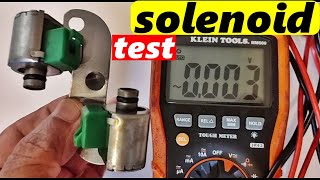
Disconnect the transmission connector and measure the solenoid's resistance. Compare to factory specs (typically 5-30 ohms). A reading of infinity (O.L.) indicates an open coil; near zero indicates a shorted coil.
Tools: Digital Multimeter, Vehicle Wiring Diagram (Advanced) - [PRO TIP] Perform a 'Wiggle Test'
Connect a multimeter set to ohms between the TCM and transmission connector for the solenoid 'E' circuit. Wiggle the wiring harness along its length. Fluctuations or jumps to 'O.L.' indicate a broken wire or loose pin.
Tools: Digital Multimeter, Vehicle Wiring Diagram (Advanced) - [PRO TIP] Back-Probe the Solenoid Command Signal
Back-probe the signal wire at the transmission connector. With the engine running, monitor the Pulse Width Modulation (PWM) signal. The signal should switch between battery voltage (~12V) and near 0V. A missing signal points to a faulty TCM.
Tools: Digital Multimeter or Oscilloscope, Back-probe Kit, Wiring Diagram (Professional) - Inspect the Internal Harness and Valve Body
If external tests pass, drain the fluid and remove the transmission pan. Inspect the internal wiring harness for damage and the valve body for scoring or stuck valves.
Tools: Socket Set, Drain Pan, Torque Wrench (Professional)
When This Code Triggers (Freeze-Frame Conditions)
- Engine Coolant Temp: 170-210°F (77-99°C) (The code typically sets when the vehicle reaches full operating temperature.)
- RPM: 1500-3000 RPM (The fault is detected during steady-state cruising or moderate acceleration when a gear change involving solenoid 'E' is commanded.)
- Vehicle Speed: 30-60 mph (Occurs at city or highway cruising speeds when the transmission shifts between higher gears.)
- Transmission Fluid Temperature: 150-220°F (The performance issue is identified once the transmission fluid warms up and its viscosity stabilizes.)
Related Codes
- P0985 — Indicates 'Shift Solenoid E Control Circuit Low,' meaning a short to ground. Diagnosis focuses on finding a wire shorted to the vehicle's chassis.
- P0986 — Indicates 'Shift Solenoid E Control Circuit High,' meaning a short to power. Diagnosis focuses on finding a wire rubbing against a voltage source.
- U0401 — Indicates 'Invalid Data Received From ECM/PCM.' When paired with P0984, it strongly suggests a communication problem (bad TCM, poor ground, weak battery) rather than a mechanical solenoid failure.
- P0700 — A generic 'Transmission Control System Malfunction' code. It simply informs you that the TCM has stored a more detailed code like P0984.
Climate & Environmental Factors
- Extreme Cold: Cold temperatures thicken transmission fluid, exacerbating pre-existing hydraulic issues or slow-acting solenoids. Harsh shifting becomes more noticeable during vehicle warm-up.
- Extreme Heat: High temperatures accelerate fluid breakdown and increase electrical resistance in wiring and solenoid coils, worsening intermittent electrical faults.
- High Humidity / Water Intrusion: Water exposure corrodes external wiring connectors and pins. This corrosion increases circuit resistance, directly triggering range/performance codes like P0984.
How to Talk to a Mechanic About This Code
Say this: "I have a P0984 code and I'm experiencing harsh shifting. I'd like to schedule a diagnostic. Based on my vehicle, I know a TCM software update or a wiring issue is a common cause, so please check for TSBs and inspect the wiring harness before recommending major part replacements."
This signals you are an informed consumer. It directs the technician to check the cheapest fixes first (software and wiring) before quoting expensive hardware like a valve body.
Avoid saying:
- 'My transmission is acting weird.'
- 'My check engine light is on, can you just fix it?'
- 'Just do whatever you think is best.'
Questions to ask before authorizing the repair:
- Did you check for any available TSBs or software updates for the Transmission Control Module?
- Did you perform electrical tests on the solenoid circuit, like a resistance check or a wiggle test, and what were the results?
- If a part needs replacement, is it the solenoid, the harness, or the whole valve body? What is the warranty?
Where to Take It: Dealer vs Independent vs Chain
- Dealer:
Recommended for FCA/Subaru owners as the first stop. For other brands, consider an independent shop first.
Best for: Vehicles under warranty (powertrain or recall)., FCA (Jeep, Chrysler, Ram) and Subaru vehicles, where software updates and specific recalls are the most common fixes., Complex diagnostics requiring proprietary software.
Downsides: Highest labor rates., May replace an entire assembly (like a valve body) when only a smaller component failed. (Typical cost: +50% vs. baseline) - Independent Shop:
Best fit for most out-of-warranty vehicles. Transmission specialists are more likely to perform component-level diagnosis to save money.
Best for: Out-of-warranty vehicles., Common vehicles like Honda, Toyota, or Ford where P0984 is often a fluid, solenoid, or wiring issue., Shops specializing in transmission repair.
Downsides: Quality varies greatly; look for ASE certification., May lack access to the latest manufacturer software updates. (Typical cost: +0% vs. baseline) - Chain Shop:
AVOID for P0984 diagnosis and repair. This code requires a higher level of expertise than chain shops provide.
Best for: Basic fluid and filter changes, provided they use the exact OEM fluid.
Downsides: Not equipped for in-depth electrical or internal transmission diagnostics., High pressure to upsell transmission flushes that don't solve the root problem. (Typical cost: -10% vs. baseline)
When to Walk Away From the Repair
If the estimated repair cost for P0984 exceeds 40-50% of your car's private-party value, it is time to consider selling or trading the vehicle.
- Car worth $4000, fix is $2000: Borderline. The repair is 50% of the car's value. Get a second opinion before proceeding.
- Car worth $12000, fix is $1800: Fix it. The cost is 15% of the vehicle's value and is a reasonable investment.
- Car worth $2500, fix is $1500: Walk away. The repair is 60% of the car's value. Put this money towards a replacement vehicle.
What Scan Tool You Need for This Code
Minimum: A scanner that reads manufacturer-specific transmission codes (TCM) and views live transmission data, such as solenoid command status.
A basic $20 code reader only shows the P0984 code. It cannot access the TCM to view live data or perform a transmission relearn procedure after the fix.
Budget: BlueDriver Pro Scan Tool (~$100) — Reads and clears transmission codes for supported brands and provides freeze-frame data. Lacks bidirectional control to perform a relearn.
Mid-range: Foxwell NT510 Elite (~$180) — Reads live transmission data and performs bidirectional control to command the solenoid on/off. Crucially, it runs transmission relearn procedures after a repair.
Professional: Autel MaxiCOM MK808 / MK906BT (~$500) — Provides full OE-level bidirectional control. Commands solenoids, views detailed live data streams, and performs all necessary relearn and initialization procedures.
Rent vs buy: Buy a mid-range tool. Auto parts stores rent basic scanners that lack the transmission-specific functions needed to properly diagnose P0984 and perform the required relearn procedure.
How to Clear the Code After You Fix It
- Use an OBD-II scan tool to clear the diagnostic trouble codes (DTCs).
- Perform a transmission 'relearn' or 'quick learn' procedure with a capable scan tool if the valve body or TCM was replaced.
- Perform a complete OBD-II drive cycle to allow all readiness monitors to run.
Drive cycle (~30 minutes): Start the vehicle cold (sat overnight) and idle for 3 minutes. Perform mixed city driving (stops, starts, moderate acceleration) followed by steady-state highway driving at 40-60 mph for 15 minutes. This meets the run criteria for the vehicle's self-test monitors.
Readiness monitors affected: Comprehensive Component Monitor (CCM), Transmission Component Monitor
Before emissions retest: drive at least 50 miles to fully set monitors.
Watch out for:
- Disconnecting the battery clears the code but resets all readiness monitors to 'incomplete', causing an automatic emissions test failure.
- The code returns immediately if the underlying electrical or mechanical fault remains unfixed.
- Skipping the transmission relearn procedure causes harsh shifting even after a successful mechanical repair.
Will This Fail Emissions / State Inspection?
Yes — this code typically fails an OBD-II emissions inspection.
- California: An illuminated Check Engine Light results in an automatic smog check failure. All readiness monitors must be 'complete' to pass.
- New York: The NYS DMV inspection includes an OBD-II scan. Any active DTC, including P0984, causes an automatic emissions failure.
- Texas: In the 17 counties requiring emissions testing, an active P0984 code causes an automatic failure. Readiness monitors must be 'ready' to pass re-inspection.
Most Commonly Affected Vehicles
- Jeep Cherokee, Renegade (2014-2016) — Extremely common on the ZF 9-speed transmission. Caused by a faulty internal transaxle wiring harness (recall S55 / NHTSA 16V-529) or outdated TCM software (TSB 21-019-17 REV. A).
- Chrysler 200 (2015-2016) — Suffers from the same ZF 9-speed issues as Jeep. Included in the S55 wiring harness recall and requires TSB 21-019-17 REV. A software updates.
- Ram ProMaster City (2015-2016) — Included in the S55 / NHTSA 16V-529 recall for a faulty transaxle wire harness that causes a sudden shift to neutral.
- Fiat 500X (2016) — Equipped with the ZF 9-speed and part of the S55 safety recall for insufficient wire terminal crimps in the transmission harness.
- Honda Accord, Odyssey, Pilot (2008-2017) — Solenoid codes are frequently triggered by degraded fluid. Using non-genuine Honda ATF leads to solenoid performance issues.
- Ford Focus, Fusion (2012-2018) — The 4F27E transmission is known for solenoid failures. It is critical to use the correct Mercon V or LV fluid.
- Subaru Outback, Forester, Impreza (2010-2018) — Solenoid codes point to a failing valve body. The entire valve body assembly must be replaced. Covered by a 10-year/100,000-mile CVT warranty extension.
- Toyota Tundra (2007-2021) — Pending P0984 codes manifest as a feeling of low power rather than harsh shifting, sometimes leading to misdiagnosis of engine problems.
Manufacturer-Specific Notes
- Chrysler/Jeep/Dodge/Ram/Fiat: On ZF 9-speed automatics, P0984 is extremely common. Always check for TCM software updates first. Next, investigate the internal transaxle wiring harness covered under safety recall S55 (NHTSA 16V-529) for insufficient wire crimps.
- Honda: Honda transmissions are highly sensitive to fluid type. Using non-genuine Honda ATF causes solenoid performance codes. A 3x drain-and-fill with genuine fluid often resolves intermittent issues.
- Subaru: Individual shift solenoids are not serviced separately on modern CVTs. Code P0984 requires replacing the entire valve body assembly. Check for the 10-year/100,000-mile CVT warranty extension.
- Ford: In the 4F27E 4-speed automatic, shift solenoids fail frequently but are easily accessible after removing the transmission pan. Software updates (like recall 24S37) also resolve unexpected shifting behaviors.
Real Owner Stories
2015 Jeep Cherokee, 75K miles - The Classic FCA Wiring/Software Fix
Check engine light came on with harsh shifting between 3rd and 4th gear. The transmission occasionally shifted to neutral on the highway.
Outcome: The dealer identified the vehicle was covered under recall S55 (NHTSA 16V-529). They performed a TCM software update and replaced the internal transaxle wiring harness. Total cost: $0. The code was resolved.
Lesson: For any P0984 code on a 2014-2016 FCA vehicle, check for software updates and recall eligibility before authorizing expensive part replacements.
2012 Honda Odyssey, 110K miles - A Simple Fluid Fix
P0984 and P0700 codes appeared with slight hesitation during shifts.
Outcome: After the third drain and fill, the fluid was bright red. The owner cleared the codes, and P0984 did not return. Shifting performance improved noticeably.
Lesson: On Honda vehicles, old or incorrect fluid is a primary cause of solenoid codes. A fluid change is an inexpensive first step that often resolves the issue.
2017 Subaru Outback, 91K miles - The Inevitable Valve Body
The check engine light, AT Oil Temp light, and EyeSight warning lights illuminated simultaneously with rough shifting.
Outcome: The dealership replaced the valve body assembly. The repair was covered under Subaru's 10-year/100,000-mile extended CVT warranty. Total cost: $0.
Lesson: On modern Subarus, solenoid codes require a full valve body replacement. Always check if your vehicle falls under the CVT warranty extension program.
2018 Ram 1500, 100K miles - Intermittent Electrical Gremlin
The truck threw a P0984 code and became stuck in Park.
Outcome: A mechanic performed a 'wiggle test' and found a loose pin in the main transmission connector. Reseating the pin and securing it with dielectric grease resolved the problem permanently.
Lesson: An intermittent P0984 is often traced to a poor electrical connection. Thoroughly inspect wiring and connectors before replacing the solenoid or TCM.
How to Prevent This Code From Triggering
- Change transmission fluid and filter per manufacturer's schedule (Every 30,000 to 60,000 miles for severe conditions, or 60,000-100,000 for normal use.) — Clean fluid maintains hydraulic pressure, cools components, and prevents abrasive debris from clogging solenoid valves.
- Use ONLY the manufacturer-specified transmission fluid (Every time fluid is added or changed) — Incorrect fluid viscosity and friction modifiers cause poor shifting, overheating, and degradation of internal seals.
- Maintain a healthy battery and clean electrical connections (Test battery annually) — A weak battery causes the TCM to receive incorrect data or lose its adaptive memory, leading to false solenoid codes.
- Address fluid leaks immediately (As needed) — Low fluid reduces hydraulic pressure, causes overheating, and starves the system of lubrication, leading to widespread damage.
Frequently Asked Questions
What does shift solenoid 'E' do?
It is an electronically controlled valve that directs hydraulic fluid within the transmission to engage or disengage clutch packs. This action changes the vehicle's gears. Solenoid 'E' controls the hydraulic circuit for specific gears based on the transmission design.
Where is shift solenoid 'E' located?
Shift solenoid 'E' is located inside the transmission, mounted directly to the valve body. Accessing it requires draining the transmission fluid and removing the transmission oil pan.
Can I fix P0984 myself?
Basic steps like checking fluid levels and visually inspecting external wiring are DIY-friendly. However, diagnosing the electrical circuit or replacing internal components requires advanced skills, a multimeter, and wiring diagrams. If external tests pass, take the vehicle to a transmission specialist.
How much does it cost to fix P0984?
Costs vary widely based on the root cause. A TCM software update costs $150-$250, while a fluid change runs $200-$370. Replacing a single solenoid ranges from $225 to $600, and a full valve body replacement costs $600 to over $2,000.
Will clearing the code fix the problem?
No. Clearing the code only erases the fault from the computer's memory temporarily. The TCM detects the performance issue again during its next self-test, and the code returns within one drive cycle.
Can a bad battery cause P0984?
Yes. A weak battery provides unstable voltage to the vehicle's control modules, including the TCM. This disrupts communication and causes the TCM to misinterpret data, triggering false solenoid performance faults.
I replaced the solenoid, but the code came back. What now?
The fault lies elsewhere, likely an intermittent open/short in the wiring harness or a poor ground connection at the TCM. Verify if a TCM software update is available, as this is a frequently overlooked root cause. Perform a wiggle test on the harness to locate broken wires.
What is a transmission 'relearn' procedure?
A relearn procedure allows the TCM to learn a new component's specific operating characteristics and reset its adaptive shift strategy. It is required after replacing major transmission components like a solenoid, valve body, or TCM. Skipping this step causes poor shift quality even after a successful mechanical repair.
Key Takeaways
- Code P0984 flags an electrical or performance failure in Shift Solenoid 'E', directly impacting the transmission's ability to change gears.
- Driving with P0984 carries a severe safety risk; affected vehicles can unexpectedly shift into Neutral at highway speeds, causing a total loss of motive power.
- On 2014-2016 Jeep, Chrysler, and Fiat models with 9-speed transmissions, check for safety recall S55 first—a free TCM software update or wiring harness replacement fixes this code 80% of the time.
- Never replace hard parts without checking the transmission fluid and scanning for Technical Service Bulletins (TSBs); a $200 fluid flush or 1-hour software update often resolves the fault.
Helpful Videos


The information in this article is provided for general reference and educational purposes only. Vehicle specifications, procedures, and part compatibility can vary by production date, trim level, and region. Always consult your vehicle's factory service manual and verify part numbers before purchasing or performing repairs. Safety-critical components such as airbags, seat belts, and braking systems should be installed by a qualified professional.
- 🎬 Helpful Videos
- What Does P0984 Mean?
- Can I Drive With P0984?
- Common Causes
- Symptoms
- Diagnostic Flowchart
- Common Fixes & Costs
- DIY vs Professional
- Used vs. New Parts: Buying Guide
- What Happens If You Wait — Timeline
- Cost of Not Fixing It
- Diagnosis Steps
- When This Code Triggers (Freeze-Frame Conditions)
- Related Codes
- Climate & Environmental Factors
- How to Talk to a Mechanic About This Code
- Where to Take It: Dealer vs Independent vs Chain
- When to Walk Away From the Repair
- What Scan Tool You Need for This Code
- How to Clear the Code After You Fix It
- Will This Fail Emissions / State Inspection?
- Most Commonly Affected Vehicles
- Manufacturer-Specific Notes
- Real Owner Stories
- 2015 Jeep Cherokee, 75K miles - The Classic FCA Wiring/Software Fix
- 2012 Honda Odyssey, 110K miles - A Simple Fluid Fix
- 2017 Subaru Outback, 91K miles - The Inevitable Valve Body
- 2018 Ram 1500, 100K miles - Intermittent Electrical Gremlin
- How to Prevent This Code From Triggering
- Frequently Asked Questions
- What does shift solenoid 'E' do?
- Where is shift solenoid 'E' located?
- Can I fix P0984 myself?
- How much does it cost to fix P0984?
- Will clearing the code fix the problem?
- Can a bad battery cause P0984?
- I replaced the solenoid, but the code came back. What now?
- What is a transmission 'relearn' procedure?
- Key Takeaways
- 🎟️ Get 5% Off