

OBD-II Code P0981: Shift Solenoid 'E' Control Circuit Range/Performance
What P0981 means, why it triggers, and how to fix it
- Code P0981 indicates an electrical circuit performance issue with shift solenoid 'E', meaning the fault often lies in the wiring or TCM rather than the solenoid itself.
- Driving with P0981 triggers 'limp mode' (locking the transmission in 2nd or 3rd gear) and causes harsh shifting that can destroy internal clutches within 50 miles.
- Check for Technical Service Bulletins (TSBs) before buying parts; a $200 TCM software update fixes this code on the majority of affected 2014-2018 Chrysler and Jeep vehicles.
- Never replace the solenoid if multiple solenoid codes (like P0980 or P0984) appear alongside P0981, as this guarantees a shared electrical ground or TCM failure.
What Does P0981 Mean?
P0981 means the Transmission Control Module (TCM) detects a performance problem with the 'E' shift solenoid's electrical circuit. Shift solenoids are electronically controlled valves managing hydraulic fluid to change gears. This code indicates circuit voltage or resistance is outside the expected range, pointing to an electrical or intermittent issue rather than a complete open or short circuit.
Technical definition: The SAE/OBD-II definition is "Shift Solenoid 'E' Control Circuit Range/Performance". The TCM continuously monitors the solenoid's circuit. If voltage or resistance falls outside normal parameters multiple times in a single drive cycle, the TCM stores P0981 and illuminates the Check Engine Light.
Can I Drive With P0981?
Yes, But With Caution. You can drive short distances, but doing so risks severe damage. The transmission will likely shift harshly, get stuck in one gear ('limp mode'), or fail to shift, creating a safety hazard in traffic. Continued driving beyond 50 miles generates excessive heat that destroys clutches, breaks down fluid, and warps the valve body, turning a $200 electrical fix into a $4,000 transmission rebuild.
Common Causes
- Wiring Harness and Connector Issues (Very Common) — Damaged, shorted, or loose wiring is the most frequent culprit. Wires connecting the TCM to the transmission degrade from heat, vibration, or rodents. External fluid leaks (like battery acid on Honda models) severely corrode connector pins, creating high resistance that triggers this code.
- Faulty TCM or Software (Very Common) — The TCM itself fails, or its software requires an update. This is the primary cause in 2014-2018 Chrysler and Jeep vehicles, where a software glitch misinterprets solenoid performance. A failing TCM triggers multiple, seemingly unrelated solenoid codes simultaneously.
- Failed Shift Solenoid 'E' (Common) — The solenoid fails internally due to an open/shorted coil or a sticking mechanical plunger. Test the entire circuit before replacing the part, as wiring issues perfectly mimic a solenoid failure.
- Low or Dirty Transmission Fluid (Common) — Low or contaminated fluid causes solenoids to stick. Dirty fluid clogs the microscopic passages in the solenoid and valve body, dropping hydraulic pressure and triggering performance codes.
- Faulty Internal Transmission Harness (Common) — On transmissions like the Volkswagen 09G, a flexible internal ribbon harness connects the solenoids. This harness becomes brittle and cracks, causing an open circuit. This results in multiple solenoid codes appearing at once.
- Internal Transmission or Valve Body Issues (Rare) — A clogged passage within the valve body or internal mechanical failure mimics a solenoid problem. Suspect this only after ruling out all electrical causes.
- Failed Transmission Speed Sensor (Rare) — A failing input or output speed sensor provides erratic data. The TCM misinterprets this as a shifting issue caused by a solenoid, triggering P0981 even if the solenoid circuit is perfect.
Symptoms
- Harsh, Delayed, or Erratic Shifting — The transmission slams into gear, hesitates, or shifts unpredictably.
- Transmission Stuck in Gear (Limp Mode) — The transmission locks into a single gear (usually 2nd or 3rd) to prevent damage, causing poor acceleration and high RPMs at highway speeds.
- Check Engine or Transmission Warning Light — The dashboard illuminates a warning light immediately after the fault is detected.
- Unexpected Shift to Neutral — In affected 2014-2015 Jeep Cherokees, the transmission unexpectedly shifts into neutral while driving, causing a sudden loss of power.
- Decreased Fuel Economy (also visible on scanner) — Inefficient shifting forces the engine to operate outside its optimal RPM range, burning excess fuel.
Diagnostic Flowchart
Tap your situation to follow the diagnostic path that matches what you're seeing on this code.
Common Fixes & Costs
- Reprogramming or Replacing the TCM — Parts: $0-$1,300, Labor: $150-$300, ~1.5 hr book time (Professional)
- Repairing Damaged Wiring or Connectors — Parts: $10-$50, Labor: $150-$400, ~1.5 hr book time (Intermediate)
- Replacing the Shift Solenoid or Solenoid Pack — Parts: $50-$300, Labor: $200-$500, ~3 hr book time (Professional)
- Transmission Fluid and Filter Service — Parts: $50-$150, Labor: $100-$250, ~1.5 hr book time (Intermediate)
- Replacing the Transmission Valve Body — Parts: $500-$1,500, Labor: $400-$800, ~4 hr book time (Professional)
Used vs. New Parts: Buying Guide
When a used part is worth it: A used valve body or TCM from a low-mileage donor makes sense for a vehicle over 15 years old where a new part exceeds 50% of the car's value.
Donor-vehicle mileage cap: roughly under 80000 miles for the part to have meaningful remaining life.
Donor quality checklist:
- Verify the donor vehicle was not scrapped for transmission failure.
- Match part numbers exactly; variations cause immediate incompatibility.
- Require a minimum 30-day warranty on used electronic parts.
Decision logic:
- If Vehicle is less than 8 years old or under 100,000 miles → Buy a new OEM or remanufactured part. The warranty justifies the cost.
- If Vehicle is over 15 years old or over 150,000 miles → Buy a tested, low-mileage used part to minimize repair costs.
- If The part is a known high-failure item (e.g., Ford DPS6 TCM) → Buy a remanufactured unit with upgraded components; a used part will fail the same way.
Warranty tradeoff: Used parts offer 30-90 day warranties that exclude labor. New OEM parts offer 12-month/12,000-mile warranties covering both.
Worst-case if a used part fails: $400-800 in repeat labor if the used part fails.
What Happens If You Wait — Timeline
- 0-1 month: Check Engine Light illuminates. Intermittent harsh shifts occur when warm. Slight hesitation during acceleration. (MPG impact: 0-5%% · Added cost: $0-$50 in wasted fuel. The fix is likely a software update or wiring repair ($150-$400).)
- 1-3 months: Transmission frequently enters 'limp mode' (stuck in 2nd/3rd gear). Transmission runs noticeably hotter. (MPG impact: 5-12%% · Added cost: $500-$1,200. Heat degrades clutch surfaces. A simple fix escalates into a required valve body replacement.)
- 3-6 months: Vehicle is constantly in limp mode. Fluid smells burnt. Severe slipping between gears. (MPG impact: 10-20%% · Added cost: $1,800-$3,500. Burnt clutches and contaminated hydraulics require a full transmission rebuild.)
- 6+ months: Catastrophic failure. Transmission fails to engage any gear. Loud grinding noises occur. Vehicle is undrivable. (MPG impact: N/A% · Added cost: $3,500-$7,000+. A complete transmission replacement is the only option.)
Cost of Not Fixing It
- 0-1 Month: Harsh shifting and a 5-10% drop in fuel economy. (Added cost: Negligible, but symptoms worsen rapidly.)
- 1-6 Months: Excessive heat buildup accelerates wear on clutches and bands. Fluid degrades entirely. (Added cost: $800 - $2,500. A simple wiring fix escalates into a valve body replacement.)
- 6+ Months: Catastrophic internal damage requires a complete transmission rebuild or replacement. (Added cost: $3,500 - $7,000+.)
Diagnosis Steps
- Check for Other Trouble Codes & TSBs
Scan all stored codes. If other solenoid codes (P0980, P0982) or TCM codes (P0887, U0402) are present, the problem is a shared wiring issue or faulty TCM. Always check Technical Service Bulletins (TSBs) first; a software update is often the only required fix.
Tools: OBD-II Scanner 🎬 Watch: How to test shift solenoids using an active scan tool (Beginner) - Inspect Transmission Fluid
Verify fluid level and condition. Fluid must be clean and bright red. If it is low, dark brown, or smells burnt, change it immediately. Follow the manufacturer's specific temperature-dependent checking procedure.
Tools: Gloves, Rag, Dipstick (if equipped) (Beginner) - Inspect and Test the Wiring Harness and Connectors
Visually inspect the external transmission harness for frayed wires, melted sheathing, or rodent damage. Disconnect the main harness connector and check for bent, pushed-out, or corroded pins. Clean any moisture or battery acid with contact cleaner and apply dielectric grease.
Tools: Flashlight, Socket set, Electrical contact cleaner, Dielectric grease (Intermediate) - Command Solenoid with Advanced Scan Tool
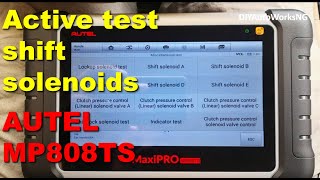
Use a bi-directional scan tool to command the 'E' solenoid on and off. Listen for a faint click inside the transmission. Monitor voltage feedback on the scanner. If the solenoid doesn't click or feedback is incorrect, the circuit or solenoid is faulty.
Tools: Advanced Bi-Directional Scan Tool (Professional) - Test Solenoid Resistance and Voltage Drop
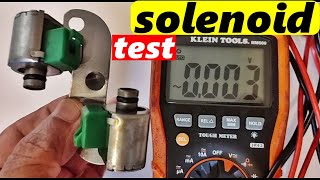
Using a multimeter and wiring diagram, test the resistance of the 'E' circuit (typically 5-30 Ohms depending on the vehicle). Infinite resistance means an open circuit; near-zero means a short. Next, perform a voltage drop test on the power side with the key on. A drop above 0.1V indicates excessive resistance in the wiring that must be repaired.
Tools: Digital Multimeter, Vehicle-specific wiring diagram (Advanced) - Analyze Live Scan Tool Data
While driving, monitor key PIDs: Solenoid 'E' Commanded State, Circuit Voltage/Current, and Transmission Fluid Temperature (TFT). A discrepancy between commanded state and actual voltage confirms a circuit issue. Normal TFT is 170-220°F.
Tools: Advanced Bi-Directional Scan Tool (Advanced) - Inspect the Valve Body and Solenoid
Drain the fluid and remove the transmission pan to access the valve body. Visually inspect the solenoid and internal wiring for damage. If electrical tests confirmed a hardware fault, replace the solenoid.
Tools: Socket set, Drain pan, Gasket scraper, New fluid and filter/gasket (Professional)
When This Code Triggers (Freeze-Frame Conditions)
- Engine Coolant Temp: 180-200°F (Sets when the vehicle is fully warmed up, as the TCM runs continuous circuit checks during normal operation.)
- RPM: 1500-2500 RPM (Triggers during steady-state cruising or light acceleration when the TCM expects a gear shift.)
- Vehicle Speed: 35-55 mph (Detected at cruising speeds when the TCM compares commanded solenoid state to actual circuit feedback.)
- Transmission Fluid Temperature: 170-220°F (Monitored at normal operating temperature. Extreme temperatures induce the fault by altering fluid viscosity or electrical resistance.)
Related Codes
- P0980 — Shift Solenoid 'D' Performance. If P0980 and P0981 appear together, a shared electrical ground or failing TCM is the culprit, not two simultaneously failed solenoids.
- P0982 — Shift Solenoid 'E' Circuit Low. Indicates a hard short to ground, whereas P0981 is an erratic performance issue.
- P0983 — Shift Solenoid 'E' Circuit High. Indicates a hard short to power. Points directly to a melted wire or internal solenoid failure.
- P0887 — TCM Power Control Circuit High. Strongly suggests the TCM's power supply is faulty, causing it to misread solenoid performance. Diagnose P0887 first.
- U0402 — Implausible Data Received From TCM. Indicates a communication breakdown, proving the fault lies with the TCM or CAN bus, not the solenoid.
Climate & Environmental Factors
- Cold Temperatures: Thickens transmission fluid, increasing hydraulic resistance. Sluggish solenoid response is misinterpreted by the TCM as a performance fault, triggering P0981.
- High Humidity & Road Salt: Moisture and salt penetrate weathered connectors, corroding pins and creating the high electrical resistance that directly causes this code.
How to Talk to a Mechanic About This Code
Say this: "I have a P0981 code on my [Year, Make, Model] and I'm experiencing [symptom]. Since this is a circuit performance code, please check for TSBs, inspect the external wiring and connectors, and confirm if any other TCM codes are present before recommending a part replacement."
This signals you understand P0981 is often an electrical or software issue. It directs the shop to follow a logical diagnostic path instead of jumping to a $4,000 transmission rebuild.
Avoid saying:
- 'My transmission is slipping, I think I need a new one.'
- 'Just fix whatever's wrong with the transmission.'
- 'I got a P0981, just replace the 'E' solenoid.'
Questions to ask before authorizing the repair:
- Did you find any TSBs or software updates related to this code?
- What were the results of the electrical tests on the solenoid circuit?
- Can you show me the damage to the wiring or the failed part?
- If other codes were present, how do they relate to the P0981?
- Is this repair warrantied, and what does the warranty cover?
Where to Take It: Dealer vs Independent vs Chain
- Dealer:
Highly recommended for Chrysler/Jeep/Dodge 9-speeds, as a software reflash is the primary fix and requires dealer tools.
Best for: Vehicles under warranty., Known software issues or recalls (Chrysler/Jeep)., Complex electrical issues requiring factory scan tools.
Downsides: Highest labor rates., Defaults to replacing expensive assemblies (entire valve body) instead of smaller components. (Typical cost: +50% vs. baseline) - Independent Shop:
Best fit for most out-of-warranty vehicles. Seek out a trusted transmission specialist.
Best for: Out-of-warranty vehicles requiring wiring repair or solenoid replacement., Dedicated transmission specialty shops.
Downsides: Quality varies; requires ASE-certified technicians., Lacks access to the latest manufacturer software updates. (Typical cost: +0% vs. baseline) - Chain Shop:
AVOID. This code requires specialized electrical and transmission knowledge lacking at general chain shops.
Best for: Simple fluid and filter changes.
Downsides: Technician skill for complex diagnostics is inconsistent., High pressure to upsell; technicians often recommend a full rebuild without proper electrical diagnosis. (Typical cost: -10% vs. baseline)
When to Walk Away From the Repair
If the estimated repair cost exceeds 50% of the car's private-party value, sell the vehicle instead of repairing it.
- Car worth $5000, fix is $2800: Walk away. The repair is over 50% of the car's value. Put the money toward a replacement vehicle.
- Car worth $12000, fix is $1500: Fix it. The repair is well below the threshold and restores the vehicle's value.
- Car worth $3000, fix is $2000: Walk away. A $2,000 repair on a $3,000 car is a poor investment.
What Scan Tool You Need for This Code
Minimum: A scanner that reads manufacturer-specific transmission codes (TCM codes) and views live data like fluid temperature.
A $20 code reader only shows generic engine codes. It cannot access the TCM to view related codes or monitor live solenoid command status, making diagnosis impossible.
Budget: BlueDriver Pro (~$100) — Reads TCM codes and graphs live data PIDs like transmission fluid temperature and solenoid states.
Mid-range: Foxwell NT510 Elite / Autel MaxiCOM MK808 (~$150) — Offers bi-directional control, allowing you to command the shift solenoid on and off to verify mechanical function.
Professional: Autel MaxiSys MS906 / Launch X431 Series (~$600-1200) — Provides dealership-level diagnostics, advanced coding, and performs mandatory TCM relearn procedures after a repair.
Rent vs buy: Auto parts stores rent basic scanners for free, but P0981 requires a mid-range scanner with bi-directional control. Buying a $150 scanner is highly recommended.
How to Clear the Code After You Fix It
- Use an OBD-II scanner to clear P0981 and related codes.
- Reconnect the battery if it was removed.
- Perform a transmission drive cycle to allow the TCM to relearn shift points.
Drive cycle (~30 minutes): Start cold. Idle for 3 minutes. Drive in stop-and-go traffic for 15 minutes, ensuring complete stops. Drive at a steady 55-60 mph for 5 miles. Allow the vehicle to cool completely.
Readiness monitors affected: Comprehensive Component Monitor (CCM), Transmission Monitor
Before emissions retest: drive at least 50 miles to fully set monitors.
Watch out for:
- Clearing the code without a drive cycle leaves monitors 'Not Ready', causing an instant emissions failure.
- If the root electrical cause wasn't fixed, P0981 returns within 10 miles.
Will This Fail Emissions / State Inspection?
Yes — this code typically fails an OBD-II emissions inspection.
- California: An illuminated Check Engine Light is an automatic failure. A full drive cycle must set readiness monitors before a re-test.
- New York: Fails automatically with the light on. For 2001+ vehicles, only one readiness monitor is allowed to be incomplete after clearing codes.
- Texas: In emissions-testing counties, the light causes an automatic failure. Drive 50 miles post-repair to set monitors.
Most Commonly Affected Vehicles
- Chrysler 200, Pacifica (2015-2017) — ZF 9-speed (948TE) models suffer TCM software faults. Check TSB #21-019-17 REV. A and warranty extension X80.
- Jeep Cherokee, Renegade (2014-2018) — Subject to Chrysler Recall S55 (NHTSA 16V-529) for harness crimps causing shifts to neutral. Software updates are the primary fix.
- Honda Accord, Odyssey, Civic (2008-2015) — Inspect the main harness connector below the battery tray; battery acid leaks destroy the pins, causing solenoid codes.
- Ford Focus, Fiesta (2011-2016) — DPS6 dual-clutch transmissions suffer high TCM failure rates. Check dealer for extended warranty coverage on the module.
- Subaru Outback, Forester, Impreza (2012-2020) — Solenoids are integrated into the CVT valve body. Failure requires replacing the entire valve body assembly.
- Volkswagen Jetta, Golf, Beetle (1999-2005) — 09G/09M transmissions suffer from brittle internal ribbon wiring harnesses that crack and cause open circuits.
- Nissan Altima, Rogue, Juke (2013-2016) — TSB NTB15-087a advises replacing the entire CVT valve body for solenoid codes. Check for CVT warranty extensions.
- Chevrolet Cruze, Sonic, Malibu, Equinox (2011-2019) — 6T40 family transmissions experience clogged solenoids from torn internal filters. Fluid changes and cleaning often resolve it.
Manufacturer-Specific Notes
- Chrysler/Jeep/Dodge: On 9-speed transmissions, P0981 is almost always a software issue. Dealers must perform TSB #21-019-17 REV. A or recall S55 before touching hardware.
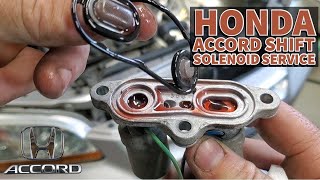
- Honda: Shift solenoids are often mounted externally on the transmission case, making them cheap and easy to replace compared to internal pan-mounted designs.
- Subaru: CVT shift solenoids are permanently integrated into the valve body. A single solenoid failure requires a $1,500 valve body replacement.
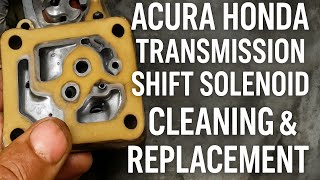
- Volkswagen: On 09G transmissions, solenoids get 'sticky' from fluid contamination. Removing and cleaning them is a highly successful, cheap alternative to replacement.
Real Owner Stories
2015 Chrysler 200 with 75K miles
The 'Service Transmission' light illuminated, the gear selector flashed, and the car entered limp mode. Scans showed P0981 alongside P0978, P0984, and P0887.
What they tried:
- Disconnected the battery to clear codes. The car drove normally for a short time before limp mode returned.
Outcome: The dealer identified TSB #21-019-17 REV. A, which addresses this exact code cluster. The fix was a $200 TCM software reflash. The codes never returned.
Lesson: On Chrysler/Jeep 9-speed transmissions, multiple solenoid codes strongly indicate a software issue. Always check TSBs before replacing expensive hardware.
2014 Jeep Cherokee with 110K miles
The vehicle unexpectedly shifted into neutral at highway speeds, causing a total loss of power, followed by a P0981 code.
What they tried:
- An independent shop quoted $1,800 to replace the valve body.
Outcome: The owner discovered Chrysler Recall S55 (NHTSA 16V-529) for insufficient wire harness crimps. The dealership performed the recall software update and harness repair free of charge.
Lesson: An unexpected shift to neutral on affected Jeep/Chrysler models is a known safety recall. Check your VIN for open recalls before authorizing repairs.
2004 VW Jetta (09G Transmission) with 150K miles
The car suffered harsh, banging 2-3 and 4-5 upshifts. Code P0981 was stored.
What they tried:
- Performed a fluid and filter change, which slightly reduced the harshness but did not clear the code.
Outcome: A VW specialist diagnosed a cracked internal ribbon wiring harness. They replaced the $100 harness and cleaned the solenoids. The $600 total repair completely resolved the shifting problems.
Lesson: On older VW 09G transmissions, P0981 is usually caused by a brittle internal wiring harness, not a failed solenoid. Replacing the harness is highly cost-effective.
How to Prevent This Code From Triggering
- Perform regular transmission fluid and filter changes (Every 30,000 to 60,000 miles) — Clean fluid prevents clutch material and metal shavings from clogging microscopic solenoid passages.
- Use only OEM-specified transmission fluid (Every fluid change) — Incorrect fluid alters hydraulic pressure and chemically degrades internal seals, destroying solenoids.
- Install an auxiliary transmission cooler (Once, if towing or living in a hot climate) — Heat destroys transmissions. A cooler stabilizes fluid temperatures, preventing fluid breakdown and extending solenoid life.
- Inspect the external transmission wiring harness (Annually) — Catching chafed wires or corroded connectors early prevents intermittent electrical faults from triggering limp mode.
Frequently Asked Questions
Can I just clear the P0981 code and keep driving?
No. The code will return immediately, and ignoring it forces the transmission into limp mode. Continued driving destroys internal clutches.
What is the most common mistake when diagnosing P0981?
Immediately replacing the solenoid without checking for TCM software updates or inspecting the wiring harness.
My scanner shows multiple solenoid codes along with P0981. What does that mean?
It guarantees the solenoids are fine. Multiple codes point to a shared failure, like a bad ground wire, a cracked internal harness, or a defective TCM.
How much does it cost to fix P0981?
A TCM software update costs $150-$300. Wiring repairs run $150-$400. Replacing a valve body or TCM costs $900-$2,300 depending on the vehicle.
What's the difference between Shift Solenoid 'D' and 'E'?
The letter designation depends entirely on the manufacturer's specific transmission design. Always refer to a factory service manual to locate the correct solenoid.
Can I replace a shift solenoid myself?
Yes, if it is externally mounted (common on Hondas). If it is internal, it requires dropping the transmission pan and performing a scanner relearn, which is best left to professionals.
Will changing the transmission fluid fix a P0981 code?
Only if the code is caused by dirty fluid sticking the mechanical plunger. If the cause is a failed wire or TCM, fluid changes do nothing.
Why do so many Chrysler and Jeep vehicles get code P0981?
Early ZF 9-speed transmissions had severe software glitches and wiring harness crimp defects. Most cases require a software reflash or recall repair, not a new solenoid.
Key Takeaways
- Code P0981 indicates an electrical circuit performance issue with shift solenoid 'E', meaning the fault often lies in the wiring or TCM rather than the solenoid itself.
- Driving with P0981 triggers 'limp mode' (locking the transmission in 2nd or 3rd gear) and causes harsh shifting that can destroy internal clutches within 50 miles.
- Check for Technical Service Bulletins (TSBs) before buying parts; a $200 TCM software update fixes this code on the majority of affected 2014-2018 Chrysler and Jeep vehicles.
- Never replace the solenoid if multiple solenoid codes (like P0980 or P0984) appear alongside P0981, as this guarantees a shared electrical ground or TCM failure.
Helpful Videos

The information in this article is provided for general reference and educational purposes only. Vehicle specifications, procedures, and part compatibility can vary by production date, trim level, and region. Always consult your vehicle's factory service manual and verify part numbers before purchasing or performing repairs. Safety-critical components such as airbags, seat belts, and braking systems should be installed by a qualified professional.
- 🎬 Helpful Videos
- What Does P0981 Mean?
- Can I Drive With P0981?
- Common Causes
- Symptoms
- Diagnostic Flowchart
- Common Fixes & Costs
- Used vs. New Parts: Buying Guide
- What Happens If You Wait — Timeline
- Cost of Not Fixing It
- Diagnosis Steps
- When This Code Triggers (Freeze-Frame Conditions)
- Related Codes
- Climate & Environmental Factors
- How to Talk to a Mechanic About This Code
- Where to Take It: Dealer vs Independent vs Chain
- When to Walk Away From the Repair
- What Scan Tool You Need for This Code
- How to Clear the Code After You Fix It
- Will This Fail Emissions / State Inspection?
- Most Commonly Affected Vehicles
- Manufacturer-Specific Notes
- Real Owner Stories
- 2015 Chrysler 200 with 75K miles
- 2014 Jeep Cherokee with 110K miles
- 2004 VW Jetta (09G Transmission) with 150K miles
- How to Prevent This Code From Triggering
- Frequently Asked Questions
- Can I just clear the P0981 code and keep driving?
- What is the most common mistake when diagnosing P0981?
- My scanner shows multiple solenoid codes along with P0981. What does that mean?
- How much does it cost to fix P0981?
- What's the difference between Shift Solenoid 'D' and 'E'?
- Can I replace a shift solenoid myself?
- Will changing the transmission fluid fix a P0981 code?
- Why do so many Chrysler and Jeep vehicles get code P0981?
- Key Takeaways
- 🎟️ Get 5% Off