

P0975 on 2015 Chrysler 200: Shift Solenoid 'B' Circuit Causes and Fixes
On a 2015 Chrysler 200, code P0975 is most often caused by outdated transmission software. Before replacing parts, check with a dealer for applicable Technical Service Bulletins (TSBs) that address this and other related codes via a software update. If software is not the issue, the shift solenoid itself or the transaxle wiring harness are the next most likely causes.
- For a 2015 Chrysler 200 with P0975, the first step is always to check for transmission software updates, as this is the most common fix.
- Do not drive the vehicle with this code, as it can cause unpredictable shifting and is a safety risk.
- If a software update does not fix the issue, the problem is likely a faulty shift solenoid 'B', wiring, or low/dirty fluid.
- This code is often accompanied by other transmission codes (P0711, P0885, P0887), all of which are typically addressed by the same software TSBs.
- Due to the need for dealer-level scan tools and the complexity of internal transmission work, this repair is not recommended for DIYers.
What's Unique About the 2015-2015 Chrysler 200
The 2015 Chrysler 200 with the 2.4L engine uses the ZF 9HP48 9-speed automatic transmission (also known as the 948TE). This transmission was notoriously problematic in its early years across multiple brands, but especially in FCA (Fiat Chrysler Automobiles) products. The issues were so widespread that Chrysler released multiple Technical Service Bulletins (TSBs) to fix shifting problems and false diagnostic codes with software updates. P0975 is explicitly mentioned in several of these TSBs as a code that can be resolved with a TCM reflash. Therefore, unlike many other vehicles where a solenoid code points directly to a bad part, on this specific car, a software update is the most common and manufacturer-recommended first step.
Diagnostic Flowchart
Tap your situation to follow the diagnostic path that matches what you're seeing on this vehicle.
Symptoms You May Notice
- Harsh, erratic, or delayed shifting
- Transmission getting stuck in gear (limp mode)
- Sudden shift to Neutral while driving
- Failure to shift into or out of certain gears
- Check Engine Light and/or Transmission Warning Light illuminated
- Flashing gear indicator on the dashboard
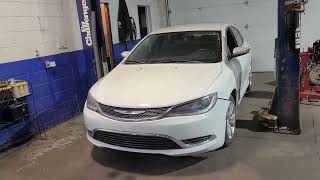
- Vehicle will not accelerate or move 🎬 Watch: Troubleshooting a Chrysler 200 that won't move in gear
- Decreased fuel efficiency
- Replacing the shift solenoid or entire valve body before checking for software updates. Many owners and shops may replace the part only to find the code returns because the root cause was software-related.
- Condemning the entire transmission when the issue is a correctable software, wiring, or valve body problem.
Most Likely Causes
- Outdated Transmission Control Module (TCM) Software 🔴 High Probability Chrysler issued multiple TSBs (e.g., 21-019-17 REV. A, 21-015-16, 21-021-15 REV. E) specifically to resolve this code and others with a software reflash for the 2.4L engine's transmission. These updates were designed to improve shift logic and correct false error detection.
How to confirm: A Chrysler dealer or a properly equipped independent shop must use a tool like wiTECH to check the vehicle's current software version against the latest available updates by referencing the VIN.
Typical fix: Flashing the TCM with the updated software provided by the manufacturer. This often includes performing a 'Transmission Quick Learn' procedure afterwards to reset adaptive values.
Est. part cost: $0 (if under warranty/recall), $75-$250 (dealer/shop labor for reflash). - Faulty Shift Solenoid 'B' / Valve Body Assembly 🟡 Medium Probability The solenoid itself can fail electrically or become clogged with debris. In the ZF 9HP48, individual solenoids are often not serviced separately; the entire valve body assembly, which includes the solenoid pack, is typically replaced.
How to confirm: After ruling out software, a technician can test the solenoid's electrical resistance with a multimeter. This requires dropping the transmission pan and accessing the valve body. The expected resistance for the Clutch 'B' solenoid is between 5.3-5.6 Ohms. A reading outside this range indicates a hardware failure.
Typical fix: Replace the entire transmission valve body assembly. This is a complex job that involves draining the fluid, removing the pan, and carefully swapping the part.
Est. part cost: $450-$1100 for the valve body assembly. - Wiring Harness or Connector Issue ⚪ Low Probability Recall S55 was issued for some 2015 Chrysler 200s due to insufficient wire terminal crimps in the transaxle harness, which could cause high resistance and trigger various DTCs, including P0975. Wires can also become damaged from heat or chafing.
How to confirm: Visually inspect the wiring harness leading to the transmission for any signs of damage. A technician would perform a pin-out test to check for continuity and resistance between the TCM and the solenoid connector.
Typical fix: Repair the damaged section of the wiring harness or replace the entire transaxle harness if it matches the fault described in recall S55.
Est. part cost: $20-$250 - Low or Dirty Transmission Fluid ⚪ Low Probability
How to confirm: Check the transmission fluid level and condition. The ZF 9-speed has a specific, complex procedure that must be followed at a specific temperature to get an accurate reading. Fluid should be clean and have a reddish-brown color, not dark or burnt-smelling.
Typical fix: Perform a transmission fluid drain and fill or a full fluid exchange with the correct Mopar ZF 8 & 9 Speed ATF (Part # 68218925AA).
Est. part cost: $150-$300
Rare But Worth Checking
- Faulty Transmission Control Module (TCM): This is rare and should only be considered after all other possibilities (software, solenoid, wiring) have been exhaustively ruled out. It is expensive and often misdiagnosed. Sometimes, a simple battery disconnect for 15 minutes can resolve temporary module glitches.
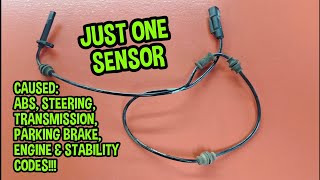
- Low System Voltage / Failing Battery: These vehicles are highly sensitive to battery voltage. A weak or failing battery can cause a cascade of communication errors across multiple modules, including the TCM, leading to false codes and erratic behavior. One technician on YouTube resolved a car with multiple transmission, ABS, and steering codes, which the owner thought was a failed transmission, by simply performing a battery disconnect reset. 🎬 See how a simple reset fixed multiple transmission and module codes
Diagnosis Steps
- Connect an OBD-II scanner and verify P0975 is present. Note any other codes stored, especially those listed in the 'Often Seen With' section.
- Check battery health and system voltage. A weak battery can cause numerous electronic faults on this platform.
- Crucial Step: Contact a Chrysler dealer or use a professional database (like ALLDATA or Mitchell) to check for open recalls (like S55) and TSBs (like 21-019-17 REV. A) related to P0975 for your vehicle's VIN.
- If an applicable software update TSB exists, have the TCM reflashed by a qualified technician using a wiTECH tool. Ensure the 'Transmission Quick Learn' procedure is performed after the flash.
- Clear the codes and perform the specific warm-up and drive cycle procedure outlined in the TSBs. If the code does not return, the issue is resolved.
- If the code returns, inspect the transmission wiring harness and connectors for any visible damage, corrosion, or loose connections, paying close attention to the main transaxle connector.
- Check the transmission fluid level and condition using the correct, temperature-sensitive procedure. Ensure the correct fluid (Mopar ZF 8 & 9 Speed ATF) is used.
- If wiring and fluid are good, the next step is to test the shift solenoid 'B' circuit. This involves accessing the valve body, checking the solenoid's resistance, and verifying voltage/ground from the TCM.
- If the solenoid fails testing, the recommended repair is to replace the entire valve body assembly.
- If the solenoid and wiring test good, the problem may be a rare internal issue with the TCM, which should be the last component to be replaced.
Parts You'll Likely Need
- Transmission Valve Body Assembly
(OEM #68346521AA (for 2.4L models), RL267361AA (supercedes 68267361AA, check VIN for fitment))— If the issue is a hardware failure, the entire valve body with its integrated solenoid pack is the standard replacement part. Individual solenoids are not typically sold by Mopar for this transmission.
Trusted brands: Mopar (OEM), ZF (Original Manufacturer), Rostra (Aftermarket)
OEM price range: $750-$1200
Aftermarket price range: $450-$700
Related Codes That Often Appear With This One
- P0711 — Transmission Fluid Temperature Sensor A Circuit Range-Performance. Often included in the same TSBs as P0975.
- P0887 — TCM Power Control Circuit High. Often included in the same TSBs as P0975.
- P0978 — Shift Solenoid 'C' Control Circuit Range/Performance. Often included in the same TSBs as P0975, indicating a broader software logic issue.
- U0402 — Implausible Data Received From TCM. This code often accompanies other transmission codes when a software or internal communication fault is present.
Technical Service Bulletins (TSBs) & Recalls
- 21-019-17 REV. A: Addresses P0975 among other codes, recommending a software update for the TCM on 2015 Chrysler 200 (UF) and Jeep Cherokee (KL) with the 2.4L engine.
- 21-015-16: Also lists P0975 as a code that can be resolved with a TCM software update.
- 21-021-15 REV-E: An earlier bulletin that also includes P0975 in a list of codes fixed by a TCM reflash and details the drive cycle procedure.
- Recall S55 / TSB 21-038-16: Addresses a potential wiring harness crimp issue that can cause loss of motive power and may set P0975. The fix is to replace the transaxle range sensor wire harness.
Platform-Specific Known Issues
- The 2015 Chrysler 200 equipped with the ZF 9HP48 9-speed transmission was subject to numerous complaints and service bulletins related to transmission performance. Many of these issues, including the setting of code P0975, were linked to software problems that required updates from the dealer. A recall (S55 / NHTSA 16V-529) was also issued for potential wiring harness issues that could cause the transmission to unexpectedly shift to neutral.
Mechanic-Grade Diagnostic Values
- Clutch 'B' Solenoid Resistance — expected: 5.3 - 5.6 Ohms. Failure: A reading significantly higher or lower than this range, or an open circuit (OL).
- Dog Clutch Solenoid Resistance (A or F) — expected: 10.0 - 12.0 Ohms. Failure: A reading outside this range.
Scan Tool Commands That Help
- wiTECH or compatible high-end scan tool (e.g., Autel, Snap-on): Transmission Quick Learn — This procedure is required after replacing the valve body, transmission, or TCM, and is often performed after a software reflash. It forces the TCM to relearn the clutch fill times and pressures to ensure smooth shifting.
- wiTECH or compatible high-end scan tool: Reset Adaptive Values — This should be performed before the 'Quick Learn' procedure. It clears the old, learned information from the TCM's memory cells, providing a clean slate for the new learn process.
- wiTECH or compatible high-end scan tool: Proxy Configuration Alignment (Proxi Align) — This function synchronizes the Vehicle Identification Number (VIN) and other configuration data across all vehicle modules. It is necessary if the TCM or another major module has been replaced. A mismatch can cause a no-start or no-move condition, even with a functional part.
Wiring & Ground Locations
- TCM (Transmission Control Module) — Located on the left rear of the engine compartment.. This is the control unit that sets code P0975. All circuit tests for the solenoid will originate or terminate at the TCM's harness connectors.
- Transmission Assembly Harness Connector — The main electrical connector on the transmission housing itself.. This is the primary point for testing the solenoid's resistance without having to drop the transmission pan. A technician would disconnect this and probe the pins leading into the transmission.
- Battery Ground Strap — The main ground cable from the battery connects to the side of the transmission case.. A Reddit user noted that early year models used a ground strap prone to corrosion. A poor ground at this critical location can cause a host of electrical issues, including erratic module behavior and false codes.
Real Owner Repair Stories
- YouTube channel 'White One Auto, LLC' (2015 Chrysler 200) — Vehicle would not move when put into gear using the rotary shifter.
❌ Tried (didn't work) The owner replaced the rotary shifter assembly based on online advice, which did not fix the problem.
✅ What actually fixed it The technician found multiple communication and mismatch codes. After reinstalling the original shifter, the technician used a Snap-on Triton D8 scanner to perform a 'Proxy Alignment' procedure. This synchronized the VIN across all modules, including the TCM, and resolved the no-move condition.
Helpful Videos

We Have This Part in Stock

The information in this article is provided for general reference and educational purposes only. Vehicle specifications, procedures, and part compatibility can vary by production date, trim level, and region. Always consult your vehicle's factory service manual and verify part numbers before purchasing or performing repairs. Safety-critical components such as airbags, seat belts, and braking systems should be installed by a qualified professional.
- Chrysler 200:
- 🎬 Helpful Videos
- 🛍️ Shop This Part
- What's Unique About the 2015-2015 Chrysler 200
- Diagnostic Flowchart
- Symptoms You May Notice
- Most Likely Causes
- Rare But Worth Checking
- Diagnosis Steps
- Parts You'll Likely Need
- Related Codes That Often Appear With This One
- Technical Service Bulletins (TSBs) & Recalls
- Platform-Specific Known Issues
- Mechanic-Grade Diagnostic Values
- Scan Tool Commands That Help
- Wiring & Ground Locations
- Real Owner Repair Stories
- 🎟️ Get 5% Off