

P0900 on 2016-2017 Ford Focus: Clutch Actuator Circuit Failure Causes & Fixes
P0900 on a 2016-2017 Ford Focus almost always indicates a failed clutch actuator motor in the problematic DPS6 PowerShift transmission. The fix is to replace the actuator motor, a repair that was covered under Ford's Customer Satisfaction Program 20B23. Swapping the upper and lower actuators is the definitive diagnostic test.
- P0900 on a 2016-2017 Focus is a very specific code pointing to the upper clutch actuator motor ('A') on the DPS6 transmission.
- This is a very common, well-documented failure. Before paying for repairs, check with a Ford dealer for any warranty extensions or customer satisfaction programs like 20B23 (for the actuators) and 14M02 (for the TCM).
- The most reliable diagnostic step is to swap the identical upper and lower actuator motors; if the code follows the motor (changing to P090C), the motor is bad.
- Poor ground connections under the air filter box are a frequent cause of electrical issues on this platform and should be cleaned before replacing parts.
- It is highly recommended to replace both actuators at the same time with genuine OEM parts, as they fail at similar rates and aftermarket quality can be questionable.
What's Unique About the 2016-2017 Ford FOCUS

The 2016-2017 Ford Focus uses the Getrag 6DCT250, marketed as the DPS6 PowerShift transmission. It's not a traditional automatic but an automated dual-clutch manual transmission known for widespread issues, including shuddering, hesitation, and premature component failure. Code P0900 is not a generic fault; it's a direct symptom of one of this transmission's most common and well-documented failure points: the electric clutch actuator motors. Ford has acknowledged this issue through multiple Technical Service Bulletins (TSBs) and customer satisfaction programs.
Diagnostic Flowchart
Tap your situation to follow the diagnostic path that matches what you're seeing on this vehicle.
Symptoms You May Notice
- Check Engine Light is on
- Transmission warning light is on or 'Transmission Fault, Service Now' message appears
- Erratic or harsh shifting.
- Shuddering or vibration, especially at low speeds.
- Vehicle takes off in 2nd gear, skipping 1st gear entirely.
- Transmission gets stuck in one gear.
- Vehicle hesitates or fails to move from a stop
- Engine may not start as a safety precaution if the transmission cannot confirm it is in Neutral or Park.
- Replacing the entire clutch assembly when only the external actuator motor has failed. The clutch plates themselves may be fine.
- Replacing the Transmission Control Module (TCM) before confirming the actuator motor and grounds are good. The actuator and grounds are far more common and cheaper failure points for this specific code.
Most Likely Causes

- Failed Clutch Actuator Motor 'A' 🔴 High Probability This is a well-documented, high-failure part on the DPS6 transmission. Ford issued Customer Satisfaction Program 20B23 and TSB 20B23-S1 directly linking P0900 to clutch actuator motor failure and advising the replacement of both motors.
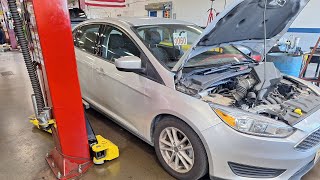
How to confirm: A definitive diagnostic step is to swap the upper (Actuator A) and lower (Actuator B) motors, as they are identical parts. Clear the codes and drive. If the code changes to P090C (Clutch 'B' Actuator Control Circuit Low), the actuator is confirmed bad. This is the most common and reliable test before buying parts. 🎬 Watch: A professional diagnostic walkthrough for erratic shifts and actuator codes.
Typical fix: Replace the faulty clutch actuator motor. It is highly recommended to replace both actuators (upper 'A' and lower 'B') at the same time, as they are the same age and subject to the same wear. A relearn procedure with a capable scan tool is recommended after replacement.
Est. part cost: $100-$210 for one OEM Motorcraft actuator. Be wary of cheap aftermarket parts on Amazon/eBay, as many are reported to be counterfeit or fail quickly. - Damaged Wiring or Poor Ground Connection 🟡 Medium Probability The wiring harness to the transmission can be susceptible to damage from heat, vibration, or chafing against other components. More commonly, the main ground points under the air filter box are known to be poor from the factory due to being attached to a painted surface, leading to corrosion and high resistance.
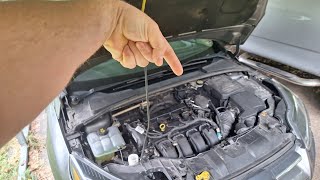
How to confirm: Visually inspect the wiring harness leading to the clutch actuators. Check the two ground studs on the chassis located under the air filter housing. Remove the ground nuts (often 10mm), clean the paint off the chassis to bare metal, clean the terminals, and re-secure tightly. 🎬 Watch: How to properly clean the TCM ground points. Use a multimeter to test for continuity and proper voltage at the actuator connector.
Typical fix: Repair the damaged section of wire or, more commonly, clean and secure the ground connections under the airbox. Some owners add a supplementary ground strap directly from the battery negative terminal to the chassis ground stud as a preventative measure.
Est. part cost: $10-$50 for wiring repair supplies or a new ground strap. - Faulty Transmission Control Module (TCM) ⚪ Low Probability The TCM is another notorious failure point on the DPS6 transmission and was subject to a massive warranty extension (14M02), covering it for 10 years or 150,000 miles. While it can cause actuator codes, it's less likely to be the root cause for a single 'open circuit' code like P0900 compared to the motor or a bad ground. The TCM often fails due to heat soak.
How to confirm: This is typically diagnosed by exclusion. If a new actuator (or a swapped actuator) and verified good wiring/grounds do not resolve the code, the TCM is the likely culprit. A high-end scan tool may show communication faults with the TCM (U-codes).
Typical fix: Replace the TCM and have it programmed by a Ford dealer or a specialized shop. Check for warranty coverage under program 14M02 with a Ford dealer by providing your VIN before paying for this expensive repair.
Est. part cost: $700-$900 for a new, programmed TCM, if not covered by warranty.
Diagnosis Steps
- Read the trouble codes with an OBD-II scanner. Confirm P0900 and note any other transmission-related codes.
- Disconnect the negative battery terminal to ensure safety.
- Remove the air filter housing to gain access to the top of the transmission and the ground points.
- Inspect and clean the primary ground points. Locate the two ground studs under the airbox, remove the nuts, and clean the chassis to bare metal before reattaching securely.
- Perform an actuator swap. The upper actuator is 'A' and the lower is 'B'. They are held by E8 Torx bolts. Swap their positions, reconnect the battery, clear the codes, and drive the vehicle.
- Re-scan the codes. If the code has changed to P090C or P090D (related to actuator 'B'), the original actuator 'A' is faulty and must be replaced.
- If the P0900 code returns after the swap and ground cleaning, the problem is likely in the wiring harness itself or the TCM.
- If all other steps fail, suspect a faulty Transmission Control Module (TCM). Check with a Ford dealer for any open warranty extensions (like 14M02) before replacing.
Parts You'll Likely Need

- Transmission Clutch Actuator Motor
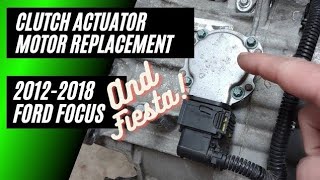
(OEM #AE8Z-7C604-A)— This is the component that fails most often, as documented by Ford's own Technical Service Bulletins. It is recommended to replace both at the same time. 🎬 See this step-by-step guide for replacing the clutch actuator motors.
Trusted brands: Motorcraft (OEM), Dorman, Standard Motor Products
OEM price range: $130-$210
Aftermarket price range: $70-$120
Related Codes That Often Appear With This One
- P0805 — Relates to the Clutch Position Sensor 'A' Circuit, which is inside the same actuator motor. It is listed in TSB 20B23.
- P090C — Relates to Clutch Actuator 'B' Circuit Low. If you swap the actuators and P0900 changes to P090C, you have confirmed the original 'A' actuator was faulty.
- P090D — Relates to the Clutch Actuator 'B' Circuit Open. All these codes are listed together in Ford's TSB for this issue.
Technical Service Bulletins (TSBs) & Recalls
- 20B23-S1 & 20B23: 'Certain 2016 through 2017 Model Year Focus equipped with a DPS6 Automatic Transmission - Replacement of Clutch Actuator Motors'. This program notes that customers may report erratic shifting, missed shifts, vibration, and a check engine light with codes including P0900, P0805, P087A, P090D, due to clutch actuator motor failure. The prescribed fix is to replace both clutch actuator motors.
Platform-Specific Known Issues
- The DPS6 PowerShift transmission in the 2016-2017 Focus is the subject of multiple warranty extensions and customer satisfaction programs due to a class-action lawsuit. Ford issued Customer Satisfaction Program 20B23 specifically to address the failing clutch actuator motors (causing P0900) by replacing both, free of charge, for affected VINs. Additionally, program 14M02 extended the warranty on the TCM to 10 years/150,000 miles. Owners should always check with a Ford dealer to see if their vehicle's VIN is covered under any open programs before paying for repairs.
Mechanic-Grade Diagnostic Values
- Clutch Actuator Motor Coil Resistance — expected: 1.5 - 2.2 ohms. Failure: Infinite or very high resistance indicates an open coil, which is the direct cause of a P0900 'Circuit/Open' code.
- Voltage at Actuator Connector (Key On) — expected: ~12V (Battery Voltage). Failure: Significantly lower voltage (e.g., 7.8V as seen in one case) indicates a power delivery issue, likely from a bad ground, corroded wiring, or a failing TCM driver.
- Continuity Check on Wiring Harness — expected: Less than 5 ohms. Failure: Resistance greater than 5 ohms indicates excessive resistance in the circuit between the TCM and the actuator, pointing to corrosion or a damaged wire.
Scan Tool Commands That Help
- Ford IDS (Integrated Diagnostic System): TCM Adaptive Learning (Clutch) — This procedure is required after replacing a clutch actuator or the TCM. It allows the module to learn the new component's clutch engagement points and shift drum positions. The path is typically Toolbox > Powertrain > Transmission > TCM Adaptive Learning.
- Ford IDS (Integrated Diagnostic System): Reset KAM (Keep Alive Memory) — Before performing the adaptive learning, it is critical to clear the TCM's KAM to erase old adaptive tables. Unhooking the battery will not clear the TCM KAM; it must be done with a scan tool.
- FORScan: Clear Transmission Adaptive Tables — FORScan, a powerful aftermarket tool for Fords, can also perform the necessary service function to reset the transmission's learned shift strategy. This should be done before the road-test relearn procedure after a part replacement.
- High-end Scan Tool (e.g., Autel, Snap-on): Live Data PIDs: Input Shaft Speed Sensor A (ISSA) and B (ISSB) — To differentiate between a mechanical clutch issue and a control-side (actuator/TCM) issue. With the engine running in Park, both PIDs should read 0 RPM. If ISSA shows RPM, it indicates Clutch A is dragging. Pulling the 'A' actuator out of the case (but leaving it connected) and re-testing can isolate the fault. If the RPM drops to zero, the issue is with the actuator or TCM commanding it incorrectly.
Wiring & Ground Locations

- Main Chassis Grounds — Underneath the air filter housing, in front of the battery. There are typically two ground studs bolted to the painted chassis.. These are the primary ground points for the transmission and engine electronics. A poor connection here due to factory paint or corrosion is a very common cause of low voltage and various transmission codes, including P0900.
- C1633 — The electrical connector on the clutch actuator motor itself.. This is the primary connection point for testing voltage and resistance of the actuator motor. A Ford diagnostic guide refers to this connector when outlining test procedures.
- C1750B — One of the main connectors at the Transmission Control Module (TCM).. This connector contains the circuits that control the clutch actuator motors. A diagnostic procedure for an open circuit involves checking for continuity between pins at this connector and the corresponding pins at the actuator connector (C1633).
Real Owner Repair Stories
- YouTube video on a Toyota Yaris with a similar actuator design (Toyota Yaris with MMT semi-automatic transmission) — P0900 code, gearbox fault light, no drive, unable to engage gears.
❌ Tried (didn't work) Initial diagnosis pointed to a failed actuator motor.
✅ What actually fixed it The technician disassembled the actuator motor and found it was heavily contaminated with carbon powder from the motor brushes mixed with bearing grease, causing an internal short circuit. The fix was to thoroughly clean the motor's internals, including the brushes and commutator, and reassemble. This restored function without replacing the part. - Reddit user /u/throwaway-2014-focus on r/FordFocus (2014 Ford Focus) — P090C (Clutch Actuator B Circuit Low), slipping out of gear, hesitation between 1-2-3, loss of reverse and sport mode. The issue would appear after about an hour of driving.
❌ Tried (didn't work) The TCM had already been replaced by a previous owner.
✅ What actually fixed it A technician in the comments suggested the issue was not the actuator but a failing TCM again, specifically due to heat soak causing MOSFETs on the board to fail. The temporary normal operation after sitting overnight is a classic symptom of a heat-related failure in the TCM.
OEM Part Supersession History
AE8Z-7C604-A→AE8Z-7C604-A (current)— No supersession found. This part number appears to be the consistent and current number for this component.
Model Year Variations Within This Range
- 2012-early 2016 vs. late 2016-2018: While the part is the same, the likely point of failure for actuator circuit codes (like P0900, P0902, P090C) shifts. On earlier models (2012-2016), these codes are more commonly caused by a failing TCM. On later models (late 2016-2018), the clutch actuator motors themselves are the more frequent cause of failure.
Helpful Videos
We Have This Part in Stock


The information in this article is provided for general reference and educational purposes only. Vehicle specifications, procedures, and part compatibility can vary by production date, trim level, and region. Always consult your vehicle's factory service manual and verify part numbers before purchasing or performing repairs. Safety-critical components such as airbags, seat belts, and braking systems should be installed by a qualified professional.
- Ford FOCUS:
- 🎬 Helpful Videos
- 🛍️ Shop This Part
- What's Unique About the 2016-2017 Ford FOCUS
- Diagnostic Flowchart
- Symptoms You May Notice
- Most Likely Causes
- Diagnosis Steps
- Parts You'll Likely Need
- Related Codes That Often Appear With This One
- Technical Service Bulletins (TSBs) & Recalls
- Platform-Specific Known Issues
- Mechanic-Grade Diagnostic Values
- Scan Tool Commands That Help
- Wiring & Ground Locations
- Real Owner Repair Stories
- OEM Part Supersession History
- Model Year Variations Within This Range
- 🎟️ Get 5% Off