

OBD-II Code P0884: TCM Power Input Signal Intermittent
The Ultimate Guide to What P0884 Means, Why It Triggers, and How to Fix It for Good
- Code P0884 indicates the Transmission Control Module (TCM) is losing power intermittently, which is an electrical circuit fault, not an internal mechanical transmission failure.
- Inspect and clean the battery terminals and main chassis grounds before replacing parts, as high resistance in these connections causes over 50% of P0884 codes.
- Do not drive with an active P0884 code; the sudden power loss forces the transmission into limp mode and stalls the engine, causing an immediate loss of power steering.
- Swap the TCM power relay with an identical non-essential relay (like the horn) to instantly test if a $20 faulty relay is causing the intermittent power drops.
- Avoid replacing the $800+ TCM until you perform a loaded 'wiggle test' on the wiring harness to definitively rule out a chafed wire or loose connector.
What Does P0884 Mean?

P0884 means the Transmission Control Module (TCM)—the transmission's computer—is receiving an unstable power supply. The TCM requires a steady 9 to 14 volts to manage gear shifts, regulate pressure, and communicate with other modules. When power cuts out for even a millisecond, the TCM reboots, causing erratic shifting and triggering the check engine light.
Technical definition: The SAE/ISO definition for P0884 is "TCM Power Input Signal Intermittent." The Powertrain Control Module (PCM) or TCM sets this diagnostic trouble code (DTC) when voltage in the TCM's dedicated power supply circuit fluctuates, drops out, or is lost sporadically. The fault logs when voltage drops below 9-10V intermittently, distinguishing it from a constant low (P0882) or high (P0883) condition.
Can I Drive With P0884?
no_not_recommended. Driving with P0884 is a significant safety risk. The transmission suddenly enters 'limp mode' (stuck in one gear) or shifts erratically, which is dangerous in traffic. More critically, the power interruption stalls the engine without warning during low-speed turns, causing a complete loss of power steering and brakes. Continuing to drive causes secondary damage to internal transmission components like clutches and bearings, adding over $1,000 to the final repair bill.
Common Causes

- Loose or corroded battery terminals and grounds (Very Common) — A poor connection at the battery posts, chassis grounds, or the TCM interrupts power flow. Green corrosion or a physically loose cable clamp forces the TCM to power on and off intermittently.
- Failing or weak vehicle battery (Common) — An old battery fails to provide stable voltage during high-load situations like engine cranking. This momentary voltage drop triggers the code.
- Faulty TCM power relay (Common) — This small electromagnetic switch controls electricity flow to the module. Internal contacts wear out or overheat, intermittently cutting power.
- Damaged or chafed wiring (Common) — Wires in the TCM power circuit short-to-ground or open due to engine heat, vibration, or rubbing against chassis components.
- Faulty TIPM (Chrysler/Dodge/Jeep) (Common) — On many FCA vehicles, the TCM relay is soldered internally to the Totally Integrated Power Module (TIPM). This known failure point requires a TIPM bypass or replacement.
- Failing alternator (Less Common) — A failing alternator produces unstable voltage (AC ripple) or drops output significantly, starving the sensitive TCM.
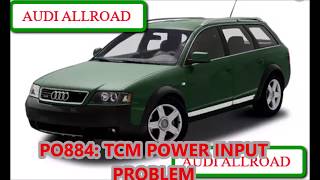
- Water intrusion (Less Common) — On Audi and VW models, water seeps into the TCM or connectors located in the passenger floorboard or plenum chamber 🎬 Watch: Diagnosing TCM power input problems on an Audi., causing intermittent shorts.
- Internal TCM failure (Rare) — Internal solder joints (common on Ford Focus/Fiesta 🎬 Watch: How to fix common TCM power issues on Ford Focus and Fiesta.), capacitors, or other components break down. This is rare and should be the last component suspected.
Symptoms

- Transmission enters 'limp mode' — The transmission defaults to a single gear (usually 2nd or 3rd) to prevent damage. This happens randomly and resets after restarting the car.
- Harsh, erratic, or delayed shifting — Gears slam into place or the transmission shudders between shifts as the TCM loses and regains power.
- Vehicle stalls unexpectedly — The engine cuts out during high electrical load situations like turning the steering wheel at low speeds, resulting in a sudden loss of power steering and brakes.
- Loss of gear indicator display — The dashboard display (P, R, N, D) goes blank when the TCM loses power and communication with the instrument cluster.
- Check Engine Light and Transmission Warning Light illuminate (also visible on scanner) — The first and most consistent sign of a TCM power fault.
- ABS or Traction Control lights illuminate (also visible on scanner) — Because the TCM shares vehicle speed data over the CAN bus network, a power fault triggers warning lights for related braking systems.
Diagnostic Flowchart
Tap your situation to follow the diagnostic path that matches what you're seeing on this code.
Common Fixes & Costs
- Clean or tighten battery terminals and ground connections — Parts: $0-$10, Labor: $0-$100, ~0.5 hr book time (DIY)
- Replace Vehicle Battery — Parts: $150-$300, Labor: $25-$75, ~0.5 hr book time (DIY)
- Replace TCM Power Relay — Parts: $15-$40, Labor: $0-$50, ~0.2 hr book time (DIY)
- Repair Wiring Harness or Connectors — Parts: $10-$50, Labor: $150-$500, ~2.5 hr book time (Professional)
- Replace Transmission Control Module (TCM) — Parts: $400-$1000, Labor: $150-$300, ~2 hr book time (Professional)
Used vs. New Parts: Buying Guide
When a used part is worth it: A used TCM from a low-mileage vehicle is cost-effective for older cars where a new module exceeds the vehicle's value. The part number must match exactly.
Donor-vehicle mileage cap: roughly under 80000 miles for the part to have meaningful remaining life.
Donor quality checklist:
- Verify the part number on the module case matches your original EXACTLY.
- Ask the seller for the VIN and mileage of the donor vehicle.
- Avoid modules from flood-damaged or rust-belt vehicles.
- Ensure the seller offers at least a 30-day warranty.
Decision logic:
- If Vehicle has a known TCM extended warranty (e.g., Ford DPS6) and is eligible → Use the warranty for a new OEM part at no cost.
- If Vehicle is less than 10 years old and under 120k miles → Favor a new or professionally remanufactured part for longevity and better warranty.
- If Vehicle is over 150k miles and budget is the primary concern → A tested, warranted used part is an acceptable risk.
Warranty tradeoff: Used parts offer a 30-90 day functional warranty on the part only. Remanufactured units offer a 1-year to lifetime warranty. New OEM parts carry a 1-2 year warranty.
Worst-case if a used part fails: 500-800. If a used TCM fails, you pay for diagnostic and replacement labor costs a second time.
What Happens If You Wait — Timeline
- 0-1 month: Intermittent Check Engine Light, code P0884 is stored. Occasional, brief hesitation or a single harsh shift, often during a cold start. (MPG impact: 0-2%% · Added cost: $0)
- 1-3 months: Symptoms become frequent. Randomly enters 'limp mode' (stuck in 2nd or 3rd gear). Noticeable harsh shifting and increased fuel consumption. (MPG impact: 5-10%% · Added cost: $50-150 in wasted fuel)
- 3-6 months: Stalling becomes a risk at low speeds. Constant power cycling causes premature mechanical wear on internal transmission clutches and solenoids. (MPG impact: 10-15%% · Added cost: $500-1500 (risk of solenoid pack or clutch pack damage))
- 6+ months: Catastrophic transmission failure is possible. The vehicle becomes undrivable. The repair escalates to a full transmission rebuild or replacement. (MPG impact: 15-25%+% · Added cost: $2500-5000+ (transmission rebuild/replacement))
Cost of Not Fixing It
- 0-1 month: Unpredictable stalling and limp mode create a significant safety hazard. Increased fuel consumption of 5-15% occurs due to inefficient shifting. (Added cost: 0-50)
- 1-6 months: Continued harsh shifting causes premature wear on mechanical transmission components like clutch packs, bands, and bearings. (Added cost: 1000-2500)
- 6+ months: Catastrophic internal transmission failure occurs. The cost escalates from a simple electrical fix to a complete transmission rebuild. (Added cost: 2500-5000+)
Diagnosis Steps
- Inspect the Battery and Main Grounds
Check that the battery terminals are clean, tight, and free of corrosion. Follow the main negative battery cable to its connection points on the chassis and engine block. Ensure these ground connections are clean, free of rust, and securely fastened.
Tools: Wrench set, wire brush, battery terminal cleaner (Beginner) - Test the Battery and Alternator
Use a multimeter to verify voltage. A healthy battery reads 12.6 volts with the engine off and 13.7 to 14.7 volts with the engine running. An alternator putting out fluctuating voltage or a battery failing a load test is a primary suspect.
Tools: Multimeter or professional battery tester (Beginner) - Swap the TCM Power Relay
Locate the TCM power relay in the main fuse box. Swap it with an identical relay from a non-essential system (like the horn or rear defroster) to see if the symptoms disappear. This is a quick, free way to test the relay.
Tools: Owner's manual, fuse puller or needle-nose pliers (Beginner) - Perform a Loaded Wiggle Test
Turn on high-draw accessories (A/C, headlights). With the vehicle in gear and your foot on the brake, turn the steering wheel lock-to-lock. While under load, wiggle the main power cables, grounds, and TCM harness. If the engine stumbles or lights flicker, you found the intermittent fault.
Tools: Helper recommended (Intermediate) - Visually Inspect the Wiring Harness and Connectors
Inspect all visible wiring leading to the TCM for frayed wires, melted insulation, or rubbing against the engine. Unplug the TCM connector and inspect for corrosion, moisture, or bent pins.
Tools: Flashlight, inspection mirror (Intermediate) - Test for Voltage Drop
Set your multimeter to DC Volts. Back-probe the positive lead to the power input pin at the TCM and the negative lead to the positive battery post. With the key on, the reading must be under 0.2V. Repeat for the ground circuit. Readings above 0.3V indicate excessive resistance.
Tools: Multimeter with back-probe pins, wiring diagram (Advanced) - Test Alternator AC Ripple
Set your multimeter to AC Volts. With the engine running at 1500 RPM and headlights on, connect the leads to the battery terminals. A reading consistently above 100mV (0.1V) indicates a failing alternator diode introducing AC voltage into the system.
Tools: Multimeter with AC Volts setting (Advanced) - Capture the Fault with an Oscilloscope
Connect a lab scope to the TCM power and ground pins. Set a trigger to catch any voltage drop below 10V. Drive the vehicle. The scope graphs the voltage over time, providing visual confirmation of the millisecond-long power dropout.
Tools: Automotive oscilloscope, back-probe pins, wiring diagram (Professional)
When This Code Triggers (Freeze-Frame Conditions)
- Engine Coolant Temp: 180-210°F (Fully warmed up, as electrical components' resistance changes with temperature.)
- RPM: 1200-2500 RPM (During light acceleration or steady-state cruising, when shifts are expected to be smooth.)
- Vehicle Speed: 25-55 mph (Occurs during city or highway driving, rarely at a standstill.)
- Electrical Load: High (Triggers when high-draw accessories (A/C, headlights, power steering) are used, exposing a weak point in the power supply.)
Related Codes
- P0882 — Means 'TCM Power Input Signal Low,' indicating a constant low voltage state. Seeing both P0882 and P0884 points to a severe high-resistance problem like a corroded ground strap.
- P0883 — Means 'TCM Power Input Signal High,' pointing to voltage spikes from a faulty alternator. P0883 alone directs diagnosis toward the alternator, whereas P0884 points to a loss of voltage.
- U0101 — Means 'Lost Communication with TCM.' A complete power loss from a P0884 fault causes a U0101. Fix the P0884 power issue first, and U0101 will resolve.
- P0700 — A generic 'Transmission Control System Malfunction' code requested by the TCM to turn on the check engine light. It provides no diagnostic value on its own.
Climate & Environmental Factors
- High Humidity & Road Salt: Vehicles in the 'Rust Belt' are significantly more susceptible to P0884. Saltwater dramatically accelerates the corrosion of battery terminals, chassis grounds, and connector pins.
- Cold Weather: Cold temperatures expose electrical weaknesses. A marginal battery's voltage output drops, and contracting metal causes loose connections to lose contact entirely during a cold start.
How to Talk to a Mechanic About This Code
Say this: "I have a P0884 code, which is an intermittent power supply issue for the Transmission Control Module. Please start by testing the battery and charging system, checking main power and ground connections for corrosion, and testing the TCM power relay before diagnosing the wiring harness or the TCM itself."
This establishes a logical, cost-effective diagnostic path. It directs the technician to check the most common and inexpensive failure points first, preventing them from immediately quoting a costly TCM replacement.
Avoid saying:
- 'My transmission is acting weird.'
- 'Just fix whatever's wrong, I don't care what it is.'
- 'My car is broken, can you look at it?'
Questions to ask before authorizing the repair:
- What were the results of the battery and alternator tests?
- Did you perform a voltage drop test on the TCM power and ground circuits, and what were the readings?
- If you're recommending a wiring repair, can you show me where the damage is?
- If you're recommending a TCM replacement, what specific tests did you run to definitively rule out the entire power supply circuit first?
- Does the estimate for a new TCM include the cost of programming the module?
Where to Take It: Dealer vs Independent vs Chain
- Dealer:
Best for: Vehicles under warranty., Known manufacturer-specific issues like a Chrysler TIPM failure or a required TCM software update., Complex repairs requiring specialized programming tools.
Downsides: Highest labor rates and part costs., May be quicker to replace an entire module rather than perform a detailed circuit repair. (Typical cost: +50% vs. baseline) - Independent Shop:
Best fit for most cases. An independent shop specializing in electrical diagnostics offers the best balance of expertise and cost for tracing the root cause of P0884.
Best for: Out-of-warranty vehicles where cost is a factor., Diagnosing and repairing common electrical faults like bad grounds or wiring issues., Getting a second opinion on a dealer's diagnosis.
Downsides: Quality varies; it's crucial to find a shop with strong electrical diagnostic skills and ASE certification., May not have the latest tools for programming certain new modules. (Typical cost: +0% vs. baseline) - Chain Shop:
AVOID for diagnosis. This code requires specialized electrical troubleshooting. Use them only to buy a part you've already identified as faulty.
Best for: Free battery testing., Purchasing a battery or a simple relay if you've already diagnosed the problem yourself.
Downsides: Technicians lack the advanced electrical diagnostic training needed for intermittent faults., High pressure to meet sales targets leads to unnecessary parts replacement., Not equipped for complex wiring repairs or module programming. (Typical cost: -10% vs. baseline)
When to Walk Away From the Repair
If the estimated repair cost exceeds 50% of the car's private-party value, seriously consider selling the car as-is or trading it in.
- Car worth $3000, fix is $1800: Walk away. The repair cost is 60% of the car's value. It is not economical to perform this repair.
- Car worth $12000, fix is $1800: Fix it. The repair cost is only 15% of the vehicle's value. This is a worthwhile investment.
- Car worth $4500, fix is $350: Fix it. If the diagnosis finds a simple issue like a bad relay, the low repair cost makes it an easy decision.
What Scan Tool You Need for This Code

Minimum: A basic OBD-II reader to confirm the P0884 code, plus a digital multimeter to perform essential voltage and resistance tests.
A $20 code reader only tells you the code exists. To diagnose P0884, you must measure voltage, test for continuity, and ideally graph live data to see the voltage drop as it happens.
Budget: Ancel BD310 or BAFX Bluetooth Adapter with Torque Pro App (~$50) — Connects to your smartphone to graph live data, including 'Control Module Voltage'. This lets you watch voltage in real-time while performing a wiggle test.
Mid-range: Foxwell NT809 or Autel MaxiCOM MK808S (~$350) — Offers full system diagnostics, better live data graphing, and service functions like battery registration needed after a repair.
Professional: Automotive Oscilloscope (e.g., Owon HDS272, PicoScope 2204A) (~$300-600) — Graphs voltage over time, allowing you to set a trigger and capture a visual record of the millisecond-long power dropout, providing undeniable proof of an electrical fault.
Rent vs buy: You can't effectively rent the tools for this job. Buying a budget Bluetooth scanner with live data graphing is a high-value investment for any serious DIYer.
How to Clear the Code After You Fix It
- Reconnect the battery if it was disconnected for the repair.
- Use an OBD-II scan tool to erase P0884 and related codes like U0101.
- Perform a complete drive cycle to allow readiness monitors to run.
Drive cycle (~20 minutes): Start from a cold start (sitting 8+ hours). Idle for 3 minutes. Drive in stop-and-go city traffic for 10 minutes. Drive at a steady highway speed (50-60 mph) for 10 minutes. Allow the vehicle to cool down.
Readiness monitors affected: Comprehensive Component Monitor, Misfire Monitor
Before emissions retest: drive at least 50 miles to fully set monitors.
Watch out for:
- Disconnecting the battery clears the code but resets all readiness monitors to 'Not Ready', causing an automatic emissions failure.
- The code returns immediately if the underlying intermittent electrical fault is not fixed.
- TCM replacements require a specific relearn procedure initiated with a dealer-level scan tool.
Will This Fail Emissions / State Inspection?
Yes — this code typically fails an OBD-II emissions inspection.
- California: An illuminated Check Engine Light results in an automatic failure. All OBD-II readiness monitors must be in a 'Ready' state. A drive cycle of 50-100 miles is needed to set monitors before a retest.
- New York: The NYS DMV emissions inspection includes an OBD-II scan. An active P0884 code causes an immediate test failure.
- Texas: In counties requiring emissions testing, an illuminated Check Engine Light is an automatic failure. After clearing the code, you can only have one monitor 'Not Ready' to pass.
Most Commonly Affected Vehicles
- Chrysler/Dodge/Jeep Town & Country, Grand Caravan, Avenger, Journey (2008-2016) — Commonly caused by a faulty TIPM (Totally Integrated Power Module), where the TCM relay is internal. Also check for loose positive battery cables causing stalling during turns.
- Ford Focus, Fiesta (2011-2018) — The DPS6 transmission is notorious for this code due to poor solder joints on the connector pins inside the TCM. The fix is to re-solder the pins or replace the module.
- Hyundai Elantra, Sonata, Tucson (2011-2017) — Frequently affected by poor connections at the main TCM connector or corrosion on chassis ground points. Internal TCM failure requires replacing the valve body.
- Chevrolet/GMC Silverado, Sierra, Traverse, Cruze (2007-2015) — Wiring harness issues are prevalent. Look for corrosion in the under-hood fuse block and bad ground connections on the driver's side frame rail.
- Volkswagen/Audi Jetta, Golf, Passat, A3, A4 (2008-2016) — The Mechatronic unit suffers from intermittent power supply issues. Check for water intrusion in the plenum chamber or under the passenger carpet.
- Nissan Altima, Rogue, Sentra (2007-2015) — Intermittent power issues and P0884 are early indicators of TCM failure in CVT-equipped vehicles. Check main power and ground connections first.
- Mazda 3, 5, CX-7 (2006-2014) — TCMs are sensitive to voltage fluctuations and are a common failure point. The module is mounted directly to the transmission, exposing it to heat and vibration.
- Subaru Outback, Forester, Impreza (2010-2017) — This code appears due to heavily corroded battery terminals or a failing alternator causing voltage to drop when electrical accessories are turned on.
Manufacturer-Specific Notes

- Chrysler/Dodge/Jeep: Chrysler calls P0884 'Power-Up At Speed', indicating the TCM rebooted while moving. Diagnosis leads to the TIPM, requiring a TIPM replacement or an external relay bypass.
- Ford: On Focus and Fiesta models, Customer Satisfaction Program 14M02 extends the TCM warranty to 10 years or 150,000 miles. Owners should check VIN eligibility before paying for repairs.
- General Motors (Chevrolet/GMC): GM trucks are highly susceptible to poor ground connections. The primary body-to-frame ground on the driver's side frame rail frequently corrodes, causing P0884.
- Audi/Volkswagen: Water damage is a significant factor. Always check for moisture in the passenger footwell and plenum chamber before condemning an expensive Mechatronic unit.
Real Owner Stories
2011 Ford Fiesta at 115K miles
Car intermittently lost communication with the TCM, triggering P0884 and U0101.
What they tried:
- Checked all wiring using diagrams.
- Verified powers and grounds were good.
- Replaced a damaged TCM connector lock.
Outcome: The problem persisted. As a last resort, they opened the module and re-soldered all the main connector pins on the circuit board. This permanently fixed the issue.
Lesson: On Ford Focus/Fiesta models, internal solder joints on the TCM connector pins are a known failure point. Re-soldering the pins is a low-cost repair before replacing the entire module.
2009 Mazda 6 at 120K miles
Dash lights flickered, speedometer dropped to zero, and the car lurched. Check engine light came on with code P0884.
What they tried:
- Tested and replaced the vehicle battery.
- Tested the alternator, which showed a healthy 14.3 volts.
- Replaced the serpentine belt.
Outcome: The problem returned. The root cause was an intermittent power loss not resolved by battery and alternator checks, pointing towards a wiring issue.
Lesson: Even if the battery and alternator test good, P0884 indicates an intermittent power interruption. A 'wiggle test' on the harness is the next logical step.
2004 Chrysler Grand Voyager
While driving, the transmission suddenly slipped into 2nd gear (limp mode), and engine RPMs spiked.
What they tried:
- Owner was advised the TCM and PCM are a single unit.
- Sought wiring diagrams to self-diagnose.
Outcome: The final fix was a faulty power connection to the integrated PCM/TCM located behind the driver's side bumper.
Lesson: On Chrysler products, meticulously check the dedicated power and ground wires for corrosion, as the module's location exposes it to the elements.
How to Prevent This Code From Triggering
- Clean battery terminals and chassis grounds (Every 12 months or every oil change) — Corrosion creates high resistance, the number one cause of intermittent voltage drops. Cleaning prevents this buildup.
- Apply dielectric grease to terminals and connectors (After every cleaning or electrical repair) — Dielectric grease blocks moisture and oxygen from reaching metal contacts, preventing corrosion.
- Perform a battery health test (Twice a year) — Regular testing identifies a failing battery before it causes intermittent voltage drops to sensitive modules like the TCM.
- Visually inspect wiring harnesses (During routine maintenance) — Checking for wires rubbing against the engine catches potential shorts before they cause a power failure.
- Keep plenum and cowl drains clear of debris (Every 6 months) — Clogged drains cause water to overflow into electrical components, leading to severe corrosion and shorts.
Frequently Asked Questions
Can a bad battery really cause transmission problems?
Yes. The TCM is a sensitive computer requiring stable voltage. A weak battery drops below the TCM's 9-10V operational threshold during engine cranking or high accessory use. This causes the module to malfunction and set P0884.
Can a bad ground wire cause these transmission problems?
Yes. A poor or corroded ground creates an unstable, high-resistance path. This causes the TCM's voltage supply to flicker, making it reboot intermittently. It perfectly mimics the symptoms of a failing module.
Will clearing the code fix the problem?
No. P0884 indicates a physical intermittent fault, so clearing the code only turns the light off temporarily. The symptoms return as soon as the electrical interruption happens again. You must fix the underlying electrical issue.
What is a TIPM and why does it cause P0884?
The Totally Integrated Power Module (TIPM) is the main fuse box in many Chrysler, Dodge, and Jeep vehicles. The TCM power relay is soldered directly onto its internal circuit board. When this internal relay fails intermittently, it cuts power to the TCM.
How much does it cost to fix P0884?
Costs range from $0 for tightening a loose battery cable to $40 for a new relay. If the entire TCM requires replacement, expect to pay $800 to $1,800. This includes the part, labor, and mandatory dealer programming.
Is the TCM the same as the PCM or ECM?
It depends on the vehicle. On Ford and GM vehicles, the TCM is usually a separate module. On many Chrysler and Honda products, transmission control functions integrate directly into the main Powertrain Control Module (PCM).
I replaced the battery and the code came back. What's next?
Swap the TCM power relay with a known good one from a non-essential system like the horn. Next, thoroughly inspect and clean the main ground straps from the battery to the chassis and engine block. Finally, perform a wiggle test on the TCM wiring harness.
Can water damage cause a P0884 code?
Yes. Water entering the TCM housing or its electrical connector causes corrosion and short circuits. This is a known issue on Audi and VW models where the TCM sits in areas prone to water collection. Clear your cowl drains regularly to prevent this.
Key Takeaways
- Code P0884 indicates the Transmission Control Module (TCM) is losing power intermittently, which is an electrical circuit fault, not an internal mechanical transmission failure.
- Inspect and clean the battery terminals and main chassis grounds before replacing parts, as high resistance in these connections causes over 50% of P0884 codes.
- Do not drive with an active P0884 code; the sudden power loss forces the transmission into limp mode and stalls the engine, causing an immediate loss of power steering.
- Swap the TCM power relay with an identical non-essential relay (like the horn) to instantly test if a $20 faulty relay is causing the intermittent power drops.
- Avoid replacing the $800+ TCM until you perform a loaded 'wiggle test' on the wiring harness to definitively rule out a chafed wire or loose connector.
Helpful Videos



The information in this article is provided for general reference and educational purposes only. Vehicle specifications, procedures, and part compatibility can vary by production date, trim level, and region. Always consult your vehicle's factory service manual and verify part numbers before purchasing or performing repairs. Safety-critical components such as airbags, seat belts, and braking systems should be installed by a qualified professional.
- 🎬 Helpful Videos
- What Does P0884 Mean?
- Can I Drive With P0884?
- Common Causes
- Symptoms
- Diagnostic Flowchart
- Common Fixes & Costs
- Used vs. New Parts: Buying Guide
- What Happens If You Wait — Timeline
- Cost of Not Fixing It
- Diagnosis Steps
- When This Code Triggers (Freeze-Frame Conditions)
- Related Codes
- Climate & Environmental Factors
- How to Talk to a Mechanic About This Code
- Where to Take It: Dealer vs Independent vs Chain
- When to Walk Away From the Repair
- What Scan Tool You Need for This Code
- How to Clear the Code After You Fix It
- Will This Fail Emissions / State Inspection?
- Most Commonly Affected Vehicles
- Manufacturer-Specific Notes
- Real Owner Stories
- 2011 Ford Fiesta at 115K miles
- 2009 Mazda 6 at 120K miles
- 2004 Chrysler Grand Voyager
- How to Prevent This Code From Triggering
- Frequently Asked Questions
- Can a bad battery really cause transmission problems?
- Can a bad ground wire cause these transmission problems?
- Will clearing the code fix the problem?
- What is a TIPM and why does it cause P0884?
- How much does it cost to fix P0884?
- Is the TCM the same as the PCM or ECM?
- I replaced the battery and the code came back. What's next?
- Can water damage cause a P0884 code?
- Key Takeaways
- 🎟️ Get 5% Off