

P0868 on 2016-2020 Ram 2500: Transmission Fluid Pressure Low Causes and Fixes
On a 2016-2020 Ram 2500 with the 68RFE transmission, P0868 means transmission line pressure is low. The most common causes are an incorrect fluid level (both overfilled and underfilled), or a problem with the transmission filters, often after a recent service. If fluid and filters are good, the line pressure sensor or the entire solenoid pack are the next likely culprits.
- P0868 on a 2016-2020 Ram 2500 is a serious code indicating low transmission line pressure that requires immediate attention to prevent catastrophic damage.
- Always check the transmission fluid level first. It must be checked correctly (hot, running, in neutral) as both low and overfilled levels can cause this code.
- If the transmission was recently serviced, the most likely cause is an improperly installed sump filter or its O-ring, creating a suction leak.
- Do not drive the vehicle extensively. The transmission may enter a protective 'limp mode,' but continued driving will cause slipping and overheating, quickly destroying the clutches.
- If fluid and filters are correct, the next most likely culprit is a failed line pressure sensor, a known weak point on the 68RFE transmission.
What's Unique About the 2016-2020 Ram 2500

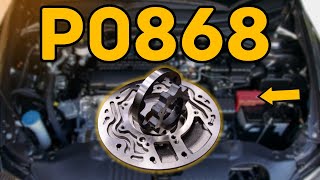
This code is exceptionally common on the 68RFE transmission, which is standard on Ram 2500s with the 6.7L Cummins engine. 🎬 Watch: A pro's guide to diagnosing common 68RFE transmission issues. While low fluid is a universal cause, these trucks have specific, well-documented failure points. A very frequent issue, often cited on forums like CumminsForum.com and RamForum.com, is a cracked or improperly seated sump filter O-ring after a fluid service. This creates a suction leak and starves the pump. The line pressure sensor and the entire solenoid block are also known weak points that fail more often on this platform than on others.
Diagnostic Flowchart

Tap your situation to follow the diagnostic path that matches what you're seeing on this vehicle.
Generation note: The 2016-2020 range covers the end of the fourth generation (2016-2018) and the start of the fifth generation (2019-2020) Ram 2500. Both generations used the 68RFE transmission with the Cummins diesel engine. While the core causes of P0868 are similar, 2019+ models feature a redesigned valve body and solenoid pack with a different (blue) connector that is not interchangeable with earlier models. A safety recall (NHTSA 22V-835) for fluid expulsion from the dipstick tube specifically affects some 2020 models due to pressure and heat buildup.
Symptoms You May Notice
- Check Engine Light illuminated
- Vehicle enters 'limp mode' (often stuck in 4th gear)
- Harsh or delayed gear shifts
- Transmission slipping or RPM surging between shifts
- Inability to shift from Reverse to Drive, or at all
- Transmission overheating
- Bubbles or high reading on the transmission dipstick (indicates overfilling)
- Immediately replacing the transmission without checking fluid level and filters. A large percentage of P0868 codes on this truck are caused by simple fluid level or filter installation errors.
- Replacing only the pressure sensor when the entire solenoid pack is failing. Due to the high failure rate of the solenoid pack, it is often recommended to replace it at the same time as the sensor.
Most Likely Causes

- Low or Incorrect Transmission Fluid Level 🔴 High Probability Leaks are common, and overfilling is a frequent mistake after a service. A recall (NHTSA 22V-835) was issued for 2020-2023 models for fluid being expelled from the dipstick tube due to heat and pressure, leading to low levels and a fire risk.
How to confirm: Check the transmission fluid level on level ground with the engine running in Neutral and the transmission at operating temperature (around 160-180°F). The fluid should be red and at the 'HOT' mark. Bubbles on the dipstick can indicate overfilling, which aerates the fluid and causes pressure loss. A RamForum.com user reported fixing their P0868 code by draining over 3 quarts of excess fluid.
Typical fix: Adjust fluid to the correct level. If low, find and repair the leak. If overfilled, drain the excess. Use only Mopar ATF+4 or a certified equivalent.
Est. part cost: $50-$150 for fluid - Clogged or Improperly Installed Transmission Filters 🔴 High Probability This is a very common issue after a transmission service. The O-ring on the main sump filter can be easily cracked, dislodged, or not seated correctly in the pump housing, creating a suction leak that starves the pump. Using low-quality aftermarket filters is also frequently linked to this problem.
How to confirm: This requires dropping the transmission pan. Inspect the main sump filter for cracks and ensure its O-ring is seated perfectly flush in the pump housing. The issue often appears immediately after a fluid/filter change. The filter is held by a T25 screw torqued to 40 in-lbs.
Typical fix: Replace both the spin-on cooler return filter and the main sump filter. Ensure the new sump filter O-ring is properly lubricated and seated. Torque the pan bolts to specification (105 in-lbs or 8-9 ft-lbs).
Est. part cost: $40-$80 for a filter kit - Failed Line Pressure Sensor (Transducer) 🟡 Medium Probability The line pressure sensor is a known failure point on the 68RFE transmission. It operates in a harsh environment and can fail electronically, providing incorrect readings to the PCM. It is integrated with the transmission temperature sensor.
How to confirm: Use a scan tool to compare 'Desired Line Pressure' to 'Actual Line Pressure'. If the actual pressure reads very low or erratically while desired pressure is normal, the sensor is suspect. A definitive test involves comparing the scan tool reading to a mechanical pressure gauge connected to the transmission's test port. If the gauge and scan tool differ by more than 5 psi (34 kPa), the sensor is likely bad.
Typical fix: Replace the line pressure sensor. This requires dropping the transmission pan and removing the valve body to access the sensor. The OEM part is often cited as Mopar P/N 4799758AF.
Est. part cost: $100-$250
Rare But Worth Checking
- Failing Transmission Solenoid Pack: The entire solenoid pack, which includes the line pressure control solenoid, is a known weak point on the 68RFE and a common cause of P0868. Many technicians replace the solenoid pack and pressure sensor together. The Mopar part number for 2016-2018 models is often superseded, with 68353383AC replacing older numbers like 5170877AA.
- Outdated PCM Software: Multiple Technical Service Bulletins, including #18-069-25, list P0868 as a code that may be resolved by a PCM software update, especially if it appears with other codes like P0933 or various gear ratio errors.
- Failing Transmission Oil Pump: A worn-out pump that cannot generate sufficient pressure will trigger this code. This is a major internal failure, usually confirmed by finding significant metal debris in the transmission pan or by a mechanical pressure test showing consistently low pressure that doesn't respond to disconnecting the main transmission harness.
Diagnosis Steps
- Verify the transmission fluid level and condition. The engine must be running in Neutral, on a level surface, and at full operating temperature (160-180°F). Check for signs of overfilling (bubbles) or low level.
- Use a capable scan tool to read 'Desired Line Pressure' and 'Actual Line Pressure'. A large, persistent discrepancy points towards either a sensor failure or a true low-pressure condition.
- Inspect for external transmission fluid leaks, paying attention to the pan gasket and cooler lines.
- Drop the transmission pan. Inspect the fluid for excessive clutch material or metal shavings (indicating severe internal wear). Check for a missing pan magnet.
- CRITICAL: Carefully inspect the sump filter for cracks and confirm its O-ring is properly seated in the pump housing. A dislodged or damaged O-ring is a very common cause.
- If fluid and filters are confirmed good, test the line pressure sensor circuit and sensor. Compare the sensor's reading to a mechanical gauge connected to the transmission's line pressure test port.
- If the sensor is good but pressure is genuinely low, the problem is likely internal, such as the solenoid pack or the front pump. Disconnecting the main transmission electrical connector should cause pressure to default to maximum; if it doesn't, a mechanical issue like the pump is likely.
Parts You'll Likely Need
- Transmission Filter Kit (Sump and Spin-on) — A clogged or improperly installed filter is a primary cause. Filters are replaced during any pan-drop service. Using OEM Mopar filters is highly recommended to avoid fitment issues.
Trusted brands: Mopar, Wix, ATP
OEM price range: $50-$70
Aftermarket price range: $30-$50 - Transmission Line Pressure Sensor
(OEM #4799758AF)— This sensor is a common electronic failure point on the 68RFE transmission that directly causes the P0868 code.
Related Codes That Often Appear With This One
- P0218 — This code for 'Transmission High Temperature Operation Activated' is a direct consequence of P0868. Low line pressure causes clutch slippage, which generates intense heat. TSB #1813022REVA lists both codes together.
- P0729 - P0735 — These codes for 'Incorrect Gear Ratio' in various gears often accompany P0868. The low line pressure is insufficient to hold the clutch packs firmly, causing them to slip and creating a mismatch between engine speed and output speed. TSB #18-069-25 lists several of these codes with P0868.
- P0933 — P0933 indicates a 'Hydraulic Pressure Sensor Range/Performance' issue. It often appears with P0868 because they both relate to the same pressure sensing circuit. TSB #18-069-25 lists both codes.
Technical Service Bulletins (TSBs) & Recalls

- 18-069-25
- 1806623
- 1808022
- 1813022REVA
- 1810122REVA
- NHTSA 22V-835 / FCA ZA3
Platform-Specific Known Issues
- An owner complaint to the NHTSA (ODI #11300469) documents the P0868 code appearing multiple times specifically while towing a travel trailer, highlighting the issue's tendency to appear under heavy load.
- Safety Recall ZA3 (NHTSA 22V-835) affects some 2020-2023 models with the 68RFE. Heat and pressure can cause fluid to be expelled from the dipstick tube, creating a fire risk and leading to a low fluid level that can trigger P0868.
- Multiple TSBs (#18-069-25, #1806623, #1808022, #1813022REVA) confirm P0868 as 'Line Pressure Low' and indicate that a PCM software update may be part of the solution in some cases.
Mechanic-Grade Diagnostic Values
- Line Pressure Sensor (LPS) Voltage Range — expected: 0.35V - 4.75V. Failure: Voltage outside this range will set codes P0934 (low) or P0935 (high).
- Scan Tool vs. Mechanical Pressure Gauge — expected: Readings should be within 34 kPa (5 psi) of each other.. Failure: A difference greater than 5 psi indicates a faulty line pressure sensor.
- Pressure Control Solenoid (PCS) Resistance — expected: 4.9 Ohms. Failure: Significant deviation from 4.9 Ohms indicates a faulty solenoid.
- Other Shift Solenoids (LR, MS, UD, OD, 4C, 2C) Resistance — expected: 1.3 Ohms. Failure: Significant deviation from 1.3 Ohms indicates a faulty solenoid.
- Pressure Control Solenoid (PCS) Duty Cycle — expected: Varies based on demand.. Failure: The PCM commands the duty cycle. 5% duty cycle equals maximum line pressure, while 62% duty cycle equals minimum line pressure.
Hidden / Shadow Codes Worth Checking
- P0868-00: This is the full code format often seen on dealer-level scan tools. The '-00' suffix is a standard identifier and doesn't typically indicate a specific sub-fault, but its presence is noted in multiple Technical Service Bulletins for this vehicle. (see via Dealer scan tools like wiTECH or high-end aftermarket scanners.)
Scan Tool Commands That Help
- wiTECH, Snap-on, Autel, Launch X431: Quick Learn — This procedure is mandatory after replacing the valve body, solenoid pack, or entire transmission. It resets transmission adaptive memory and calibrates clutch fill volumes and shift timing. Failure to perform a Quick Learn can lead to poor shift quality and premature transmission wear.
- wiTECH or equivalent: Line Pressure Test (using Transmission Simulator) — This is a diagnostic step to verify the line pressure sensor and its circuit independently of the transmission's hydraulics. It uses a special tool (Miller #8333) to send known pressure signals to the PCM, which can then be read on the scan tool to confirm sensor accuracy.
Wiring & Ground Locations
- Transmission Solenoid / TRS Assembly Connector — Main 23-pin electrical connector on the passenger side of the transmission case.. This is the primary connection for all internal transmission electronics, including the line pressure sensor and solenoids. Checking for corrosion, pushed-out pins, or damage here is a key step.
- Pin 12 (T140) - Pressure Control Solenoid Control — On the main transmission connector.. This is the circuit the PCM uses to control the Pressure Control Solenoid. Checking for shorts or opens on this wire is part of advanced electrical diagnosis.
- (F856) 5-Volt Supply Circuit — Wire running from the PCM to the line pressure sensor via the main transmission connector.. This circuit provides the reference voltage for the line pressure sensor. A short to ground or an open on this wire will cause the sensor to read incorrectly and can set P0868 or related sensor codes.
Real Owner Repair Stories
- RamForum.com user 'CRB357' (2016 Ram 2500 5.7L) — P0868 code appeared immediately after purchasing the used truck. Fluid on dipstick was very high with bubbles.
✅ What actually fixed it The transmission was overfilled by 3.25 quarts. After extracting the excess fluid to bring the level to the correct 'HOT' mark, the code cleared on its own and shift quality improved. - YouTube channel 'Pine Hollow Auto Diagnostics' (Dodge Ram with 6.7L Cummins and 68RFE) — Check engine light with code P0868.
❌ Tried (didn't work) Initial checks at the main transmission connector showed the correct 5V reference and ground signals were being sent from the PCM.
✅ What actually fixed it Testing directly at the line pressure sensor connector (inside the pan) revealed 5 volts on the ground wire. This indicated an open ground within the short internal transmission harness that connects the main plug to the valve body. Replacing this internal harness resolved the issue.
OEM Part Supersession History
Various (e.g., 5170877AA)→68353383AC (Grey/White Connector)— Updates and revisions to improve reliability.
Heads up: The grey/white connector solenoid packs are for 2011-2018 models. They are NOT compatible with 2019+ models.N/A→OEM Mopar Only (Blue Connector)— Major redesign of the valve body and electronics.
Heads up: 2019 and newer Ram 2500s with the 68RFE use a solenoid pack with a blue connector. It is physically and electronically different and is not interchangeable with any earlier (white or grey) solenoid packs.4799758AD (4-pin design)→4799758AF (3-pin design)— Design update.
Heads up: The newer 3-pin sensor (4799758AF) is the correct replacement for the older 4-pin design for this application.
Model Year Variations Within This Range
- 2019-2020: The 68RFE was significantly updated. It features an auxiliary valve body, a dedicated TCC control solenoid, and a new solenoid pack with a blue connector that is not backward compatible. Aftermarket pressure-boosting modules are not recommended for these years; TCM tuning is required to safely increase line pressure.
- 2016-2018: These models use the 'Gen 2' 68RFE valve body with a grey or white connector solenoid pack. These solenoid packs are not compatible with 2019+ models.
Helpful Videos

Used OEM Parts in Stock

New Aftermarket Parts Available



The information in this article is provided for general reference and educational purposes only. Vehicle specifications, procedures, and part compatibility can vary by production date, trim level, and region. Always consult your vehicle's factory service manual and verify part numbers before purchasing or performing repairs. Safety-critical components such as airbags, seat belts, and braking systems should be installed by a qualified professional.
- Ram 2500:
- 🎬 Helpful Videos
- 🛍️ Shop This Part
- What's Unique About the 2016-2020 Ram 2500
- Diagnostic Flowchart
- Symptoms You May Notice
- Most Likely Causes
- Rare But Worth Checking
- Diagnosis Steps
- Parts You'll Likely Need
- Related Codes That Often Appear With This One
- Technical Service Bulletins (TSBs) & Recalls
- Platform-Specific Known Issues
- Mechanic-Grade Diagnostic Values
- Hidden / Shadow Codes Worth Checking
- Scan Tool Commands That Help
- Wiring & Ground Locations
- Real Owner Repair Stories
- OEM Part Supersession History
- Model Year Variations Within This Range
- 🎟️ Get 5% Off