

OBD-II Code P0864: TCM Communication Circuit Range/Performance
What P0864 means, why it triggers, and how to fix it
- Code P0864 triggers when the Powertrain Control Module (PCM) stops receiving valid data from the Transmission Control Module (TCM) over the CAN bus network.
- Always test the battery and clean the main ground straps before replacing parts; voltage drops below 12.4V are the leading cause of this communication error.
- Driving with an active P0864 code forces the transmission into 2nd or 3rd gear 'limp mode,' which destroys internal clutch packs within 1 to 3 months.
- Expect repair costs to range from $10 for a DIY ground wire cleaning to over $1,200 if the TCM requires replacement and dealer reprogramming.
What Does P0864 Mean?

P0864 means your car's main computer, the Powertrain Control Module (PCM), detects a problem with the signal from the Transmission Control Module (TCM). The TCM is the 'brain' for your automatic transmission, controlling when and how it shifts gears. This code indicates the communication between these two critical computers is unstable, weak, or incorrect, preventing your transmission from shifting properly.
Technical definition: The official SAE/OBD-II definition is "TCM Communication Circuit Range/Performance. 🎬 Watch: A quick overview of the P0864 code and its meaning." This indicates the Powertrain Control Module (PCM) detects the communication signal from the Transmission Control Module (TCM) is out of its expected range or performing erratically. The modules communicate over the Controller Area Network (CAN) bus, and this code sets when the PCM fails to receive a valid, logical signal from the TCM within a specified timeframe.
Can I Drive With P0864?
No — Do Not Drive. Do not drive the vehicle. The transmission shifts harshly, gets stuck in gear, or enters a low-power 'limp mode,' which is unsafe in traffic. Continuing to drive causes catastrophic mechanical damage to internal transmission components like clutches and gears, turning a $100 wiring repair into a $3,000 transmission rebuild.
Common Causes

- Low Battery Voltage or Bad Grounds (Very Common) — A weak battery, failing alternator, or loose ground strap causes low voltage across the vehicle's electrical system. Control modules are highly sensitive to voltage drops and fail to communicate correctly if the supply dips below 12.0V.
- Damaged Wiring or Contaminated Connectors (Very Common) — Wires in the CAN bus harness become corroded, frayed, or shorted against the chassis. Connectors loosen or suffer from fluid intrusion (transmission fluid, oil, or water), which shorts the pins and interrupts the signal between the TCM and PCM.
- Failing Transmission Control Module (TCM) (Common) — The TCM fails internally due to heat and vibration, especially when mounted directly on the transmission. A failing TCM sends invalid data packets to the network even if the physical wiring connection is perfect.
- TCM/PCM Software Issues (Less Common) — Software glitches disrupt communication logic. Manufacturers frequently release Technical Service Bulletins (TSBs) with software updates (reflashes) to resolve these specific communication bugs.
- Faulty Power Relay (Less Common) — A failing main power relay intermittently cuts power to various control modules, including the TCM. This causes a sudden loss of communication and frequently leads to the engine stalling unexpectedly.
- Failed Vehicle Speed Sensor (VSS) (Uncommon) — A faulty Vehicle Speed Sensor sends erratic data to the TCM. This incorrect data forces the TCM to send implausible signals to the PCM, triggering P0864 as a secondary fault.
- Faulty Powertrain Control Module (PCM) (Rare) — The main engine computer rarely fails compared to the TCM or the wiring harness. It is the least likely culprit for a communication code.
Symptoms

- Check Engine and Transmission Warning Lights On — The dashboard illuminates the Check Engine Light immediately. A blinking gear indicator or traction control light also appears.
- Vehicle Stuck in 'Limp Mode' — The transmission locks into a single gear (usually 2nd or 3rd) to prevent internal damage, resulting in sluggish acceleration and high RPMs at highway speeds.
- Harsh, Erratic, or Delayed Shifting — The car slams violently into gear, shifts at incorrect RPMs, or hesitates for several seconds before engaging Drive or Reverse.
- ABS and Traction Control Lights On — Anti-lock braking and traction control systems rely on transmission data. A communication loss disables these safety systems and triggers their warning lights.
- Inability to Shift Out of Park — The communication failure prevents the electronic shift interlock solenoid from disengaging.
- Engine Stalls While Driving — If a main power relay fails, the loss of TCM communication is accompanied by the engine shutting off completely.
Diagnostic Flowchart
Tap your situation to follow the diagnostic path that matches what you're seeing on this code.
Common Fixes & Costs
- Cleaning or Replacing Battery Terminals and Ground Straps — Parts: $5-$50, Labor: $50-$200, ~0.5 hr book time (DIY)
- Repairing Damaged Wiring or Connectors — Parts: $10-$50, Labor: $100-$400, ~1.5 hr book time (Professional)
- Reprogramming (Reflashing) the TCM — Parts: $0, Labor: $120-$300, ~1 hr book time (Professional)
- Replacing the Transmission Control Module (TCM) — Parts: $250-$1200, Labor: $150-$400, ~2.5 hr book time (Professional)
- Replacing a Faulty Power Relay — Parts: $15-$60, Labor: $50-$100, ~0.2 hr book time (DIY)
Used vs. New Parts: Buying Guide
When a used part is worth it: For an older vehicle (>150k miles) where a new TCM is a significant portion of the car's value, a used module from a reputable seller is a cost-effective option if you accept a shorter part lifespan.
Donor-vehicle mileage cap: roughly under 80000 miles for the part to have meaningful remaining life.
Donor quality checklist:
- Verify the exact part number matches; modules from different years or trim levels are incompatible.
- Purchase from a salvage yard or parts reseller offering at least a 30-day warranty.
- Ask for the mileage of the donor vehicle.
- Avoid modules from flood-damaged or rust-belt vehicles due to hidden corrosion.
Decision logic:
- If The vehicle is less than 8 years old or has under 100,000 miles → Buy a new or professionally remanufactured TCM. The long-term reliability and warranty outweigh the initial cost savings.
- If The vehicle is over 10 years old and budget is the primary concern → A used part from a low-mileage donor is an acceptable risk, but prepare for potential programming challenges.
- If The TCM requires programming to the vehicle's VIN → Favor a new or remanufactured unit, as many shops cannot program a used module. Verify programming requirements before purchasing.
Warranty tradeoff: Used parts typically come with a 30-90 day functional warranty. Remanufactured modules offer a 1-year to lifetime warranty. New OEM parts carry a 1-2 year warranty if installed by a dealer.
Worst-case if a used part fails: $400-$800 if a used part is dead on arrival, covering repeat labor and diagnostic fees, plus the cost of another module.
What Happens If You Wait — Timeline
- 0-1 month: Check Engine Light is on. Shifting is slightly harsh or erratic, but the vehicle is mostly drivable. Limp mode occurs intermittently. (MPG impact: 0-5%% · Added cost: $0-$50 in wasted fuel.)
- 1-3 months: Harsh shifting becomes consistent. The vehicle enters limp mode frequently, getting stuck in 2nd or 3rd gear, causing high engine RPMs at moderate speeds. (MPG impact: 10-20%% · Added cost: $50-$200 in wasted fuel. Increased stress wears on transmission clutch packs.)
- 3-6 months: Constant slamming into gear causes mechanical damage. Clutch material burns and contaminates the transmission fluid. Solenoids fail from the stress. (MPG impact: 15-25%% · Added cost: $1,000-$2,500. The electrical problem causes clutch pack and solenoid damage, requiring a partial rebuild.)
- 6+ months: Catastrophic internal transmission failure occurs. Burned clutches, damaged gear sets, or a failed valve body render the vehicle completely undrivable. (MPG impact: N/A (undrivable)% · Added cost: $2,500-$8,000+. The initial electrical fix escalates into a complete transmission replacement.)
Cost of Not Fixing It
- 0-1 month: Unpredictable shifting and vehicle enters 'limp mode' at any time, posing a safety risk. Fuel economy drops by 5-15%. (Added cost: Negligible, other than increased fuel costs.)
- 1-6 months: Continued harsh shifting and high RPMs in limp mode cause excessive wear on transmission clutches, bands, and solenoids, leading to premature mechanical failure. (Added cost: $2,500-$8,000+ if a full transmission rebuild becomes necessary due to mechanical damage.)
- 6+ months: Catastrophic transmission failure occurs. The vehicle becomes completely undrivable. A simple wiring issue escalates into a complete transmission replacement. (Added cost: $3,000-$8,000+)
Diagnosis Steps

- Check for Other Codes
Use an OBD-II scanner to read all stored codes. P0864 is frequently accompanied by U-series communication codes (e.g., U0101) or P0700. If U0101 is present, prioritize diagnosing a complete loss of power or a severed wire.
Tools: OBD-II Scanner (Beginner) - Inspect the Battery and Charging System
Verify the battery is fully charged (12.4V-12.8V engine off). Start the engine and use a multimeter to confirm alternator output is 13.5V-14.8V. Low voltage is the leading cause of module communication errors. Fix charging issues before proceeding.
Tools: Multimeter (Beginner) - Check for Technical Service Bulletins (TSBs)
Search online for TSBs related to your specific year, make, and model for code P0864. Manufacturers often issue software updates to fix known communication glitches, saving you hours of physical diagnosis.
Tools: Internet access (Beginner) - Inspect Wiring and Perform a 'Wiggle Test'
Visually inspect the harness between the PCM and TCM for chafed, burnt, or corroded wires. With the key on and a scan tool showing live TCM data, gently wiggle the wiring harness and connectors. If the data stream drops out, you have located the physical wiring break.
Tools: Flashlight, OBD-II Scanner, assistant (Intermediate) - Check Main Ground Connections
Locate the main engine, transmission, and TCM ground straps. Unbolt them, clean the chassis contact points and the ring terminals with a wire brush until shiny, and re-secure them tightly. A poor ground creates electrical noise that corrupts CAN bus signals.
Tools: Socket set, wire brush (Intermediate) - Verify TCM Power and Ground Inputs
Using a wiring diagram, identify the power and ground pins at the TCM connector. With the key on, use a multimeter to confirm the power pins show battery voltage and the ground pins have less than a 0.1V drop to the chassis. If power is missing, trace back to the TCM fuse or relay.
Tools: Multimeter, vehicle-specific wiring diagram (Advanced) - Test the CAN Bus Circuit Resistance
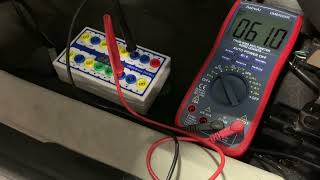
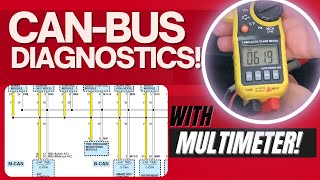
Disconnect the battery. Use a multimeter to measure resistance between CAN High (Pin 6) and CAN Low (Pin 14) at the OBD-II port. A healthy bus reads 60 ohms. A reading of 120 ohms means a terminating resistor (or module) is offline. A reading near 0 ohms indicates a short circuit.
Tools: Multimeter (Advanced) - Check CAN Bus Voltage and Waveform
With the key on, check CAN voltage: CAN High fluctuates between 2.5V and 3.5V; CAN Low fluctuates between 1.5V and 2.5V. For definitive proof, use an oscilloscope to view the waveform. A distorted square wave proves external interference or an internally shorted module.
Tools: Oscilloscope, Multimeter, vehicle-specific wiring diagram (Professional)
When This Code Triggers (Freeze-Frame Conditions)
- Engine Coolant Temp: 180-210°F (Fully warmed up and at operating temperature.)
- RPM: 1500-2500 RPM (During steady-state cruising or light acceleration.)
- Engine Load: 25-60% (The fault occurs under normal driving load, not typically at idle or full throttle.)
- Vehicle Speed: 30-60 mph (Logged during city or highway driving as the transmission actively shifts and communicates.)
Related Codes
- U0101 — Means 'Lost Communication With TCM.' P0864 indicates an erratic signal, while U0101 indicates a complete signal loss. If U0101 is present, suspect a cut wire, blown fuse, or completely dead module.
- P0700 — A generic code meaning the TCM detected a fault and requested the Check Engine Light. It acts as a flag telling you to look for specific transmission codes. Always diagnose P0864 first.
- P0868 — Means 'Transmission Fluid Pressure Low.' On CVT vehicles, low pressure causes erratic transmission behavior, disrupting TCM operation and setting P0864. Fix the fluid pressure issue first.
- P0863 — Means 'TCM Communication Circuit.' Very similar to P0864, but P0863 is a general circuit fault while P0864 points to a specific 'Range/Performance' logic error. They share identical diagnostic paths.
Climate & Environmental Factors
- High Humidity and Road Salt: Salty water acts as an electrolyte that aggressively corrodes wiring harnesses, connector pins, and ground points. This corrosion increases resistance in the CAN bus, directly causing communication failures.
- Extreme Cold: Cold temperatures cause wiring insulation to become brittle and crack, creating entry points for moisture. It also strains the battery, and the resulting low voltage during startup triggers transient communication codes.
- Extreme Heat: High under-hood temperatures accelerate the breakdown of electronic components within the TCM, especially if mounted on the transmission. This leads to internal TCM failure and erratic signal generation.
How to Talk to a Mechanic About This Code
Say this: "I have a P0864 code and I'd like to schedule a diagnostic. I'd like you to start by checking for any related TSBs, and then verifying the power and ground circuits for the TCM. Please check the basics of the communication circuit before recommending a module replacement."
This signals you understand that P0864 is often a wiring or power supply issue, not just a bad TCM. It directs the shop to follow a logical diagnostic process and prevents them from jumping to the most expensive conclusion.
Avoid saying:
- 'Just fix whatever's wrong'
- 'My check engine light is on, can you look at it?'
- 'Whatever you recommend'
Questions to ask before authorizing the repair:
- What diagnostic steps did you take to isolate the cause?
- Did you perform a voltage drop test on the TCM's power and ground wires?
- What was the resistance on the CAN bus? Did you check it at the TCM connector as well?
- If you're recommending a TCM replacement, how did you confirm the module itself failed and not the wiring to it?
- Is there a software update (TSB) available for this issue?
- What is the warranty on this specific repair, including both parts and labor?
Where to Take It: Dealer vs Independent vs Chain
- Dealer:
A safe, but expensive, option. The best choice if a software reflash is the confirmed fix or if the vehicle is under warranty.
Best for: Vehicles still under powertrain warranty, Complex software updates (reflashing) requiring manufacturer-specific tools, Known, quirky issues on specific brands where they have exclusive service bulletins.
Downsides: Highest labor rates, often 1.5-2x more than independent shops., Defaults to replacing entire assemblies instead of repairing a smaller component. (Typical cost: +50% vs. baseline) - Independent Shop:
Excellent choice, IF it's the right kind of independent shop. Seek out a specialist in transmissions or auto electrics comfortable with network diagnostics.
Best for: Out-of-warranty vehicles where cost is a major factor., Shops specializing in transmission or auto electrical diagnostics., Building a long-term relationship with a trusted mechanic.
Downsides: Quality and diagnostic capability vary widely. A general mechanic lacks the tools for complex network issues., Lacks access to the very latest manufacturer software or tools. (Typical cost: +0% vs. baseline) - Chain Shop:
AVOID for this code. The risk of misdiagnosis is extremely high. This is not the type of repair they handle effectively.
Best for: Simple, high-volume jobs like tires, brakes, and oil changes.
Downsides: Technicians are less experienced and pressured to upsell., Not equipped for in-depth electrical or network diagnostics like P0864 requires. (Typical cost: -10% vs. baseline)
When to Walk Away From the Repair
If the estimated repair cost exceeds 40-50% of the car's private-party value, seriously consider selling or trading it in instead of repairing it.
- Car worth $4000, fix is $1800: Walk away. The repair cost is 45% of the car's value. It's not economically sound to invest this much into an older car for a single repair.
- Car worth $15000, fix is $1600: Fix it. The repair cost is only about 11% of the vehicle's value, well below the threshold.
- Car worth $5000, fix is $800: Fix it, but get a firm quote. This is a reasonable 16% of the car's value, but ensure there are no other major pending repairs.
What Scan Tool You Need for This Code

Minimum: A tool that reads manufacturer-specific codes from the Transmission Control Module (TCM) and views live data from that module.
A $20 reader only shows the P0864 code from the engine computer. It won't tell you if the scanner communicates with the TCM, which is a critical first diagnostic step. It cannot show the live data needed to diagnose the communication circuit.
Budget: BlueDriver Pro (~$100) — Reads and clears enhanced codes (ABS, Airbag, Transmission) for most major brands. It allows you to see if you can establish communication with the TCM and view live data.
Mid-range: Foxwell NT510 Elite / Autel MaxiCOM MK808S (~$180) — Offers bidirectional controls, allowing you to command components to see if they work. You test relays and solenoids directly from the scanner to pinpoint the fault, saving significant diagnostic time.
Professional: Launch X431 / Autel MaxiSys Series (~$900-2000) — Provides full OE-level diagnostics, including topology mapping to see which modules are on the network. Offers ECU coding and programming, required when replacing a TCM.
Rent vs buy: For P0864, a free rental scanner from an auto parts store is insufficient. If this is a one-time issue, spend the money on a professional diagnosis. Buy a mid-range scanner only if you perform your own diagnostics regularly.
How to Clear the Code After You Fix It
- Reconnect battery if it was disconnected.
- Use an OBD-II scan tool to erase all Diagnostic Trouble Codes (DTCs).
- Perform a complete OBD-II drive cycle to allow readiness monitors to run.
Drive cycle (~30 minutes): A generic drive cycle includes a cold start (engine off for 8+ hours), 2-3 minutes of idling, 15 minutes of mixed city/highway driving with steady speeds and gentle acceleration, and a 5-minute steady cruise at 55-60 mph. The vehicle must then cool down completely.
Readiness monitors affected: Comprehensive Component Monitor (CCM), Misfire Monitor, Catalyst (CAT) Monitor, Oxygen (O2) Sensor Monitor
Before emissions retest: drive at least 100 miles to fully set monitors.
Watch out for:
- Disconnecting the battery clears codes but resets all readiness monitors to 'Incomplete'.
- The code returns immediately if the underlying electrical or module fault is not repaired.
- Driving at a constant highway speed for a long distance fails to complete all necessary monitors; varied driving is required.
Will This Fail Emissions / State Inspection?
Yes — this code typically fails an OBD-II emissions inspection.
- California: An active P0864 code is an automatic failure. After repair, you must complete a drive cycle to set all required readiness monitors to 'Ready' before passing the smog check.
- New York: The NYS DMV emissions inspection includes an OBD-II scan. A Check Engine Light with code P0864 results in an immediate test failure.
- Texas: In the 17 counties requiring emissions testing, an illuminated Check Engine Light for P0864 causes the vehicle to fail the inspection.
Most Commonly Affected Vehicles
- Ford Focus, Fiesta (2011-2019) — The DPS6 PowerShift transmission is infamous for TCM failures. A common root cause is a corroded ground connection under the battery tray. Ford issued extended warranty program 14M02 for these TCMs.
- Nissan Altima, Sentra, Rogue, Juke (2007-2018) — P0864 frequently appears alongside P0868 (low fluid pressure). The issue is often related to internal CVT wear or degraded fluid causing the TCM to report errors. Check TSB NTB11-005 for software updates.
- Dodge/Chrysler/Jeep Journey, Avenger, 200, Patriot, Compass (2007-2017) — The wiring harness near the front of the vehicle is highly susceptible to corrosion and road debris damage, leading to CAN bus shorts.
- Chevrolet/Holden Silverado, Commodore (VZ) (2004-2014) — This code often points directly to an internal TCM failure where the module sends invalid data packets to the PCM, requiring a full module replacement and programming.
- Honda Civic, Accord, CR-V (2016-2023+) — Indicates a PT-CAN or PF-CAN malfunction. Diagnosis requires the Honda Diagnostic System (HDS) to check communication status and inspect specific CAN circuit wiring.
- Volkswagen Jetta, Golf (2010-2021) — Owners report P0864 alongside an EPC light and engine stalling. This is frequently traced to a failing primary power relay (Terminal 30) rather than a direct TCM fault.
- Subaru Outback, Forester, Impreza (2010-2019) — Often related to a faulty valve body or integrated TCM. Triggered frequently by low transmission fluid or severely degraded fluid.
- Hyundai/Kia Elantra, Sonata, Optima (2011-2019) — Caused by a faulty transmission range sensor or inhibitor switch sending incorrect gear position data to the TCM, leading to a communication fault with the PCM.
Manufacturer-Specific Notes
- Ford: On Focus and Fiesta models, a bad ground connection under the battery box is the primary cause for this code. Always clean this ground before condemning the TCM.
- Nissan: In CVTs, this code is less about the TCM and more about the transmission overheating or failing mechanically, which disrupts communication. Checking fluid condition is critical.
- Volkswagen/Audi: A failing primary power relay intermittently cuts power to the control modules, causing a P0864 and a stall condition. Always test the J317/Terminal 30 relay.
- GM/Holden: The diagnostic procedure for P0864 is paired directly with U0101, requiring technicians to check the GM LAN serial data circuit and the powertrain interface module (PIM).
Real Owner Stories
2012 Ford Focus at 110K miles
Transmission warning light on, harsh shifting, and occasional failure to engage from a stop.
What they tried:
- Took it to a general mechanic who read the P0864 code and recommended a $1,200 TCM replacement.
Outcome: The owner searched online forums and found the common ground wire issue. They located the ground point under the battery tray, found it heavily corroded, cleaned it with a wire brush, and re-secured it. The code cleared and did not return. Total cost: $10.
Lesson: Always check the simplest, most common fixes for your specific vehicle first. A 30-minute ground check saves you from an expensive and unnecessary module replacement.
2014 VW Jetta at 85K miles
Car suddenly stalled while driving. EPC, check engine, and battery lights came on. The car restarted but stalled again shortly after. Code P0864 was present.
What they tried:
- Towed to a shop that couldn't communicate with the car's computer.
- Owner suspected TCM or major wiring failure.
Outcome: A mechanic confirmed the primary power relay was failing intermittently, causing power loss to multiple modules, triggering the communication code and stalling. A $45 relay replacement fixed the issue completely.
Lesson: If unusual electrical symptoms occur (like stalling), consider components that supply power to multiple modules, like a main relay, before focusing only on the TCM.
2007 Holden Commodore VZ at 130K miles
Intermittent 'limp mode' and powertrain warning light. A transmission shop suspected a faulty TCM but referred the owner to an auto electrician.
What they tried:
- An auto electrician connected an oscilloscope to the CAN bus wires.
- They verified power and grounds to the TCM were good.
- They observed the CAN bus waveform, which looked normal even when the fault occurred.
Outcome: Because the physical network layer was perfect, the technician concluded the TCM was internally failing and sending invalid data packets. Replacing the TCM resolved the fault.
Lesson: P0864 means the quality of communication is bad, not necessarily lost. Advanced diagnosis proves when the wiring is good but the module itself is 'speaking nonsense', confirming the need for TCM replacement.
2015 Nissan Altima at 95K miles
Check engine light on with codes P0864 and P0868 (Transmission Fluid Pressure Low). The car had a slight shudder on acceleration.
What they tried:
- The owner feared a TCM failure due to the P0864 code.
- A mechanic checked the transmission fluid and found it dark and low.
Outcome: The mechanic performed a CVT fluid drain and fill to address the P0868 code. After the fluid service, the shudder and both codes disappeared.
Lesson: When P0864 is paired with pressure-related codes like P0868 on a CVT, address the mechanical code first. The communication fault is often a symptom of the primary hydraulic issue.
How to Prevent This Code From Triggering
- Change automatic transmission fluid at recommended intervals (Every 30,000-60,000 miles, or per owner's manual.) — Clean fluid prevents overheating and reduces wear on mechanical parts. Overheating causes erratic operation that disrupts TCM communication.
- Annually inspect and clean main battery terminals and chassis grounds (Once per year, especially before winter) — Prevents voltage drops and electrical noise caused by corrosion. Control modules are highly sensitive to voltage, and a poor ground causes communication faults.
- Apply dielectric grease to critical connectors when exposed (Anytime a connector is disconnected for service) — Dielectric grease is non-conductive and seals out moisture, preventing high-resistance connections from forming on the CAN bus lines.
- Keep vehicle software updated (Check for TSBs during routine service visits) — Manufacturers release software updates to fix communication logic bugs between modules that trigger codes like P0864.
- Avoid high-pressure washing the engine bay (Always) — High-pressure water forces its way past weather seals on connectors and modules, leading to short circuits and immediate communication failures.
Frequently Asked Questions
What is the most common misdiagnosis for P0864?
The most common mistake is immediately replacing the expensive TCM without inspecting the basics. Technicians often overlook simple causes like a corroded ground wire, a loose connector pin, or low battery voltage.
Can a bad battery cause code P0864?
Yes. A weak battery provides unstable voltage (below 12.4V) to the vehicle's computers, leading to communication errors between the TCM and PCM. Always verify battery health early in your diagnosis.
What is the difference between a TCM and a PCM?
The PCM (Powertrain Control Module) is the main computer for the engine. The TCM (Transmission Control Module) is a dedicated computer that controls the automatic transmission. They must constantly communicate over the CAN bus for the car to drive.
How much does it cost to fix P0864?
Costs range from $10 for a DIY ground cleaning to $1,600 for a full TCM replacement and programming. Software reflashes typically cost $120-$300 at a dealership. If driven in limp mode too long, secondary mechanical damage requires a $2,500+ transmission rebuild.
Will clearing the code fix the problem?
No. Clearing the code only turns off the check engine light temporarily. The code returns as soon as the PCM detects the communication fault again, usually within minutes of driving.
Is the TCM inside the transmission?
It depends on the vehicle. On older cars, the TCM is a separate module in the engine bay; on newer vehicles, it is often integrated into a 'mechatronic' unit inside the transmission housing, making replacement expensive.
Can I check the CAN bus myself?
Basic checks are possible for experienced DIYers. With the battery disconnected, use a multimeter to check for 60 Ohms of resistance between CAN_H and CAN_L pins at the OBD-II port.
My scanner can't communicate with the TCM at all. Is that P0864?
If your scan tool cannot communicate with the TCM, you are dealing with a U0101 'Lost Communication' code, indicating a total break in power or wiring. P0864 implies the module is powered up but sending faulty data.
Key Takeaways
- Code P0864 triggers when the Powertrain Control Module (PCM) stops receiving valid data from the Transmission Control Module (TCM) over the CAN bus network.
- Always test the battery and clean the main ground straps before replacing parts; voltage drops below 12.4V are the leading cause of this communication error.
- Driving with an active P0864 code forces the transmission into 2nd or 3rd gear 'limp mode,' which destroys internal clutch packs within 1 to 3 months.
- Expect repair costs to range from $10 for a DIY ground wire cleaning to over $1,200 if the TCM requires replacement and dealer reprogramming.
Helpful Videos

The information in this article is provided for general reference and educational purposes only. Vehicle specifications, procedures, and part compatibility can vary by production date, trim level, and region. Always consult your vehicle's factory service manual and verify part numbers before purchasing or performing repairs. Safety-critical components such as airbags, seat belts, and braking systems should be installed by a qualified professional.
- 🎬 Helpful Videos
- What Does P0864 Mean?
- Can I Drive With P0864?
- Common Causes
- Symptoms
- Diagnostic Flowchart
- Common Fixes & Costs
- Used vs. New Parts: Buying Guide
- What Happens If You Wait — Timeline
- Cost of Not Fixing It
- Diagnosis Steps
- When This Code Triggers (Freeze-Frame Conditions)
- Related Codes
- Climate & Environmental Factors
- How to Talk to a Mechanic About This Code
- Where to Take It: Dealer vs Independent vs Chain
- When to Walk Away From the Repair
- What Scan Tool You Need for This Code
- How to Clear the Code After You Fix It
- Will This Fail Emissions / State Inspection?
- Most Commonly Affected Vehicles
- Manufacturer-Specific Notes
- Real Owner Stories
- 2012 Ford Focus at 110K miles
- 2014 VW Jetta at 85K miles
- 2007 Holden Commodore VZ at 130K miles
- 2015 Nissan Altima at 95K miles
- How to Prevent This Code From Triggering
- Frequently Asked Questions
- What is the most common misdiagnosis for P0864?
- Can a bad battery cause code P0864?
- What is the difference between a TCM and a PCM?
- How much does it cost to fix P0864?
- Will clearing the code fix the problem?
- Is the TCM inside the transmission?
- Can I check the CAN bus myself?
- My scanner can't communicate with the TCM at all. Is that P0864?
- Key Takeaways
- 🎟️ Get 5% Off