

OBD-II Code P0844: Transmission Fluid Pressure Sensor 'A' Circuit Intermittent
The Ultimate Expert Guide to Diagnosing and Fixing P0844
- Code P0844 indicates a flickering or unstable signal from the transmission fluid pressure sensor, immediately disabling normal gear shifts.
- Tow the vehicle to a shop; driving in limp mode with erratic hydraulic pressure can destroy a $3,500 transmission in under 50 miles.
- Check the transmission fluid level and color first, as low fluid introduces air bubbles that cause the exact pressure fluctuations triggering this code.
- Perform a live-data 'wiggle test' on the sensor's wiring harness before buying parts, as corroded connector pins cause 30% of P0844 misdiagnoses.
What Does P0844 Mean?
The Transmission Control Module (TCM) detects an unstable, flickering signal from Transmission Fluid Pressure Sensor (TFPS) 'A'. This sensor provides critical hydraulic pressure data needed for smooth shifting. When the signal fluctuates unpredictably, the TCM cannot control gear changes, triggering the Check Engine Light and forcing the transmission into a protective 'limp mode'.
Technical definition: Transmission Fluid Pressure Sensor/Switch 'A' Circuit Intermittent.
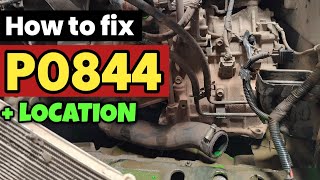
🎬 Watch: A quick overview of the P0844 code and its causes.Can I Drive With P0844?
No — Do Not Drive. Do not drive. While you can 'limp' to a repair shop, you risk catastrophic transmission damage. Harsh shifting burns out clutch packs and overheats components, turning a $250 sensor fix into a $3,500 transmission rebuild. Inefficient engine operation during limp mode also damages the catalytic converter, adding $1,500 to the bill. Tow the vehicle.
Common Causes
- Low, Burnt, or Dirty Transmission Fluid (Very Common) — Low fluid allows the transmission pump to draw in air, causing unstable hydraulic pressure. Contaminated fluid clogs passages and interferes with accurate sensor readings.
- Faulty Transmission Fluid Pressure Sensor (TFPS) (Very Common) — The sensor fails internally from constant heat and vibration, sending erratic voltage signals to the TCM despite normal hydraulic pressure.
- Damaged Wiring or Corroded Connectors (Common) — Wires chafe or melt, and connector pins lose tension or corrode. This creates a loose connection resulting in a flickering, intermittent signal.
- Damaged Internal Transmission Harness (Less Common) — On transmissions like the VW/Audi 09G, the internal oil pan wiring harness becomes brittle from heat, cracking wires and creating intermittent open circuits.
- Internal Valve Body or Mechanical Failure (Less Common) — A sticking valve, cracked housing, or failing internal pump causes genuine erratic pressure fluctuations that the sensor accurately reports.
- Faulty Transmission Control Module (TCM) (Rare) — The TCM itself fails due to cracked solder joints or internal driver failure. Rule out all other possibilities before replacing the TCM.
Symptoms
- Check Engine Light & Limp Mode — The transmission locks into a single gear (usually 2nd or 3rd) to prevent damage, causing poor acceleration and high RPMs at highway speeds.
- Erratic or Harsh Shifting — The vehicle slams into gear, hesitates between shifts, or clunks loudly when moving from Park to Drive.
- Transmission Slipping — Engine RPMs flare up between shifts without a corresponding increase in vehicle speed.
- Decreased Fuel Economy — Inefficient shifting and limp mode force the engine to work harder, dropping fuel efficiency by 10-20%.
Diagnostic Flowchart
Tap your situation to follow the diagnostic path that matches what you're seeing on this code.
Common Fixes & Costs
- Transmission Fluid and Filter Change — Parts: $60-$120, Labor: $100-$200, ~1.5 hr book time (DIY)
- Replace Transmission Fluid Pressure Sensor — Parts: $50-$150, Labor: $150-$300, ~2.0 hr book time (Intermediate)
- Repair Damaged Wiring or Connector — Parts: $20-$50, Labor: $150-$250, ~1.5 hr book time (Intermediate)
- Replace Valve Body — Parts: $400-$800, Labor: $300-$600, ~3.5 hr book time (Advanced)
- Replace Transmission Control Module (TCM) — Parts: $300-$900, Labor: $150-$300, ~2.0 hr book time (Professional)
Used vs. New Parts: Buying Guide
When a used part is worth it: A used sensor makes sense only if it is part of a larger assembly (like a complete valve body) from a verified low-mileage vehicle.
Donor-vehicle mileage cap: roughly under 60000 miles for the part to have meaningful remaining life.
Donor quality checklist:
- Verify the donor vehicle was not scrapped due to transmission failure.
- Match the part number exactly; superseded numbers have different internal calibrations.
- Avoid parts from flood-damaged or rust-belt vehicles due to corrosion risk.
Decision logic:
- If The part is an externally mounted sensor and a new aftermarket part is under $100 → Buy new. The small savings from a used part aren't worth the risk of immediate failure.
- If The sensor is internal and requires significant labor to access → Buy a new OEM or high-quality aftermarket part to avoid repeating expensive labor.
- If The vehicle has >150k miles and the budget is extremely tight → A used sensor from a reputable salvage yard with a warranty is a reasonable gamble.
Warranty tradeoff: Used parts carry a 30-90 day warranty covering the part only. New aftermarket parts offer 1-year to lifetime warranties.
Worst-case if a used part fails: 300-600. If a used sensor fails, you pay for the part and the installation labor twice.
What Happens If You Wait — Timeline
- 0-4 weeks: Check Engine Light is on. Shifting feels normal most of the time, with occasional hard shifts when warm. The issue is intermittent. (MPG impact: 0-5%% · Added cost: $0-50 in wasted fuel)
- 1-3 months: Harsh shifting becomes daily. The transmission enters limp mode occasionally. Unstable pressure causes minor premature wear on clutch surfaces. (MPG impact: 5-10%% · Added cost: $50-200 in wasted fuel and component stress)
- 3-6 months: Limp mode is persistent. Constant harsh shifting glazes clutch packs and overheats fluid. Contamination accelerates wear throughout the transmission. (MPG impact: 10-20%% · Added cost: $800 - $2,800 for clutch pack wear and potential catalytic converter damage.)
- 6+ months: Catastrophic failure. Clutch material disintegrates, clogging the valve body and damaging the torque converter. The vehicle stops moving. (MPG impact: >20%% · Added cost: $2,500 - $5,000+ for a complete transmission rebuild or replacement.)
Cost of Not Fixing It
- 0-1 Month: Erratic shifting, decreased fuel economy (10-20% drop), and risk of being stranded if the transmission enters limp mode permanently. (Added cost: 50-150)
- 1-6 Months: Continued harsh shifting causes premature wear on clutch packs and internal seals. Inefficient engine operation overheats and destroys the catalytic converter. (Added cost: 1200-2800)
- 6+ Months: Catastrophic internal transmission failure. Worn clutches send debris throughout the transmission, ruining the valve body and torque converter. (Added cost: 2500-5000)
Diagnosis Steps
- Check Transmission Fluid Level and Condition
Check the fluid level on the dipstick or via the electronic procedure. Fluid must be at the correct level, pink/red, and not smell burnt. Dark fluid indicates internal wear.
Tools: Rag, Gloves (Beginner) - Scan for Codes & Check TSBs
Use an OBD-II scanner to confirm P0844 and document freeze frame data. Check for Technical Service Bulletins (TSBs) for your specific vehicle, as manufacturers often document fixes for this code.
Tools: OBD-II Scanner (Beginner) - Visual Inspection & 'Wiggle Test'
Connect a scan tool and monitor live data for the TFPS 'A' voltage. Wiggle the wiring harness and connector at the sensor. If the voltage jumps erratically, drops to 0V, or spikes to 5V, repair the intermittent connection.
Tools: Scan Tool, Flashlight (Intermediate) - Test Reference Voltage and Ground
Unplug the sensor and turn the key on. Using a multimeter, verify the TCM supplies a steady 5V reference to one pin, and another pin has near 0 ohms of resistance to chassis ground. A reading >0.1V on the ground circuit indicates excessive resistance.
Tools: Digital Multimeter (Intermediate) - Test Sensor Resistance
With the sensor unplugged, measure its internal resistance across the signal and ground pins. Compare this to the service manual specifications. Wiggle the sensor connector gently; fluctuating resistance confirms an internal sensor fault.
Tools: Digital Multimeter, Service Manual (Advanced) - Check Actual Hydraulic Pressure
Connect a manual pressure gauge to the transmission test port. Compare the gauge reading to the scan tool's live data. If the gauge shows stable pressure but the scan tool is erratic, the sensor or circuit is bad. If both are erratic, the problem is mechanical.
Tools: Manual Pressure Gauge, Scan Tool, Service Manual (Advanced) - Scope the Signal Wire
Connect an oscilloscope to the sensor's signal wire. A failing sensor or bad connection shows sharp dropouts to 0V or erratic spikes in the waveform. This catches micro-faults a multimeter misses.
Tools: Oscilloscope, Service Manual (Professional)
When This Code Triggers (Freeze-Frame Conditions)
- Engine Coolant Temp: 180-210°F (The fault appears after the vehicle reaches full operating temperature, as heat expands failing electronics and wiring.)
- RPM: 1500-2500 (The code sets during steady-state cruising or light acceleration, not typically during hard acceleration or at idle.)
- Engine Load: 25-60% (Moderate engine load, consistent with maintaining speed on a flat road, triggers the intermittent fault detection.)
- Vehicle Speed: 35-60 mph (The issue manifests at city and highway cruising speeds where the transmission expects stable hydraulic pressure.)
Related Codes
- P0700 — A generic transmission fault code. It tells the main engine computer to turn on the Check Engine Light and always appears alongside a specific code like P0844.
- P0841 — Indicates a 'Performance' problem where the sensor reading is illogical (e.g., high pressure when the engine is off). P0844 indicates an electrically unstable signal.
- P0842 / P0843 — These indicate hard electrical faults. P0842 is a short to ground (stuck near 0V). P0843 is an open circuit (stuck near 5V). P0844 is a flickering, changing voltage.
- P0840 — A general fault code for the 'A' circuit. P0844 specifically means the circuit is 'intermittent', while P0840 covers a broader range of electrical faults.
Climate & Environmental Factors
- Cold Climates / Road Salt: Road salt spray seeps into electrical connectors and wiring looms, accelerating corrosion on pins and copper wires, leading to intermittent electrical faults.
- High Humidity / Coastal Regions: Constant high humidity or salty air promotes corrosion on electrical connections. Moisture degrades metal contacts and causes unstable signals.
- Extreme Cold: Transmission fluid becomes thicker, temporarily causing abnormal pressure readings during cold starts. Brittle wiring insulation cracks, creating paths for moisture.
How to Talk to a Mechanic About This Code
Say this: "I have a P0844 code and erratic shifting. Please start by checking the fluid condition and performing a live-data wiggle test on the sensor wiring before quoting major parts."
This guides the mechanic to follow a logical, cost-effective diagnostic path, ruling out a $160 fluid issue before quoting a $1,400 valve body.
Avoid saying:
- 'Just fix whatever's wrong'
- 'My check engine light is on, can you look at it?'
- 'I got a quote over the phone, can you beat it?'
Questions to ask before authorizing the repair:
- Did you perform a 'wiggle test' on the wiring harness while watching live data?
- Did you test the sensor's voltage and ground at the connector?
- If recommending a sensor replacement, did you rule out a wiring/connector issue first?
- What is the 'worst-case scenario' price if more issues are found?
- What is the warranty on this specific repair, and does it cover parts and labor?
Where to Take It: Dealer vs Independent vs Chain
- Dealer:
Recommended only if the vehicle is under warranty or has a known, dealer-specific TSB.
Best for: Vehicles still under powertrain warranty., Vehicles with known, complex manufacturer-specific issues (e.g., 2020-21 C8 Corvette TSB).
Downsides: Highest labor rates., May outsource complex rebuilds to a specialty shop and add a markup., May favor replacing a large assembly over repairing a smaller component. (Typical cost: +50% vs. baseline) - Independent Shop:
Best fit for most P0844 scenarios. A trusted, local independent transmission specialist is the ideal choice.
Best for: Out-of-warranty vehicles where cost is a major factor., Diagnosing common causes of P0844 like fluid issues, bad wiring, or sensor failure., Shops that specialize specifically in transmissions.
Downsides: Quality and expertise vary widely; vetting through reviews and certifications is crucial., May not have access to the very latest manufacturer-specific tools. (Typical cost: +0% vs. baseline) - Chain Shop:
AVOID for diagnosis. They are not recommended for diagnosing the root cause of a P0844 code due to the risk of misdiagnosis.
Best for: Simple, routine maintenance like a transmission fluid drain-and-fill.
Downsides: Technician skill varies dramatically., High pressure to upsell services; may recommend a costly transmission rebuild for a minor sensor issue., Lack the deep diagnostic expertise for complex intermittent electrical problems. (Typical cost: -10% vs. baseline)
When to Walk Away From the Repair
If the estimated repair cost exceeds 50% of the car's private-party value, seriously consider selling the car as-is.
- Car worth $4000, fix is $2500: Walk away. The repair cost is over 60% of the car's value.
- Car worth $12000, fix is $1200: Fix it. The repair is only 10% of the vehicle's value.
- Car worth $3000, fix is $600: Borderline, but likely worth fixing. The repair is 20% of the car's value.
What Scan Tool You Need for This Code
Minimum: A scanner that can read and graph live data for transmission PIDs (Parameter IDs).
A basic $20 code reader cannot show the live, flickering voltage signal from the sensor, which is essential for confirming an intermittent electrical fault and performing a 'wiggle test'.
Budget: FOXWELL NT301 (~$70) — Reads codes and provides live data graphing for transmission sensors. This is the minimum needed to visually identify intermittent signal dropouts.
Mid-range: BlueDriver Pro (~$120) — Connects to your smartphone and offers excellent live data graphing. It reads enhanced transmission codes and monitors fluid pressure in real-time.
Professional: Autel MaxiCOM MK808 / Foxwell NT510 Elite (~$150-500) — Offers bi-directional control to command solenoids and run system tests. Accesses manufacturer-specific PIDs and resets adaptation values after a repair.
Rent vs buy: For a one-time diagnosis, auto parts stores offer loaner scanners for free. If you diagnose vehicles yearly, buying a tool like the BlueDriver is a worthwhile investment.
How to Clear the Code After You Fix It
- Use an OBD-II scan tool to clear the diagnostic trouble codes (DTCs).
- Perform a complete drive cycle to allow the vehicle's readiness monitors to run.
Drive cycle (~30 minutes): A generic drive cycle involves: 1) A cold start. 2) 5 minutes of city driving with stops. 3) 15 minutes of steady highway driving between 55-65 mph. 4) Coasting down without brakes. 5) Idling for 3 minutes before shutdown.
Readiness monitors affected: Catalyst Monitor, Evaporative System (EVAP) Monitor, Oxygen (O2) Sensor Monitor
Before emissions retest: drive at least 100 miles to fully set monitors.
Watch out for:
- Clearing the code without performing a drive cycle leaves readiness monitors 'Not Ready', causing an automatic emissions failure.
- The code returns immediately if the underlying electrical or mechanical fault was not repaired.
Will This Fail Emissions / State Inspection?
Yes — this code typically fails an OBD-II emissions inspection.
- California: An active Check Engine Light for code P0844 is an automatic failure. You must complete a drive cycle to set readiness monitors before re-testing.
- New York: The NYS DMV vehicle inspection includes an OBD-II scan. An illuminated Check Engine Light from P0844 results in an emissions test failure.
- Texas: In the 17 Texas counties requiring emissions testing, a vehicle with P0844 fails the OBD portion of the inspection.
Most Commonly Affected Vehicles
- Nissan Altima, Maxima, Rogue, Sentra, Murano (2007-2018) — Extremely common on Nissan CVTs. Often caused by a failing pressure sensor, but frequently indicates a failing valve body requiring a $1,200+ repair.
- Honda Pilot, Odyssey (2016-2022) — On 9-speed models, P0844 is linked to a severe internal mechanical 'Dog Clutch Malfunction' (often with P170A), requiring significant internal repair.
- Honda Accord, Civic, CR-V (2003-2013) — These models have issues with individual transmission pressure switches. The 2005-2008 models use a set of three switches that frequently fail.
- Ford Focus, Fiesta (2011-2019) — On DPS6 'PowerShift' transmissions, P0844 is triggered by a failing TCM or wiring harness issues. A major class-action settlement exists for these.
- Dodge / Chrysler / Jeep Ram 1500, Grand Cherokee, 300, Charger (2005-2015) — Vehicles with 45RFE/545RFE/68RFE transmissions suffer from failing pressure transducer sensor blocks, requiring replacement of the entire internal assembly.
- Chevrolet Corvette (C8) (2020-2021) — GM service bulletin 21-NA-033 mandates a special scan tool 'transmission system cleaning procedure' before any parts are replaced for this code.
- Hyundai / Kia Elantra, Sonata, Optima, Forte (2011-2020) — Typically points to a failed pressure sensor or wiring harness issues. The internal transmission temperature sensor is a related common failure point.
- Volkswagen / Audi Jetta, Golf, Passat, A3 (2005-2013) — On 09G 6-speed transmissions, the internal wiring harness connecting to the valve body becomes brittle, causing intermittent connections for multiple sensors.
Manufacturer-Specific Notes
- General Motors: For the 2020-2021 C8 Corvette, GM TSB 21-NA-033 mandates a scan tool 'hydraulic system flush procedure' to dislodge internal debris before authorizing valve body replacement.
- Honda: On 2016+ Pilots and Odysseys with the 9-speed transmission, P0844 frequently points to a serious internal mechanical 'dog clutch' failure rather than a simple sensor circuit.
- Nissan: Extremely common on CVTs. Technicians often find the true cause is a failing valve body; replacing only the sensor leads to the code returning.
- Ford: On 2011-2016 Focus and Fiesta models with the DPS6 transmission, a class-action settlement reimburses owners for repairs related to codes like P0844.
Real Owner Stories
2013 Nissan Rogue at 110K miles with CVT
Check engine light came on, transmission started making a whining noise and occasionally hesitated to accelerate. Code P0844 was present.
What they tried:
- A local shop changed the transmission fluid, but the code and symptoms returned within a week.
- Owner took it to a transmission specialist.
Outcome: The specialist identified a failing valve body. Replacing only the sensor would have been a temporary fix. The valve body was replaced for $1,200, permanently clearing the code.
Lesson: On Nissan CVTs, P0844 is frequently a symptom of a larger valve body problem. Proper diagnosis prevents wasting money on temporary sensor fixes.
2011 Dodge Ram 1500 at 155K miles
Vehicle intermittently went into limp mode with harsh shifting after warming up. Code P0844 appeared.
What they tried:
- Owner replaced the externally accessible transmission fluid pressure sensor, but the problem persisted.
- Owner researched forums and suspected the internal sensor block.
Outcome: The actual problem was the internal transmission pressure transducer sensor block. A shop dropped the transmission pan and replaced the assembly for $750, solving the limp mode.
Lesson: On many Dodge/Chrysler vehicles, the issue is the entire internal sensor block, not a single external switch. Replacing the wrong sensor is a common misdiagnosis.
2017 Honda Pilot at 72K miles
Sudden hard shifts. Check engine light came on with codes P0844 and P0848.
What they tried:
- Owner performed a transmission drain and fill, providing a temporary fix.
- Owner researched the specific Honda codes.
Outcome: The problem was a faulty 3rd clutch pressure switch (P0848). P0844 was a secondary code triggered by the primary switch failure. The owner replaced the specific switch for under $100, resolving all symptoms.
Lesson: Multiple codes can appear together. Identify and fix the primary failure first, as it often resolves secondary codes like P0844.
How to Prevent This Code From Triggering
- Perform regular transmission fluid and filter changes. (Every 30,000-60,000 miles.) — Clean fluid maintains correct hydraulic pressure, lubricates parts, and keeps contaminants from fouling sensors.
- Use only the manufacturer-specified transmission fluid. (Every time fluid is added or changed.) — Using the wrong fluid type causes improper pressure, slipping, and long-term damage.
- Check and clean main electrical grounding points. (Once every few years.) — A corroded engine or chassis ground causes stray voltage and erratic sensor signals, mimicking a sensor failure.
- Come to a complete stop before shifting from Drive to Reverse. (Daily habit.) — Shifting while moving causes extreme pressure spikes, dramatically accelerating wear on the valve body and clutches.
Frequently Asked Questions
What does 'intermittent' mean for code P0844?
Intermittent means the sensor signal cuts in and out unpredictably, like a flickering light bulb. This is usually caused by a loose wire, a corroded connector, or a failing sensor. It is not a constant, hard failure.
Can low transmission fluid cause this code?
Yes. Low fluid allows the transmission pump to suck in air, causing unstable hydraulic pressure. The sensor accurately reports this erratic pressure, triggering the P0844 code.
What is the most common misdiagnosis for P0844?
The biggest mistake is replacing the pressure sensor without testing the wiring. Technicians often find the code returns because the actual fault was a corroded connector pin or a chafed wire harness.
My connector looks clean, could it still be the problem?
Yes. The female pins inside the connector lose spring tension over time due to heat and vibration. This poor 'pin fitment' creates a loose connection and micro-arcing, leading to an intermittent signal.
How much does it cost to fix P0844?
Costs range from $160 for a fluid change to $450 for a sensor replacement. If the valve body or TCM is faulty, repairs escalate to $700-$1,400. Accurate diagnosis prevents wasting money on the wrong parts.
Why did the code come back after I replaced the sensor?
If a new sensor didn't fix it, the issue is likely a hidden break in the wiring harness or a loose pin in the connector. It can also indicate a deeper mechanical problem in the valve body that wasn't addressed.
Is P0844 a serious code?
Yes, it is highly serious. The pressure sensor controls gear shifts, and ignoring it causes severe internal transmission damage. Driving with this code can leave you stranded and require a complete transmission rebuild.
Can I fix P0844 myself?
Beginners can check fluid levels and visually inspect wiring. Replacing an external sensor is a moderate DIY job. However, internal sensors or complex electrical testing require professional tools and expertise.
Key Takeaways
- Code P0844 indicates a flickering or unstable signal from the transmission fluid pressure sensor, immediately disabling normal gear shifts.
- Tow the vehicle to a shop; driving in limp mode with erratic hydraulic pressure can destroy a $3,500 transmission in under 50 miles.
- Check the transmission fluid level and color first, as low fluid introduces air bubbles that cause the exact pressure fluctuations triggering this code.
- Perform a live-data 'wiggle test' on the sensor's wiring harness before buying parts, as corroded connector pins cause 30% of P0844 misdiagnoses.
Helpful Videos

The information in this article is provided for general reference and educational purposes only. Vehicle specifications, procedures, and part compatibility can vary by production date, trim level, and region. Always consult your vehicle's factory service manual and verify part numbers before purchasing or performing repairs. Safety-critical components such as airbags, seat belts, and braking systems should be installed by a qualified professional.
- 🎬 Helpful Videos
- What Does P0844 Mean?
- Can I Drive With P0844?
- Common Causes
- Symptoms
- Diagnostic Flowchart
- Common Fixes & Costs
- Used vs. New Parts: Buying Guide
- What Happens If You Wait — Timeline
- Cost of Not Fixing It
- Diagnosis Steps
- When This Code Triggers (Freeze-Frame Conditions)
- Related Codes
- Climate & Environmental Factors
- How to Talk to a Mechanic About This Code
- Where to Take It: Dealer vs Independent vs Chain
- When to Walk Away From the Repair
- What Scan Tool You Need for This Code
- How to Clear the Code After You Fix It
- Will This Fail Emissions / State Inspection?
- Most Commonly Affected Vehicles
- Manufacturer-Specific Notes
- Real Owner Stories
- 2013 Nissan Rogue at 110K miles with CVT
- 2011 Dodge Ram 1500 at 155K miles
- 2017 Honda Pilot at 72K miles
- How to Prevent This Code From Triggering
- Frequently Asked Questions
- What does 'intermittent' mean for code P0844?
- Can low transmission fluid cause this code?
- What is the most common misdiagnosis for P0844?
- My connector looks clean, could it still be the problem?
- How much does it cost to fix P0844?
- Why did the code come back after I replaced the sensor?
- Is P0844 a serious code?
- Can I fix P0844 myself?
- Key Takeaways
- 🎟️ Get 5% Off