

P0841 on 2010-2017 Subaru Outback: Transmission Pressure Sensor & Valve Body Guide
P0841 on a 2010-2017 Subaru Outback often points to a failing transmission valve body, not just the pressure sensor. This is a known issue covered by a Technical Service Bulletin (TSB) where aerated fluid causes a false code. Expect a professional repair costing between $1,500 and $3,000, primarily for a new valve body.
- P0841 on a 2010-2017 Outback is most often caused by a faulty transmission valve body, not the pressure sensor itself.
- Do not simply replace the pressure sensor without proper diagnosis; Subaru released an updated valve body (P/N 31825AA055) specifically to fix this issue.
- Diagnosis must follow the steps in TSB 16-102-16R, which may involve checking wiring, fluid, and comparing sensor data to mechanical gauges.
- Expect a repair bill between $1,500 and $3,000 at a dealer or reputable independent shop for a valve body replacement.
What's Unique About the 2010-2017 Subaru OUTBACK

On this specific platform, P0841 is frequently a misleading code. While it names the secondary pressure sensor, a very common underlying cause is a faulty control valve assembly (often called the valve body). Subaru issued TSB 16-119-19 acknowledging that in some cases, 'air bubbles (aerated fluid) may enter certain pressure circuits within the control valve assembly causing fluid pressure control and adjustment to be calculated incorrectly resulting in DTC P0841'. This makes diagnosis tricky, as simply replacing the sensor often fails to fix the root problem, a scenario reported repeatedly by owners.
Diagnostic Flowchart

Tap your situation to follow the diagnostic path that matches what you're seeing on this vehicle.
Generation note: The 2010-2017 year range covers the fourth generation (2010-2014) and the early fifth generation (2015-2017) of the Subaru Outback. The P0841 issue, particularly related to the valve body, is known to affect both generations using the TR580 CVT, as confirmed by TSBs and owner reports covering vehicles from these years.
Symptoms You May Notice

- Check Engine Light illuminated
- AT OIL TEMP light flashing
- Harsh, jerky, or delayed shifting
- Vehicle entering 'limp mode' with reduced power
- Shuddering at low RPM
- High-pitched whining or droning noise from the transmission
- Replacing only the secondary pressure sensor without investigating the valve body. As noted in owner complaints and TSBs, the sensor itself is often not the root cause of the problem.
- Assuming a full transmission replacement is needed without first diagnosing the valve body, a much cheaper repair. One owner was quoted for a new transmission when the issue was a loose connector.
Most Likely Causes

- Faulty Control Valve Assembly (Valve Body) 🔴 High Probability A specific design issue can cause fluid aeration, leading to false P0841 codes, as documented in Subaru TSB #16-119-19. The bulletin states 'The shape of these circuits has been changed to prevent this occurrence' in the new part. Forum and owner discussions confirm this is the most frequent, yet often overlooked, root cause.
How to confirm: Diagnosis requires following the specific, updated diagnostic flow chart from Subaru's TSB 16-102-16R. A technician should compare mechanical pressure gauge readings to the sensor's electronic output. If the sensor and wiring test good, the valve body is the likely culprit.
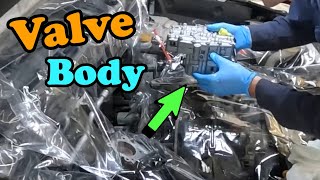
Typical fix: Replacement of the entire control valve assembly with the updated OEM part. 🎬 Watch: Step-by-step TR580 CVT valve body replacement walkthrough.
Est. part cost: $790-$1200 - Defective Secondary Transmission Fluid Pressure Sensor 🟡 Medium Probability The sensor is named in the code definition, and sensors can fail. However, it is often replaced unnecessarily when the valve body is the real issue. A technician on a forum notes that P0841 is the 'more common code' that points to a valve body replacement.
How to confirm: Test the sensor's voltage output and resistance to see if it's within the manufacturer's specifications. TSB 16-102-16R provides a detailed procedure for checking the sensor circuit, including checking for 4.6-5.4V at the TCU.
Typical fix: Replace the secondary oil pressure sensor. This is often attempted first but frequently fails to resolve the code.
Est. part cost: $100-$200 - Wiring or Connector Issues ⚪ Low Probability
How to confirm: Visually inspect the wiring harness and connectors leading to the secondary pressure sensor for damage, corrosion, or looseness. TSB 16-102-16R recommends 'wiggle-testing' the harness and connectors to check for intermittent faults. A YouTube video demonstrates a case where a loose connector pin was the sole cause of the P0841/P0842 codes.
Typical fix: Repair or replace the damaged section of the wiring harness or secure the connector.
Est. part cost: $20-$150 - Low, Old, or Contaminated Transmission Fluid ⚪ Low Probability
How to confirm: Check the level and condition (color, smell, debris) of the CVT fluid. Note that many newer Subarus do not have a user-serviceable dipstick, requiring a technician to perform the check. Dirty fluid can clog passages but is less likely to be the root cause than the valve body itself if only P0841 is present.
Typical fix: Perform a CVT fluid drain and fill using only the specified Subaru CVT fluid. This is sometimes attempted as a first step but rarely solves the underlying valve body issue.
Est. part cost: $150-$300
Rare But Worth Checking
- Faulty Transmission Control Module (TCM): This is very uncommon. The TCM should only be considered after all other possibilities, including the valve body, sensor, fluid, and wiring, have been exhaustively ruled out. TSB 16-102-16R lists replacing the TCU as a final diagnostic step if all else fails.
Diagnosis Steps
- Check for any other stored DTCs. Address codes like P0842, P0843, P0962, or P0963 first, as per TSB 16-102-16R.
- Interview the driver about symptoms and save any Freeze Frame Data.
- Check the CVT fluid level and condition. Look for burnt smell or excessive metal particles.
- Inspect the wiring harness and connector for the secondary pressure sensor. Perform a 'wiggle-test' on the connector and harness while monitoring sensor voltage to check for intermittent connections.
- Follow the manufacturer's specific diagnostic flow chart from TSB #16-102-16R. This involves using a scan tool to check sensor voltage (spec: 4.6-5.4V with ignition on, engine off) and comparing live data to mechanical pressure gauge readings.
- If the sensor and wiring test correctly, the control valve assembly (valve body) is the most likely cause of the issue, as per TSB #16-119-19.
- Confirm the repair by performing a drive cycle and ensuring the code does not return.
Parts You'll Likely Need
- Transmission Control Valve Assembly (Valve Body)
(OEM #31825AA055)— This is the most common root cause for P0841 on this vehicle. TSB 16-119-19 announced this new part to fix a design issue causing false codes. This part number supersedes 31825AA050, 31825AA051, 31825AA052, 31825AA053, and 31825AA054.
Trusted brands: Subaru (OEM)
OEM price range: $790-$1200
Aftermarket price range: $375-$700 (Remanufactured) - Secondary Transmission Oil Pressure Sensor — This part is named by the code and may have failed, but it is often misdiagnosed. It should be tested thoroughly before replacement. Subaru does not sell the individual solenoids/sensors separately from the valve body.
Trusted brands: Subaru (OEM, as part of valve body)
OEM price range: $120-$200
Aftermarket price range: $80-$150
Related Codes That Often Appear With This One
- P0700 — This is a generic Transmission Control System Malfunction code. It often appears alongside more specific transmission codes like P0841 to indicate the TCM has detected a fault.
- P0842 — This code indicates 'Transmission Fluid Pressure Sensor/Switch “A” Circuit Low', which points to the same sensor circuit and can be triggered by similar faults, including wiring issues.
- P0843 — This code indicates 'Transmission Fluid Pressure Sensor/Switch “A” Circuit High', also related to the same sensor circuit.
Technical Service Bulletins (TSBs) & Recalls
- 16-119-19: Announces a new control valve assembly (valve body) designed to prevent false detection of DTC P0841 due to aerated fluid. Applies to Outback, Legacy, Forester, Impreza, and Crosstrek.
- 16-102-16R: Provides the revised and extensive diagnostic flow chart for troubleshooting DTC P0841, including electrical checks, 'wiggle-testing', and pressure tests.
- 16-102-16: Original bulletin providing a new flow chart and diagnostic tools for P0841.
Platform-Specific Known Issues
- Subaru TSB #16-119-19 specifically states that a new control valve assembly was released to prevent false detection of DTC P0841. It explains that 'air bubbles (aerated fluid) may enter certain pressure circuits,' causing the false code. The bulletin confirms 'The shape of these circuits has been changed to prevent this occurrence.'
Mechanic-Grade Diagnostic Values
- Secondary Oil Pressure Sensor Power Supply Voltage — expected: 4.6 - 5.4 Volts (with ignition ON, engine OFF). Failure: Voltage outside of this range indicates a problem in the TCU 5V power supply circuit or wiring.
- Secondary Oil Pressure Sensor Signal Voltage (via Scan Tool) — expected: 0.39 - 0.61 Volts (with ignition ON, engine OFF). Failure: Voltage outside this range or showing abnormal fluctuation suggests a faulty sensor or wiring issue.
- Secondary Pressure Sensor Connector Wire Colors — expected: Yellow/Red wire: 5V Reference; Pink wire: Signal; Green wire: Ground.. Failure: N/A - for identification during testing.
Scan Tool Commands That Help
- Subaru Select Monitor (SSM): Clear AT Learning Data — After replacing the valve body or other major transmission components, this function must be used to clear the old adaptive learning values from the TCM. The AT Temp light will flash 4 times in 2 seconds to confirm successful clearing.
- Subaru Select Monitor (SSM): Compulsory learning mode — After clearing the AT learning data, this procedure must be performed to allow the TCM to learn the characteristics of the new components. This is done with the vehicle lifted and wheels off the ground, following on-screen prompts.
Wiring & Ground Locations
- Secondary Pressure Sensor Connector — Located on the transmission valve body, accessible after removing the transmission pan.. This is the primary connection point for the sensor. A loose pin or corrosion here can directly cause P0841, P0842, and P0843 codes, mimicking a failed sensor or valve body.
- Transmission Control Module (TCM) — Typically located on the left side of the dash for this generation.. The TCM is the endpoint for the sensor's signal wire. All voltage and resistance checks of the circuit will ultimately lead back to the TCM connector pins.
- T4 Connector — An external connector on the transmission case that contains the pins for the internal valve body solenoids and sensors.. This connector allows for testing the resistance of internal components like the secondary pressure sensor without removing the transmission pan. However, pin layouts can be confusing and vary.
Real Owner Repair Stories
- YouTube channel 'THIS IS YOUR TRANSMISSION' (2012 Subaru Outback) — Check Engine Light with codes P0841 and P0842.
❌ Tried (didn't work) Changing the transmission fluid., Replacing the pressure switch with a used one.
✅ What actually fixed it The root cause was a loose pin within the main transmission connector on top of the transmission. Pushing on the connector caused the secondary pulley pressure reading on the scan tool to appear and disappear. The final fix was securing the connector pin, which resolved the codes without replacing the transmission as another shop had recommended. - Reddit user in r/Subaru_Outback (2013 Subaru Outback) — Shuddering, flashing dash lights, and P0841 code returned 9 months after a valve body replacement.
❌ Tried (didn't work) A new OEM valve body was installed 9 months prior but the issue returned.
✅ What actually fixed it The independent shop initially diagnosed a faulty transmission pump. After discussion, the shop agreed to source a used CVT, transfer the 9-month-old valve body onto it, and credited back the previous repair. This suggests the failure was likely internal to the transmission itself, beyond just the valve body.
OEM Part Supersession History
31825AA050, 31825AA051, 31825AA052, 31825AA053, 31825AA054→31825AA055— The new part number corresponds to the redesigned valve body mentioned in TSB 16-119-19, which changes the shape of internal fluid circuits to prevent aeration that causes false P0841 codes.
Model Year Variations Within This Range
- 2010-2018: Subaru extended the CVT warranty for many vehicles in this range due to known issues, including problems that can trigger P0841. The extension covers the transmission and valve body for 10 years or 100,000 miles. Owners should check with a dealer to see if their specific VIN is covered.
- 2010-2017: All non-turbo Outbacks in this range use the TR580 CVT. While the transmission is fundamentally the same, internal parts like the valve body and wiring harness can have minor differences between platforms (e.g., Outback vs. Forester), but are generally interchangeable with the correct harness and cover.
Helpful Videos
We Have This Part in Stock

The information in this article is provided for general reference and educational purposes only. Vehicle specifications, procedures, and part compatibility can vary by production date, trim level, and region. Always consult your vehicle's factory service manual and verify part numbers before purchasing or performing repairs. Safety-critical components such as airbags, seat belts, and braking systems should be installed by a qualified professional.
- Subaru OUTBACK:
- 🎬 Helpful Videos
- 🛍️ Shop This Part
- What's Unique About the 2010-2017 Subaru OUTBACK
- Diagnostic Flowchart
- Symptoms You May Notice
- Most Likely Causes
- Rare But Worth Checking
- Diagnosis Steps
- Parts You'll Likely Need
- Related Codes That Often Appear With This One
- Technical Service Bulletins (TSBs) & Recalls
- Platform-Specific Known Issues
- Mechanic-Grade Diagnostic Values
- Scan Tool Commands That Help
- Wiring & Ground Locations
- Real Owner Repair Stories
- OEM Part Supersession History
- Model Year Variations Within This Range
- 🎟️ Get 5% Off