

P0841 on 2010-2017 Subaru Legacy: Transmission Pressure Sensor Fault Causes & Fixes
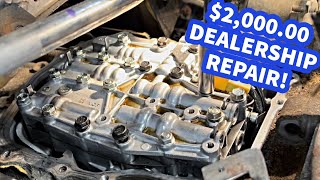
On a 2010-2017 Subaru Legacy, P0841 is most often caused by a faulty transmission valve body. Subaru issued a Technical Service Bulletin (TSB #16-119-19) for this exact problem, acknowledging a design flaw. The fix is replacing the valve body with an updated part, a complex job often costing between $1,500 and $2,500 at a dealership. Owners should check if their vehicle is covered by Subaru's CVT warranty extension (10 years / 100,000 miles).
- P0841 on a 2010-2017 Legacy is most likely a faulty transmission valve body, a known issue confirmed by Subaru TSB #16-119-19.
- The repair involves replacing the valve body with an updated part and is a complex, expensive job.
- Before authorizing repairs, owners MUST check if their vehicle is covered under Subaru's 10-year/100,000-mile CVT warranty extension.
- Symptoms include a flashing 'AT OIL TEMP' light, limp mode, and harsh shifting.
- While low fluid or a bad external sensor can cause the code, the valve body is the most probable root cause on this specific platform.
What's Unique About the 2010-2017 Subaru LEGACY

Subaru has specifically acknowledged a design issue on these models that can cause a false P0841 code. According to Technical Service Bulletin (TSB) #16-119-19, air bubbles can get into the transmission fluid (aeration) within certain pressure circuits of the original valve body. This aerated fluid causes incorrect pressure readings, leading the TCM to set the code. To resolve this, Subaru released an updated control valve assembly (commonly called the valve body) with redesigned fluid circuits to prevent this aeration. This makes a faulty valve body a much more likely cause on this platform compared to others where a simple sensor or wiring failure might be more common. The Legacy models in this year range use either the TR580 or TR690 Lineartronic CVT, both of which are implicated in these TSBs.
Diagnostic Flowchart

Tap your situation to follow the diagnostic path that matches what you're seeing on this vehicle.
Generation note: This range covers the fifth generation (2010-2014) and the early sixth generation (2015-2017) Legacy. The underlying issue with the CVT valve body is documented by Subaru in TSBs that cover models across both generations, which use the TR580 and TR690 CVTs.
Symptoms You May Notice

- Check Engine Light is on
- AT OIL TEMP light flashing
- Vehicle enters 'limp mode' with severely limited power
- Harsh, erratic, or delayed shifting
- Vehicle may feel like it's slipping or shuddering
- Difficulty or poor acceleration from a stop
- Engine speed increases abruptly
- Inability to shift into gear after starting
- Replacing only the external secondary pressure sensor when the root cause is the internal valve body assembly design flaw.
- Assuming a full transmission replacement is needed without first diagnosing the valve body, which is a known, separate, and less expensive (though still costly) repair.
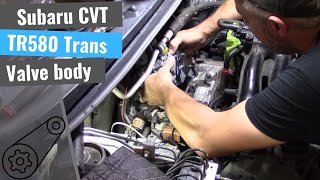
- Replacing individual solenoids on the valve body. While some DIYers attempt this, Subaru does not sell the solenoids separately and recommends replacing the entire assembly to get the updated design. 🎬 See why a mechanic recommends avoiding aftermarket or rebuilt valve bodies.
Most Likely Causes

- Faulty Transmission Control Valve Body 🔴 High Probability Subaru issued TSB #16-119-19 for a known design issue where aerated fluid can cause false P0841 detection. An updated valve body was released to fix this. This is the most common failure point, corroborated by numerous owner complaints and dealer diagnoses.
How to confirm: A technician will follow Subaru's diagnostic procedure (outlined in TSB #16-102-16R) which involves electrical checks and pressure tests using a scan tool. If wiring and the external sensor are good, and fluid is clean and full, the valve body is the confirmed culprit.
Typical fix: Replace the control valve assembly with the updated part. This is an internal transmission component. After replacement, a transmission relearn procedure must be performed with a Subaru-capable scan tool.
Est. part cost: $800-$1200 - Low or Degraded Transmission Fluid 🟡 Medium Probability The TSB mentions that 'aerated fluid' can cause the code. Low, old, or incorrect fluid is more likely to aerate and cause pressure problems. Many owners report dealers claiming the fluid is 'lifetime,' leading to neglected service.
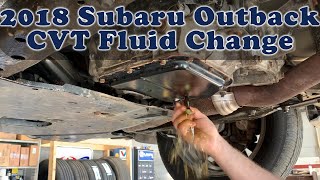
How to confirm: Check the CVT fluid level and condition according to the manufacturer's procedure. This must be done at a specific temperature (95-113°F). The fluid should be the correct type (Subaru High-Torque CVT fluid) and not dark or burnt. Note: These CVTs do not have a traditional dipstick. 🎬 Watch: How to properly drain and fill Subaru CVT fluid.
Typical fix: Perform a transmission fluid drain and fill using the correct Subaru High-Torque CVT fluid. This is often the first diagnostic step.
Est. part cost: $150-$300 - Faulty Transmission Fluid Pressure Sensor ⚪ Low Probability While the sensor can fail, it is often not the root cause. For the P0841 code, the 'Secondary Pressure Sensor' is external and can be replaced separately. However, given the known TSB for the valve body, replacing only the sensor may not be a permanent fix if the underlying cause is fluid aeration.
How to confirm: A technician can test the sensor's circuit for proper voltage, ground, and resistance. Live data can be monitored with a scan tool to see if the pressure readings are erratic.
Typical fix: If the sensor is confirmed faulty, it is replaced. The part number is typically 31878AA020. More commonly, this is attempted before a full valve body replacement due to lower cost, but the code may return.
Est. part cost: $100-$1500 (depending on sensor vs. full assembly)
Rare But Worth Checking
- Wiring Harness Damage: The wiring between the TCM and the transmission pressure sensor can become damaged, corroded, or have a loose connection, leading to an incorrect signal. This is especially true for the connector directly at the sensor. This should be checked before condemning expensive hard parts.
- Faulty Transmission Control Module (TCM): This is very rare. The TCM is the computer that controls the transmission. It should only be considered after all other possibilities, including wiring and the valve body, have been thoroughly ruled out.
Diagnosis Steps
- Check and record any other stored fault codes. Note if P0700 is present.
- Check the transmission fluid level and condition. This must be done at the correct operating temperature (95-113°F). Ensure the correct type of Subaru CVT fluid is being used.
- Refer to Subaru TSB #16-102-16R for the specific diagnostic flowchart for P0841. This involves using a scan tool to monitor secondary pressure sensor data under specific conditions (e.g., idle, 3000 RPM).
- Perform electrical tests on the secondary pressure sensor circuit, including checking for proper voltage (5V reference), ground, and continuity on the signal wire.
- Inspect the wiring harness and connector between the TCM and the transmission for any signs of damage, corrosion, or loose connections.
- If electrical tests are inconclusive and the fluid is good, the likely cause is the control valve body, as per TSB #16-119-19.
Parts You'll Likely Need
- Transmission Control Valve Body Assembly
(OEM #31706AA034 (TR690) or 31825AA052 (TR580) - Note: Part numbers are superseded often, always verify with VIN.)— This is the most common fix due to a known design flaw acknowledged by Subaru in TSB #16-119-19, which causes false P0841 codes. The replacement part has updated internal fluid passages.
Trusted brands: Subaru (OEM)
OEM price range: $800-$1200
Aftermarket price range: $400-$900 (Remanufactured) - Subaru High-Torque CVT Fluid
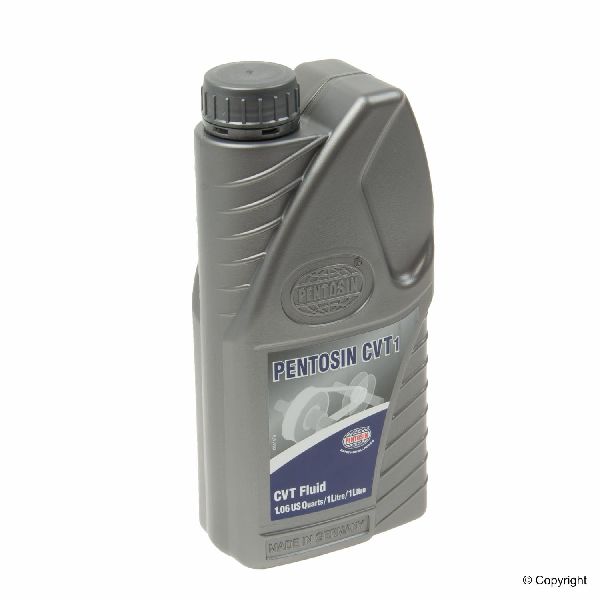
(OEM #SOA427V1660 (Orange Bottle, High Torque) or SOA748V0200 (CVTF-II, Green). Verify correct fluid for your specific transmission (TR580 vs TR690).)— This specific fluid is required when replacing the valve body or servicing the transmission. Using incorrect fluid will cause performance issues and damage.
Trusted brands: Subaru (OEM)
OEM price range: $20-$30 per quart
Related Codes That Often Appear With This One
- P0700 — This is a generic code that means the Transmission Control Module (TCM) has stored a fault. It acts as a 'check engine light' for the transmission and will almost always appear alongside a specific transmission code like P0841. This was seen in NHTSA complaint #11723218 and multiple forum reports.
- P0971 — This code relates to the Pressure Control Solenoid 'C' Control Circuit Range/Performance. It can appear with P0841, indicating a wider electrical or hydraulic control issue within the transmission, often still pointing towards the valve body.
- C1431 — This is a Vehicle Dynamics Control (VDC) code indicating an abnormal signal from the transmission. The VDC system relies on transmission data, so a fault like P0841 will often trigger related VDC/ABS lights and codes.
Technical Service Bulletins (TSBs) & Recalls
- 16-119-19: An
Platform-Specific Known Issues
- Subaru issued TSB #16-119-19 for a new control valve assembly designed to prevent false detection of DTC P0841 caused by aerated fluid.
- Subaru also released TSB #16-102-16R with an updated diagnostic flow chart to help technicians troubleshoot this specific code.
- Subaru extended the CVT warranty for many vehicles, including 2010-2017 Legacy models, to 10 years / 100,000 miles. Owners experiencing this code should check with a dealer by VIN to see if their vehicle is covered before paying for repairs.
Mechanic-Grade Diagnostic Values
- Secondary Oil Pressure Sensor voltage (SSM) — expected: 0.39 - 0.61 V (with ignition ON, engine OFF). Failure: Voltage is outside this range or fluctuates abnormally when wiggling harness.
- Secondary Oil Pressure Sensor power supply voltage (at TCM connector) — expected: 4.6 - 5.4 V (with sensor disconnected). Failure: Voltage outside this range indicates a problem in the TCM 5V power supply circuit or wiring.
- Secondary pressure (SSM live data, engine idling) — expected: 0.5 - 1.5 MPa (after warming CVTF to 60°C and performing drive cycle). Failure: Pressure outside this range may indicate a stuck sensor or internal hydraulic issue.
- Secondary pressure (SSM live data, at 3,000 RPM in Park) — expected: 1.5 - 2.5 MPa. Failure: Pressure outside this range can indicate a stuck sensor or control valve issue.
- Wiring harness continuity (between TCM and sensor connectors) — expected: Less than 1 Ω. Failure: Resistance higher than 1 Ω indicates a problem in the harness.
- Wiring harness insulation resistance — expected: More than 1 MΩ (between harness pins and to ground). Failure: Resistance less than 1 MΩ indicates a short in the harness.
Scan Tool Commands That Help
- Subaru Select Monitor (SSM) or equivalent (e.g., Autel, XTool): Clear AT Learning Data — This must be performed after replacing the valve body. It clears the old adaptive values stored by the TCM. After clearing, the AT Temp light will flash 4 times in 2 seconds to confirm.
- Subaru Select Monitor (SSM) or equivalent (e.g., Autel, XTool): Compulsory learning mode / AT Learning Mode — This is the mandatory procedure to calibrate the new valve body to the transmission after clearing the old values. It involves lifting the vehicle and following on-screen prompts to shift through gears (D, R, N) while the tool controls the process.
Wiring & Ground Locations
- Secondary Oil Pressure Sensor — Externally mounted, threaded into the rear of the left side (driver's side) of the transmission case.. This is the sensor that generates the signal for the P0841 code. Its location makes it physically accessible for testing or replacement without removing the transmission, but it is often replaced unnecessarily when the valve body is the true cause.
- Transmission Ground — Some models have a specific ground wire or strap for the transmission located near the pitch stop mount (the 'dog bone' on the right side of the engine by the firewall).. A poor ground connection for the transmission can cause erratic sensor readings and control module behavior. While not a primary cause, it's a crucial check for any electrical fault.
- Main Engine/ECU Ground — The ECU gets its primary ground reference from the top of the intake manifold. This point is connected to the block, alternator, and chassis via ground straps.. Since the TCM works in concert with the ECU, a poor main ground on the intake manifold can cause a variety of strange electrical issues, including transmission codes. Ensuring this ground path is clean and secure is a foundational step.
- Sensor Connector [AT6] — The electrical connector for the secondary oil pressure sensor, located on the left side of the transmission.. This connector is a common point of failure due to corrosion or loose pins. TSB #16-102-16 specifically calls for wiggling the harness and connector during testing to check for intermittent faults.
Real Owner Repair Stories
- Ultimate Subaru Message Board user 'Numbchux' (2012 Subaru Impreza 2.0i Premium, 216k miles) — AT Oil Temp light flashing, stored codes P0841, U0100, C1431, C1422. Poor acceleration, abrupt engine speed increase.
❌ Tried (didn't work) The user was in the process of diagnosing and considering a fluid change first.
✅ What actually fixed it The user noted that the local dealership kept the external secondary pressure sensor (Part #31878AA020) in stock because they replace them about once a month. Another user in the thread confirmed a co-worker fixed a similar issue by replacing just the sensor from a salvage yard. This suggests that while the valve body is the most common cause, a simple sensor failure is a possible and much cheaper fix.
OEM Part Supersession History
31706AA030, 31706AA031, 31706AA032, 31706AA033→31706AA034, which is now superseded by 31706AA331— Updates to the valve body design to address performance issues and the fluid aeration problem described in TSB #16-119-19.
Heads up: These part numbers are generally for the TR690 transmission. Always verify the correct part number with the vehicle's VIN, as using the wrong valve body will result in failure.
Model Year Variations Within This Range
- 2012+: On TR580 transmissions (found in many 2.0L and 2.5L models), the valve body is located on the top of the transmission, accessible by removing a top cover, whereas on many other transmissions it is accessed from the bottom pan.
Helpful Videos

We Have This Part in Stock


The information in this article is provided for general reference and educational purposes only. Vehicle specifications, procedures, and part compatibility can vary by production date, trim level, and region. Always consult your vehicle's factory service manual and verify part numbers before purchasing or performing repairs. Safety-critical components such as airbags, seat belts, and braking systems should be installed by a qualified professional.
- Subaru LEGACY:
- 🎬 Helpful Videos
- 🛍️ Shop This Part
- What's Unique About the 2010-2017 Subaru LEGACY
- Diagnostic Flowchart
- Symptoms You May Notice
- Most Likely Causes
- Rare But Worth Checking
- Diagnosis Steps
- Parts You'll Likely Need
- Related Codes That Often Appear With This One
- Technical Service Bulletins (TSBs) & Recalls
- Platform-Specific Known Issues
- Mechanic-Grade Diagnostic Values
- Scan Tool Commands That Help
- Wiring & Ground Locations
- Real Owner Repair Stories
- OEM Part Supersession History
- Model Year Variations Within This Range
- 🎟️ Get 5% Off