

OBD-II Code P0810: Clutch Position Control Error
An ASE-Certified Master Technician's Expanded Guide to P0810
- Code P0810 indicates a clutch position control error, which intentionally disables the starter to prevent the vehicle from lurching forward in gear.
- On Ford PowerShift and Toyota MMT transmissions, the root cause is a failed clutch actuator motor in over 70% of cases, often fixable by replacing the internal motor brushes.
- For 2021-2024 Jeep 4xe models, P0810 is almost exclusively a software glitch requiring a 1-hour dealer TCM update per TSB 21-024-24, not a hardware replacement.
- Never replace the starter motor for a P0810 no-crank symptom; diagnose the clutch position sensor circuit using a multimeter to verify the 5-volt reference signal.
- After replacing any clutch component on an automated manual transmission, you must perform a mandatory clutch relearn procedure using a bi-directional scan tool to clear the code permanently.
What Does P0810 Mean?

Trouble code P0810 indicates the Powertrain Control Module (PCM) or Transmission Control Module (TCM) detects a fault in the clutch position sensor circuit. This sensor acts as a safety interlock preventing the engine from starting in gear. On automated manual transmissions, it provides critical feedback for smooth gear shifting and clutch engagement.
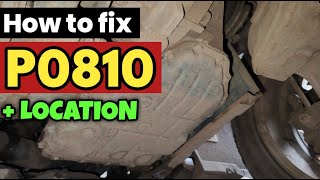
Technical definition: The SAE definition for P0810 is "Clutch Position Control Error." The PCM/TCM detects a discrepancy between the commanded clutch position and the actual position reported by the sensor. 🎬 Watch: A quick overview of the P0810 error code This primarily affects manual and automated-manual transmissions (e.g., Ford PowerShift, Toyota MMT). On hybrids like the Jeep 4xe, it indicates a TCM software error or internal clutch pack fault.
Can I Drive With P0810?

No — Do Not Drive. Do not drive. The vehicle often will not start, leaving you stranded. Worse, a failed safety interlock allows the car to start in gear and lurch unexpectedly, creating a severe safety risk. Continuing to operate the vehicle causes secondary damage to the starter, flywheel, or transmission internals.
Common Causes

- Faulty Clutch Actuator (Automated Manuals) (Very Common) — Worn internal motor brushes create carbon dust that shorts out the motor, preventing clutch movement. This is the leading cause on Toyota MMT and Ford PowerShift systems.
- TCM Software Glitch (Hybrids/Specific Models) (Very Common) — Overly sensitive software parameters misinterpret normal clutch operation as a fault. This is the near-exclusive cause of P0810 on 2021+ Jeep 4xe models.
- Faulty Clutch Position Sensor (Common) — The sensor wears out or fails internally from heat and vibration, sending incorrect or dead signals to the TCM.
- Wiring and Connector Issues (Common) — Broken, frayed, or corroded wires disrupt the 5-volt reference or signal return to the computer. Pushed-out connector pins are frequent culprits.
- Binding Mechanical Clutch Components (Less Common) — A worn clutch disc, broken pressure plate, or binding release bearing prevents the clutch from physically reaching the commanded position.
- Low or Contaminated Hydraulic Fluid (Less Common) — Degraded fluid in hydraulic actuators causes sluggish operation, triggering a position timeout error in the TCM.
- Improperly Adjusted Pedal or Sensor (Rare) — Incorrect installation after a repair prevents the sensor from reading the full range of motion, triggering the code despite healthy components.
Symptoms
- Engine Will Not Crank or Start — The starter refuses to engage because the TCM safety lockout is active, preventing a start without confirmed clutch disengagement.
- Flashing Gear Indicator on Dash — On automated manuals, the selected gear indicator (like 'N') flashes, signaling a total actuator failure.
- Harsh, Failed, or No Shifting — The transmission shifts roughly, gets stuck in neutral, or enters a limp mode with limited gear availability.
- Engine Starts While in Gear — An extreme safety hazard where the safety interlock fails, allowing the car to start and lurch forward or backward.
- Check Engine or Transmission Warning Light — The Malfunction Indicator Lamp (MIL) or a gear/spanner symbol illuminates on the dashboard.
- Unusual Grinding or Clunking Noises — Mechanical grinding occurs during attempted shifts as the actuator struggles to move a binding clutch.
Diagnostic Flowchart

Tap your situation to follow the diagnostic path that matches what you're seeing on this code.
Common Fixes & Costs
- Replace or Rebuild Clutch Actuator — Parts: $200-$600, Labor: $200-$500, ~3.0 hr book time (Professional)
- Reprogram Transmission Control Module (TCM) — Parts: $0, Labor: $100-$200, ~1.0 hr book time (Professional)
- Replace Clutch Position Sensor — Parts: $30-$85, Labor: $100-$200, ~1.0 hr book time (DIY)
- Repair Wiring or Connectors — Parts: $10-$30, Labor: $100-$250, ~1.5 hr book time (Intermediate)
- Full Clutch Assembly Replacement — Parts: $400-$1000, Labor: $800-$1500, ~8.0 hr book time (Professional)
DIY vs Professional
- Replace Clutch Position Sensor — Beginner:
Tools: Basic hand tools, flashlight. - Repair Wiring or Connectors — Beginner:
Tools: Multimeter, wire strippers, crimpers, heat shrink tubing. - Replace or Rebuild Clutch Actuator — Beginner:
Tools: Vehicle lift, advanced bi-directional scan tool.
Used vs. New Parts: Buying Guide
When a used part is worth it: Buy used only for expensive, complex electro-mechanical units (like a clutch actuator) on older, high-mileage vehicles where a new OEM part exceeds the vehicle's value.
Donor-vehicle mileage cap: roughly under 60000 miles for the part to have meaningful remaining life.
Donor quality checklist:
- Verify the donor vehicle was not scrapped due to a transmission failure.
- Match the part number exactly; superseded numbers are often incompatible.
- Ensure the seller offers a return policy for electronic modules.
Decision logic:
- If The part is a simple clutch position sensor → Buy new. Cost savings are minimal and not worth the risk of premature failure.
- If The part is a clutch actuator → A professionally remanufactured unit with a warranty is the best balance of cost and reliability.
- If The part is a Transmission Control Module (TCM) → Favor a new or remanufactured unit. Used modules carry hidden software issues and require expensive reprogramming.
Warranty tradeoff: Salvage yard parts carry a 30-90 day warranty. Remanufactured aftermarket parts offer 1-year warranties. New OEM parts include a 12-month/12,000-mile warranty.
Worst-case if a used part fails: $400-800 in repeated labor costs if a used actuator or TCM fails after installation.
What Happens If You Wait — Timeline
- First Occurrence: Check Engine Light illuminates. The engine refuses to crank, or the transmission enters limp mode with harsh shifting. (MPG impact: 0-5%% · Added cost: $0)
- Days to Weeks: Continued operation with a struggling actuator causes excessive heat and wear on the clutch disc. Repeatedly trying to start a non-cranking engine strains the starter. (MPG impact: 5-10%% · Added cost: $300 - $700)
- 1-3 Months: Carbon dust from worn actuator motor brushes shorts out the actuator's internal electronics, requiring a full replacement instead of a cheap brush repair. (MPG impact: 10-15%% · Added cost: $800 - $1200)
- 3+ Months: Catastrophic secondary damage. The struggling automated system destroys the clutch assembly, flywheel, and internal transmission gears. (MPG impact: 15-25%% · Added cost: $2500 - $7000)
Cost of Not Fixing It
- Immediate: Vehicle refuses to start, or starts in gear and lurches, causing a potential accident. (Added cost: $0 to accident damages)
- Short-Term (days to weeks): Repeated attempts to start a non-cranking engine destroys the starter motor and solenoid. (Added cost: $300 - $700)
- Medium-Term (1-6 months): Ignoring a struggling automated clutch actuator burns out the clutch disc and pressure plate. (Added cost: $1100 - $2500)
- Long-Term (6+ months): Catastrophic transmission failure. Internal gears and bearings shatter due to forced shifts. (Added cost: $3000 - $7000)
Diagnosis Steps
- Read Codes & Freeze Frame Data
Confirm P0810 is present and check for related codes like P0900. Note the freeze frame data to see vehicle conditions when the fault occurred.
Tools: OBD-II Scanner (Beginner) - Check Technical Service Bulletins (TSBs)
Search for manufacturer TSBs. Software updates resolve this code entirely on many modern vehicles (e.g., Jeep 4xe).
Tools: Internet Access (Beginner) - Perform Visual Inspection
Inspect the clutch position sensor, actuator, and wiring harness for chafing, melted wires, pushed-out connector pins, or hydraulic leaks.
Tools: Flashlight (Beginner) - Test Sensor Wiring (Reference & Ground)
Disconnect the sensor. With the key on, verify the reference wire has 5 volts and the ground wire has near 0 ohms resistance to the chassis.
Tools: Digital Multimeter (DVOM) (Intermediate) - Test Clutch Position Sensor Signal
Back-probe the sensor's signal wire. Slowly press the clutch pedal. The voltage must sweep smoothly (typically 0.5V to 4.5V) without dropouts.
Tools: Digital Multimeter (DVOM), Back-probe Kit (Intermediate) - Test Clutch Actuator Operation
On automated manuals, use a scanner to command the clutch actuator to move. If it fails to move or moves slowly, the actuator motor is failing.
Tools: Bi-directional Scan Tool (Advanced) - Test Actuator Motor Resistance
Disconnect the actuator motor. Measure resistance across the terminals. Infinite resistance (OL) means a broken winding; near zero means a short.
Tools: Digital Multimeter (DVOM) (Advanced) - Analyze Live Scan Tool Data
Compare 'Commanded Clutch Position' to 'Actual Clutch Position' in live data. A discrepancy confirms an actuator or mechanical failure.
Tools: Advanced Scan Tool (Advanced) - Perform Clutch Relearn Procedure
If parts were replaced, execute the mandatory clutch initialization procedure to teach the TCM the new engagement points.
Tools: Bi-directional Scan Tool (Advanced)
When This Code Triggers (Freeze-Frame Conditions)
- Engine Coolant Temp: Varies (Sets at any temperature, but cold weather exacerbates hydraulic actuator sluggishness.)
- RPM: 0 or 700-800 (Triggers at 0 RPM during a startup attempt, or at 700-800 RPM while idling.)
- Vehicle Speed: 0 mph (Detected when the vehicle is stationary during an ignition cycle or gear selection.)
- Gear Position: Neutral or shifting (Occurs as the TCM attempts to verify clutch position before allowing a gear change or engine start.)
Related Codes
- P0900 — Indicates an electrical open in the actuator circuit. If present with P0810, the fault is definitively a broken wire or dead actuator motor.
- P0805 — Indicates a general electrical malfunction in the sensor circuit, whereas P0810 is a performance error. Diagnosing one resolves the other.
- P0949 — Appears when a mandatory clutch relearn procedure is skipped or fails after a repair. You must fix the P0810 cause, then perform the relearn.
Climate & Environmental Factors
- Cold Temperatures: Cold thickens hydraulic fluid, causing automated clutch actuators to become sluggish and trigger position errors. It also worsens intermittent electrical connections.
- High Humidity: Moisture accelerates corrosion on wiring and connectors, leading to poor electrical signals. It also contaminates hydraulic fluid.
How to Talk to a Mechanic About This Code
Say this: "I have a P0810 Clutch Position Control Error and the car won't start. I'd like to schedule a diagnostic. Please check for any Technical Service Bulletins or software updates before replacing parts, and verify the actuator and wiring."
This steers the mechanic away from a simple, incorrect sensor swap and toward a proper system diagnosis, including checking for known software fixes which are the cheapest repair.
Avoid saying:
- My car won't start, I think it's the starter.
- The check engine light is on, can you just fix it?
- My transmission is acting weird.
Questions to ask before authorizing the repair:
- Did you check for software updates or TSBs for this code on my specific model?
- What were the results of testing the sensor, wiring, and actuator individually?
- If a new component is needed, does it require a relearn procedure, and is your scan tool capable of performing it?
Where to Take It: Dealer vs Independent vs Chain
- Dealer:
Best for warranty claims and software updates. For out-of-warranty hardware issues, use an independent specialist.
Best for: Vehicles under warranty., Known software issues (e.g., Jeep 4xe)., Manufacturer-specific transmission issues with warranty extensions (e.g., Ford PowerShift TCM).
Downsides: Highest labor rates., Prefers replacing large assemblies rather than performing cheaper component repairs. (Typical cost: +50% vs. baseline) - Independent Shop:
Excellent choice if they are a transmission specialist with documented experience on your specific automated transmission.
Best for: Out-of-warranty vehicles., Common, well-documented failures (e.g., Toyota MMT actuator rebuild)., Basic manual transmission sensor or wiring issues.
Downsides: Some lack the expensive, specialized scan tools needed for relearn procedures. (Typical cost: +0% vs. baseline) - Chain Shop:
AVOID for diagnosing automated or dual-clutch transmission issues. The risk of misdiagnosis is very high.
Best for: Simple part swaps on traditional manual transmissions.
Downsides: Technician skill varies dramatically., Lacks tools and expertise for actuator repairs or TCM programming. (Typical cost: -10% vs. baseline)
When to Walk Away From the Repair
If the estimated repair cost for the transmission issue exceeds 50% of the car's current private-party value, consider selling the car as-is.
- Car worth $4000, fix is $2500: Walk away. A $2,500 repair on a $4,000 car is a bad investment.
- Car worth $12000, fix is $1200: Fix it. The repair cost is only 10% of the vehicle's value.
What Scan Tool You Need for This Code
Minimum: A tool that reads transmission-specific codes and views live data PIDs for the clutch position sensor and actuator.
A basic $20 code reader cannot show live data (Commanded vs. Actual Position) needed to verify actuator movement, nor can it perform mandatory clutch relearn procedures.
Budget: BlueDriver Pro (~$100) — Reads enhanced transmission codes and graphs live sensor data. Good for initial diagnosis, but lacks bidirectional control for relearns.
Mid-range: Innova 5610 / XTOOL D7 (~$300-400) — Entry-level bidirectional tools. They view live data and perform special functions like commanding the actuator and initiating clutch relearns.
Professional: Autel MaxiCOM MK808BT (~$500-900) — Provides full bidirectional control for deep diagnostics. Performs clutch relearns, initializations, and adaptations on complex European models.
Rent vs buy: Renting is not viable. Free rental tools are basic code readers. Buying a midrange bidirectional tool is required for automated manual transmission diagnostics.
How to Clear the Code After You Fix It
- Use an OBD-II scan tool to clear the diagnostic trouble codes.
- For automated manuals, perform the mandatory clutch relearn/initialization procedure using a bi-directional scan tool.
- Complete a 20-minute drive cycle to verify the repair and run readiness monitors.
Drive cycle (~20 minutes): Cold start the vehicle and idle for 3 minutes. Drive in mixed city/highway conditions, including several complete stops and steady-speed cruising, allowing the transmission to shift through all gears.
Readiness monitors affected: Comprehensive Component Monitor, Catalyst (CAT) Monitor, Evaporative (EVAP) System Monitor
Before emissions retest: drive at least 50 miles to fully set monitors.
Watch out for:
- Disconnecting the battery clears the code but resets all readiness monitors, causing an automatic emissions test failure.
- The code returns immediately if a mandatory clutch relearn procedure is skipped after replacing an actuator or sensor.
- Failing to clear the code with a scan tool leaves the system in a fault state, preventing the starter from engaging.
Will This Fail Emissions / State Inspection?
Yes — this code typically fails an OBD-II emissions inspection.
- California: An illuminated Check Engine Light results in an automatic smog test failure. A full drive cycle must be completed post-repair to set readiness monitors.
- New York: An active P0810 code fails the mandatory annual OBD-II emissions inspection.
- Texas: In emissions-testing counties, an illuminated MIL is an automatic failure. Clearing the code without repairing the root cause results in a 'Not Ready' failure.
Most Commonly Affected Vehicles
- Ford Focus, Fiesta (2011-2018) — PowerShift transmissions are notorious for this code, caused by failing TCMs (warranty extension 14M02) or worn actuator motor brushes.
- Toyota Yaris, Corolla, Aygo (2005-2014) — Multi-Mode Transmission (MMT) models frequently suffer clutch actuator motor brush failures.
- Jeep Wrangler 4xe, Grand Cherokee 4xe (2021-2024) — P0810 is almost exclusively a software glitch requiring a TCM update per TSB 21-024-24 Rev. A.
- Honda Civic, Jazz (2005-2015) — I-Shift automated manual gearboxes experience failures in the clutch actuator control unit.
- Volkswagen Jetta, Golf (DSG) (2008-2018) — DSG mechatronic units log this code due to internal sensor failures or cold-weather fluid issues.
- Chevrolet Cruze (2011-2016) — Manual models suffer from faulty clutch position sensors or pedal assembly binding.
Manufacturer-Specific Notes
- Toyota: On MMT systems, P0810 is frequently caused by worn motor brushes inside the clutch actuator. Rebuilding the motor is a proven, low-cost alternative to dealer replacement.
- Ford: On PowerShift transmissions, P0810 is often a symptom of a failing TCM covered under warranty extension 14M02 (10 years/150,000 miles).
- Jeep: On 4xe PHEV models, P0810 is a known software issue. The fix is a dealer TCM reflash, not hardware replacement.
Real Owner Stories
2008 Toyota Yaris MMT - The Actuator Fix
Owner experienced a flashing 'N' light on the dash. The car would not go into gear and threw codes P0810 and P0900.
Outcome: A repair service rebuilt the original actuator by replacing the worn internal motor brushes. The rebuilt unit was plug-and-play, requiring only a scan tool clutch relearn. This solved both codes for $250.
Lesson: For Toyota MMT systems, P0810 is almost always the clutch actuator motor. Rebuilding the original part is significantly cheaper than a dealer replacement and avoids complex reprogramming.
2022 Jeep Wrangler 4xe - The Software Ghost
Owner experienced a sudden loss of propulsion, a 'Service Transmission' warning, and a P0810 code. Restarting temporarily cleared the issue.
Outcome: The dealer applied TSB 21-024-24 Rev. A, which required a simple software reflash of the TCM. The issue was caused by overly sensitive software, not a mechanical failure.
Lesson: On modern hybrids like the Jeep 4xe, P0810 is a software glitch. Insist the dealer checks for TSBs and software updates before authorizing any hardware replacement.
Honda Civic I-Shift - The Misdiagnosis Trap
Owner experienced a no-start condition and a P0810 code.
Outcome: The actual problem was a broken wire in the clutch position sensor circuit, which intentionally disabled the starter. Repairing the $10 wire fixed the car.
Lesson: A 'no-crank' symptom with a P0810 code is never a bad starter. The computer is intentionally disabling the starter. Diagnose the clutch position circuit first.
How to Prevent This Code From Triggering
- Change automated manual transmission / hydraulic actuator fluid. (Every 30,000 to 60,000 miles.) — Degraded fluid causes hydraulic actuators to operate slowly or stick, triggering position timeout errors.
- Shift to Neutral when stopped in traffic. (Daily habit (for automated manuals).) — Holding the car on the brake in Drive keeps the automated clutch partially engaged, generating massive heat and premature actuator wear.
- Allow the vehicle to warm up briefly in cold weather. (During cold seasons.) — Cold, thick transmission fluid strains hydraulic actuators. Idling for 60 seconds allows fluid to circulate and thin out.
Frequently Asked Questions
I replaced the clutch position sensor, but the P0810 code came back. What now?
This is a common misdiagnosis pitfall. If a new sensor doesn't fix it, meticulously check the wiring harness for intermittent faults by wiggling wires while testing voltage. If wiring is good, the problem lies with the clutch actuator, a binding mechanical part, or the TCM.
What is a 'clutch relearn' and when is it needed?
A clutch relearn is a mandatory procedure on automated manual transmissions after replacing the clutch, actuator, or control module. It uses a scan tool to teach the TCM the new clutch's engagement point. Skipping this guarantees a returning P0810 or P0949 code.
Can a bad battery cause a P0810 code?
Yes, a weak or failing battery causes widespread electronic havoc. Low voltage forces control modules to malfunction, lose adaptive memory, and generate false codes. Always verify your battery and charging system are healthy before starting complex diagnostics.
Is a P0810 code serious?
Yes, it is a severe safety and drivability code. It leaves you stranded if the car refuses to start. Worse, a failed safety interlock allows the car to start in gear and lurch unexpectedly, risking an accident.
My car has an automatic transmission but I got a P0810 code. Why?
This is rare on conventional automatics but common on modern hybrids like the Jeep 4xe. It typically points to an issue with an internal clutch pack or a software error in the Transmission Control Module (TCM). The fix is usually a dealer software update, not a mechanical repair.
How much does it cost to fix a P0810 code?
Costs range from $130 for a simple sensor replacement to over $1,000 for a full clutch actuator replacement. Repairing actuator motor brushes costs around $250, while a TCM software update is often $150 or free under warranty. A complete clutch job on a dual-clutch transmission exceeds $1,200.
What's the difference between P0810 and P0900?
P0900 points specifically to an electrical fault like a broken wire or dead motor in the actuator. P0810 is a performance code meaning the clutch isn't reaching the commanded position. A P0900 almost always triggers a P0810, but P0810 also stems from mechanical binding.
Can cold weather cause a P0810 code?
Yes, cold temperatures thicken hydraulic fluid, making automated clutch actuators sluggish. Extreme cold also worsens moisture intrusion in electrical connectors, causing intermittent signal loss. These faults sometimes disappear once the engine bay reaches operating temperature.
Key Takeaways
- Code P0810 indicates a clutch position control error, which intentionally disables the starter to prevent the vehicle from lurching forward in gear.
- On Ford PowerShift and Toyota MMT transmissions, the root cause is a failed clutch actuator motor in over 70% of cases, often fixable by replacing the internal motor brushes.
- For 2021-2024 Jeep 4xe models, P0810 is almost exclusively a software glitch requiring a 1-hour dealer TCM update per TSB 21-024-24, not a hardware replacement.
- Never replace the starter motor for a P0810 no-crank symptom; diagnose the clutch position sensor circuit using a multimeter to verify the 5-volt reference signal.
- After replacing any clutch component on an automated manual transmission, you must perform a mandatory clutch relearn procedure using a bi-directional scan tool to clear the code permanently.
Helpful Videos

The information in this article is provided for general reference and educational purposes only. Vehicle specifications, procedures, and part compatibility can vary by production date, trim level, and region. Always consult your vehicle's factory service manual and verify part numbers before purchasing or performing repairs. Safety-critical components such as airbags, seat belts, and braking systems should be installed by a qualified professional.
- 🎬 Helpful Videos
- What Does P0810 Mean?
- Can I Drive With P0810?
- Common Causes
- Symptoms
- Diagnostic Flowchart
- Common Fixes & Costs
- DIY vs Professional
- Used vs. New Parts: Buying Guide
- What Happens If You Wait — Timeline
- Cost of Not Fixing It
- Diagnosis Steps
- When This Code Triggers (Freeze-Frame Conditions)
- Related Codes
- Climate & Environmental Factors
- How to Talk to a Mechanic About This Code
- Where to Take It: Dealer vs Independent vs Chain
- When to Walk Away From the Repair
- What Scan Tool You Need for This Code
- How to Clear the Code After You Fix It
- Will This Fail Emissions / State Inspection?
- Most Commonly Affected Vehicles
- Manufacturer-Specific Notes
- Real Owner Stories
- 2008 Toyota Yaris MMT - The Actuator Fix
- 2022 Jeep Wrangler 4xe - The Software Ghost
- Honda Civic I-Shift - The Misdiagnosis Trap
- How to Prevent This Code From Triggering
- Frequently Asked Questions
- I replaced the clutch position sensor, but the P0810 code came back. What now?
- What is a 'clutch relearn' and when is it needed?
- Can a bad battery cause a P0810 code?
- Is a P0810 code serious?
- My car has an automatic transmission but I got a P0810 code. Why?
- How much does it cost to fix a P0810 code?
- What's the difference between P0810 and P0900?
- Can cold weather cause a P0810 code?
- Key Takeaways
- 🎟️ Get 5% Off