

P0771 on 2019-2023 Ford Ranger: Shift Solenoid 'E' Causes and Fixes
P0771 on a 2019-2023 Ford Ranger indicates a 'Stuck Off' fault with Shift Solenoid 'E' in the 10R80 transmission. This code is frequently a symptom of a deeper, well-documented issue with the main control (valve body) assembly or the related CDF clutch drum. The most common fix is replacing the entire valve body, a repair costing between $1,500 and $3,000. In some cases, a more intensive repair involving the CDF drum may be required.
- P0771 on a 2019-2023 Ranger is a serious code that points to a problem inside the 10-speed automatic transmission.
- The most probable cause is a faulty main control (valve body) assembly, a known issue for this transmission.
- Driving with this code is not recommended as it can cause further damage and leave you stranded.
- This is not a simple DIY fix; it requires professional diagnosis and repair, with costs likely exceeding $1,500.
What's Unique About the 2019-2023 Ford RANGER
The 2019-2023 Ford Ranger uses the 10-speed 10R80 automatic transmission, which is known for having issues related to its main control valve body and the CDF (Clutch D/F) drum. Ford has issued multiple Technical Service Bulletins (TSBs) that include code P0771, acknowledging problems like harsh or delayed shifts due to sticking valves within the main control. Furthermore, a common failure point is the bushing/sleeve on the CDF drum, which can walk out of position, causing a loss of hydraulic pressure that can trigger solenoid performance codes like P0771. This means the code is often a symptom of a larger, known mechanical issue rather than just an isolated solenoid failure.
Diagnostic Flowchart
Tap your situation to follow the diagnostic path that matches what you're seeing on this vehicle.
Symptoms You May Notice
- Illuminated Malfunction Indicator Lamp (Check Engine Light).
- Harsh, abrupt, or delayed gear shifts, particularly the 3-4 or 1-2 upshift.
- Transmission may get stuck in one gear or enter a limited-functionality "limp mode".
- Delayed engagement when shifting from Park to Drive or Reverse.
- Slipping between gears or a flare in RPM during shifts.
- Transmission overheating.
- A feeling of the transmission neutralizing on the 3-4 shift.
- Replacing only a single shift solenoid when the root cause is a sticking valve or contaminated passage within the larger valve body assembly.
- Replacing the valve body when the true root cause is a failed CDF clutch drum bushing causing a hydraulic pressure loss.
- Assuming the entire transmission needs to be rebuilt without first properly diagnosing the valve body, CDF drum, and their electrical circuits.
Most Likely Causes
- Faulty Transmission Main Control (Valve Body) Assembly 🔴 High Probability The 10R80 transmission in these Rangers is known for issues with sticking valves and solenoid failures within the valve body, as documented by multiple Ford TSBs (including TSB 22-2428). The solenoids are integrated into this assembly, and individual replacement is not standard practice; a complete replacement is the recommended repair.
How to confirm: A technician with an advanced scan tool can monitor the commanded state versus the actual state of Shift Solenoid 'E'. If the solenoid doesn't respond to commands and its wiring is intact, the valve body is the likely cause. Visual inspection of the pan may show excessive clutch material, but a clean pan does not rule out a valve body issue.
Typical fix: Replacement of the entire main control valve body assembly, followed by a fluid fill with Motorcraft MERCON ULV, and performing the solenoid body strategy relearn procedure with a diagnostic tool.
Est. part cost: $800-$1500 - Worn or Failed CDF Clutch Drum Bushing/Sleeve Medium-high Probability This is a widely documented failure on the 10R80. A bushing inside the CDF clutch drum assembly can walk out of place, uncovering an oil passage and causing a significant hydraulic leak. This pressure loss starves the clutches and can cause the TCM to flag solenoid performance codes like P0771 as a secondary fault.
How to confirm: This requires transmission disassembly to visually inspect the CDF drum. A key sign is a sleeve that has visibly moved and exposed an oil port. Sometimes, fine metallic or brass-colored shavings from the bushing can be found in the transmission pan.
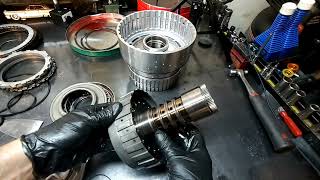
Typical fix: Replacement of the CDF clutch drum with an updated part that has a machined lip to prevent the bushing from moving. 🎬 Watch: See exactly how the CDF drum bushing fails internally. This is a major repair that requires removing and partially disassembling the transmission.
Est. part cost: $200-$400 for the drum, plus significant labor. - Low or Contaminated Transmission Fluid 🟡 Medium Probability
How to confirm: Check the transmission fluid level and condition according to the manufacturer's procedure. The fluid must be the correct type (Motorcraft MERCON ULV), at the proper level, and free of debris or a burnt smell. Dirty or low fluid can cause pressure issues and prevent solenoids from operating correctly.
Typical fix: Perform a transmission fluid drain-and-fill or a full fluid exchange if the fluid is very dirty. Only use Motorcraft MERCON ULV fluid.
Est. part cost: $150-$350
Rare But Worth Checking
- Wiring Harness or Connector Issue: An open or short in the wiring between the TCM and the transmission can mimic a solenoid failure. This is worth checking before condemning an expensive valve body, especially if the vehicle has been exposed to harsh conditions or has had previous underbody work.
- Faulty Transmission Control Module (TCM): While rare, the TCM itself can fail to send the correct signal to the solenoid. This is typically the last item to be diagnosed after all other possibilities have been ruled out.
Diagnosis Steps
- Verify the transmission fluid level and condition. Ensure it is clean, full, and of the correct type (Motorcraft MERCON ULV).
- Use a professional OBD-II scanner to check for any other pending or stored transmission codes.
- Use the scanner's live data function to monitor the commanded state and feedback for Shift Solenoid 'E' during operation.
- Perform a solenoid actuation test with the scan tool to command the solenoid on and off, listening for an audible click from the transmission pan area.
- Inspect the transmission's main electrical connector for corrosion, moisture, or pushed-out pins.
- Drop the transmission pan and inspect for excessive metal shavings or clutch material. Gray sludge or glitter can indicate internal mechanical wear, possibly from the CDF drum bushing.
- If accessible, test the resistance of the solenoid coil and check for power and ground at the solenoid connector to rule out a wiring issue.
- If the solenoid fails tests and wiring is confirmed to be good, the main control (valve body) assembly is a likely cause.
- If the valve body is replaced and issues persist, or if significant metal is found in the pan, an internal inspection of the CDF clutch drum is warranted.
Parts You'll Likely Need
- Transmission Main Control Valve Body Assembly
(OEM #HL3Z-7A100-B)— This is the most common failure point for P0771 on the 10R80 transmission. The assembly includes the solenoids and the hydraulic valve body. This part number supersedes HL3Z-7A100-A.
Trusted brands: Motorcraft
OEM price range: $900-$1500
Aftermarket price range: $700-$1200 - CDF Clutch Drum
(OEM #JL3Z-7H351-A (example, verify for specific vehicle))— A common underlying cause of hydraulic pressure loss that can trigger P0771. The original design is prone to bushing failure; an updated part is required for a permanent fix.
Trusted brands: Motorcraft
OEM price range: $200-$400 - Automatic Transmission Fluid
(OEM #XT-12-QULV)— The transmission fluid must be drained to replace the valve body and should be replaced with new fluid during the service. Only Motorcraft MERCON ULV is specified.
Trusted brands: Motorcraft MERCON ULV
OEM price range: $20-$30 per quart
Aftermarket price range: $15-$25 per quart - Transmission Pan Gasket
(OEM #HL3Z-7A191-B)— The old gasket should be replaced whenever the transmission pan is removed to prevent leaks. The 10R80 often uses a reusable gasket, but replacement is best practice.
Trusted brands: Motorcraft
OEM price range: $30-$50
Aftermarket price range: $20-$40
Related Codes That Often Appear With This One
- P0751, P0756, P0761, P0766 — These are codes for other shift solenoids (A, B, C, D). When multiple solenoid codes appear with P0771, it strongly points to a systemic problem like a faulty valve body, low fluid, or a wiring harness issue affecting multiple components. TSBs for the 10R80 often list all these codes together.
- P0729, P0731-P0736 — These codes indicate incorrect gear ratios. They often appear as a result of a solenoid fault (like P0771) or a related hydraulic issue (like the CDF drum failure) because the transmission is unable to achieve or hold the correct gear, leading to a detected slip or ratio error.
Technical Service Bulletins (TSBs) & Recalls
- TSB 25-2134: Mentions P0771 in a list of codes related to delayed shifts.
- TSB 25-2024: Lists P0771 with symptoms like harsh or delayed shifts.
- TSB 24-2046: Identifies sticking valves in the main control valve body as a cause for harsh/delayed shifts and lists P0771 as a related code for 2019-2023 Rangers.
- TSB 22-2428: Supersedes previous TSBs and provides a comprehensive diagnostic procedure for harsh/delayed shifts and numerous DTCs including P0771. It explicitly names sticking valves in the main control and 'axial movement of the CDF clutch cylinder sleeve' as potential root causes.
Platform-Specific Known Issues
- Ford has released multiple Technical Service Bulletins (TSBs) for the 10R80 transmission, including TSB 24-2046 and TSB 22-2428, which directly address harsh/delayed shifts and list P0771 as a possible related DTC. These bulletins point to potential issues with the main control valve body, the CDF clutch cylinder sleeve, or the PCM/TCM software.
Mechanic-Grade Diagnostic Values
- Shift Solenoid Coil Resistance — expected: 3-5 Ω. Failure: A reading outside of this range, or an open/shorted reading, indicates a faulty solenoid coil.
Hidden / Shadow Codes Worth Checking
- P0984, P0985, P0986: These are Ford-specific DTCs for Shift Solenoid E Control Circuit Range/Performance, Low, and High, respectively. They provide more granular detail than the generic P0771 and may be visible on advanced scan tools like Ford's IDS, pointing more directly to an electrical circuit fault rather than a mechanical performance issue. (see via Ford Integrated Diagnostic System (IDS) or equivalent professional-grade scan tool.)
Scan Tool Commands That Help
- Ford IDS (Integrated Diagnostic System): PCM – Transmission Strategy Download / Transmission Characterization — This function is mandatory after replacing the transmission main control (valve body) or the entire transmission. It requires inputting the 12-digit solenoid body ID and 13-digit strategy number from the new part tag to program the PCM/TCM with the correct calibration for the new solenoids.
- Ford IDS (Integrated Diagnostic System): Adaptive Learning Drive Cycle — After programming the new solenoid strategy, a specific drive cycle procedure must be performed. This allows the TCM to relearn shift points and clutch apply pressures. Failure to complete this can result in continued erratic shifting even after a successful repair.
Wiring & Ground Locations
- C175T, Pin 11 — This is a large connector at the Powertrain Control Module (PCM).. Pin 11 on the C175T connector is the specific circuit for the control signal to Shift Solenoid 'E' (SSE). A technician can test for voltage and continuity at this pin to diagnose whether a fault lies in the wiring harness between the PCM and the transmission, or within the PCM itself.
- Main Engine & Body Grounds — Key grounds include the battery-to-engine block strap, engine-to-firewall strap, and battery-to-body ground on the inner fender.. While not specific to P0771, a poor or corroded main ground can cause a host of unpredictable electrical issues in the powertrain control system, including erratic solenoid behavior. Verifying these main grounds are clean and tight is a crucial first step in any electrical diagnosis.
Real Owner Repair Stories
- Ford F150 Forum user (2018 Ford F-150 (Shares 10R80 transmission with Ranger)) — Error code from Ford servers saying 'Solenoid Not Found' when trying to program a new valve body strategy.
❌ Tried (didn't work) Using FORScan to program the new solenoid strategy., Using Ford's official FJDS software with a J2534 passthrough device.
✅ What actually fixed it The user had to have the dealership manually write the new solenoid parameters into the PCM using their internal tools and then perform the relearn procedure. This highlights that even with official software, some programming functions may require dealer-level intervention.
OEM Part Supersession History
HL3Z-7A100-A→HL3Z-7A100-B— This is the part number for the complete main control valve body assembly. Supersessions typically involve internal improvements to address known failure modes like sticking valves.
Heads up: The new part (HL3Z-7A100-B) is the correct replacement for the old one. However, it is critical to perform the Solenoid Body Strategy relearn procedure after installation, as the calibration will be different.Unknown (original CDF drum design)→Updated CDF Clutch Drum (e.g., JL3Z-7H351-A)— The original CDF drum design allowed an internal bushing/sleeve to 'walk' out of position, uncovering an oil passage and causing a major hydraulic leak. The updated part features a machined lip or 'dam' on the drum that physically prevents the bushing from moving.
Model Year Variations Within This Range
- 2023: Some owner and forum discussions suggest that Ford began using an updated CDF drum in 2023 model year Rangers to address the known issue of the bushing walking out. While not a guarantee, a 2023 model may be less susceptible to the CDF drum failure than a 2019-2022 model.
- 2019-2023: Ford issued TSB 24-2046 which supersedes previous bulletins and covers the entire 2019-2023 Ranger model range. It acknowledges that harsh/delayed shifts can be caused by the solenoid ID strategy, sticking valves in the valve body, or movement of the CDF clutch sleeve, indicating all three are potential failure points across this entire generation.
Helpful Videos

We Have This Part in Stock


The information in this article is provided for general reference and educational purposes only. Vehicle specifications, procedures, and part compatibility can vary by production date, trim level, and region. Always consult your vehicle's factory service manual and verify part numbers before purchasing or performing repairs. Safety-critical components such as airbags, seat belts, and braking systems should be installed by a qualified professional.
- Ford RANGER:
- 🎬 Helpful Videos
- 🛍️ Shop This Part
- What's Unique About the 2019-2023 Ford RANGER
- Diagnostic Flowchart
- Symptoms You May Notice
- Most Likely Causes
- Rare But Worth Checking
- Diagnosis Steps
- Parts You'll Likely Need
- Related Codes That Often Appear With This One
- Technical Service Bulletins (TSBs) & Recalls
- Platform-Specific Known Issues
- Mechanic-Grade Diagnostic Values
- Hidden / Shadow Codes Worth Checking
- Scan Tool Commands That Help
- Wiring & Ground Locations
- Real Owner Repair Stories
- OEM Part Supersession History
- Model Year Variations Within This Range
- 🎟️ Get 5% Off