

OBD-II Code P0771: Shift Solenoid 'E' Performance / Stuck Off
An ASE Master Technician's Expanded Guide to P0771
- Code P0771 indicates Shift Solenoid 'E' is stuck off, causing harsh shifts, limp mode, and rapid internal transmission damage if driven.
- Check your transmission fluid level and color immediately; low or contaminated fluid is the most common trigger and costs under $250 to fix.
- Do not blindly replace the solenoid; on modern vehicles like the 2017+ Ford F-150, the root cause is almost always a failed $1,500 valve body or CDF drum.
- Stop driving the vehicle immediately; continuing for even 50 miles with slipping clutches generates extreme heat that turns a $300 repair into a $4,000 complete transmission rebuild.
What Does P0771 Mean?

P0771 indicates the Transmission Control Module (TCM) detected a malfunction with Shift Solenoid 'E'. This electro-hydraulic valve directs transmission fluid to change gears. The TCM commanded the solenoid to open, but it remained mechanically or electrically 'stuck off', preventing the expected gear change.
Technical definition: The official SAE/OBD-II definition is "Shift Solenoid 'E' Performance or Stuck Off". The TCM verifies solenoid operation by monitoring input and output speed sensors; when a commanded shift fails to produce the correct gear ratio change, the TCM logs this performance fault.
Can I Drive With P0771?
No — Do Not Drive. Do not drive the vehicle. The transmission will likely enter limp mode, shift harshly, or fail to accelerate, creating an immediate traffic hazard. Driving even 50 miles with slipping clutches generates extreme heat that warps internal components, turning a manageable repair into a $4,000+ complete transmission rebuild.
Common Causes

- Low or Dirty Transmission Fluid (Very Common) — Low fluid levels prevent proper hydraulic pressure, while contaminated fluid causes the solenoid's mechanical plunger to stick or clog its internal passages.
- Faulty Transmission Valve Body (Common) — The shift solenoid lives inside the valve body. Sludge blocks its passages, or heat warps the housing. On modern Fords and Subarus, a failed valve body is the true root cause, not the individual solenoid.
- Faulty Shift Solenoid 'E' (Common) — The solenoid fails electrically (internal short/open circuit) or mechanically (stuck plunger or clogged internal filter screen). Overheating and moisture drive this failure.
- Internal Wiring or Connector Issues (Common) — The internal wiring harness becomes brittle from heat and fluid exposure, causing breaks or shorts. The external connector corrodes or loosens, blocking the command signal.
- Internal Hydraulic Leak or Worn Seals (Less Common) — A worn internal hydraulic seal, cracked clutch piston, or faulty gasket causes a pressure leak in the circuit fed by Solenoid 'E'. The TCM interprets this pressure loss as a solenoid fault, even if the solenoid works perfectly.
- Clogged Transmission Cooler or Filter (Uncommon) — A severely clogged main filter or external cooler restricts overall fluid flow and pressure, starving the solenoids and preventing actuation.
- Failed Transmission Pump (Uncommon) — If the transmission pump fails to generate sufficient line pressure, no solenoids can function correctly, triggering performance codes.
- Faulty Transmission Control Module (TCM) (Rare) — The driver circuit within the TCM that sends voltage to the solenoid fails. Rule out all fluid, solenoid, wiring, and valve body issues before replacing the TCM.
Symptoms

- Harsh, Delayed, or Failed Shifts — The transmission shifts abruptly, pauses excessively before changing gears, or refuses to enter a specific gear.
- Transmission Stuck in Limp Mode — The transmission locks into a single gear (usually 2nd or 3rd) to prevent further damage, severely limiting speed.
- Transmission Slipping — Engine RPM flares during shifts without a corresponding increase in vehicle speed, feeling like a momentary shift into neutral.
- Check Engine / Transmission Warning Light — The TCM illuminates the Malfunction Indicator Lamp (MIL) or a dedicated transmission warning light.
- Engine Stalling When Stopping — If the solenoid controls torque converter lock-up and fails to disengage, the engine stalls when stopping, similar to a manual car without the clutch pressed.
- Reduced Fuel Economy — Inability to reach overdrive gears forces the engine to run at higher RPMs, burning more fuel.
- Transmission Overheating (also visible on scanner) — Slipping clutches generate excessive heat, causing a burning fluid smell and elevated operating temperatures. 🎬 Watch: A breakdown of common bad shift solenoid symptoms
Diagnostic Flowchart
Tap your situation to follow the diagnostic path that matches what you're seeing on this code.
Common Fixes & Costs

- Transmission Fluid and Filter Change — Parts: $75-$150, Labor: $150-$250, ~1.5 hr book time (DIY)
- Replace Shift Solenoid 'E'
— Parts: $50-$150, Labor: $250-$500, ~3 hr book time
(Intermediate)
: OEM 35470-33010 (Alt: Rostra, ATP)
: OEM 28250-P7W-003 (Alt: Denso, Standard Motor Products (SMP)) - Replace Transmission Valve Body
— Parts: $700-$1500, Labor: $400-$800, ~4.5 hr book time
(Professional)
: OEM JL3Z-7A100-B (Alt: Often sold as remanufactured units) - Ford 10R80: Replace Valve Body and/or CDF Drum — Parts: $800-$2000, Labor: $1200-$3000, ~12 hr book time (Professional)
- Repair Transmission Wiring Harness
— Parts: $50-$200, Labor: $200-$500, ~3.5 hr book time
(Professional)
: OEM 46307-4G*** (Varies by model) (Alt: Dorman, Mopar)
Used vs. New Parts: Buying Guide
When a used part is worth it: A used OEM external solenoid from a low-mileage donor is acceptable. Never buy a used internal valve body; always choose a professionally remanufactured unit with a warranty.
Donor-vehicle mileage cap: roughly under 70000 miles for the part to have meaningful remaining life.
Donor quality checklist:
- Verify the donor vehicle was not scrapped for transmission failure.
- Match the part number exactly; internal calibrations vary.
- Avoid parts from vehicles with burnt fluid.
Decision logic:
- If The part is a single, external solenoid on a 10+ year old vehicle → A used OEM part is a cost-effective choice.
- If The part is an internal valve body or solenoid pack → Buy a new OEM or high-quality remanufactured part. The labor to replace a failed used part is too high.
- If The vehicle is a known problem model (e.g., Ford 10R80, Subaru CVT) → Buy the latest revised NEW OEM part to avoid repeating the factory defect.
Warranty tradeoff: Salvage yards offer 30-90 day part-only warranties. Remanufactured valve bodies include 1-3 year warranties that often cover partial labor.
Worst-case if a used part fails: $500-$1500 in repeated labor costs if a used internal part fails.
What Happens If You Wait — Timeline
- 0-1 month: Check Engine Light illuminates with P0771. Driver notices occasional harsh shifts or delayed gear engagement, especially when cold. (MPG impact: 0-5%% · Added cost: $0)
- 1-3 months: Harsh shifts and RPM flares become frequent. The transmission intermittently enters limp mode. Slipping clutches begin generating excessive heat. (MPG impact: 5-10%% · Added cost: $50-$150 in wasted fuel.)
- 3-6 months: Constant slipping burns the fluid, turning it black. Burnt fluid loses lubricity, accelerating wear. Clutch debris clogs the valve body and filter. (MPG impact: 10-20%% · Added cost: $1,800-$3,500. A simple fix is impossible; requires valve body and clutch pack replacement.)
- 6+ months: Catastrophic failure. Heat and debris destroy the valve body, clutch packs, and seals. The vehicle loses all forward or reverse gears. (MPG impact: 20%+% · Added cost: $3,500-$8,000+. Requires complete transmission replacement or rebuild.)
Cost of Not Fixing It
- 0-1 month: Harsh shifts, slipping, and sudden limp mode activation create a severe safety hazard in traffic. (Added cost: $0, but high risk of stranding.)
- 1-6 months: Slipping clutches burn the transmission fluid, destroying internal seals and clutch packs. (Added cost: $1,800-$3,500 for a major internal repair.)
- 6+ months: Catastrophic internal failure. Extreme heat warps hard parts and destroys the torque converter. (Added cost: $3,500-$8,000+ for a complete replacement.)
Diagnosis Steps

- Check Transmission Fluid Level and Condition
With the engine running and transmission in Park, check the dipstick. Fluid must be bright red and smell sweet. Dark brown, black, or metallic fluid indicates severe internal damage requiring a rebuild, not a simple flush.
Tools: Rag, Owner's Manual (Beginner) - Scan Codes and Review Live Data
Use an OBD-II scanner to pull freeze frame data. Monitor live data PIDs like 'Solenoid E Command' and 'Feedback' while driving. A command signal without feedback confirms a wiring or mechanical fault.
Tools: OBD-II Scanner (Beginner) - Inspect External Wiring and Connectors
Visually inspect the transmission wiring harness. Look for chafing, melted insulation, or corrosion on the main connector. High humidity corrodes pins, causing signal loss.
Tools: Flashlight (Intermediate) - Perform Scan Tool 'Active Test'
Use a bi-directional scan tool to command Solenoid 'E' on and off. Listen for a click or watch pressure changes. This isolates the fault to the solenoid/wiring versus a hydraulic blockage before dropping the pan.
Tools: Professional OBD-II Scanner (Advanced) - Test Solenoid Resistance
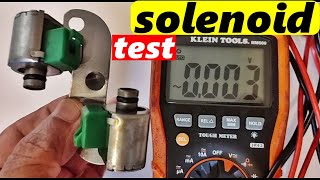
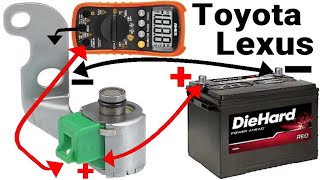
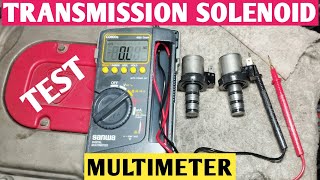
Drop the transmission pan. Disconnect the solenoid and measure resistance across its terminals. Compare to OEM specs (e.g., 11-15 ohms for Toyota U660E). Infinite ohms means an open circuit; zero means a short.
Tools: Digital Multimeter, Socket Set, Drain Pan, Service Manual (Advanced) - Perform a Solenoid 'Click Test'
Apply 12V power and ground directly to the solenoid terminals using fused jumper wires. A distinct 'click' confirms mechanical actuation. No click means the solenoid is stuck or burned out.
Tools: Fused Jumper Wires, 12V Power Source (Advanced) - Inspect the Valve Body
Check the exposed valve body for sludge, metal shavings, or scored valve bores. If multiple solenoid codes exist, the entire valve body assembly requires replacement.
Tools: Flashlight, Gasket Scraper (Advanced) - Perform Hydraulic Pressure Tests
Connect transmission pressure gauges to the case ports. Run the engine and monitor line pressure. Low pressure when the solenoid is commanded on confirms a hydraulic leak from a worn seal or cracked drum.
Tools: Transmission Pressure Gauge Set, Service Manual (Professional) - Analyze Command Signal with an Oscilloscope
Back-probe the solenoid signal wire. A clean square wave pattern confirms the TCM is sending the correct Pulse Width Modulated (PWM) signal, ruling out the computer and pointing to the solenoid or wiring.
Tools: Oscilloscope, Back-probe kit (Professional)
When This Code Triggers (Freeze-Frame Conditions)
- Engine Coolant Temp: 180-210°F (82-99°C) (The engine reached normal operating temperature. The TCM rarely runs diagnostic checks on a cold transmission.)
- Engine RPM: 1500-2500 RPM (During a commanded shift under light to moderate acceleration. The code sets when the expected RPM drop fails to occur.)
- Vehicle Speed: 35-55 mph (56-88 km/h) (Steady cruising or gentle acceleration when the transmission commands an overdrive gear.)
- Gear Commanded: Varies (e.g., 4, 5, or 6) (The TCM commanded a specific gear utilizing Solenoid 'E', but speed sensors report a mismatched gear ratio.)
Related Codes
- P0700 — A generic ECM code stating the TCM has a fault. Always scan the TCM to find the specific P0771 code.
- P0751, P0756, P0761, P0766 — Performance codes for other solenoids. Multiple solenoid codes indicate a systemic failure (bad valve body, major hydraulic leak, or shared ground issue), not multiple bad solenoids.
- P0729 - P0736 (Incorrect Gear Ratio) — Mechanical outcome codes. The TCM sets P0771 when the solenoid fails, and sets a P073x code when the resulting gear ratio is wrong. Fixing P0771 resolves the gear ratio code.
- P0773 — Shift Solenoid E Electrical. P0771 is a performance fault (mechanical, hydraulic, or electrical), while P0773 strictly indicates an electrical open or short circuit.
Climate & Environmental Factors
- High Humidity: Moisture penetrates non-sealed connectors, accelerating pin corrosion. This increases resistance and blocks the TCM's command signal to the solenoid.
- Extreme Heat: High ambient temperatures accelerate fluid breakdown and bake wiring insulation until it cracks, causing electrical shorts and mechanical sticking.
- Cold Weather: Thick, cold fluid exacerbates borderline sticky solenoids or clogged passages, causing delayed shifts on initial startup.
How to Talk to a Mechanic About This Code
Say this: "I have a P0771 code on my [Year, Make, Model] with [symptoms]. Please start by checking the fluid condition and external wiring. If those pass, I'd like a quote for testing the solenoid circuit and checking for any relevant TSBs."
This proves you understand the diagnostic process. It forces the shop to check cheap causes first and prevents them from immediately quoting a full rebuild. Mentioning TSBs is critical for known problem vehicles.
Avoid saying:
- My transmission is acting up, can you fix it?
- Just replace shift solenoid E.
- My car won't shift right, do whatever it takes.
Questions to ask before authorizing the repair:
- What was the condition of the transmission fluid? Was there metal in the pan?
- Did you test the solenoid's resistance and did it 'click' with voltage applied?
- If you recommend a valve body, why won't a simpler repair fix it?
- Will this repair require a transmission adaptive learning procedure afterward?
- What is the warranty on parts and labor?
Where to Take It: Dealer vs Independent vs Chain
- Dealer:
Recommended for specific manufacturer defects (e.g., Ford CDF drum) or warranty work. They have direct access to updated parts.
Best for: Vehicles under warranty, Known complex issues covered by TSBs (Ford 10R80, Subaru CVT), Vehicles requiring proprietary software for relearn procedures
Downsides: Highest labor rates, Often defaults to replacing large, expensive assemblies instead of smaller components (Typical cost: +50% vs. baseline) - Independent Shop:
Best overall choice, IF it is a reputable transmission specialty shop. They perform the targeted hydraulic and electrical diagnosis this code requires.
Best for: Out-of-warranty vehicles requiring standard component failure diagnosis, Getting a second opinion on a dealer quote
Downsides: General mechanics lack deep transmission knowledge. You must find a dedicated transmission specialist. (Typical cost: +0% vs. baseline) - Chain Shop:
AVOID. The risk of misdiagnosis and being sold an unnecessary $4,000 rebuild is too high.
Best for: A fluid and filter change, only if you are certain that is the sole issue.
Downsides: Technician skill is highly variable., Lack specialized diagnostic tools for internal transmission work., High pressure to upsell unnecessary full replacements. (Typical cost: -10% vs. baseline)
When to Walk Away From the Repair
Sell or trade the vehicle if the transmission repair exceeds 50% of its current private-party value.
- Car worth $4000, fix is $1800: Borderline (45%). Get a second opinion. If the rest of the car is pristine, fix it.
- Car worth $15000, fix is $2500: Fix it. The repair is 17% of the vehicle's value.
- Car worth $3000, fix is $2800: Walk away. The repair is 93% of the car's value.
What Scan Tool You Need for This Code
Minimum: A scanner that reads manufacturer-specific transmission codes and views live data PIDs (solenoid command status, fluid temperature).
A $20 code reader only shows the generic P0700 engine code. It cannot communicate with the TCM to retrieve P0771 or view live diagnostic data.
Budget: BlueDriver Pro (~$100) — Reads specific transmission codes and provides freeze frame data. Lacks bi-directional control for active tests.
Mid-range: Foxwell NT510 Elite (~$200) — Performs bi-directional 'active tests' to command the solenoid on and off, allowing you to hear it click and confirm functionality before dropping the pan.
Professional: Autel MaxiCOM MK808S / MK808Z-BT (~$450-600) — Full bi-directional control and performs advanced service functions like resetting transmission adaptive values after a repair.
Rent vs buy: Auto parts store loaner tools are basic code readers. You must buy a mid-range bi-directional scanner or pay for professional diagnosis.
How to Clear the Code After You Fix It
- Use an OBD-II scan tool to clear the DTCs.
- Perform a transmission adaptive pressure/learning reset using a bi-directional scan tool (mandatory on many modern vehicles).
- Complete a full drive cycle to set readiness monitors.
Drive cycle (~20 minutes): Start cold. Idle 3 minutes. Drive city speeds (25-45 mph) with gentle acceleration. Drive steady highway speeds (55-60 mph) for 10 minutes. Cool down completely and repeat.
Readiness monitors affected: Comprehensive Component Monitor, Catalyst Monitor, Evaporative System Monitor
Before emissions retest: drive at least 50 miles to fully set monitors.
Watch out for:
- Disconnecting the battery clears the code but resets all readiness monitors, guaranteeing an emissions failure.
- Failing to perform the transmission adaptive learning procedure after repair causes continued harsh shifting and damages new parts.
Will This Fail Emissions / State Inspection?
Yes — this code typically fails an OBD-II emissions inspection.
- California: An active P0771 automatically fails a smog check. Disconnecting the battery resets monitors, requiring a full drive cycle before re-testing.
- New York: The NYS DMV inspection includes an OBD-II scan. Any powertrain code, including P0771, results in immediate failure.
- Texas: In the 17 emissions-testing counties, an illuminated Check Engine Light for P0771 fails the OBD inspection.
Most Commonly Affected Vehicles
- Ford F-150, Transit, Explorer, Ranger, Mustang (2017-2023) — The 10R80 transmission is notorious for P0771. TSBs 22-2428 and 23-2123 confirm the root cause is sticking valves in the main control (valve body) or a sleeve walking out of the CDF clutch drum. Requires valve body or drum replacement.
- Toyota Camry, Corolla, RAV4, Sienna (2004-2013) — Often called 'Shift Solenoid SL'. Diagnosis requires verifying resistance (11-15 Ω at 68°F) and performing active tests with a scan tool.
- Honda Accord, Civic, CR-V, Odyssey (2003-2016) — Solenoids are often externally mounted, making replacement easier. Replace the full set of linear solenoids if one fails, as they share a similar lifespan.
- Hyundai / Kia Sonata, Elantra, Optima, Santa Fe (2011-2018) — TSB 22-AT-005H traces this code to a faulty internal transmission wiring harness. The fix requires replacing the solenoid and the valve body harness.
- Nissan Altima, Sentra, Maxima, Murano (2006-2016) — Indicates a failing solenoid pack or valve body in the CVT. Using incorrect universal fluid instead of Nissan NS-2/NS-3 is the primary cause of failure.
- Volkswagen / Audi GTI, Jetta, Golf, A3 (DSG) (2010-2016) — Points to a failure within the Mechatronic unit (combined TCM and valve body). Requires expensive, professional replacement and software adaptation.
- Subaru Outback, Forester, Impreza (2012-2019) — Indicates a failing CVT valve body assembly. Solenoids are not serviced separately; the entire valve body must be replaced.
- General Motors Malibu, Impala, Equinox, Cruze (2007-2016) — On 6T40/6T45 transmissions, a shattered clutch wave plate sends metal debris through the system, clogging the solenoids and valve body.
Manufacturer-Specific Notes
- Ford: On 10R80 transmissions, do not replace only solenoid 'E'. TSBs confirm the root cause is a faulty valve body or CDF clutch drum sleeve leak.
- Honda/Acura: Shift solenoids are often mounted externally on the transmission case, allowing replacement without dropping the fluid pan.
- Toyota: ECM logic is highly sensitive. Diagnosis requires specific resistance checks (11-15 Ω for the U660E SL solenoid) and active tests using Techstream software.
- Hyundai/Kia: TSBs point to the internal transmission wiring harness degrading from heat cycles. The official fix replaces both the solenoid and the internal harness.
Real Owner Stories
2018 Ford F-150 with 10R80 at 75,000 miles
Owner experienced harsh 3-5 shifts and occasional 'free-revving' between gears, followed by the Check Engine Light with code P0771.
What they tried:
- Dealer performed a PCM update, which failed to solve the problem.
- Owner researched forums and discovered common 10R80 valve body defects.
Outcome: The correct repair, confirmed by Ford TSBs, was a full valve body replacement costing $2,200. Replacing a single solenoid would have failed.
Lesson: On a Ford 10R80 transmission, P0771 is rarely a single solenoid failure. The root cause is almost always the entire valve body assembly or a CDF drum leak.
2012 Toyota Camry with U660E at 110,000 miles
Vehicle set P0771, exhibiting delayed gear engagement and harsh upshifts.
What they tried:
- Owner replaced only Shift Solenoid 'E' (SL solenoid).
- Symptoms remained identical, and P0771 returned within 24 hours.
Outcome: Debris from a failing torque converter clutch contaminated the hydraulic system. The fix required a new torque converter, flushed lines, and a new valve body. The initial solenoid replacement was wasted money.
Lesson: Inspect the transmission pan for metallic debris before replacing parts. Excessive metal indicates a catastrophic internal failure that a single solenoid cannot fix.
2005 Honda CR-V at 153,000 miles
Owner reported transmission slipping and 1st-to-2nd gear upshift issues, triggering a solenoid performance code.
What they tried:
- Owner installed a $50 aftermarket dual linear solenoid from eBay.
- Low-speed shifting improved, but high-RPM slipping continued.
Outcome: The cheap aftermarket part failed to meet OEM flow specifications, and underlying clutch pack wear caused the high-RPM slip. The owner eventually required a transmission rebuild.
Lesson: Avoid cheap, non-OEM electronic transmission parts. If slipping persists after an OEM solenoid replacement, the clutch packs are mechanically worn out.
How to Prevent This Code From Triggering
- Regular Transmission Fluid Changes (Every 30,000-60,000 miles) — Clean fluid maintains hydraulic pressure and dissipates heat. Degraded fluid forms sludge that clogs solenoid passages and valve bodies.
- Use ONLY Manufacturer-Specified Fluid (Every fluid change) — Modern transmissions require exact viscosity and additive packages. Universal fluids damage seals, cause clutch slip, and destroy solenoids.
- Install an Auxiliary Transmission Cooler (One-time installation for towing or hot climates) — Heat destroys transmissions. A 10-degree drop in fluid temperature significantly extends the life of fluid, seals, and electronic solenoids.
- Ensure Battery and Electrical System Health (Annual check) — Solenoids require stable voltage. A weak battery or failing alternator provides inconsistent voltage, triggering erratic solenoid performance codes.
Frequently Asked Questions
What is the most common mistake when fixing P0771?
The most common mistake is blindly replacing the solenoid without diagnosis. Technicians often find the true cause is low fluid, a corroded connector, or a failed valve body.
What is the most common misdiagnosis for P0771?
Condemning the solenoid when the fault is a hydraulic pressure leak. A worn clutch seal causes pressure loss that the TCM misinterprets as a solenoid failure.
Can a transmission flush fix P0771?
Only if the code is caused by dirty fluid sticking the solenoid plunger. If the solenoid failed electrically or a hard part broke, a flush wastes money.
What does Shift Solenoid 'E' actually do?
Solenoid 'E' directs hydraulic fluid to engage specific gears, though its exact role varies by transmission design. It does not control a single gear like 5th; rather, it works in combination with other solenoids. Consult your vehicle's service manual for its exact application chart.
Can I fix P0771 myself?
Experienced DIYers can perform fluid changes or accessible solenoid replacements. However, replacing internal wiring or valve bodies requires a pristine environment and advanced relearn tools.
What happens if I ignore code P0771?
Ignoring it causes severe drivability issues and transmission overheating. Slipping clutches rapidly destroy internal parts, forcing a multi-thousand dollar rebuild.
How much does it cost to fix P0771?
Costs range from $200 for a fluid change to $500 for a solenoid replacement. Modern 10-speed transmissions often require a $1,500-$3,000 valve body replacement.
Can a bad battery or alternator cause P0771?
Yes. Solenoids require stable voltage to operate. A weak battery or failing alternator causes voltage drops that trigger false solenoid performance codes.
Key Takeaways
- Code P0771 indicates Shift Solenoid 'E' is stuck off, causing harsh shifts, limp mode, and rapid internal transmission damage if driven.
- Check your transmission fluid level and color immediately; low or contaminated fluid is the most common trigger and costs under $250 to fix.
- Do not blindly replace the solenoid; on modern vehicles like the 2017+ Ford F-150, the root cause is almost always a failed $1,500 valve body or CDF drum.
- Stop driving the vehicle immediately; continuing for even 50 miles with slipping clutches generates extreme heat that turns a $300 repair into a $4,000 complete transmission rebuild.
Helpful Videos

The information in this article is provided for general reference and educational purposes only. Vehicle specifications, procedures, and part compatibility can vary by production date, trim level, and region. Always consult your vehicle's factory service manual and verify part numbers before purchasing or performing repairs. Safety-critical components such as airbags, seat belts, and braking systems should be installed by a qualified professional.
- 🎬 Helpful Videos
- What Does P0771 Mean?
- Can I Drive With P0771?
- Common Causes
- Symptoms
- Diagnostic Flowchart
- Common Fixes & Costs
- Used vs. New Parts: Buying Guide
- What Happens If You Wait — Timeline
- Cost of Not Fixing It
- Diagnosis Steps
- When This Code Triggers (Freeze-Frame Conditions)
- Related Codes
- Climate & Environmental Factors
- How to Talk to a Mechanic About This Code
- Where to Take It: Dealer vs Independent vs Chain
- When to Walk Away From the Repair
- What Scan Tool You Need for This Code
- How to Clear the Code After You Fix It
- Will This Fail Emissions / State Inspection?
- Most Commonly Affected Vehicles
- Manufacturer-Specific Notes
- Real Owner Stories
- 2018 Ford F-150 with 10R80 at 75,000 miles
- 2012 Toyota Camry with U660E at 110,000 miles
- 2005 Honda CR-V at 153,000 miles
- How to Prevent This Code From Triggering
- Frequently Asked Questions
- What is the most common mistake when fixing P0771?
- What is the most common misdiagnosis for P0771?
- Can a transmission flush fix P0771?
- What does Shift Solenoid 'E' actually do?
- Can I fix P0771 myself?
- What happens if I ignore code P0771?
- How much does it cost to fix P0771?
- Can a bad battery or alternator cause P0771?
- Key Takeaways
- 🎟️ Get 5% Off