

P0766 on 2020-2023 Lincoln Aviator: Shift Solenoid 'D' Causes and Fixes
On a 2020-2023 Aviator, P0766 is a serious code that almost always indicates a known internal issue with the 10-speed transmission, not just a bad solenoid. The most likely causes are sticking valves in the main control valve body or a catastrophic failure of the CDF clutch drum bushing. Both are well-documented problems covered by multiple TSBs. This is a complex, expensive repair requiring professional service and should be addressed immediately.
- P0766 on a 2020-2023 Aviator is a serious code indicating a significant internal transmission problem, not just a cheap sensor.
- The most likely cause is a faulty main control valve body, an issue so common that Lincoln has issued multiple service bulletins about it.
- Do not continue to drive the vehicle extensively. The shifting can be unpredictable and you risk causing catastrophic, multi-thousand-dollar damage to the transmission.
- This is not a DIY repair. The vehicle needs to be taken to a qualified transmission shop or a Lincoln dealer who is aware of the TSBs for the 10-speed transmission.
- When speaking with a service advisor, mentioning the TSBs related to harsh shifting (like TSB 20-2403 or TSB 22-2428) can help guide the diagnosis.
What's Unique About the 2020-2023 Lincoln AVIATOR
For the 2020-2023 Lincoln Aviator, equipped with a 10R60 or 10R80 10-speed automatic transmission, P0766 is rarely an isolated, simple solenoid failure. This code is a well-documented symptom of a larger internal transmission problem. Multiple Technical Service Bulletins (TSBs) from Ford/Lincoln, such as TSB 23-2250, point to sticking valves within the main control valve body as a primary cause. In many cases, the code is also a symptom of a more severe mechanical failure where a bushing in the CDF clutch drum 'walks' out of position, causing a major internal hydraulic leak. This design flaw was a significant issue in earlier builds of the 10R80 transmission, with updated parts being implemented in vehicles built after mid-2022.
Diagnostic Flowchart
Tap your situation to follow the diagnostic path that matches what you're seeing on this vehicle.
Symptoms You May Notice
- Harsh or abrupt shifts, both up and down
- Delayed gear engagement, especially when shifting from Park to Drive or Reverse
- Vehicle lunging or jerking during shifts
- Clunking or banging noises during shifts
- Transmission failing to shift into or out of certain gears
- Illuminated Malfunction Indicator Lamp (Check Engine Light)
- Transmission entering 'limp mode' with limited gear availability
- Replacing only the 'D' shift solenoid without addressing the underlying valve body or CDF drum issue. The problem will likely return.
- Performing a fluid flush and expecting it to fix a mechanical problem like a sticking valve or a major hydraulic leak from the CDF drum.
Most Likely Causes
- Sticking Valves in the Main Control Valve Body 🔴 High Probability This is a widely documented issue for the 10R60/10R80 transmission, acknowledged by multiple manufacturer TSBs (e.g., TSB 20-2403, TSB 23-2250). The valves can develop burrs or stick due to metallic debris, causing hydraulic pressure deviations and erratic shifts.
How to confirm: A technician follows the TSB diagnostic path, which often starts with a 'Transmission Adaptive Pressure Learning' routine using a Ford-specific scan tool like FDRS. If symptoms persist, the valve body must be inspected or replaced.
Typical fix: If the adaptive learn procedure fails, TSBs instruct technicians to overhaul or, more commonly, replace the entire main control valve body assembly.
Est. part cost: $800-$1500 - Internal Failure of the CDF Clutch Drum 🟡 Medium Probability A known design flaw on 10R80 transmissions built before mid-to-late 2022 involves a bushing in the CDF drum 'walking' or sliding out of place. This uncovers oil passages, causing a major hydraulic leak that starves clutches of pressure and triggers various solenoid codes like P0766.
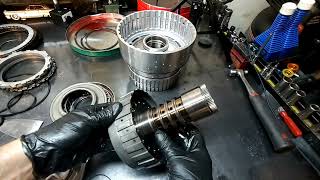
How to confirm: This requires professional diagnosis involving hydraulic pressure tests and ultimately transmission disassembly for visual confirmation of the displaced bushing 🎬 Watch: A mechanic shows exactly what a CDF drum failure looks like and damaged Teflon seals.
Typical fix: The transmission must be removed and rebuilt to replace the faulty CDF clutch drum with an updated part (such as JL3Z-7H351-B) that has a machined lip to prevent the bushing from moving. The valve body is often replaced at the same time.
Est. part cost: $800-$2500 - Low or Contaminated Transmission Fluid ⚪ Low Probability While possible, it's rarely the root cause on these newer vehicles unless there's an external leak. The 10-speed transmission is extremely sensitive to the correct fluid level and type (Motorcraft MERCON ULV). Contaminated fluid can accelerate wear on the valve body.
How to confirm: Check the transmission fluid level and condition following the specific, complex procedure for this transmission. A professional check is recommended.
Typical fix: Perform a transmission fluid drain and fill or flush with the correct fluid. This will not fix a mechanical issue like a faulty valve body or CDF drum.
Est. part cost: $150-$400 - Failed Shift Solenoid 'D' ⚪ Low Probability While the code directly points to the solenoid, it is far more common for the solenoid to be flagged due to a systemic pressure issue (from the valve body or CDF drum) than for the solenoid itself to fail individually. The solenoid is part of the valve body assembly and not typically replaced alone.
How to confirm: A technician can test the solenoid's resistance and command it with a scan tool, but this may not reveal the underlying hydraulic problem that is the true root cause.
Typical fix: Solenoids are replaced as part of the entire main control valve body assembly.
Est. part cost: $800-$1500 (as part of valve body)
Rare But Worth Checking
- Wiring Harness Issue: Damage to the wiring between the TCM and the transmission can cause erratic signals. This should be checked before condemning expensive internal components.
- Powertrain Control Module (PCM/TCM) Failure: In very rare cases, the control module itself can fail, but all other possibilities, especially the known mechanical issues, should be ruled out first.
- Damaged Main Control to Oil Pump Seal: A dislodged or damaged seal between the valve body and the oil pump can cause a massive pressure loss, resulting in a no-move condition and multiple solenoid codes. This is most common after a recent repair where the valve body was disturbed.
Diagnosis Steps
- Verify the code with a professional OBD-II scanner that can read transmission-specific data.
- Check for the presence of other transmission-related codes to assess the scope of the problem.
- Consult the relevant Technical Service Bulletins (TSBs) for the 2020-2023 Aviator, specifically the latest superseding TSB like TSB 23-2250.
- Following TSB procedure, a technician may perform the 'Transmission Strategy Download' and 'Adaptive Learning Drive Cycle' routines using a diagnostic scan tool like FDRS.
- Check the transmission fluid level and condition, ensuring the correct fluid (Motorcraft MERCON ULV) is used. Note any excessive metal shavings in the pan.
- If the adaptive learn routine does not resolve the issue, the next step per the TSBs is to inspect, overhaul, or replace the main control valve body.
- If symptoms persist or point to a major hydraulic leak (especially on pre-2023 models), further diagnosis will involve hydraulic pressure testing and likely transmission removal to inspect the CDF clutch drum for bushing movement.
Parts You'll Likely Need
- Main Control Valve Body Assembly
(OEM #L1MZ-7A100-C (Verify by VIN))— This is the most common fix identified in manufacturer TSBs for the symptoms associated with P0766 on this vehicle. Replacement is often more effective than an overhaul.
Trusted brands: Motorcraft
OEM price range: $800-$1500 - CDF Clutch Drum
(OEM #JL3Z-7H351-B)— A known major failure point on the 10R80 transmission platform that causes this code. Replacement requires a full transmission rebuild with an updated part to prevent recurrence.
Trusted brands: Motorcraft
OEM price range: $800-$1200 - Automatic Transmission Fluid
(OEM #XT-12-QULV)— The transmission must be refilled with the correct fluid (Motorcraft MERCON ULV) after any valve body or internal repair.
Trusted brands: Motorcraft
OEM price range: $25-$35 per quart
Related Codes That Often Appear With This One
- P0751, P0756, P0761, P0771 — These are performance codes for other shift solenoids (A, B, C, E). Multiple solenoid codes appearing together strongly suggest a systemic hydraulic or valve body problem, not multiple individual solenoid failures.
- P0729, P0731-P0736 — These are incorrect gear ratio codes. They are set when the transmission fails to achieve the commanded gear, which is a direct result of the hydraulic pressure loss caused by a faulty valve body or CDF drum.
- P2700-P2705 — These codes relate to friction element apply time. They are also listed in the TSBs alongside P0766 as being caused by sticking valves in the main control body.
Technical Service Bulletins (TSBs) & Recalls
- TSB 20-2403: Initial bulletin identifying sticking valves in the main control as the cause for P0766 and other codes, recommending a break-in routine or valve body replacement.
- TSB 21-2046: Supersedes 20-2403, updating parts and procedures for the valve body overhaul/replacement.
- TSB 22-2428: Supersedes previous versions, expanding the list of vehicles and refining the diagnostic process, including software updates and adaptive learning procedures before component replacement.
- TSB 23-2250: Supersedes 22-2428, further updating the procedure and warranty information for a wide range of Ford/Lincoln vehicles with the 10-speed transmission.
Platform-Specific Known Issues
- The 10-speed 10R60/10R80 automatic transmission in the 2020-2023 Aviator is subject to multiple Technical Service Bulletins (TSBs) for harsh shifting, delayed shifts, and related issues. TSB 23-2250 directly links code P0766 to "sticking valves in the main control valve body" and/or "axial movement of the CDF clutch cylinder sleeve". This TSB supersedes several previous versions and provides a detailed diagnostic and repair path for technicians.
Mechanic-Grade Diagnostic Values
- Shift Solenoid 'D' Resistance — expected: 16-45 Ohms (Note: This is a general value for some Ford transmissions and may vary slightly for the 10R80. Always verify with official service data.). Failure: A reading outside of the specified range indicates a faulty solenoid coil.
Scan Tool Commands That Help
- Ford Diagnostic & Repair System (FDRS) or FORScan: Clear All Adaptive Tables — This function should be used after a major transmission repair, such as replacing the valve body or rebuilding the transmission, to reset the learned shift strategy. It forces the TCM to start a new learning process.
- Ford Diagnostic & Repair System (FDRS): PCM – Transmission Strategy Download — This is required when a new main control valve body is installed. The technician must enter the 13-digit solenoid body strategy number from the new part tag to ensure the PCM/TCM has the correct calibration for the new solenoids. Failure to do so can result in poor shifting and other DTCs like P163E.
- Ford Diagnostic & Repair System (FDRS): Adaptive Learning Drive Cycle — After clearing adaptive tables or performing a strategy download, a specific drive cycle must be performed. This involves a series of controlled accelerations and shifts to allow the TCM to learn the transmission's characteristics and optimize shift quality.
Wiring & Ground Locations
- C175T (Powertrain Control Module Connector) — This is one of the main connectors at the Powertrain Control Module (PCM), typically located on the firewall.. Pin 10 on connector C175T is the control circuit for Shift Solenoid 'D' (SSD). A technician can perform a continuity or voltage test at this pin to check the integrity of the wiring between the PCM and the transmission.
Real Owner Repair Stories
- Reddit user on r/f150 (2019 F-150 Lariat 2.7L 4x4 (with 10R80 transmission, same architecture as Aviator)) — Initially harsh upshifts/downshifts. Later developed a 2-3 second delay when shifting from Park to Drive/Reverse.
❌ Tried (didn't work) A reflash and some parts swapped per a TSB did not resolve the issue long-term.
✅ What actually fixed it The delayed engagement was fixed by replacing the CDF drum. However, this was followed by very hard shifts into 3rd gear. The valve body assembly was then replaced, which ultimately resolved all shifting issues after the adaptive learning period. - Ford F150 Forum user (2018 F-150 Lariat 3.5L (with 10R80 transmission) at 88k miles) — Transmission skipping 2nd and 4th gears, with very hard shifts into 3rd and 5th. Eventually set a P07F7 code (Unable to Engage Gear 10) and locked out 10th gear.
❌ Tried (didn't work) Resetting the PCM and TCM had no effect.
✅ What actually fixed it A full transmission rebuild was required. The root cause was identified as the CDF drum bushing having 'walked' out of place, which then destroyed the corresponding Teflon seal, causing a hydraulic pressure loss. The owner noted the mechanic stated Ford has a redesigned part to fix this.
OEM Part Supersession History
HL3Z-7H351-A, JL3Z-7H351-A→JL3Z-7H351-B— The updated CDF Clutch Drum/Cylinder (JL3Z-7H351-B) features a machined lip or wall to prevent the internal bushing from 'walking' out of place, which was the primary design flaw causing major hydraulic leaks.L1MZ-7A100-B→L1MZ-7A100-F— Part revisions for the main control valve body often address issues with sticking valves, cross-leaks, or updated solenoid calibrations. Using the latest part number is critical for a lasting repair.
Heads up: The part number L1MZ-7A100-C provided in the pass 2 data appears to be for the hybrid (10R80-MHT) version of the transmission. The non-hybrid version has a different part number history. Always verify the correct part number by VIN.JL3Z-7A100-A→JL3Z-7A100-C— Supersession for the valve body used in many 10R80 applications (F-150, Ranger, etc.). Revisions typically improve durability and address known shift quality concerns.
Model Year Variations Within This Range
- 2020 - Mid-2022: Vehicles built on or before August 15, 2022, are more susceptible to the CDF clutch drum bushing failure as they were built with the original, flawed design. TSB 23-2250 specifically targets these earlier models for potential CDF drum inspection and replacement.
- Late 2022 - 2023: Vehicles built after approximately December 2022 likely have the revised CDF drum from the factory, making the valve body the more probable cause of P0766, though not guaranteed.
Helpful Videos
We Have This Part in Stock


The information in this article is provided for general reference and educational purposes only. Vehicle specifications, procedures, and part compatibility can vary by production date, trim level, and region. Always consult your vehicle's factory service manual and verify part numbers before purchasing or performing repairs. Safety-critical components such as airbags, seat belts, and braking systems should be installed by a qualified professional.
- Lincoln AVIATOR:
- 🎬 Helpful Videos
- 🛍️ Shop This Part
- What's Unique About the 2020-2023 Lincoln AVIATOR
- Diagnostic Flowchart
- Symptoms You May Notice
- Most Likely Causes
- Rare But Worth Checking
- Diagnosis Steps
- Parts You'll Likely Need
- Related Codes That Often Appear With This One
- Technical Service Bulletins (TSBs) & Recalls
- Platform-Specific Known Issues
- Mechanic-Grade Diagnostic Values
- Scan Tool Commands That Help
- Wiring & Ground Locations
- Real Owner Repair Stories
- OEM Part Supersession History
- Model Year Variations Within This Range
- 🎟️ Get 5% Off