

P0756 on 2001-2008 GMC Sierra 2500: Shift Solenoid 'B' Causes and Fixes
P0756 indicates a problem with the 2-3 Shift Solenoid 'B' inside the transmission. The most common fix is to replace the faulty solenoid, along with the transmission fluid and filter. Before buying parts, always check the transmission fluid level and condition, as low or dirty fluid is a frequent and cheaper cause. For GMT800 trucks with the 4L80-E, it's highly recommended to replace both 'A' and 'B' solenoids at the same time as they are identical parts and have endured the same wear.
- P0756 points to a fault with the 2-3 shift solenoid 'B', which will likely put your transmission in a protective 'limp mode'.
- Always start diagnosis by checking the transmission fluid level and condition. This is the simplest and cheapest potential fix.
- The most common failed part is the shift solenoid itself, which is located inside the transmission oil pan.
- This year range covers different truck generations and transmissions. You must identify your specific transmission (e.g., 4L80-E, Allison) to buy the correct parts.
- Due to the need to work inside the transmission, this repair is complex and best suited for experienced DIYers or a professional mechanic.
What's Unique About the 2001-2008 Gmc SIERRA 2500
This year range spans two distinct generations of the Sierra 2500: the GMT800 (2001-2007 Classic) and the GMT900 (2007-2008). GMT800 models with gas engines typically use the 4L80-E transmission, where the 'A' (1-2) and 'B' (2-3) shift solenoids are simple, individual, and often identical components. Later models, especially those with the 6-speed automatic (like the 6L90), may have more complex solenoid arrangements integrated into a single valve body assembly or TEHCM (Transmission Electro-Hydraulic Control Module). Diesel models in both generations typically use an Allison transmission, which has its own unique design and solenoid pack. Correctly identifying your specific transmission is the most critical step before attempting a repair.
Diagnostic Flowchart
Tap your situation to follow the diagnostic path that matches what you're seeing on this vehicle.
Generation note: This range covers the first generation GMT800 (2001-2006 and 2007 'Classic' models) and the second generation GMT900 (2007-2008). The primary difference for this code is the transmission used. GMT800 gas models often have the 4L80-E, where the 'A' and 'B' solenoids are identical parts (ACDelco P/N: 24230298). GMT900s may have a 6-speed automatic (6L80/6L90). Diesel trucks typically use an Allison transmission. The specific solenoid and its replacement procedure differ significantly between these transmissions.
Symptoms You May Notice
- Check Engine Light is on
- Transmission gets stuck in one gear (limp mode)
- Harsh or delayed shifting, particularly the 2-3 shift
- Failure to shift into or out of certain gears
- Transmission slipping
- Reduced fuel economy
- Inability to engage 2nd gear at all
- Transmission overheating
- No reverse engagement [⭐ MANUFACTURER TSB — highest authority] Bulletin #PIP4379N
- Replacing the entire transmission when only a single, inexpensive solenoid has failed.
- Replacing the shift solenoid without first checking for low or dirty transmission fluid.
- Replacing the solenoid when the actual problem is a stuck 2-3 shift valve in the valve body, which requires cleaning the valve body itself.
Most Likely Causes
- Low or Dirty Transmission Fluid 🔴 High Probability High mileage, heavy towing, and infrequent service can lead to fluid breakdown and contamination. Debris can physically block the solenoid's small internal passages or cause the valve to stick.
How to confirm: Check the transmission fluid level and condition using the dipstick. If the fluid is dark, smells burnt, or contains metallic debris, it needs to be changed.
Typical fix: Perform a transmission fluid and filter change. This is often the first and most cost-effective step.
Est. part cost: $50-$150 - Faulty 2-3 Shift Solenoid 'B' 🔴 High Probability Solenoids are electromechanical parts with a finite lifespan. The internal coil can fail electrically (open or short), or the mechanical valve can become stuck from age or debris.
How to confirm: After dropping the transmission pan, the solenoid can be tested with a multimeter for correct resistance (typically 20-30 ohms for a 4L80-E). A professional can also command the solenoid with a bi-directional scan tool to check its operation.
Typical fix: Replace the faulty shift solenoid. For the 4L80-E, it is highly recommended to replace both 'A' and 'B' solenoids at the same time. The OEM part number for the identical A/B solenoid is 24230298.
Est. part cost: $25-$80 - Sticking Valve in the Valve Body 🟡 Medium Probability Varnish and debris from normal wear can cause the 2-3 shift valve, which is actuated by the solenoid, to stick in its bore. This will set a P0756 code even if the solenoid is functioning perfectly.
How to confirm: This is typically found after replacing the solenoid does not fix the issue. A user on GMTNation.com reported this exact scenario, having to remove the valve body to free a stuck 2-3 shift valve.
Typical fix: The valve body must be removed, disassembled, and thoroughly cleaned with a solvent to free the stuck valve. If the bore is scored, the valve body may need replacement.
Est. part cost: $5-$20 for cleaning supplies, or $300-$800 for a valve body. - Wiring or Connector Issues ⚪ Low Probability The external transmission harness connector can be damaged by road debris or corrosion. The internal wiring harness is bathed in hot fluid, which can make insulation brittle over time, leading to shorts or breaks. The harness can also be pinched between components if routed incorrectly during a previous service.
How to confirm: Visually inspect the main transmission connector for bent pins or corrosion. Check for continuity on the solenoid's circuit from the TCM/PCM connector. Inspect the internal harness for damage when the pan is dropped.
Typical fix: Repair the damaged section of the harness or clean/replace the connector.
Est. part cost: $10-$150
Rare But Worth Checking
- Cracked Forward Accumulator Piston: In 4L80-E transmissions, a cracked forward accumulator piston can cause a pressure loss that affects shifting and may trigger solenoid performance codes. This is a known weak point in the 4L80-E design.
- Faulty Transmission Control Module (TCM) or Powertrain Control Module (PCM): This is a rare cause. The module itself can fail, but all other potential causes, especially wiring, should be exhaustively checked before condemning the TCM/PCM.
Diagnosis Steps
- Check the transmission fluid level and condition. Top off or change if necessary.
- Use an OBD-II scanner to check for other transmission-related codes, especially P0700, P0751, or gear ratio codes.
- Inspect the external transmission wiring harness and main connector for any signs of damage, corrosion, or loose connections.
- If possible, use a scan tool to command the 'B' solenoid on and off to check for an audible click from the transmission pan.
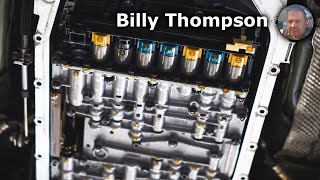
- Drop the transmission oil pan to gain access to the valve body and solenoids.
- Visually inspect the fluid in the pan for excessive metal shavings or debris. Fine grey clutch material is normal, but large metal chunks indicate a serious internal failure.
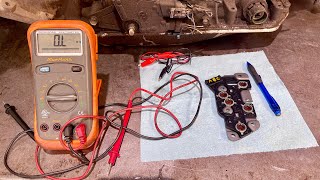
- Test the resistance of the suspect solenoid with a multimeter. For a 4L80-E, the reading should be between 20-30 ohms. Compare the reading to the 'A' solenoid; they should be nearly identical.
- If the solenoid tests bad, replace it. It is highly recommended to replace both the 'A' and 'B' shift solenoids (P/N 24230298 for 4L80-E) and the transmission filter at this time.
- If the solenoid tests good, carefully inspect the internal wiring harness for brittle or cracked insulation. Also, remove the solenoid and check if the 2-3 shift valve moves freely in its bore in the valve body.
Parts You'll Likely Need
- Shift Solenoid A/B Kit (for 4L80-E)
(OEM #24230298)— This is the component directly identified by the code. For the common 4L80-E, the 'A' and 'B' solenoids are identical and should be replaced as a pair.
Trusted brands: ACDelco, Delphi, Rostra
OEM price range: $40-$90
Aftermarket price range: $25-$60 - Transmission Filter Kit (with Gasket) — Must be replaced whenever the transmission pan is removed. A clogged filter can cause this code by restricting fluid flow.
Trusted brands: ACDelco, Wix, ATP
OEM price range: $30-$60
Aftermarket price range: $20-$40 - DEXRON-VI Automatic Transmission Fluid
Related Codes That Often Appear With This One
- P0751 — This code is for Shift Solenoid 'A'. Since the 'A' and 'B' solenoids in the 4L80-E are identical and work in tandem, a failure of one can sometimes be accompanied by a code for the other, often pointing to a widespread electrical or fluid pressure issue. [⭐ MANUFACTURER TSB — highest authority] Bulletin #PIP4379N
- P0732 — This code indicates 'Gear 2 Incorrect Ratio'. Since P0756 affects the 2-3 shift, a failure here can directly cause the computer to detect an incorrect ratio when 2nd gear is expected, linking the two codes. [⭐ MANUFACTURER TSB — highest authority] Bulletin #PIP4379N
- P0894 — This code means 'Transmission Component Slipping'. A malfunctioning shift solenoid can cause clutches to engage improperly, leading to slippage that the TCM detects. [⭐ MANUFACTURER TSB — highest authority] Bulletin #PIP4379N
- P0700 — This is a general transmission fault code, indicating that the Transmission Control Module (TCM) has stored a specific code (like P0756) and has requested the Check Engine Light to be turned on.
Technical Service Bulletins (TSBs) & Recalls
- PIP4379N: A general TSB listing numerous transmission codes (including P0756) that can be caused by various internal issues. It serves as a starting point for diagnostics rather than a specific fix.
- 01-07-30-038: While originally for P0757, this TSB addresses poor transmission performance and slipping by recommending cleaning the transmission valve body and case oil passages of debris, a procedure directly relevant to a mechanically stuck solenoid or valve causing P0756.
Mechanic-Grade Diagnostic Values
- 4L80-E Shift Solenoid 'A' or 'B' Resistance — expected: 20-30 Ohms. Failure: A reading of 0 Ohms (short) or infinite/OL (open circuit).
- Allison 1000 Shift Solenoid (SSC, SSD, SSE) Resistance — expected: 22-24.5 Ohms. Failure: Reading significantly outside the specified range.
- 4L80-E Transmission Connector Pinout (Solenoid B) — expected: Pin B is the control (ground) circuit for the 2-3 Shift Solenoid. Pin E is the +12V power feed for both shift solenoids.. Failure: No continuity to ground on Pin B from the TCM, or no +12V at Pin E with key on.
Scan Tool Commands That Help
- Tech2 / GDS2: Solenoid Test Mode / Transmission Output Controls — This allows a technician to command Shift Solenoid 'B' on and off while listening for an audible 'click' from the transmission pan. This can help confirm if the solenoid is mechanically responding to electrical commands before dropping the pan.
Wiring & Ground Locations
- G104 — Left rear of engine block on GMT800 gas engines.. This is a primary engine block ground. A poor connection here can cause a variety of electrical issues, including erratic sensor readings and module behavior that could mimic a transmission fault.
- G102 / G103 — Right side/front of engine block on GMT800 gas engines.. These are additional engine block grounds. The PCM/TCM and their sensors rely on solid engine and chassis grounds to function correctly. A bad ground can introduce voltage offsets and noise into the system.
- Transmission Internal Harness Connector — The main round electrical connector on the passenger side of the 4L80-E transmission case.. This connector is a known point of failure. The internal O-ring can leak, allowing transmission fluid to seep through the pins, contaminating the external connector and causing electrical faults like shorts or high resistance, which can trigger P0756. In some cases, the connector can be pushed into the case when trying to connect the external harness, which can be fixed with a special Sonnax bracket.
Real Owner Repair Stories
- GMTNation.com forum user (2005 GMC Envoy) — Sudden loss of power in first gear, sluggishness, Check Engine Light with code P0756.
❌ Tried (didn't work) Replaced both shift solenoids ('A' and 'B')., Changed transmission fluid and filter., Cleared code by disconnecting the battery.
✅ What actually fixed it The user later found success by removing and cleaning the valve body. This implies the issue was not the solenoid itself, but a valve sticking within the valve body, which is a common misdiagnosis. - PerformanceTrucks.net forum user (1995 4L80-E in a 1998 Sonoma) — Transmission fluid leaking from the main case connector, causing the transmission to go into limp mode.
❌ Tried (didn't work) Attempting to push the old connector back into place.
✅ What actually fixed it Replacing the internal transmission wiring harness, which includes a new pass-through connector and O-ring. Another user suggested adding Permatex "Ultra Black" sealant to the O-ring groove for a better seal.
When the Usual Fixes Don't Work
- In one documented case, a user with a P0756 code replaced the shift solenoids, but the problem persisted. The final fix was removing and thoroughly cleaning the valve body to free a sticking 2-3 shift valve. This highlights that the code points to a performance issue in the circuit, which can be caused by a mechanical restriction (stuck valve) just as easily as an electrical failure of the solenoid itself.
OEM Part Supersession History
10478131, 24236521→24230298— Part consolidation and design updates by GM.
Heads up: Part number 24230298 is the widely accepted replacement for both 'A' and 'B' shift solenoids on most 4L80-E transmissions within this year range.
Model Year Variations Within This Range
- 2007: 2007 was a transition year. The 'Classic' models were the outgoing GMT800 body style and typically used the 4L80-E transmission. The new body style GMT900 models were introduced, which could have the newer 6-speed 6L80/6L90 automatic. The solenoids, valve body, and diagnostic procedures are completely different between these transmissions.
Helpful Videos

We Have This Part in Stock



The information in this article is provided for general reference and educational purposes only. Vehicle specifications, procedures, and part compatibility can vary by production date, trim level, and region. Always consult your vehicle's factory service manual and verify part numbers before purchasing or performing repairs. Safety-critical components such as airbags, seat belts, and braking systems should be installed by a qualified professional.
- Gmc SIERRA 2500:
- 🎬 Helpful Videos
- 🛍️ Shop This Part
- What's Unique About the 2001-2008 Gmc SIERRA 2500
- Diagnostic Flowchart
- Symptoms You May Notice
- Most Likely Causes
- Rare But Worth Checking
- Diagnosis Steps
- Parts You'll Likely Need
- Related Codes That Often Appear With This One
- Technical Service Bulletins (TSBs) & Recalls
- Mechanic-Grade Diagnostic Values
- Scan Tool Commands That Help
- Wiring & Ground Locations
- Real Owner Repair Stories
- When the Usual Fixes Don't Work
- OEM Part Supersession History
- Model Year Variations Within This Range
- 🎟️ Get 5% Off