

P0741 on 2017-2018 Honda Odyssey: Torque Converter Clutch Failure Causes and Fixes
On 2017-2018 Honda Odysseys, P0741 almost always indicates a failing torque converter, often due to a cracked lock-up piston as cited in Honda's own Technical Service Bulletins. This is a major repair requiring transmission removal and torque converter replacement, costing between $1,000 and $2,500. For the 2017 model with the 6-speed automatic, Honda has extended the warranty to cover this specific failure.
- P0741 on a 2017-2018 Odyssey is very likely a failed torque converter, not just a sensor.
- Symptoms include a flashing 'D' light, Check Engine Light, and possible transmission overheating warnings.
- Owners of 2017 models should immediately check with a Honda dealer about the warranty extension (TSB A23-077) before paying for repairs.
- The repair is complex and expensive, requiring the removal of the transmission.
- Always start diagnosis by checking transmission fluid level and condition, as it's the simplest and cheapest first step.
What's Unique About the 2017-2018 Honda ODYSSEY

This two-year range covers a major generation change. The 2017 model (4th generation) uses a 6-speed automatic transmission, while the 2018 model (5th generation) uses either a 9-speed or a 10-speed automatic. Despite the different transmissions, the P0741 code is a known issue across this range. For the 2017 model's 6-speed AT, Honda has issued multiple Technical Service Bulletins (TSBs) pointing to a specific manufacturing defect: a crack in the torque converter's lock-up piston. This defect prevents the clutch from holding hydraulic pressure, making it the most likely cause of the code, rather than more common electronic or fluid issues seen on other vehicles. While the 9-speed and 10-speed transmissions in the 2018 models can also log P0741, the cracked piston issue is most thoroughly documented for the 6-speed.
Diagnostic Flowchart
Tap your situation to follow the diagnostic path that matches what you're seeing on this vehicle.
Generation note: The 2017 model year is the final year of the 4th generation Odyssey and is equipped with a 6-speed automatic transmission. This specific transmission is the primary subject of Honda's TSBs and warranty extension for P0741. The 2018 model year marks the beginning of the 5th generation, which uses a ZF-sourced 9-speed automatic on lower trims (LX, EX, EX-L) and a new Honda-developed 10-speed automatic on upper trims (Touring, Elite). While P0741 can occur on these newer transmissions, the well-documented cause of a cracked torque converter piston is specific to the 6-speed AT.
Symptoms You May Notice
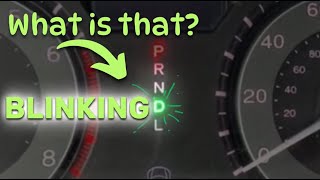
- Flashing 'D' (Drive) indicator light on the dashboard. 🎬 Watch: See what happens when the D light starts blinking.
- Check Engine Light (MIL) is illuminated.
- A 'Transmission System Problem' or 'Transmission Overheat' message may appear on the information display.
- Vehicle may shudder or vibrate, especially between 20 and 60 mph.
- Noticeable decrease in fuel economy.
- Sensation of the transmission slipping or engine RPMs being higher than usual at highway speeds.
- In some cases, a blind spot monitor warning light may appear simultaneously.
- Replacing only the TCC solenoid without addressing the root cause. On these Odysseys with the 6-speed AT, the mechanical failure of the torque converter itself is the overwhelmingly probable cause documented by Honda.
- Performing a transmission fluid change as a final fix. While good for maintenance, it will not repair the cracked lock-up piston inside the torque converter.
Most Likely Causes

- Cracked Torque Converter Lock-up Piston 🔴 High Probability Multiple Honda TSBs (including #A23-077 for the Odyssey) state that torque converters in the 6-speed automatic transmissions were not manufactured to proper specifications. This leads to a crack in the lock-up piston that prevents it from holding hydraulic pressure, causing the slip that triggers P0741.
How to confirm: Diagnosis is confirmed by a dealer verifying the presence of code P0741. Per the TSB, if the code is stored, the corrective action is to replace the torque converter. A technician can also use a scan tool to monitor TCC slip RPM; significant slip (over 50-60 RPM) when lock-up is commanded confirms the failure.
Typical fix: Replace the torque converter assembly with the updated part. Honda has extended the warranty for this specific issue on 2017 models with the 6AT to 8 years or 150,000 miles.
Est. part cost: $200-$700 - Low or Dirty Transmission Fluid 🟡 Medium Probability All automatic transmissions rely on clean fluid at the correct level for hydraulic pressure. While the cracked piston is more likely for P0741, poor fluid condition can cause or exacerbate transmission issues.
How to confirm: Check the transmission fluid level and condition. Fluid should be red and clear, not brown, black, or burnt-smelling. Honda TSBs note that checking fluid level must be done when the transmission is hot (over 176°F / 80°C), otherwise it will read artificially low.
Typical fix: Perform a transmission fluid drain-and-fill using Honda Genuine ATF DW-1. A full fluid flush may be necessary if the fluid is very contaminated. However, for the specific P0741 issue on the 2017 6AT, this is unlikely to be a permanent fix if the converter has failed.
Est. part cost: $50-$150 - Failed Torque Converter Clutch (TCC) Solenoid ⚪ Low Probability While less common than the converter failure on this platform, the solenoid is the electronic component that controls fluid flow to the TCC. It can fail electrically or become clogged with debris. On these specific models, the mechanical failure of the converter is far more probable.
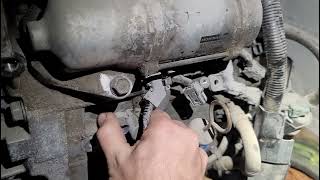
How to confirm: A technician can test the solenoid's resistance with a multimeter, which should be between 12-25 Ohms. A scan tool can also be used to command the solenoid on and off. On the 6-speed transmission, the TCC solenoid is located externally, underneath the starter, making it accessible for testing after removing the battery. 🎬 Watch: How to access and replace the 6-speed TCC solenoid.
Typical fix: Replace the faulty TCC solenoid. This is a much less intensive repair than the torque converter itself but should only be performed after confirming the solenoid is indeed the point of failure.
Est. part cost: $100-$250
Diagnosis Steps

- Use an OBD-II scanner to confirm P0741 is present. Crucial: If you see the 'Transmission System Problem' light, do not clear the code before visiting a dealer, as the stored P0741 code is required for warranty eligibility.
- Check for any applicable warranty extensions or recalls with a Honda dealer using your VIN. TSB #A23-077 specifically extends the warranty on the torque converter for 2017 Odysseys with the 6-speed automatic transmission.
- Check the transmission fluid level and condition when the transmission is fully warmed up (above 176°F / 80°C). Ensure the fluid is clean, at the correct level, and does not smell burnt.
- If the vehicle is out of warranty and the fluid is dirty, a drain-and-fill with Honda DW-1 ATF can be attempted, but it is unlikely to solve the problem if the cause is the known converter defect.
- If the fluid is fine and the code persists (and warranty is not an option), the next step is to test the TCC solenoid and its wiring harness for electrical faults. The solenoid is located under the starter on the 6AT. Test the solenoid's resistance; a reading outside of 12-25 Ohms indicates failure. 🎬 Watch: Understanding the causes and fixes for code P0741.
- If the solenoid and wiring test correctly, the cause is almost certainly an internal failure of the torque converter, as documented in the Honda TSBs.
- The final repair is to remove the transmission and replace the torque converter assembly with the updated part kit.
Parts You'll Likely Need

- Automatic Transmission Torque Converter Kit (6-Speed AT)
(OEM #06260-R9R-000 or updated 06260-R9R-010)— This is the primary failure point for code P0741 on the 2017 model, as documented by Honda TSB A23-077. The kit contains the revised torque converter that corrects the manufacturing defect.
Trusted brands: Honda OEM
OEM price range: $400-$700
Aftermarket price range: $200-$500 - Automatic Transmission Torque Converter Kit (10-Speed AT)
(OEM #06260-5B7-000)— For 2018+ models with the 10-speed transmission, this is the corresponding torque converter. While not subject to the same TSB as the 6-speed, it can still fail and cause P0741.
Trusted brands: Honda OEM
OEM price range: $500-$800 - Honda Genuine ATF DW-1 Automatic Transmission Fluid
(OEM #08200-9008)— The correct fluid is required when replacing the torque converter or performing a fluid service. TSB A23-077 specifies a quantity of ~4.8 quarts for the 6AT after a torque converter replacement.
Trusted brands: Honda OEM
OEM price range: $10-$15 per quart
Technical Service Bulletins (TSBs) & Recalls

- A23-077: Warranty Extension: 2017 Odyssey 6AT Torque Converter–DTC P0741 Stored. This is the key document for Odyssey owners, extending the warranty to 8 years/150,000 miles and confirming the cause is a cracked lock-up piston.
- A23-078: Warranty Extension: 2017–19 Multi-Model 6AT Torque Converter - DTC P0741 Stored. This TSB covers other affected Honda models like the Pilot and Ridgeline with the same 6-speed transmission issue, providing wider context for the defect.
- ABOM08312023901: Notes that P0741 is set due to pressure bleeding down through a crack in the lock-up piston.
- ONL6T806032025: States the reduced lock-up clutch capacity results in a flashing “D” indicator and sets DTC P0741.
- AEBM04182025901: Mentions that along with P0741, the “D” light flashes and a “Transmission Overheat” message may appear.
- 17-043 / 17-044: Discusses a judder from the torque converter on 2014-2017 models caused by deteriorated ATF, which could be a related or preceding symptom.
Platform-Specific Known Issues
- A known manufacturing defect can cause the torque converter lock-up piston to crack in the 6-speed automatic transmission, preventing the clutch from engaging and triggering code P0741.
- Honda issued TSB #A23-077, which extends the warranty on the torque converter for all 2017 Odysseys with the 6-speed automatic transmission to 8 years or 150,000 miles for this specific issue.
- An owner of a 2018 Odyssey filed a complaint with the NHTSA (ODI #11577225) reporting that the P0741 code and associated transmission problems occurred 7 times in 6 months, highlighting the persistent nature of the fault.
Mechanic-Grade Diagnostic Values
- Torque Converter Clutch (TCC) Solenoid Resistance — expected: 12 - 25 Ohms. Failure: A reading of 0 Ohms (short circuit) or infinite resistance (open circuit) indicates a failed solenoid.
- TCC Slip Speed (Live Scan Tool Data) — expected: Near 0 RPM when TCC is commanded ON at a steady cruise.. Failure: A consistent slip of more than 50-60 RPM when lock-up is commanded indicates the clutch is not holding.
- Transmission Fluid Level Check Temperature — expected: 176°F (80°C). Failure: Checking the fluid when cold will result in an artificially low reading. If fluid is filled to the top mark when cold, the transmission will be overfilled.
Scan Tool Commands That Help
- Honda Diagnostic System (HDS): Lockup Solenoid Test (in Miscellaneous Test Menu) — This command manually actuates the TCC solenoid. The technician listens for an audible 'click' to confirm the solenoid is mechanically responding to the electrical command. A lack of a click indicates a failed solenoid.
- Honda Diagnostic System (HDS): Live Data Monitoring (TCC Slip RPM) — This is the primary diagnostic step to confirm the mechanical failure of the torque converter clutch. While test driving, the technician monitors the slip RPM when the HDS shows the TCC is commanded to lock. If slip remains high (>50-60 RPM), it confirms the internal failure cited in TSBs.
Wiring & Ground Locations
- Torque Converter Clutch (TCC) Solenoid — On the 6-speed automatic transmission, the TCC solenoid is an external component located on the front of the transmission case, directly underneath the engine starter.. Its external location makes it accessible for electrical testing (resistance check) and replacement without removing the transmission, allowing it to be ruled out before condemning the torque converter.
- Transmission Ground Cable (G3) — General Honda diagrams show a primary transmission ground cable (often labeled G3) connecting the transmission case to the vehicle's chassis or subframe.. A poor ground connection can cause erratic behavior in transmission solenoids and sensors, potentially leading to incorrect codes. Verifying this ground is clean and tight is a fundamental step in any electrical diagnosis.
Real Owner Repair Stories
- YouTube channel 'Melnik Automotive' (2017 Honda Odyssey, 6-speed AT, 45,000 miles) — Flashing 'D' (Drive) light while cruising at highway speeds, no noticeable juddering or performance loss, stored code P0741.
❌ Tried (didn't work) The owner first checked the transmission fluid level and condition, which were perfectly fine.
✅ What actually fixed it The owner replaced the TCC solenoid, which is located under the starter. A test drive after the replacement showed the flashing 'D' light was gone and the issue was resolved.
"I Checked Everything" — The Actual Cause
- For code P0741, the equivalent of a 'smoke test clean' scenario is when the TCC solenoid passes all electrical tests (resistance is 12-25 Ohms, it clicks when 12V is applied) and the fluid is clean and full, yet the code persists. In this specific case for the 2017 Odyssey 6AT, the actual cause is almost certainly the internal, mechanical failure of the torque converter due to the cracked lock-up piston, as documented extensively in Honda's Technical Service Bulletins.
When the Usual Fixes Don't Work
- While Honda's official service bulletins for the 2017 6-speed AT point almost exclusively to a failed torque converter as the cause for P0741, at least one real-world repair case on a low-mileage (45k) 2017 Odyssey showed that replacing only the TCC solenoid was sufficient to fix the code and the flashing 'D' light symptom. This suggests that while the torque converter is the most probable cause under the warranty extension, a faulty solenoid should not be completely ruled out as a possible, and much cheaper, fix for vehicles outside of warranty.
OEM Part Supersession History
06260-R9R-000→06260-R9R-010— The original torque converter was prone to a manufacturing defect where the lock-up piston could crack, leading to a loss of hydraulic pressure and triggering code P0741. The updated part corrects this defect.
Model Year Variations Within This Range
- 2017 (6-Speed AT): This model is subject to Honda TSB #A23-077 and a warranty extension (8 years/150,000 miles) specifically for P0741 caused by a cracked torque converter piston. The diagnosis is straightforward: if P0741 is present, the TSB directs replacement of the torque converter.
- 2018 (9-Speed & 10-Speed AT): These models are not covered by the same TSB or warranty extension for a cracked piston. While P0741 can still occur, the cause is not assumed to be the same specific manufacturing defect. Diagnosis must be more thorough and may point to other issues like the valve body, solenoids, or different internal faults.
Helpful Videos

We Have This Part in Stock





The information in this article is provided for general reference and educational purposes only. Vehicle specifications, procedures, and part compatibility can vary by production date, trim level, and region. Always consult your vehicle's factory service manual and verify part numbers before purchasing or performing repairs. Safety-critical components such as airbags, seat belts, and braking systems should be installed by a qualified professional.
- Honda ODYSSEY:
- 🎬 Helpful Videos
- 🛍️ Shop This Part
- What's Unique About the 2017-2018 Honda ODYSSEY
- Diagnostic Flowchart
- Symptoms You May Notice
- Most Likely Causes
- Diagnosis Steps
- Parts You'll Likely Need
- Technical Service Bulletins (TSBs) & Recalls
- Platform-Specific Known Issues
- Mechanic-Grade Diagnostic Values
- Scan Tool Commands That Help
- Wiring & Ground Locations
- Real Owner Repair Stories
- "I Checked Everything" — The Actual Cause
- When the Usual Fixes Don't Work
- OEM Part Supersession History
- Model Year Variations Within This Range
- 🎟️ Get 5% Off