

P0734 on 2006-2010 GMC Sierra: Gear 4 Incorrect Ratio Causes and Fixes
P0734 on a 2006-2010 GMC Sierra indicates the transmission is slipping in 4th gear. The most common cause is low or dirty transmission fluid. If fluid is healthy, the issue is often a failing shift solenoid or, more seriously, internal wear. For 4L60-E models, this is typically the 3-4 clutch pack. For 6L80 models, it's often a failing torque converter clutch shedding debris that damages the system.
- P0734 means your truck's transmission is slipping in 4th gear.
- Always check the transmission fluid level and condition first; this is the simplest and most common fix.
- If the fluid is fine, the problem is likely a bad shift solenoid or a more serious internal mechanical failure.
- Driving with this code can lead to severe transmission damage, so it should be addressed promptly.
- Due to the complexity of transmission diagnostics and repair, professional service is highly recommended.
What's Unique About the 2006-2010 Gmc SIERRA
The 2006-2010 GMC Sierra spans two truck generations (GMT800 and GMT900) and primarily used two different automatic transmissions: the 4-speed 4L60-E/4L65-E and the 6-speed 6L80. While P0734 has the same meaning for both, the specific internal components that fail can differ. The 4L60-E family is notoriously weak in its 3-4 clutch pack, a very common cause for this code. The 6L80, a more complex transmission, is prone to torque converter lockup clutch failure, which contaminates the fluid with metallic debris, leading to valve body and solenoid issues that can also trigger a P0734 code.
Diagnostic Flowchart
Tap your situation to follow the diagnostic path that matches what you're seeing on this vehicle.
Generation note: This range covers the end of the first generation 'Classic' (GMT800, 2006) and the second generation (GMT900, 2007-2010). The 2006 models typically have the 4-speed 4L60-E/4L65-E. The 2007-2010 models could have the 4-speed 4L60-E/4L65-E/4L70-E or the newer 6-speed 6L80 transmission. The specific transmission must be identified to ensure correct diagnosis and parts, as their common failure points for P0734 are different.
Symptoms You May Notice
- Check Engine Light is on.
- Transmission fails to shift into 4th gear, or shifts with a long delay or flare.
- Engine RPMs are higher than usual at highway speeds.
- Transmission slips, hesitates, or makes harsh/clunking shifts, particularly around the 3-4 shift.
- A shuddering feeling, like driving over rumble strips, especially with the 6L80 transmission, indicating torque converter issues. 🎬 See this guide on identifying failing torque converter symptoms.
- Reduced fuel economy.
- Vehicle may enter "limp mode," getting stuck in a lower gear (often 3rd in the 4L60-E or 2nd in the 4L80-E).
- Replacing input or output speed sensors when they are functioning correctly. A gear ratio code is about the *result* of the sensor readings (slip), not necessarily the sensors themselves. 🎬 Watch: This video explains common causes for the P0734 code. However, a sensor tip covered in metal shavings is a clear clue to internal mechanical damage.
Most Likely Causes
- Low or Dirty Transmission Fluid 🔴 High Probability Leaks from pan gaskets, cooler lines, or seals can lead to low fluid levels over time. Fluid also degrades and collects clutch material and metal shavings, which can clog passages and solenoids, preventing proper hydraulic pressure.
How to confirm: Check the transmission fluid dipstick (if equipped) for level and condition. The fluid should be bright red and clear, not dark, brown, or smelling burnt. Finding significant metallic debris or clutch material in the fluid is a strong indicator of internal failure.
Typical fix: Top off the fluid if low and inspect for leaks. If the fluid is dirty or burnt, perform a transmission fluid and filter change. However, if significant debris is present, a simple fluid change will not fix the underlying mechanical damage.
Est. part cost: $50-$150 - Faulty Shift Solenoid 🟡 Medium Probability Solenoids are electronic actuators that control fluid flow to engage gears. They can fail electrically or become clogged with debris from normal wear or other failing components like the torque converter.
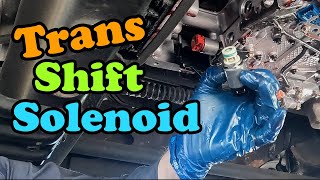
How to confirm: A professional scan tool can command the solenoid to activate and monitor its response. Resistance can also be checked with a multimeter (typically 20-40 Ohms for 4L60-E solenoids). This requires removing the transmission pan. 🎬 Watch: A helpful walkthrough for replacing a shift solenoid.
Typical fix: Replace the faulty shift solenoid. In the 4L60-E, the 2-3 shift solenoid (part of a pair) is involved. In the 6L80, solenoids are part of the TEHCM (solenoid body) inside the pan.
Est. part cost: $40-$100 for a single 4L60-E solenoid, $250-$500 for a 6L80 TEHCM/solenoid pack. - Internal Mechanical Failure (Worn 3-4 Clutch Pack) 🟡 Medium Probability On 4L60-E/4L65-E transmissions, the 3-4 clutch pack is a known weak point that wears out, causing slipping specifically in 3rd and 4th gear. This is one of the most common reasons for a P0734 on these models.
How to confirm: This is diagnosed after all external and electronic causes are ruled out. A transmission pressure test may show low pressure when 4th gear is commanded. The ultimate confirmation is finding burnt clutch material in the pan and visual inspection during a teardown.
Typical fix: The transmission must be removed and rebuilt, replacing the worn clutch packs, steels, seals, and any other damaged components. Upgraded clutch kits are available.
Est. part cost: $300-$800 for a rebuild kit - Faulty Valve Body or Torque Converter (6L80) 🟡 Medium Probability On 6L80 transmissions, the torque converter clutch is a frequent failure point. It sheds friction material that looks like 'coffee grounds' into the fluid, clogging the valve body, TEHCM passages, and solenoids, leading to pressure loss and gear ratio codes.
How to confirm: Symptoms include a shudder at highway speeds and finding excessive metallic debris in the pan. A pressure test can confirm hydraulic issues. Diagnosis often points to the torque converter after other causes are eliminated.
Typical fix: Requires replacing the torque converter and often rebuilding or replacing the transmission due to widespread contamination. Simply replacing solenoids or the valve body is often a temporary fix if the converter is the root cause.
Est. part cost: $250-$700 for a valve body, $400-$1200 for a quality torque converter.
Rare But Worth Checking
- Worn Stator Support Shaft Bushings (4L60-E): The bushings on the stator support shaft inside the transmission can wear out. This allows the input drum to wobble, creating a poor seal for the clutch apply rings and causing a pressure loss that leads to 3-4 clutch burn-up and a P0734 code.
- Faulty Transmission Control Module (TCM): While rare, the TCM (or TEHCM in the 6L80) can fail, causing incorrect commands or misinterpretation of sensor data. This is usually considered only after all other possibilities are exhausted.
- Wiring Harness Damage: The wiring harness to the transmission can be damaged by road debris, heat, or corrosion. More commonly, the internal harness can become brittle and fail, causing intermittent signals for sensors or solenoids. TSB 01-07-30-002E points to loss of voltage in the solenoid power supply circuit as a cause for multiple transmission codes and limp mode.
Diagnosis Steps
- Check the transmission fluid level and condition. If low, top it off and check for leaks. If dark, burnt-smelling, or full of metallic/clutch debris, internal failure is highly likely.
- Use a professional OBD-II scanner to check for other transmission-related codes, especially P0700 or P0741, which provide critical context.
- Perform a road test to confirm the symptoms. Note if the transmission slips, refuses to shift into 4th, or if a shudder is present at certain speeds.
- Inspect the transmission's external wiring harness and connectors for any visible damage, corrosion, or loose connections.
- Use a scan tool to monitor the input and output speed sensors in real-time to confirm the slippage is occurring when 4th gear is commanded.
- Perform a transmission line pressure test to check if hydraulic pressure is within spec. Low pressure in 4th gear points to an internal leak or worn components.
- Drop the transmission pan. Inspect the fluid and pan magnet for excessive metal debris ('coffee grounds' in a 6L80 or gray/black clutch material in a 4L60-E). This is a definitive sign of internal wear.
- With the pan off, test shift solenoid resistance and inspect the valve body for stuck valves or scoring.
- If the problem is still not found, the issue is almost certainly an internal mechanical failure (e.g., clutch packs, seals, stator support bushings), requiring transmission removal and teardown.
Parts You'll Likely Need
- Transmission Fluid and Filter Kit — This is the first and most common fix, required for low or dirty fluid conditions.
Trusted brands: ACDelco, Valvoline
OEM price range: $60-$120
Aftermarket price range: $40-$80 - Shift Solenoid (A/B or 1-2/2-3)
(OEM #24230298 (Commonly used for 4L60-E/6L80 Shift A/B))— A failed solenoid is a common electronic cause for a specific gear failure. For the 4L60-E, this involves the 1-2 and 2-3 shift solenoids.
Trusted brands: ACDelco, Bosch
OEM price range: $50-$100
Aftermarket price range: $30-$70 - Transmission Rebuild Kit (4L60-E)
(OEM #8654145 (Raybestos High-Energy 3-4 Clutch Friction Plate OEM #))— Required if the diagnosis points to internal mechanical failure, such as a worn 3-4 clutch pack in a 4L60-E. The kit should include frictions, steels, seals, and gaskets.
Trusted brands: Transtar, Raybestos, Precision International
Aftermarket price range: $300-$800 - Torque Converter (6L80) — A failing torque converter is a primary cause of P0734 on the 6L80. Replacing it with a quality billet-cover unit is highly recommended during a rebuild to prevent repeat failure.
Trusted brands: ACDelco, Circle D, Monster Transmission
OEM price range: $500-$900
Aftermarket price range: $400-$1200
Related Codes That Often Appear With This One
- P0731, P0732, P0733 — These codes indicate incorrect gear ratios for 1st, 2nd, and 3rd gears, respectively. Seeing them together with P0734 points to a more widespread transmission problem, such as critically low fluid, a major hydraulic issue, a failing torque converter, or TCM failure.
- P0700 — This is a general transmission fault code sent by the TCM to the main engine computer (ECM) to turn on the Check Engine Light. It simply indicates that a more specific transmission code, like P0734, is stored in the TCM.
- P0741 — This code means 'Torque Converter Clutch Circuit Performance or Stuck Off'. It is very common on 6L80 transmissions and is a strong indicator that the torque converter is failing. A failing TCC is a primary cause of fluid contamination that leads to other codes like P0734.
Technical Service Bulletins (TSBs) & Recalls
- PIP4379K: Mentions P0734 among a list of DTCs related to delayed or no transmission engagement, range inhibit, and other shift quality issues.
- 01-07-30-038E: Describes a 'no 3rd and 4th gear' condition on 4L60-E transmissions, directly related to the failure that causes P0734.
- 01-07-30-002E: Details how a loss of voltage to the transmission solenoid power supply circuit can cause multiple solenoid codes and force the transmission into a default gear (limp mode).
Platform-Specific Known Issues
- A GM Technical Service Bulletin (TSB #PIP4379K) mentions P0734 in a list of codes related to various transmission engagement and shifting problems, which could point to a range of internal hydraulic or mechanical issues. [Bulletin #PIP4379K]
- GM TSB #01-07-30-038E addresses conditions where no 3rd and 4th gear is available, which can set a P0734. The cause is often a worn 3-4 clutch pack, and the bulletin outlines diagnosis for this specific failure in the 4L60-E family.
- On 6L80-equipped trucks, a shudder between 35-55 mph is a classic sign of a failing torque converter lock-up clutch, which is a very common precursor to a P0734 code as debris contaminates the system.
Mechanic-Grade Diagnostic Values
- 4L60-E Shift Solenoid (1-2 and 2-3) Resistance — expected: 20-40 Ohms (most sources cite 20-30 Ohms as a tighter, more realistic range). Failure: A reading outside this range, or open/infinite resistance, indicates a failed solenoid coil.
- 6L80 Shift Solenoid (On/Off type) Resistance — expected: 20-40 Ohms. Failure: An incorrect resistance value means the solenoid has failed and the TEHCM needs replacement.
- 6L80 Pressure Control Solenoid (PWM type) Resistance — expected: 3-8 Ohms (most sources cite 5-6 Ohms). Failure: A reading outside this range points to a failed solenoid, requiring TEHCM replacement.
- 4L60-E Line Pressure at Idle (in Drive) — expected: Approximately 55-70 PSI. Failure: Significantly lower pressure indicates a worn pump, clogged filter, or internal leaks.
- 4L60-E Line Pressure at Wide Open Throttle (WOT) — expected: Minimum 190 PSI, optimum around 225 PSI. Failure: Low maximum pressure can indicate a weak EPC (Electronic Pressure Control) solenoid or a worn boost valve.
Scan Tool Commands That Help
- GM Tech2 / GDS2: Solenoid Cleaning Process — If a solenoid performance DTC is present or a solenoid is suspected of sticking due to debris, this automated function can be initiated. The scan tool cycles all solenoids to flush contaminants from the valves and circuits. If the code does not return after cleaning, it can prevent the unnecessary replacement of the TEHCM.
- GM Tech2 / GDS2: Solenoid Control / Output Control — This bidirectional function allows a technician to command specific shift solenoids on and off while the vehicle is stationary to verify electrical circuit integrity and listen for an audible click from the solenoid, helping to isolate a failed component without immediate disassembly.
Wiring & Ground Locations
- G103 — On the front of the passenger side (right) cylinder head.. This is a primary engine ground. A poor connection here can cause a host of electrical issues, including erratic sensor readings and improper operation of electronically controlled transmissions.
- G104 — On the rear of the driver's side (left) cylinder head, where a ground strap from the firewall attaches.. This ground strap is a critical link for the cab and its modules. Corrosion or looseness can lead to intermittent power and ground issues for the TCM, potentially causing incorrect commands or fault codes.
- Underhood Fuse Block (Main Harness Ground) — A ground wire from the main engine harness bolts to the chassis near the underhood fuse block.. This is reported by some technicians to be the main ground for the PCM/TCM. A loose or corroded connection here can cause a wide range of shifting problems and codes, including P0734.
Real Owner Repair Stories
- LS1Tech forum user (Chevrolet truck with 4L60-E) — After a rebuild for a burnt 3-4 clutch pack, the transmission would not shift into 3rd gear at all. Manually shifting to 3rd would cause the engine to rev as if in neutral.
❌ Tried (didn't work) A complete transmission rebuild with a new kit, solenoids, and other electrical components.
✅ What actually fixed it The user suspected an issue with the input drum where the 3-4 clutches sit, noting visible wear. The ultimate cause of repeat 3-4 clutch failure is often a leak in the input drum assembly (worn splines or a leak where the shaft is pressed in) or a leaking 3rd accumulator check ball in the case, both of which prevent proper hydraulic pressure from applying the clutch pack.
OEM Part Supersession History
24256524 (and others like 24241873, 24251029)→Varies by year, later numbers include 24256939, 24041956— GM has released numerous updates to the 6L80 TEHCM (Control Solenoid Valve Assembly) to address solenoid failures, board issues from heat, and performance complaints.
Heads up: TEHCMs are generally grouped by year ranges (e.g., 2007-2013) and must be programmed to the vehicle's VIN. Using a TEHCM from the wrong year group can result in communication errors or failure to operate, even if it physically fits.
Model Year Variations Within This Range
- 2007-2010 (6L80): Early 6L80 transmissions were more susceptible to torque converter clutch failure due to a combination of fluid type and higher operating temperatures from the transmission thermostat design. Later models and service bulletins recommended a new lower-temperature thermostat and updated fluid to improve longevity.
Helpful Videos

We Have This Part in Stock




The information in this article is provided for general reference and educational purposes only. Vehicle specifications, procedures, and part compatibility can vary by production date, trim level, and region. Always consult your vehicle's factory service manual and verify part numbers before purchasing or performing repairs. Safety-critical components such as airbags, seat belts, and braking systems should be installed by a qualified professional.
- Gmc SIERRA:
- 🎬 Helpful Videos
- 🛍️ Shop This Part
- What's Unique About the 2006-2010 Gmc SIERRA
- Diagnostic Flowchart
- Symptoms You May Notice
- Most Likely Causes
- Rare But Worth Checking
- Diagnosis Steps
- Parts You'll Likely Need
- Related Codes That Often Appear With This One
- Technical Service Bulletins (TSBs) & Recalls
- Platform-Specific Known Issues
- Mechanic-Grade Diagnostic Values
- Scan Tool Commands That Help
- Wiring & Ground Locations
- Real Owner Repair Stories
- OEM Part Supersession History
- Model Year Variations Within This Range
- 🎟️ Get 5% Off