

P0734 on 2019-2023 Ford Ranger: Gear 4 Incorrect Ratio Causes and Fixes
P0734 on a 2019-2023 Ford Ranger indicates an incorrect gear ratio in 4th gear, often due to an internal transmission issue with the CDF clutch drum. This is a known problem with the 10R80 transmission, addressed by Ford TSBs like 23-2123. The fix usually requires professional transmission repair involving the installation of an updated CDF drum assembly.
- P0734 on a 2019-2023 Ranger is a serious code that almost always points to an internal transmission problem.
- The most likely cause is a known defect with the CDF clutch drum, especially on trucks built before mid-August 2022.
- This is not a DIY-friendly repair. The transmission must be removed and either rebuilt with updated parts or replaced entirely.
- If your vehicle is under warranty, reference TSB 25-2134 when you take it to the dealer for diagnosis.
- Do not waste money on simple fixes like fluid changes or sensor replacements, as they will not solve the underlying mechanical failure.
What's Unique About the 2019-2023 Ford RANGER

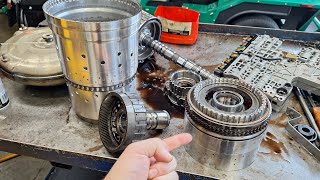
The 2019-2023 Ranger uses the Ford-GM 10R80 10-speed automatic transmission, which is known for a specific internal failure that directly causes this code. A sleeve inside a component called the CDF clutch cylinder can "walk" or move out of its intended position, blocking hydraulic fluid passages. This movement causes a loss of hydraulic pressure needed to engage the clutches for 4th gear (and often others), leading to slippage and the ratio error code. This is not just a generic fluid or solenoid issue; it's a well-documented mechanical design flaw in earlier versions of this transmission, leading Ford to issue multiple technical service bulletins and an updated part. Rangers built on or before August 15, 2022, are particularly susceptible 🎬 Watch: A breakdown of Ford's harsh shifting TSB and updates. to this failure.
Diagnostic Flowchart

Tap your situation to follow the diagnostic path that matches what you're seeing on this vehicle.
Symptoms You May Notice
- Check Engine Light is on
- Harsh, erratic, or delayed shifting, particularly into or out of 4th gear.
- Violent or banging shifts, especially when the transmission is cold.
- Transmission slipping.
- Jerky gear changes, especially between 3-4 and 5-6. [ODI #11673377]
- A long pause or delay when shifting from Park into Drive or Reverse.
- Occasional loss of forward drive, sometimes when pulling into traffic.
- Flashing overdrive or transmission warning light
- Vehicle entering "limp mode," limiting engine power and available gears.
- Decreased fuel economy.
- Burnt transmission fluid smell.
- Replacing only the speed sensors. While faulty sensors can cause shifting issues, with P0734 on this platform, the problem is almost always mechanical/hydraulic.
- Performing a transmission fluid flush without addressing the root cause. A flush will not fix a failed CDF drum and may be a waste of money if a rebuild is imminent.
- Replacing only the valve body. While the valve body can be affected by debris, it is often a symptom of the CDF drum failure. Replacing it without fixing the drum may lead to a recurrence of the problem.
Most Likely Causes

- CDF Clutch Cylinder Sleeve Failure 🔴 High Probability A known design issue in 10R80 transmissions built before mid-August 2022. The sleeve inside the CDF clutch drum can walk out of position, blocking hydraulic passages and causing pressure loss to the C, D, and F clutch packs. This is the most common root cause for P0734 and related ratio codes on this platform.
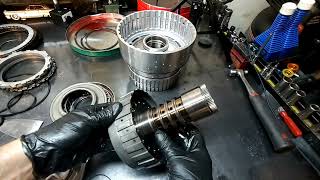
How to confirm: This requires a transmission teardown to visually inspect the CDF drum and sleeve. 🎬 See a full teardown showing the internal bushing failure. A technician can see if the sleeve has moved and is covering the fluid feed holes. Before disassembly, a technician may perform a pressure test on the clutch circuits to confirm internal leakage, as outlined in Ford's diagnostic procedures.
Typical fix: The transmission must be removed and disassembled. The original CDF drum is replaced with an updated part (JL3Z-7H351-B) that has a machined lip or retaining feature to prevent the sleeve from moving. Associated seals, gaskets, and any burnt clutches are also replaced as part of the rebuild.
Est. part cost: $150-$450 for the updated drum and associated parts. - Low or Burnt Transmission Fluid 🟡 Medium Probability While not specific to the Ranger, low fluid level reduces hydraulic pressure needed for clutch engagement, causing slipping and ratio errors. Burnt fluid is often a symptom of an underlying mechanical problem like the failing CDF drum causing clutch slippage.
How to confirm: Check the transmission fluid level and condition per the owner's manual procedure. The 10R80 does not have a traditional dipstick, so this must be done from under the vehicle with the engine running at a specific temperature. Fluid should be red and clear, not dark brown/black or smelling burnt.
Typical fix: Top off the fluid to the correct level using only Ford MERCON ULV fluid. If the fluid is burnt, a full transmission flush may be attempted, but this rarely fixes an underlying mechanical issue like a failed CDF drum and may only be a temporary solution. Any leaks must be repaired.
Est. part cost: $20-$30 per quart of MERCON ULV fluid. - Valve Body/Solenoid Failure ⚪ Low Probability Debris from a failing component (like the CDF drum) can contaminate the valve body, causing solenoids to stick or valves to malfunction. Some TSBs address valve body issues, but they are often secondary to the CDF drum failure.
How to confirm: A technician can use a high-end scan tool to command individual solenoids and monitor pressure. The valve body can be removed and inspected for debris or stuck valves. Some owners have had the valve body replaced only to have the problem return because the underlying CDF drum issue was not addressed.
Typical fix: Cleaning or replacing the entire valve body assembly. Solenoids can sometimes be replaced individually. This is often done in conjunction with the CDF drum replacement.
Est. part cost: $500-$1200 for a new valve body assembly.
Rare But Worth Checking
- Faulty Transmission Control Module (TCM): While possible, a faulty TCM is rarely the cause. All other mechanical and hydraulic possibilities should be exhausted before considering TCM replacement. Sometimes a PCM/TCM software update is attempted first, but it cannot fix the mechanical CDF drum flaw.
Diagnosis Steps
- Verify the code with a professional-grade OBD-II scanner.
- Check the transmission fluid level and condition. Note that this requires lifting the vehicle and following a specific procedure as there is no dipstick.
- Check for any available software updates for the Powertrain Control Module (PCM) or Transmission Control Module (TCM), though this is unlikely to be the final fix.
- Review Ford Technical Service Bulletins (TSB) like 23-2123 and 24-2046, which directly address this code and the underlying CDF drum issue.
- Perform hydraulic pressure tests on the transmission clutch circuits to check for internal leaks, specifically the CDF clutch circuit test.
- If pressure tests indicate a leak or if symptoms strongly align with the TSB, the transmission will need to be removed and disassembled for inspection.
- Inspect the CDF clutch drum for a migrated sleeve, which is the most probable cause.
- Inspect the valve body for debris and proper valve movement.
Parts You'll Likely Need

- CDF Clutch Cylinder Hub Assembly (Updated)
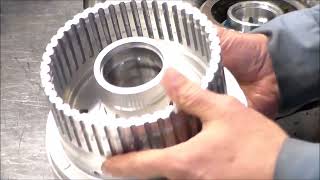
(OEM #JL3Z-7H351-B)— This is the updated part from Ford designed to fix the sleeve migration issue that causes P0734. It replaces the original, failure-prone drum and supersedes previous part numbers HL3Z-7H351-A 🎬 Watch: A close-up look at the updated CDF clutch drum. and JL3Z-7H351-A.
Trusted brands: Motorcraft
OEM price range: $140-$210
Aftermarket price range: N/A - Transmission Overhaul Gasket and Seal Kit — Required for any transmission rebuild to replace all necessary seals, O-rings, and gaskets during reassembly.
Trusted brands: Motorcraft
OEM price range: $200-$400
Aftermarket price range: $150-$250 - Ford MERCON ULV Automatic Transmission Fluid
(OEM #XT-12-QULV)— This is the only fluid specified for the 10R80 transmission. Using any other fluid can cause damage. A full refill requires approximately 13 quarts.
Trusted brands: Motorcraft
OEM price range: $20-$30 per quart
Aftermarket price range: N/A
Related Codes That Often Appear With This One
- P0733 — Incorrect Gear Ratio for 3rd Gear. This often appears with P0734 as the underlying CDF drum issue affects multiple clutch packs and hydraulic circuits. [ODI #11673377]
- P0729 — Incorrect Gear Ratio for 6th Gear. Like P0733, this points to a widespread hydraulic pressure issue within the transmission.
- P0735 — Incorrect Gear Ratio for 5th Gear. Another common companion code pointing to the same CDF drum failure.
- P0751, P0756, P0761, etc. — These are shift solenoid performance codes. They are often triggered as a consequence of the primary mechanical failure (CDF drum) and the resulting hydraulic problems.
Technical Service Bulletins (TSBs) & Recalls
- TSB 23-2123: Addresses harsh/delayed engagement and shifts, and a long list of DTCs including P0734, due to main control valve body issues or adaptive calibration incompatibility.
- TSB 24-2046: Supersedes earlier TSBs, identifying the cause of harsh/delayed shifts as the transmission solenoid ID strategy, sticking valves in the main control valve body, and/or axial movement of the CDF clutch cylinder sleeve.
- TSB 23-2134: A general TSB number that seems to be a typo in the original prompt, but related TSBs like 23-2123 and 22-2139 address the same core issue.
- TSB 25-2134: A future-dated TSB from the original prompt, likely a typo for one of the above. The summary correctly identifies the cause as axial movement of the CDF clutch cylinder sleeve.
Platform-Specific Known Issues
- TSB 23-2123 / 24-2046: Ford issued multiple bulletins for 2019-2023 Rangers (among other models) with the 10R80 transmission that exhibit harsh/delayed shifts and store codes like P0734. The bulletins identify the cause as axial movement of the CDF clutch cylinder sleeve causing hydraulic leaks and points to a repair involving replacement of this component.
- Owner Complaint ODI #11673377: A 2021 Ford Ranger owner reporte
Mechanic-Grade Diagnostic Values
- Shift Solenoid Resistance — expected: 5.0 - 5.4 Ohms at 68°F (20°C). Failure: Resistance outside of this range indicates a faulty solenoid coil.
- Transmission Fluid Temperature (TFT) Sensor Resistance — expected: Varies with temperature. Examples: 37k-16k Ohms (69°F-104°F), 2.7k-1.5k Ohms (195°F-230°F).. Failure: Readings that do not correlate with the temperature chart suggest a faulty sensor.
Scan Tool Commands That Help
- FORScan or Ford IDS: Clear Transmission Adaptive Tables — This function resets the transmission's learned shift, clutch fill, and pressure data. It should be performed after any transmission repair, such as replacing the valve body or CDF drum, to force the TCM to relearn control strategies.
- FORScan or Ford IDS: Adaptive Learning Drive Cycle — This is a specific, multi-step driving procedure that MUST be performed after clearing the adaptive tables. It allows the TCM to relearn clutch fill times and pressures for smooth shifting. Failure to perform this cycle can result in continued harsh shifts even after a mechanical repair.
- Ford IDS or capable J2534 device: PCM - Transmission Strategy Download / Transmission Characterization Update — When replacing the valve body or the entire transmission, the 13-digit Solenoid Body Strategy number from the new part must be programmed into the PCM/TCM. This ensures the control module uses the correct calibration for that specific set of solenoids. Failure to do this will cause shifting problems and may set other codes like P163E.
Wiring & Ground Locations
- C177 — Internal transmission connector at the main control valve body.. This is the main electrical interface for all solenoids and sensors within the transmission. A poor connection or corrosion here could theoretically cause solenoid control issues, though it is far less common than the mechanical CDF drum failure.
- Fuse 49 (BJB) — Battery Junction Box (underhood fuse box).. This 10A fuse provides power to the Transmission Control Module (TCM). While a blown fuse would likely cause a no-communication issue, intermittent power problems could lead to erratic behavior.
OEM Part Supersession History
HL3Z-7H351-A→JL3Z-7H351-A— Initial design was prone to sleeve migration. This was an early revision.JL3Z-7H351-A→JL3Z-7H351-B— Part JL3Z-7H351-B is the definitive updated design with an integrated retention lip to prevent the internal sleeve from 'walking' out of position, which was the root cause of the hydraulic leak leading to P0734.
Heads up: While the older parts will physically fit, they contain the original design flaw and should not be used for repairs. Only JL3Z-7H351-B should be installed.
Model Year Variations Within This Range
- 2019 - Mid-2022: Vehicles with a 10R80 transmission built on or before August 15, 2022, are susceptible to the CDF clutch cylinder sleeve movement. Ford TSB 22-2428 explicitly states this build date cutoff for when the manufacturing process was likely updated to include the revised part.
Helpful Videos
We Have This Part in Stock


The information in this article is provided for general reference and educational purposes only. Vehicle specifications, procedures, and part compatibility can vary by production date, trim level, and region. Always consult your vehicle's factory service manual and verify part numbers before purchasing or performing repairs. Safety-critical components such as airbags, seat belts, and braking systems should be installed by a qualified professional.
- Ford RANGER:
- 🎬 Helpful Videos
- 🛍️ Shop This Part
- What's Unique About the 2019-2023 Ford RANGER
- Diagnostic Flowchart
- Symptoms You May Notice
- Most Likely Causes
- Rare But Worth Checking
- Diagnosis Steps
- Parts You'll Likely Need
- Related Codes That Often Appear With This One
- Technical Service Bulletins (TSBs) & Recalls
- Platform-Specific Known Issues
- Mechanic-Grade Diagnostic Values
- Scan Tool Commands That Help
- Wiring & Ground Locations
- OEM Part Supersession History
- Model Year Variations Within This Range
- 🎟️ Get 5% Off