

P0734 on 2001-2005 Chevrolet Silverado: 4th Gear Incorrect Ratio Causes and Fixes
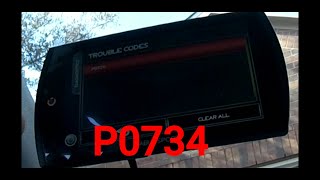
P0734 on a 2001-2005 Silverado means the transmission is slipping in 4th gear. The most common causes are low/dirty transmission fluid or a failing shift solenoid. However, it often points to a worn 3-4 clutch pack inside the 4L60-E transmission, a common failure requiring a rebuild.
- P0734 means your Silverado's transmission is slipping in 4th gear.
- Always check the transmission fluid level and condition first; it's the easiest and cheapest first step.
- On these trucks, this code frequently points to a worn-out 3-4 clutch pack in the 4L60-E transmission, which is a major repair.
- Replacing the shift solenoids is a possible fix if the problem is electronic, but it will not solve a mechanical slipping issue.
- Do not ignore this code. Continued driving can lead to complete transmission failure, leaving you stranded.
What's Unique About the 2001-2005 Chevrolet SILVERADO
The 2001-2005 Silverado primarily uses the 4L60-E automatic transmission (or the heavier-duty 4L80-E in 2500/3500 models). For the common 4L60-E, code P0734 is notoriously linked to the failure of the 3-4 clutch pack, which is the most common internal weak point of this transmission, especially after high mileage or heavy use. While solenoids can fail, this code on a GMT800 truck often foreshadows an internal mechanical problem that a simple fluid change won't fix.
Diagnostic Flowchart
Tap your situation to follow the diagnostic path that matches what you're seeing on this vehicle.
Symptoms You May Notice
- Check Engine Light is on.
- Transmission fails to shift into 4th gear.
- Delayed or harsh shifting into 4th gear.
- Engine RPMs flare up when shifting into 4th gear (slipping).
- Vehicle feels like it's in neutral when it should be in 3rd or 4th gear.
- Transmission may get stuck in a lower gear, causing poor fuel economy.
- Transmission may enter 'limp mode', limiting available gears to 1st, 2nd, and 3rd.
- Sudden downshift from a high gear to a lower gear at highway speeds.
- Replacing only the shift solenoid when the 3-4 clutch pack is actually worn out. A new solenoid cannot fix a mechanical slip.
- Assuming a fluid change will fix everything. If the fluid is burnt and full of clutch material, the damage is already done and a rebuild is necessary.
Most Likely Causes
- Low or Dirty Transmission Fluid 🔴 High Probability Leaks from the pan gasket, cooler lines, or seals are common on high-mileage trucks. Fluid breaks down over time, losing its hydraulic properties and collecting clutch material, which can clog passages.
How to confirm: Check the transmission fluid dipstick (engine running, in Park, on a level surface). The fluid should be at the correct level and bright red. If it's low, dark brown, or smells burnt, it indicates a problem.
Typical fix: If low, top off with DEXRON-VI fluid and check for leaks. If dirty or burnt, perform a transmission fluid and filter change. This may temporarily help but often won't fix underlying mechanical wear.
Est. part cost: $50-$150 - Failed 3-4 Clutch Pack 🔴 High Probability This is the most common major mechanical failure in the 4L60-E transmission. The seals on the 3-4 piston shrink or harden over time, causing a pressure loss that burns up the clutches. This is a well-documented weak point.
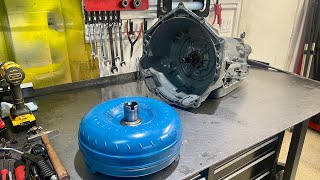
How to confirm: This is confirmed by dropping the transmission pan and finding excessive clutch material (looks like black sludge or grit). A transmission pressure test may also show low pressure during the 3-4 shift. Definitive diagnosis requires transmission disassembly. 🎬 See how to diagnose a transmission with no 3rd or 4th gear.
Typical fix: Requires a complete transmission rebuild or replacement of the transmission. During a rebuild, the 3-4 clutch pack, piston, and seals are replaced, often with upgraded components like high-energy frictions from Raybestos or Sonnax.
Est. part cost: $1500-$3500 - Faulty Shift Solenoid 🟡 Medium Probability The 1-2 and 2-3 shift solenoids (Solenoid A and B) are identical and can fail electronically or become clogged with debris, preventing them from directing fluid to engage 4th gear.
How to confirm: A professional scan tool can command the solenoid on and off to check its operation. The solenoid's resistance can also be tested with a multimeter after removing the transmission pan. It should be within 20-40 Ohms (typically 20-25 Ohms when good).
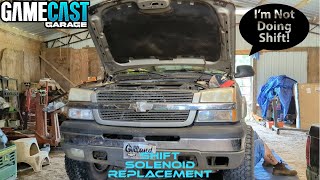
Typical fix: Replace the faulty shift solenoid. The 4L60-E uses two identical shift solenoids (A & B); it's often recommended to replace both while the pan is off. 🎬 Watch: Step-by-step guide to replacing your Silverado's shift solenoids.
Est. part cost: $30-$60 - Worn Valve Body or TCC Regulator Valve ⚪ Low Probability The bore for the TCC (Torque Converter Clutch) regulator valve in the valve body can wear out, causing pressure leaks that affect clutch holding power and can lead to slippage codes. Aftermarket solutions like Sonnax kits exist specifically to address this wear.
How to confirm: This is a complex diagnosis for a professional. It involves inspecting the valve body for wear after removal. Often diagnosed after other more common causes are ruled out. Vacuum testing the valve body can pinpoint leaks.
Typical fix: The valve body can be reamed and an oversized valve installed (e.g., Sonnax P/N 77701-07K), or the entire valve body can be replaced.
Est. part cost: $200-$500
Rare But Worth Checking
- Faulty Transmission Control Module (TCM): This is very rare. The TCM is generally reliable, and you should eliminate all other possibilities before considering replacing it.
- Damaged Internal Wiring Harness: The wiring inside the transmission can become brittle from heat and age, causing intermittent connections to the solenoids or sensors.
- Corroded Engine-to-Firewall Ground Strap: A missing or corroded main ground strap can cause voltage to seek a path through other components, leading to erratic sensor readings and transmission solenoid codes, including P0734, even when the transmission itself is mechanically sound.
Diagnosis Steps
- Check the transmission fluid level and condition. Ensure the engine is warm and running at idle in Park.
- If the fluid is low, top it off with DEXRON-VI and re-test. Check for visible leaks at the pan, cooler lines, and seals.
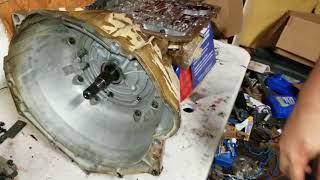
- If the fluid is dark or smells burnt, drop the transmission pan and inspect for metal shavings or clutch material. A significant amount of debris points to internal 🎬 Watch this teardown to see what a 3-4 clutch failure looks like. mechanical failure.
- If the pan is relatively clean, the issue could be electronic. Use a scan tool to monitor transmission input and output speed sensors while driving to confirm the slip in 4th gear.
- Test the shift solenoids. This can be done by commanding them with a bidirectional scan tool or by removing the pan and testing their resistance with a multimeter. The resistance should be between 20-40 ohms.
- If solenoids and fluid level are good, perform a transmission line pressure test. The pressure port is on the driver's side of the transmission case. At idle in Park, pressure should be around 55-75 PSI. At wide-open throttle (WOT) stall, it should rise to 170-190 PSI. Low pressure confirms an internal leak (e.g., from worn seals, a bad pump, or valve body wear).
- If all other tests are inconclusive, the issue may be within the valve body or require a full transmission teardown for inspection.
Parts You'll Likely Need
- Transmission Filter and Gasket Kit
(OEM #24208576 (Deep Pan Filter Kit))— Needed for a basic fluid and filter service, which is the first step in diagnosis.
Trusted brands: ACDelco, Wix, ATP
OEM price range: $30-$50
Aftermarket price range: $20-$40 - A/B Shift Solenoid (1-2 / 2-3)
(OEM #24230298)— A common electronic failure point that can cause this code. The 4L60-E uses two of these identical solenoids for 1-2 and 2-3 shifts; their operation is critical for achieving 4th gear.
Trusted brands: ACDelco, Delphi
OEM price range: $30-$40
Aftermarket price range: $15-$30 - Transmission Master Rebuild Kit — Required if the 3-4 clutch pack has failed. Kits typically include all necessary clutches, steels, seals, gaskets, and often an improved sun shell ('The Beast') and Corvette servo for better performance.
Trusted brands: Raybestos, Transtar, Alto, JEGS, Phoenix Transmission Parts
Aftermarket price range: $250-$500
Related Codes That Often Appear With This One
- P0731 — Incorrect Gear 1 Ratio. Often appears with other gear ratio codes when there is a systemic issue like low fluid or a major internal failure.
- P0732 — Incorrect Gear 2 Ratio. Indicates slipping in 2nd gear, pointing towards a broader transmission problem.
- P0733 — Incorrect Gear 3 Ratio. Indicates slipping in 3rd gear. Since the 3-4 clutch pack is involved in both gears, seeing P0733 and P0734 together strongly suggests this pack has failed.
- P0894 — Transmission Component Slipping. This is a more general code that often accompanies specific gear ratio codes like P0734.
- P0700 — Transmission Control System Malfunction. This is a general code indicating the TCM has detected a fault and requested the check engine light. It will always be present with other specific codes like P0734.
Technical Service Bulletins (TSBs) & Recalls
- PIP4379K: This Preliminary Information bulletin from GM addresses customer concerns of no or delayed engagement into drive or reverse and lists a wide range of DTCs, including P0734. It advises technicians to follow standard diagnostics for P0701 first and to ensure the transmission fluid level is correct before proceeding with further repairs.
Platform-Specific Known Issues
- The 3-4 clutch pack in the 4L60-E transmission is a well-documented weak point and the most likely cause of a P0734 code that isn't resolved by fluid or solenoids.
Mechanic-Grade Diagnostic Values
- 1-2 & 2-3 Shift Solenoid Resistance — expected: 20-40 Ohms at 68°F. Failure: A reading of 0 Ohms indicates a short; an infinite reading (OL) indicates an open circuit. Readings significantly outside the range suggest a failing coil.
- Pressure Control (PC) Solenoid Resistance — expected: 3.5-8.0 Ohms. Failure: A reading outside this range indicates a faulty solenoid.
- Line Pressure at Idle (in Park/Drive) — expected: 55-75 PSI. Failure: Pressure significantly below this range indicates a worn pump, clogged filter, or major internal leak.
- Line Pressure at WOT Stall (in Drive) — expected: 170-190 PSI. Failure: Failure to reach this pressure under load confirms a major hydraulic issue preventing clutches from applying properly.
- Input Speed Sensor (ISS) - (2005+ models) — expected: This is a Hall effect sensor and should not be tested for resistance. It should be monitored with a scan tool for a consistent signal or tested with an oscilloscope.. Failure: No signal, an erratic signal, or a signal that doesn't change with engine RPM indicates a faulty sensor or wiring issue.
Scan Tool Commands That Help
- Tech2 / GDS2 or equivalent: PC (Pressure Control) Solenoid Functional Test / Override — This command allows a technician to manually control the amperage sent to the PC solenoid while monitoring line pressure with a mechanical gauge. By comparing the commanded amps to the actual pressure readings against a chart, you can determine if the PC solenoid is responding correctly or if there is a hydraulic leak. Max line pressure is commanded at 0 amps, and minimum pressure at 1.1 amps.
Wiring & Ground Locations
- Input Speed Sensor (ISS) Wiring — On 2005 and later models so equipped, the ISS is internal. The wiring runs from the sensor near the pump assembly to the main transmission case connector.. The wiring for the ISS is known to chafe and short to ground on casting flash on the pump assembly. This can cause an erratic or lost signal, leading to incorrect ratio codes. The signal wire is circuit 1230, which goes to pin 'K' at the transmission connector and pin '3' at the TCM.
- PCM Connector C2 (Blue) — At the Powertrain Control Module (PCM) on the driver's side of the engine bay.. For ISS-equipped models, the ISS signal and low reference wires terminate here. For example, on a 2004 model, the ISS high signal is pin 22 (RD/BK wire) and the low signal is pin 23 (DK BLU/WH wire). Checking for continuity from these pins to the transmission connector can identify a broken wire in the harness.
Real Owner Repair Stories
- Transmission shop video (2017 Cadillac Escalade with 4L60-E (principles directly apply)) — No codes, but a soft 2-3 shift when cold that flared badly when hot, indicating a 3-4 clutch issue.
❌ Tried (didn't work) The transmission had been rebuilt 4 years prior. The initial assumption was a simple worn 3-4 clutch pack or hardened piston seals.
✅ What actually fixed it During re-disassembly, a pressure check of the input drum revealed a hairline crack. The drum was not holding pressure, causing the 3-4 clutch to lose apply force and burn up. Replacing the entire input drum resolved the issue. - YouTube user repair video (Chevrolet Truck with P0734) — Check engine light with code P0734, annoying shifting behavior.
❌ Tried (didn't work) The problem persisted for several weeks before diagnosis.
✅ What actually fixed it The owner replaced both the input and output speed sensors on the transmission. After replacement, the code did not return and the shifting problems were resolved.
"I Checked Everything" — The Actual Cause
- A standard pressure test might show acceptable line pressure at idle, but the P0734 code persists. The actual cause can be a worn valve body separator plate. Over time, the steel check balls hammer the plate, creating divots that allow hydraulic pressure in the 3-4 clutch circuit to leak into other channels. This cross-leak prevents full pressure from reaching the clutch pack, causing slippage under load, even though the pump and main seals are good.
OEM Part Supersession History
Various OE Separator Plates→TransGo 46-PLT-96— The aftermarket TransGo plate is made of tempered steel to resist wear from check balls and replaces over a dozen different GM part numbers for a wide range of years.
Heads up: This plate fits 1996-2006 models. Using the wrong year plate (e.g., a '95 plate on a 2002 truck) will cause fluid passage misalignment and immediate shifting problems.Standard Servo Pin→Sonnax 77787-02K— The Sonnax pin is extra long to simplify band clearance adjustment and is made of stronger chromoly steel. It also adds extra seals to prevent pressure leaks at the servo bore, a common wear point.
Model Year Variations Within This Range
- 2003-2005: In 2003, the Electronic Pressure Control (EPC) solenoid was changed from a 'blade type' to a style with the connector on its side. While they look different, their function and resistance specs are the same, and they are generally interchangeable if the correct internal harness is used.
- 2005: Some 2005 trucks were the first in this generation to be equipped with an Input Speed Sensor (ISS) located inside the transmission on the pump. A PCM that does not expect an ISS signal can use a transmission that has one (it will just ignore the sensor). However, a PCM from a vehicle that requires the ISS signal cannot use an older transmission without one.
- 2001-2005: The valve body separator plate gaskets changed. 2001-2004 models used one style, while 2005 introduced a small notch. The later gasket can be used on earlier valve bodies, but not always vice-versa. Using the wrong plate/gasket combination can block critical fluid passages.
Helpful Videos
We Have This Part in Stock


The information in this article is provided for general reference and educational purposes only. Vehicle specifications, procedures, and part compatibility can vary by production date, trim level, and region. Always consult your vehicle's factory service manual and verify part numbers before purchasing or performing repairs. Safety-critical components such as airbags, seat belts, and braking systems should be installed by a qualified professional.
- Chevrolet SILVERADO:
- 🎬 Helpful Videos
- 🛍️ Shop This Part
- What's Unique About the 2001-2005 Chevrolet SILVERADO
- Diagnostic Flowchart
- Symptoms You May Notice
- Most Likely Causes
- Rare But Worth Checking
- Diagnosis Steps
- Parts You'll Likely Need
- Related Codes That Often Appear With This One
- Technical Service Bulletins (TSBs) & Recalls
- Platform-Specific Known Issues
- Mechanic-Grade Diagnostic Values
- Scan Tool Commands That Help
- Wiring & Ground Locations
- Real Owner Repair Stories
- "I Checked Everything" — The Actual Cause
- OEM Part Supersession History
- Model Year Variations Within This Range
- 🎟️ Get 5% Off