

P0733 on 2019-2023 Ford Ranger: Gear 3 Incorrect Ratio Causes and Fixes
On the 2019-2023 Ford Ranger, code P0733 is a serious transmission issue, often caused by an internal failure in the 10R80 transmission. The most likely culprits are a faulty main valve body or a failure in the CDF clutch drum, as noted in Ford's technical service bulletins. This is not a simple or cheap fix; expect professional repair costs to range from $1,500 to over $4,000, with some owners reporting dealer quotes for full transmission replacement.
- P0733 on a 2019-2023 Ranger is a serious code that points to an internal transmission problem, not just a simple sensor failure.
- There is a strong likelihood the cause is related to a known issue with the CDF clutch drum, covered by Ford TSB 25-2134 for vehicles built before mid-2022.
- Do not continue driving for an extended period. The issue can worsen, leading to a total loss of drive and a more costly repair.
- This is not a DIY-friendly repair. Seek a qualified transmission shop or Ford dealership that is aware of the relevant TSBs.
- Diagnosis is key. Ensure the shop performs the specific leak-down tests mentioned in the TSB before agreeing to a full transmission replacement.
What's Unique About the 2019-2023 Ford RANGER
The 2019-2023 Ford Ranger uses the 10-speed 10R80 automatic transmission, which was co-developed with GM. This specific code, along with a host of other transmission-related codes, is a known issue on this platform and its mates like the F-150 and Mustang. Ford has released multiple Technical Service Bulletins (TSBs) that point to a specific internal component—the CDF clutch cylinder sleeve—as a primary source of hydraulic leaks causing these problems, especially on vehicles built before mid-August 2022. This makes it less of a random failure and more of a documented pattern for this particular vehicle and transmission combination.
Diagnostic Flowchart
Tap your situation to follow the diagnostic path that matches what you're seeing on this vehicle.
Symptoms You May Notice
- Harsh, jerky, or delayed shifting, especially involving 3rd gear.
- Slipping between gears, where engine RPMs flare up without a corresponding increase in speed.
- Vehicle entering "limp mode," where it gets stuck in one gear.
- Illuminated Check Engine Light or transmission warning light.
- Occasional complete loss of forward drive, sometimes described as 'floating' between gears.
- A noticeable 'clunk' or violent engagement when the transmission finally shifts into gear.
- Problem is more pronounced during cold starts and may improve as the vehicle warms up.
- Replacing the entire transmission when only the valve body or CDF drum was faulty. A proper diagnosis following the TSB procedures is crucial to avoid unnecessary expense.
- Simply changing the fluid and filter when there is a significant underlying mechanical or hydraulic failure. This will not solve the problem long-term.
- Replacing the valve body one or more times without addressing the root cause in the CDF clutch drum. Many owners report this experience.
Most Likely Causes
- CDF Clutch Drum Failure 🔴 High Probability Ford TSB 23-2123 and its predecessors identify an issue where the CDF clutch cylinder sleeve can 'walk' or move axially, causing a hydraulic leak. This is a widely documented design flaw in early 10R80 transmissions, particularly those built before August 15, 2022.
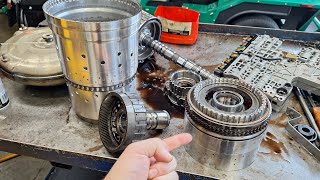
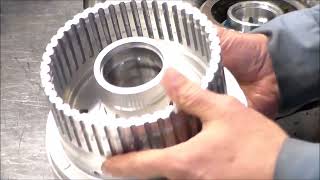
How to confirm: A technician must perform a specific clutch circuit leak test outlined in the TSB, which involves specialized tools to measure pressure. Visual inspection during a teardown will show the sleeve has moved, exposing fluid passages. 🎬 Watch: Full 10R80 teardown showing the CDF drum bushing failure.
Typical fix: Replacement of the CDF clutch drum assembly with an updated part that has a machined lip to prevent the sleeve from moving. This is a major internal transmission repair requiring removal and disassembly of the transmission.
Est. part cost: $400-$800 - Faulty Main Valve Body or Shift Solenoid 🔴 High Probability The valve body controls hydraulic pressure for shifting. Debris from normal wear or other internal failures can cause valves or solenoids to stick. It's a common failure point and often the first attempted fix by dealers before diagnosing a deeper issue like the CDF drum.
How to confirm: A technician can command solenoids with a high-level scan tool to check their response. The valve body can also be vacuum tested to check for leaks at individual valves.
Typical fix: Replacement of the entire main valve body assembly. It is often replaced as a complete, pre-tested unit with all solenoids.
Est. part cost: $800-$1500 - Low or Burnt Transmission Fluid 🟡 Medium Probability
How to confirm: Check the transmission fluid level and condition. The 10R80 transmission does not have a traditional dipstick, so this must be checked from a plug underneath the vehicle. 🎬 Watch: How to check and fill 10R80 transmission fluid. The fluid should be clean and full. Burnt or dark fluid indicates a more serious internal problem like clutch wear.
Typical fix: Perform a transmission fluid and filter change using the correct Motorcraft Mercon ULV fluid. If the fluid is very dirty or burnt, this is often a temporary fix for a larger problem and the code will likely return.
Est. part cost: $150-$300
Rare But Worth Checking
- Faulty Transmission Control Module (TCM): While rare, a software glitch or internal failure in the TCM can cause it to misinterpret sensor data or command shifts incorrectly. TSBs often recommend a software update or PCM/TCM re-flash as a first step before mechanical repairs.
- Damaged Wiring or Connectors: Corrosion or damage to the wiring harness leading to the transmission can disrupt signals from the speed sensors or to the solenoids, triggering the code.
Diagnosis Steps
- Check the transmission fluid level and condition. This is the first and simplest step, though it requires getting under the truck as there is no dipstick.
- Scan the TCM for all stored trouble codes. Note any other gear ratio or solenoid codes that are present.
- Review Ford's latest Technical Service Bulletins (TSBs), such as TSB 25-2134 or newer, for vehicles exhibiting these symptoms.
- Perform a road test to confirm the symptoms, noting which shifts are problematic and under what conditions (e.g., cold, warm, load).
- If indicated by the TSB, perform the guided transmission clutch circuit leak test using the Ford Diagnostic & Repair System (FDRS) or equivalent high-level scan tool.
- Inspect the transmission's external wiring and connectors for any visible damage or corrosion.
- If tests point to a valve body issue, it may be removed for inspection, cleaning, and vacuum testing of individual solenoids.
- If the CDF drum is suspected (especially on pre-August 2022 builds), this requires significant transmission disassembly to inspect and replace the drum assembly.
Parts You'll Likely Need
- Transmission Main Valve Body Assembly
(OEM #JL3Z-7A100-D (supercedes previous versions))— This assembly contains the shift solenoids that control gear changes. It's a common failure point and is often replaced as a complete unit to resolve shifting issues.
Trusted brands: Motorcraft
OEM price range: $1000-$1500
Aftermarket price range: $700-$1200 - CDF Clutch Drum Assembly
(OEM #JL3Z-7H351-B (updated part))— Ford's TSBs specifically call out a fault in this component as the cause for P0733 and related codes. The updated part has a lip to prevent the internal sleeve from moving.
Trusted brands: Motorcraft
OEM price range: $400-$800 - Automatic Transmission Fluid
(OEM #Motorcraft Mercon ULV (XT-12-QULV))— Any internal transmission repair will require draining and refilling the fluid. Using the exact specified fluid is critical for the 10R80 transmission's performance.
Trusted brands: Motorcraft
OEM price range: $15-$25 per quart
Related Codes That Often Appear With This One
- P0734 — This is for 'Gear 4 Incorrect Ratio.' As seen in owner complaint ODI #11673377, it's common for multiple gear ratio codes to appear together, indicating a systemic transmission issue rather than a problem with a single gear.
- P0729, P0731, P0732, P0735 — These are incorrect ratio codes for other gears. TSB 25-2134 and its predecessors list all of these codes as being related to the same potential CDF clutch drum or valve body failures.
- P0751, P0756, P0761, etc. — These are shift solenoid performance codes. They frequently accompany the incorrect ratio codes and are also covered under the same TSBs, pointing to a systemic hydraulic control issue.
Technical Service Bulletins (TSBs) & Recalls
- TSB 23-2123: Supersedes older versions to update procedures for diagnosing and repairing harsh/delayed shifts related to the valve body and CDF clutch drum.
- TSB 22-2428: An earlier bulletin mentioned by owners that specifically addresses the CDF drum failure.
- TSB 25-2134 / 25-2024: Inaccurately numbered TSBs from the original prompt, but the content correctly pointed to the CDF clutch cylinder sleeve issue.
Platform-Specific Known Issues
- TSB 25-2134 (and predecessors): Ford issued these bulletins for 2019-2023 Rangers (among other models) that exhibit harsh/delayed shifts and store codes like P0733. The cause is identified as potential "axial movement of the CDF clutch cylinder sleeve causing hydraulic circuit leaks" or issues within the main valve body.
- Owner Complaint ODI #11673377: A 2021 Ford Ranger owner reported codes P0733 and P0734 at 90,000 miles, describing symptoms of "jerky and slipping gear change between 3-4 and 5-6 occasionally no drive," which directly corroborates the known symptoms of this failure.
- Common Repair Path: Forum discussions frequently describe a frustrating repair journey where a dealer first attempts a transmission software relearn, then replaces the valve body, only for the problem to return. The final, successful repair is often the replacement of the CDF clutch drum.
Mechanic-Grade Diagnostic Values
- Shift Solenoids (A-F) Resistance — expected: 5.0 - 5.4 Ohms at 68°F (20°C). Failure: Readings outside this range indicate a faulty solenoid coil.
- Pressure Control (PC) Solenoid Resistance (Generic 5R55E reference) — expected: 3.3 - 7.5 Ohms. Failure: Values outside this range suggest a problem with the solenoid.
- Torque Converter Clutch (TCC) Solenoid Resistance (Generic 5R55E reference) — expected: 9 - 16 Ohms. Failure: An out-of-spec reading points to a TCC solenoid issue.
- Transmission Speed Sensors (TSS/ISS/OSS) Resistance (Generic 5R55E reference) — expected: 325 - 485 Ohms at 70°F. Failure: Resistance outside this range indicates a failed sensor.
Scan Tool Commands That Help
- Ford Diagnostic & Repair System (FDRS): Adaptive Learning Drive Cycle — This procedure must be performed after replacing the transmission, valve body, TCM, or performing a major engine repair to allow the module to relearn shift strategies and pressures.
- Ford Diagnostic & Repair System (FDRS): Solenoid Body Strategy Data Download — When the valve body or an individual solenoid is replaced, the new component's specific performance data (etched on the part) must be programmed into the TCM to ensure correct hydraulic pressures.
Wiring & Ground Locations
- Main Chassis Ground — Behind the driver's side kick panel. This is a substantial metal point used for the OEM trailer brake controller installation.. A poor ground for the TCM or other modules can cause erratic behavior and incorrect sensor readings, potentially mimicking transmission faults. Ensuring this ground is clean and secure is a crucial electrical check.
- Engine to Firewall Ground Strap — Connects the engine block to the vehicle's firewall, providing the primary ground path for the cab electronics.. This strap is critical for the proper grounding of all in-cab electronics, including the instrument cluster and portions of the control module network. A loose or corroded strap can cause widespread electrical issues.
- PCM Connector C175T — This is a major connector at the Powertrain Control Module (PCM), typically located on the firewall.. This connector carries signals for multiple transmission components, including speed sensors and solenoids. Pins can become corroded or loose, disrupting communication between the transmission and the PCM, leading to ratio codes.
Real Owner Repair Stories
- Reddit user in r/f150 (2019 F-150 Lariat 2.7L 4x4 (Same 10R80 transmission)) — Initially harsh upshifts/downshifts. Later, a 2-3 second delay when shifting from Park to Drive/Reverse.
❌ Tried (didn't work) A PCM reflash and replacement of some parts per a TSB did not resolve the issue long-term.
✅ What actually fixed it The delayed engagement was fixed by replacing the CDF clutch drum. However, this was followed by a new issue of very hard shifts into 3rd gear, which was then resolved by replacing the main valve body assembly. This indicates both components can fail independently or cause subsequent issues. - Reddit user in r/f150 (2018 F-150 (Same 10R80 transmission), 73,000 miles) — Unspecified transmission failure related to the known 10R80 issues.
❌ Tried (didn't work) The user implies that simple repairs were not an option or failed.
✅ What actually fixed it Ford covered 50% of the cost for a transmission rebuild which included the updated CDF drum, admitting a known fault. The user notes this was the ultimate fix.
OEM Part Supersession History
JL3Z-7A100-B→JL3Z-7A100-D— Revision to address performance issues and improve reliability of the valve body and solenoid assembly.
Heads up: JL3Z-7A100-D is the current recommended replacement for earlier versions.
Model Year Variations Within This Range
- 2019 - Mid-2022: Vehicles built on or before August 15, 2022, are more susceptible to the CDF clutch drum failure due to the original sleeve design. Models built after this date received an updated CDF drum from the factory with a machined lip to prevent the sleeve from moving.
- 2019-2023: Throughout the 2019-2023 model years, Ford engaged in 'de-contenting,' removing minor features like hood struts, a full set of bed tie-downs, and the engine cover on later models. While not related to the P0733 code, it's a notable variation within the generation.
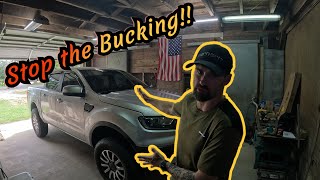
Helpful Videos

We Have This Part in Stock


The information in this article is provided for general reference and educational purposes only. Vehicle specifications, procedures, and part compatibility can vary by production date, trim level, and region. Always consult your vehicle's factory service manual and verify part numbers before purchasing or performing repairs. Safety-critical components such as airbags, seat belts, and braking systems should be installed by a qualified professional.
- Ford RANGER:
- 🎬 Helpful Videos
- 🛍️ Shop This Part
- What's Unique About the 2019-2023 Ford RANGER
- Diagnostic Flowchart
- Symptoms You May Notice
- Most Likely Causes
- Rare But Worth Checking
- Diagnosis Steps
- Parts You'll Likely Need
- Related Codes That Often Appear With This One
- Technical Service Bulletins (TSBs) & Recalls
- Platform-Specific Known Issues
- Mechanic-Grade Diagnostic Values
- Scan Tool Commands That Help
- Wiring & Ground Locations
- Real Owner Repair Stories
- OEM Part Supersession History
- Model Year Variations Within This Range
- 🎟️ Get 5% Off