

P0732 on 2006-2010 Chevrolet Silverado: 2nd Gear Incorrect Ratio Causes & Fixes
On a 2006-2010 Silverado, P0732 means the transmission is slipping in 2nd gear. The most common causes are low/dirty transmission fluid or a failing shift solenoid. A fluid and filter change may fix it for under $150, but internal repairs can range from a few hundred dollars for a solenoid to over $2,000 for a rebuild.
- P0732 indicates a serious issue: the transmission is slipping in 2nd gear.
- Always start diagnosis by checking the transmission fluid level and condition. Low or burnt fluid is a major clue.
- Common causes on the Silverado are low fluid, a bad shift solenoid, or worn internal components like the 2-4 band in the 4L60-E transmission.
- This is not a code to ignore. Driving with a slipping transmission can quickly lead to catastrophic failure, requiring a full replacement.
- Due to the complexity of internal transmission work, professional diagnosis and repair are strongly recommended.
What's Unique About the 2006-2010 Chevrolet SILVERADO
This generation of Silverado primarily used the 4-speed 4L60-E and later the 6-speed 6L80 automatic transmissions. The P0732 code is a very common issue on the widely-used 4L60-E, which is known for having weaknesses in its 2-4 band and the 1-2 accumulator pistons. Wear in the accumulator piston bore can cause hydraulic leaks leading to poor shift quality and eventually this code. While the first step is always to check the fluid, this code on a higher-mileage Silverado with a 4L60-E often points toward internal wear that requires more than just a simple fluid service to resolve. For the 6L80, while also susceptible to solenoid failure, internal issues could involve clutch packs.
Diagnostic Flowchart
Tap your situation to follow the diagnostic path that matches what you're seeing on this vehicle.
Generation note: This range covers the end of the 1st generation Silverado ('Classic' models in 2006 and early 2007) and the 2nd generation (GMT900, 2007-2010). The primary difference regarding this code is the transmission. Earlier models and V6/smaller V8s often have the 4-speed 4L60-E, while later models with larger engines (like the 6.0L or 6.2L) may have the 6-speed 6L80. Diagnostic steps are similar, but internal components and specific failure points differ. The 4L60-E is particularly known for 2-4 band and 1-2 accumulator issues causing P0732. The 4L60-E itself saw wiring harness changes during this period, moving from a 13-pin connector to a 15-pin in 2006 with the addition of an input speed sensor, and then to a 17-pin in 2009.
Symptoms You May Notice
- Check Engine Light is on.
- Delayed, harsh, or failed shifts into 2nd gear.
- Transmission slipping, where engine RPMs flare up without a corresponding increase in vehicle speed during the 1-2 shift.
- Vehicle feels like it has a loss of power, especially during acceleration from a stop.
- Increased fuel consumption due to inefficient power transfer.
- Transmission enters "limp mode," getting stuck in a single gear (usually 1st or 3rd).
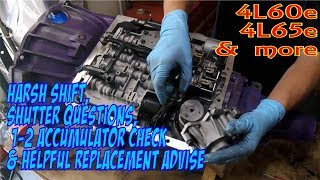
- A noticeable shudder or lurch when 🎬 See how to check and replace the 1-2 accumulator. the 1-2 shift occurs.
- Replacing the input or output speed sensors. While these sensors provide the data, they rarely fail in a way that causes an incorrect ratio code for only a single gear. A sensor failure typically produces its own specific trouble code (e.g., P0722).
- Replacing the entire transmission when only an inexpensive shift solenoid or a worn 1-2 accumulator piston has failed.
Most Likely Causes
- Low or Dirty Transmission Fluid 🔴 High Probability Leaks can develop over time from pan gaskets, cooler lines, or seals. Fluid breaks down with heat and mileage, losing its hydraulic properties. Dirty fluid can clog passages and solenoids, preventing proper pressure.
How to confirm: Check the transmission fluid dipstick (if equipped) for level and condition with the engine running and transmission warm. The fluid should be bright red and clear, not brown, black, or smelling burnt. Dark, burnt fluid with metal shavings is a sign of severe internal wear.
Typical fix: Perform a transmission fluid and filter change. If the fluid is very low, the source of the leak must be found and repaired.
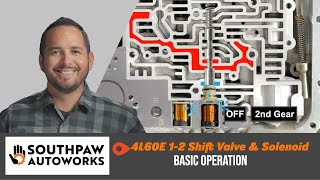
Est. part cost: $50-$150 - Faulty 1-2 Shift Solenoid (Solenoid 'A') 🟡 Medium Probability The 1-2 shift solenoid (often referred to as Solenoid 'A') in the 4L60-E is a very common failure item. It's an electronic component that can fail from heat cycles and constant use, getting stuck open or closed and preventing the correct hydraulic pressure from engaging 2nd gear.
How to confirm: A professional scan tool can command the solenoid on and off to test its function. Resistance can also be checked with a multimeter (should be 20-30 ohms) once the transmission pan is removed. A failed test confirms a bad solenoid.
Typical fix: Drop the transmission pan and replace the faulty shift solenoid. 🎬 Watch: Step-by-step guide to replacing all 4L60E shift solenoids. It is often recommended to replace both the 1-2 and 2-3 solenoids at the same time.
Est. part cost: $40-$100 - Internal Mechanical Failure (Worn 2-4 Band / 3-4 Clutch Pack) 🟡 Medium Probability The 4L60-E transmission is notoriously weak in the 2-4 band and 3-4 clutch pack. The 2-4 band is applied for 2nd gear, and when it wears out or breaks, it cannot hold the drum, causing a slip that triggers P0732. This is a very common high-mileage failure.
How to confirm: If fluid and solenoids are good, dropping the transmission pan and finding excessive clutch material (looks like black sludge or metal shavings) is a strong indicator. A transmission pressure test can also confirm internal leaks caused by worn components.
Typical fix: This requires a complete transmission rebuild to replace the worn friction components (bands and clutches), seals, and gaskets.
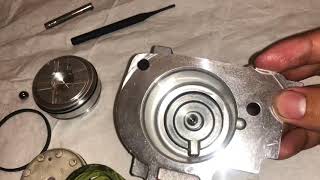
Est. part cost: $400-$1200 for a rebuild kit - Worn or Damaged 1-2 Accumulator ⚪ Low Probability The 4L60-E uses an accumulator to cushion the 1-2 shift. The piston is often plastic from the factory and can crack. The aluminum bore in the valve body where the piston rides can also wear out, causing a hydraulic leak. This leak prevents the 2-4 band from applying with sufficient pressure, causing a slip.
How to confirm: This is diagnosed by removing the valve body and inspecting the 1-2 accumulator piston for cracks and the bore for scoring or excessive wear. Wiggling the pin in the piston can reveal wear.
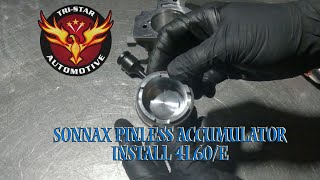
Typical fix: Replace the accumulator piston (upgraded pinless or aluminum pistons 🎬 Watch: How to install an upgraded pinless accumulator piston. are available) and potentially ream the valve body bore to install a sleeve if wear is severe.
Est. part cost: $20-$80 for a piston kit, $300-$800 for valve body repair/replacement
Rare But Worth Checking
- Faulty Transmission Control Module (TCM): While rare, a failing TCM can send incorrect signals or misinterpret sensor data, leading to the code. This is usually suspected only after all mechanical and hydraulic issues have been ruled out.
- Damaged Wiring Harness: A wire leading to a speed sensor or shift solenoid could be chafed, shorted, or have a corroded connector, causing an intermittent signal. TSB 08-07-30-021H points to issues with the main transmission harness connector causing various communication and shifting problems. A visual inspection of the harness is the first step.
Diagnosis Steps
- Check the transmission fluid level and condition. Top off or change if necessary.
- Use an OBD-II scanner to check for any other transmission-related codes, paying close attention to P0700, P0751, or P0894.
- With a professional scan tool, monitor the live data for the input and output speed sensors while driving to confirm the slippage in 2nd gear.
- Test the operation of the 1-2 shift solenoid using the scan tool's bi-directional controls. Listen for a click from the transmission pan.
- If external checks don't reveal the issue, drop the transmission oil pan. Inspect for metal shavings or clutch material, which indicates internal mechanical failure.
- With the pan off, check the resistance of the 1-2 shift solenoid with a multimeter (should be 20-30 ohms).
- Inspect the 1-2 accumulator piston and bore for wear or damage.
- Perform a transmission line pressure test to check for internal hydraulic leaks.
- If all other components test good, inspect the wiring harness and main connector for damage per TSB 08-07-30-021H, and test the TCM.
Parts You'll Likely Need
- Transmission Filter and Gasket Kit
(OEM #24208576 (For 4L60-E Deep Pan))— This is required for a basic fluid service, the first and most important diagnostic step.
Trusted brands: ACDelco, Wix, ATP
OEM price range: $40-$70
Aftermarket price range: $20-$40 - Automatic Transmission 1-2 Shift Solenoid
(OEM #24230298 (ACDelco, for 4L60-E/4L65-E))— A failed 1-2 solenoid is a primary electrical cause for this code, preventing the transmission from properly engaging 2nd gear.
Trusted brands: ACDelco, Bosch, Rostra
OEM price range: $50-$90
Aftermarket price range: $30-$60
Related Codes That Often Appear With This One
- P0700 — This is a generic code that simply means the TCM has stored a fault. It will almost always be present alongside a specific transmission code like P0732.
- P0751 — This code means 'Shift Solenoid A Performance/Stuck Off.' Since shift solenoid 'A' is the 1-2 shift solenoid, this code directly points to the likely electrical cause of the P0732 incorrect ratio.
- P0756 — This code means 'Shift Solenoid B Performance/Stuck Off.' This is the 2-3 shift solenoid. Seeing it with P0732 can indicate a wider electrical or hydraulic problem affecting multiple solenoids, like a wiring issue or contaminated fluid.
- P0894 — This code indicates 'Transmission Component Slipping.' It is a more general slip code that often appears with specific gear ratio codes like P0732 when the slip is significant enough for the TCM to detect.
Technical Service Bulletins (TSBs) & Recalls
- PIP4379K: Addresses a wide range of transmission engagement issues and lists P0732 as a possible diagnostic trouble code, pointing towards internal transmission diagnosis. [NHTSA]
- 08-07-30-021H: Details diagnosis and repair for loss of GMLAN communication due to issues in the transmission harness connector, which can cause shifting problems and codes.
- PIE0151: (Preliminary Information) Discusses how transfer case tone wheel or output shaft movement can cause erratic speed sensor signals, which may lead to ratio-related DTCs.
Platform-Specific Known Issues
- The provided Technical Service Bulletin (TSB) #PIP4379K mentions that P0732 can be one of many codes set due to various internal transmission issues, reinforcing that the cause is likely internal. [NHTSA]
- TSB #08-07-30-021H addresses intermittent communication issues from the main transmission connector, which can cause erratic shifting and various codes, including ratio errors.
- A Preliminary Information bulletin (PI) from GM notes that issues with the transfer case output shaft or tone wheel can cause erratic speed signals, potentially contributing to transmission ratio codes like P0732.
Mechanic-Grade Diagnostic Values
- 1-2 and 2-3 Shift Solenoid Resistance — expected: 20-40 Ohms (a more specific real-world range is 20-25 Ohms).. Failure: A reading of infinite resistance (open circuit) or near zero Ohms (short circuit).
- 4L60-E Line Pressure at Idle (in Drive) — expected: 55-65 PSI (minimum).. Failure: Significantly lower pressure indicates a potential pump issue, internal leak, or clogged filter.
- 4L60-E Line Pressure at Wide Open Throttle/Stall (in Drive) — expected: 170-190 PSI (maximum).. Failure: Failure to reach this pressure under load points to pump weakness, a worn pressure regulator/boost valve, or significant internal leaks.
Scan Tool Commands That Help
- Tech 1 / Tech 2: PCS Control Test — To manually command the Pressure Control Solenoid (PCS) current in 0.1 Amp increments while monitoring line pressure with a gauge. This verifies if the solenoid and hydraulic circuit respond correctly to computer commands.
Wiring & Ground Locations
- G101 — Located at the left front of the engine, on the lower block.. This ground point serves the Engine Control Module (ECM) and Transmission Control Module (TCM). A poor connection here can cause erratic behavior and false codes from both modules.
- G103 / G104 — Located on the rear of the driver's side cylinder head (G104) or on the cowl above the brake booster (G103).. These grounds are critical for the Body Control Module (BCM) and the main data link connector (DLC). A bad ground here can disrupt communication between the scan tool and the TCM, hindering diagnosis.
- Main Transmission Connector (C1/C7) — On the passenger side of the transmission case, it's a large, round, 13, 15, or 17-pin pass-through connector.. This is the single point of connection for all internal electronics. Pin A (PNK/BLK) and Pin B (PNK/RED) are for the 1-2 and 2-3 shift solenoids, respectively. Corrosion or pushed-out pins here are a common cause of electrical faults for P0732.
Real Owner Repair Stories
- SilveradoSierra.com forum user (2007 Silverado 1500 (New Body Style) with 4L60E, 130,000 miles) — P0732 code, transmission would not shift into 2nd gear, felt like it was starting in 3rd gear.
❌ Tried (didn't work) Replaced 1-2 shift solenoid., Replaced 2-3 shift solenoid., Replaced manifold pressure switch.
✅ What actually fixed it A full transmission rebuild was performed. The root cause was found to be a broken 2-4 band and a worn-out 1-2 accumulator. After replacing the band, all clutches, and the accumulator, the code was resolved and shifting returned to normal.
OEM Part Supersession History
10478112, 24227792→24230298— Consolidated part number for the 1-2 and 2-3 shift solenoid used across a wide range of GM 4L60-E applications.
Model Year Variations Within This Range
- 2006-2008: These years typically use a 4L60-E with a 15-pin main connector harness, which includes wiring for an Input Shaft Speed (ISS) sensor.
- 2009-2010: Models from 2009 onward may have a 4L60-E with a 17-pin main connector harness. This version incorporates an Internal Mode Switch (IMS) and removes the separate 3-2 downshift solenoid, changing the internal wiring and valve body configuration.
Helpful Videos

We Have This Part in Stock



The information in this article is provided for general reference and educational purposes only. Vehicle specifications, procedures, and part compatibility can vary by production date, trim level, and region. Always consult your vehicle's factory service manual and verify part numbers before purchasing or performing repairs. Safety-critical components such as airbags, seat belts, and braking systems should be installed by a qualified professional.
- Chevrolet SILVERADO:
- 🎬 Helpful Videos
- 🛍️ Shop This Part
- What's Unique About the 2006-2010 Chevrolet SILVERADO
- Diagnostic Flowchart
- Symptoms You May Notice
- Most Likely Causes
- Rare But Worth Checking
- Diagnosis Steps
- Parts You'll Likely Need
- Related Codes That Often Appear With This One
- Technical Service Bulletins (TSBs) & Recalls
- Platform-Specific Known Issues
- Mechanic-Grade Diagnostic Values
- Scan Tool Commands That Help
- Wiring & Ground Locations
- Real Owner Repair Stories
- OEM Part Supersession History
- Model Year Variations Within This Range
- 🎟️ Get 5% Off