

P0729 on 2011-2013 Chevrolet Silverado: 6th Gear Incorrect Ratio Causes and Fixes
On a 2011-2013 Silverado, P0729 indicates a 6th gear ratio error, most commonly caused by debris from a failing torque converter clogging the transmission's valve body separator plate, as cited in GM Technical Service Bulletins. This is a serious issue that can prevent the truck from moving and requires professional diagnosis and repair, often including torque converter replacement.
- P0729 on a 2011-2013 Silverado is a serious transmission code that should be addressed immediately.
- The most probable cause is not a faulty sensor, but a hydraulic blockage in the transmission's valve body, as documented by General Motors.
- The source of the blockage is often a failing torque converter, meaning both components may need service or replacement for a complete repair.
- This is not a recommended DIY repair; professional service is strongly advised due to the complexity.
- Always use DEXRON-VI specification fluid when servicing the transmission.
What's Unique About the 2011-2013 Chevrolet SILVERADO
The 2011-2013 Silverado, part of the GMT900 platform, commonly uses the 6L80 6-speed automatic transmission. This transmission is known for an issue where the torque converter lock-up clutch material delaminates and fails, sending metallic debris (often described as looking like 'coffee grounds' or 'glitter') throughout the transmission. This debris clogs small orifices in the valve body separator plate, leading to hydraulic pressure problems that prevent proper gear engagement. GM has issued Technical Service Bulletins (TSBs) PIP5100A and PIP5100 that directly link P0729 and other ratio codes to this specific internal blockage.
Diagnostic Flowchart
Tap your situation to follow the diagnostic path that matches what you're seeing on this vehicle.
Symptoms You May Notice
- Check Engine Light is on
- Vehicle will not move in forward or reverse (as noted in TSB PIP5100A)
- Transmission fails to shift into 6th gear
- Harsh or delayed shifting into 6th gear.
- Transmission slipping (engine RPMs increase but speed does not).
- Shuddering at highway speeds (35-55 mph) under light acceleration.
- Reduced fuel economy.
- Vehicle enters 'limp mode' (stuck in one gear).
- Replacing only the transmission speed sensors without inspecting the fluid or valve body. The sensors are rarely the root cause of this code on this platform.
- Replacing a single shift solenoid without cleaning the valve body or finding the source of debris that likely caused the solenoid to fail.
- Performing only a fluid and filter change when heavy contamination is present. This ignores the root cause (usually the torque converter) and the problem will quickly return.
Most Likely Causes
- Blocked Valve Body Separator Plate Orifices 🔴 High Probability This is a well-documented issue for the 6L80 transmission in these trucks, as confirmed by GM TSBs PIP5100A and PIP5100. Debris from a failing torque converter lock-up clutch is the primary culprit.
How to confirm: A technician must drop the transmission pan and inspect for excessive metallic debris, often described as 'glitter' or 'coffee grounds'. The valve body must then be removed to visually inspect the separator plate for clogged orifices.
Typical fix: The valve body must be disassembled and cleaned. Many technicians install an upgraded, more durable separator plate (e.g., from Sonnax or TransGo) to prevent future issues. 🎬 Watch: How to disassemble and clean your 6L80 valve body. This repair is incomplete without addressing the source of the debris.
Est. part cost: $50-$250 - Failing Torque Converter 🔴 High Probability The lock-up clutch within the stock 6L80 torque converter is a known weak point, prone to shedding its friction material. This failure is the root cause of the debris that leads to the P0729 code. Heat from towing or heavy loads can accelerate this failure. 🎬 Watch: See how the 6L80E torque converter fails internally.
How to confirm: Excessive metallic debris in the transmission pan is the strongest indicator. A technician can also perform a stall test or monitor torque converter slip data with a scan tool. A shudder felt during light acceleration at highway speeds is a classic symptom.
Typical fix: Replacement of the torque converter is essential for a long-term fix. This should be done along with a complete transmission fluid flush and cleaning/servicing of the valve body.
Est. part cost: $300-$800 - Low or Contaminated Transmission Fluid 🟡 Medium Probability
How to confirm: Check the transmission fluid dipstick (if equipped) or inspection plug. The fluid should be at the correct level, bright red, and not smell burnt. Dark, brown, or metallic-flecked fluid indicates contamination from internal component failure.
Typical fix: Perform a transmission fluid and filter change using only DEXRON-VI fluid. If the fluid is heavily contaminated, this is a symptom of a larger internal problem (like the torque converter) that must be addressed.
Est. part cost: $70-$200 - Failed Shift Solenoid ⚪ Low Probability
How to confirm: A professional scan tool can command individual solenoids to activate and monitor the response. Resistance can also be checked with a multimeter. However, on the 6L80, solenoids are often part of the integrated TEHCM (Transmission Electro-Hydraulic Control Module) and not serviced separately.
Typical fix: Replacement of the entire TEHCM/valve body assembly. Sometimes, aftermarket kits are available to address specific solenoid issues without replacing the whole unit.
Est. part cost: $50-$150
Rare But Worth Checking
- Transmission Control Module (TCM) Failure: While less common, an internal fault in the TCM (which is part of the TEHCM assembly inside the pan on a 6L80) can cause it to misinterpret sensor data and set a false code. This should be considered after all mechanical and hydraulic possibilities are ruled out.
- Wiring Harness Damage: Damage to the wiring between the TCM and the transmission's internal components (like speed sensors or solenoids) can corrupt signals and trigger the code. This is less common than internal mechanical failures for this specific code.
Diagnosis Steps
- Check the transmission fluid level and condition. If it is low, dark, or smells burnt, this indicates a problem.
- Scan the TCM for all stored trouble codes. Note if other gear ratio codes (P0731-P0735) or torque converter codes (P0741) are present, as this points to a systemic issue.
- Perform a thorough visual inspection of the transmission case, cooler lines, and wiring harness for leaks or damage.
- Drop the transmission pan and inspect for debris. A small amount of fine gray material is normal, but large metal shavings or glitter-like particles confirm internal failure, most likely from the torque converter.
- If significant debris is found, remove and inspect the valve body and separator plate for clogged orifices, per TSB PIP5100A.
- If the valve body is clogged, the torque converter is the most likely source of debris and should be inspected and likely replaced to prevent a repeat failure.
- If no debris is found, test the shift solenoids and internal wiring for proper resistance and function using a professional scan tool.
- Only after confirming the health of the transmission's mechanical and hydraulic systems should a faulty TCM be considered.
Parts You'll Likely Need
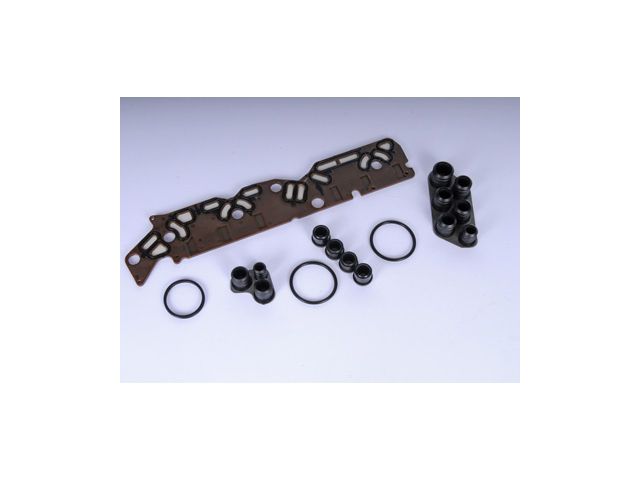
- Transmission Valve Body Separator Plate
(OEM #24248164 (Note: This is an older number, often superseded. Aftermarket is recommended))— This part contains small orifices that are prone to clogging from debris, which is the primary cause cited in GM service bulletins for this code. Upgraded aftermarket plates (e.g., Sonnax) are more durable.
Trusted brands: ACDelco, Sonnax, TransGo
OEM price range: $60-$120
Aftermarket price range: $40-$80 - Torque Converter — Often the source of the debris that clogs the valve body. Replacing it is critical to prevent the problem from reoccurring. Aftermarket billet converters offer improved durability.
Trusted brands: ACDelco, Luk, Valeo, Monster Transmission
OEM price range: $500-$900
Aftermarket price range: $250-$600 - Transmission Filter and Gasket Kit
(OEM #24236933 (Filter Kit Example))— This must be replaced any time the transmission pan is removed for service.
Trusted brands: ACDelco, Wix, ATP
OEM price range: $40-$70
Aftermarket price range: $20-$50 - DEXRON-VI Automatic Transmission Fluid
(OEM #10-9395 (ACDelco Part #))— This is the required fluid for the 6L80 transmission. Using any other fluid type can cause shifting problems and damage.
Trusted brands: ACDelco, Valvoline, Mobil 1
OEM price range: $8-$15 per quart
Aftermarket price range: $7-$12 per quart
Related Codes That Often Appear With This One
- P0731, P0732, P0733, P0734, P0735 — These are incorrect gear ratio codes for gears 1 through 5. When seen with P0729, it strongly indicates a systemic hydraulic issue like a clogged valve body or failing torque converter affecting all gears, as mentioned in TSB PIP5100A.
- P0741 — This code for 'Torque Converter Clutch (TCC) Circuit Performance or Stuck Off' often appears because a failing TCC is the source of the debris causing the P0729 code. It is a strong indicator that the torque converter needs replacement.
- P0701 — This is a general Transmission Control System Malfunction code that is often set as a companion to more specific DTCs like P0729.
Technical Service Bulletins (TSBs) & Recalls
- PIP5100A: Mentions that vehicles may not move and may set codes including P0729, advising technicians to inspect the valve body separator plate orifices for blockage.
- PIP5100: An earlier version of the same bulletin with similar information regarding no-move conditions and DTCs like P0729, pointing to debris in the valve body separator plate.
Platform-Specific Known Issues
- TSB #PIP5100A and #PIP5100 directly address P0729 (among other codes) on these trucks, pointing to debris in the valve body separator plate as the cause.
- A common owner experience involves finding a layer of fine, metallic 'glitter' in the bottom of the transmission pan, which is a tell-tale sign of torque converter clutch failure.
- Some owners on forums like silveradosierra.com report that after cleaning the valve body and replacing the torque converter, the issue is permanently resolved. A fluid flush alone is not sufficient.
Mechanic-Grade Diagnostic Values
- Shift Solenoid (On/Off type) Resistance — expected: 20-40 Ohms. Failure: A reading outside this range indicates a failed solenoid coil.
- Pressure Control & TCC Solenoid (PWM type) Resistance — expected: 3-8 Ohms (or 3.0-5.5 Ohms at 70°F). Failure: A reading outside this range indicates a failed solenoid coil.
- TEHCM Pressure Switch State — expected: Normally Closed (shows continuity with no pressure). Failure: The switch should read open circuit when pressure is applied (e.g., with a pencil eraser). If it remains closed under pressure or is always open, the switch or its diaphragm is faulty.
- Transmission Line Pressure at Idle (in gear) — expected: 45-80 psi. Failure: Pressure below this range can indicate pump wear, internal leaks, or a clogged filter.
- Speed Sensor Supply Voltage — expected: 8.3-9.3 Volts. Failure: Incorrect voltage from the TEHCM to the speed sensors can cause erratic readings.
Scan Tool Commands That Help
- GDS2 / Tech2: Solenoid Cleaning Procedure — This is an automated function that cycles all solenoids to try and flush out minor debris. It can be attempted if a solenoid performance code is suspected or as a last-ditch effort before disassembly, but it will not fix a clog from major torque converter failure.
- GDS2 / Tech2: Service Fast Learn Adapts — This procedure MUST be performed after replacing the TEHCM, valve body, or after any major internal transmission repair. It forces the TCM to relearn clutch apply volumes and shift timing. Failure to perform this can result in harsh shifting or persistent codes.
- GDS2 / Tech2: Command Solenoid ON/OFF — Used in conjunction with pressure gauges connected to the valve body test plate (DT47825) to verify if a specific solenoid is mechanically functioning and capable of controlling hydraulic pressure. This is an advanced diagnostic step to isolate a single faulty solenoid.
Wiring & Ground Locations
- T43 Main Transmission Connector — The large, round, 16-pin twist-lock connector on the passenger side of the transmission case.. This is the single point of connection for the entire internal TEHCM. A poor connection, corrosion, or damaged pins here can cause a loss of power, ground, or CAN bus communication, leading to multiple erratic codes, including P0729.
- TEHCM Main Connector Pin 5 (Ground) — Pin 5 of the 16-pin T43 round connector.. This is the main ground for the TEHCM. High resistance on this pin can cause the module to operate erratically, misread sensors, and set false codes. It's a critical point to check during electrical diagnosis.
- TEHCM Main Connector Pin 4 (Power) — Pin 4 of the 16-pin T43 round connector.. This pin supplies battery positive voltage to the TEHCM. Loss of power here will cause a total loss of transmission function and communication.
Real Owner Repair Stories
- RamForum.com user 'Redfin ss 272' (Note: Story is for a Ram but with a similar GM-sourced transmission issue) (2014 Ram 1500 5.7L Hemi) — Bad shift between 5th and 6th gear, code P0729.
❌ Tried (didn't work) Not specified, but the problem was persistent.
✅ What actually fixed it The dealership replaced the entire transmission and the torque converter under an extended warranty.
OEM Part Supersession History
24248164→24297102— Part number consolidation and potential design updates by GM.
Heads up: The original part number was for a transmission pan assembly, which may have included the separator plate in some contexts, but the numbers are often confused. The separator plate itself is best sourced from aftermarket suppliers like Sonnax or TransGo who offer improved designs over the original. The OEM part number 24248164 has been superseded by 24297102.
Model Year Variations Within This Range
- 2010-2013: While the core mechanicals of the 6L80 remained similar, the TEHCM (the internal control module) is VIN-specific. A TEHCM from a different year or even a different vehicle may not work unless it is reprogrammed by a dealer or a specialized shop using tools like GDS2. When sourcing a used transmission, it's often recommended to swap your original TEHCM into the donor transmission to avoid programming issues.
Helpful Videos
Used OEM Parts in Stock


New Aftermarket Parts Available


The information in this article is provided for general reference and educational purposes only. Vehicle specifications, procedures, and part compatibility can vary by production date, trim level, and region. Always consult your vehicle's factory service manual and verify part numbers before purchasing or performing repairs. Safety-critical components such as airbags, seat belts, and braking systems should be installed by a qualified professional.
- Chevrolet SILVERADO:
- 🎬 Helpful Videos
- 🛍️ Shop This Part
- What's Unique About the 2011-2013 Chevrolet SILVERADO
- Diagnostic Flowchart
- Symptoms You May Notice
- Most Likely Causes
- Rare But Worth Checking
- Diagnosis Steps
- Parts You'll Likely Need
- Related Codes That Often Appear With This One
- Technical Service Bulletins (TSBs) & Recalls
- Platform-Specific Known Issues
- Mechanic-Grade Diagnostic Values
- Scan Tool Commands That Help
- Wiring & Ground Locations
- Real Owner Repair Stories
- OEM Part Supersession History
- Model Year Variations Within This Range
- 🎟️ Get 5% Off