

P0716 on 2012-2018 Ford Focus 2.0L: Input Speed Sensor vs. TCM Failure Guide
On a 2012-2018 Ford Focus, code P0716 is most often caused by a failing Transmission Control Module (TCM), which is covered by a Ford warranty extension (Customer Satisfaction Program 14M02) to 10 years/150,000 miles. For vehicles outside this window, a one-time replacement was offered through June 30, 2025. Before replacing the much cheaper input speed sensor, check with a Ford dealer about warranty coverage for the TCM, as this is the most probable and historically costly part of the repair.
- For a 2012-2018 Focus, P0716 is very likely caused by a faulty Transmission Control Module (TCM), not just the sensor.
- **DO NOT pay for a repair** until you have contacted a Ford dealer with your VIN to check for coverage under the TCM warranty extension (Program 14M02).
- Symptoms like harsh shifting, shuddering, and loss of power are classic signs of the failing DPS6 transmission.
- This is not a DIY-friendly repair. Diagnosis is complex and replacing the TCM requires dealer-level programming tools.
What's Unique About the 2012-2018 Ford Focus

The 2012-2018 Ford Focus uses the DPS6 'PowerShift' dual-clutch automatic transmission, which is notoriously one of the most problematic gearboxes in modern automotive history, leading to class-action lawsuits and numerous TSBs. While P0716 points to an input speed sensor, the root cause on this specific vehicle is very frequently a faulty Transmission Control Module (TCM). The TCM's internal circuitry and solder joints are known to fail, causing it to misinterpret sensor data or lose communication entirely. Ford has acknowledged these issues by issuing multiple warranty extensions for the TCM, making it crucial for owners to investigate warranty coverage before paying for any repairs.
Symptoms You May Notice
- Harsh, erratic, or delayed gear shifts.
- Vehicle shuddering or vibrating on light acceleration, especially from a stop.
- Transmission getting stuck in one gear (limp mode).
- Flashing gear selector light (PRNDS) on the instrument cluster.
- Check Engine Light or Transmission Warning Light is on.
- Hesitation, loss of power, or complete failure to engage a gear.
- Inability to select Reverse. 🎬 Watch: A breakdown of common Powershift dual clutch TCM failure symptoms.
- Grinding or clicking noises from the transmission.
- Replacing the input speed sensor without first checking for TCM warranty coverage. Many owners pay for a sensor replacement only to find the true fault was the TCM, which may have been replaced for free by Ford.
- Replacing the TCM without checking for simple wiring issues or bad grounds first. A former Ford technician noted that cleaning the main body grounds sometimes resolved TCM-related symptoms.
Most Likely Causes

- Faulty Transmission Control Module (TCM) 🔴 High Probability The TCM on the DPS6 transmission has a well-documented high failure rate due to internal electrical circuit failures, specifically weak press-fit pin connections that fail from vibration. This led Ford to issue Customer Satisfaction Program 14M02, extending the warranty to 10 years/150,000 miles. A faulty TCM can misinterpret a perfectly good sensor signal, triggering the P0716 code.
How to confirm: A Ford dealer can check your VIN for eligibility under warranty extension 14M02. A professional scan tool (like FORScan) may show other TCM-specific codes like U0100 (Loss of Communication with TCM), U0101, P0606 (Control Module Processor), or P287A (Clutch Fork Stuck) alongside P0716, strongly pointing to the TCM. Poor ground connections are a known issue and should be cleaned before condemning the TCM.
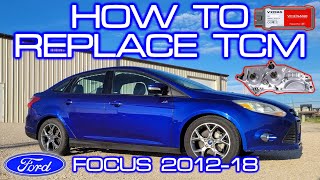
Typical fix: Replace the Transmission Control Module. This must be followed by programming the new module to the vehicle, which requires dealer-level tools (Ford IDS) or advanced functions in tools like FORScan. 🎬 See this walkthrough on replacing and programming a new TCM. An adaptive learning sequence must also be performed.
Est. part cost: $500-$1000+, but should be covered free of charge under Ford's warranty extension 14M02 if the vehicle is eligible. - Defective Input/Turbine Speed Sensor (TSS) 🟡 Medium Probability The sensor is a common failure point on many vehicles. It can fail electronically or its magnetic tip can become contaminated with metallic debris from normal transmission wear, disrupting the signal. The DPS6 has two such sensors, often referred to as TSS 'A' and 'B'.
How to confirm: After ruling out the TCM, a mechanic can test the sensor's signal with an oscilloscope for an erratic waveform. The sensor's internal resistance can also be checked with a multimeter; a typical reading should be between 500–1500 Ω at room temperature. The sensors are located on the exterior of the transmission housing, accessible after removing the battery and battery tray.
Typical fix: Remove and replace the input speed sensor. There are two speed sensors on the side of the transmission (one gray, one black connector); it is often recommended to replace both at the same time. The sensors may have shims of varying thickness depending on the model year, which must be correctly transferred or replaced.
Est. part cost: $40-$80 per sensor. - Wiring or Connector Issues ⚪ Low Probability The wiring harness leading to the transmission can be exposed to heat, vibration, and debris. Wires can chafe or break, and connector pins can corrode, causing an intermittent or out-of-range signal. A common chafe point is near the right-hand axle and where the harness routes near the transmission housing.
How to confirm: Visually inspect the harness for any signs of damage, especially where it routes near moving parts or hot exhaust components. Perform a continuity test on the signal wire (expect 0.5 Ω or lower) and check for stable voltage and ground at the sensor connector. Wiggling the harness while monitoring live data can expose intermittent faults.
Typical fix: Repair the damaged section of the wiring harness or clean/replace the faulty connector.
Est. part cost: $5-$50 for wiring supplies.
Rare But Worth Checking
- Internal Transmission Mechanical Failure: While less common for just a P0716 code, the DPS6 transmission is prone to clutch and seal failures. Leaking input shaft seals can contaminate the dry clutch assembly, and failing clutches or shift forks can create excessive debris that interferes with the speed sensors or cause other shifting faults.
Diagnosis Steps
- Check for Warranty Extensions: Before any diagnosis, contact a Ford dealership with your Vehicle Identification Number (VIN). Inquire about Customer Satisfaction Program 14M02 for the TCM and any other open recalls or programs related to the DPS6 transmission, such as 14M01 for the clutch assembly.
- Scan for All Trouble Codes: Use a high-quality OBD-II scanner (like FORScan for Fords) to read codes from all modules, not just the engine. Look for accompanying codes like P0715, U-codes, or other transmission-specific faults that point towards the TCM.
- Analyze Live Data: Monitor the Input Shaft Speed Sensor data while driving. An erratic or dropping signal that doesn't correlate with engine RPM points to a problem in the circuit. A healthy sensor should show a smooth, consistent signal that follows engine speed.
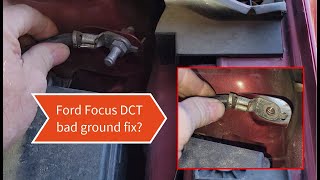
- Inspect Wiring and Grounds: Visually inspect the wiring harness going to the transmission speed sensors and the TCM. Look for any signs of chafing, melting, or corrosion on the connector pins. Pay close attention to the main body grounds located under the airbox, as they are a known weak point due to being installed over a painted surface. 🎬 Watch: How to clean the battery ground connection on your Focus.
- Test the Sensor (If TCM is Ruled Out): If the TCM is not at fault, disconnect the sensor and test its internal resistance with a multimeter. Compare the reading to the specification of 500-1500 Ω. An oscilloscope is the best tool to verify a clean signal pattern.
- Diagnose the TCM: If wiring and the sensor test okay, the fault is almost certainly the TCM. This is the most probable scenario for this vehicle and is often confirmed by the presence of other communication or processor fault codes.
Parts You'll Likely Need
- Transmission Control Module (TCM)
(OEM #AE8Z-7Z369-F (supersedes previous versions like -D, -E))— This is the most common point of failure on the DPS6 transmission and is directly responsible for a host of electronic faults, including P0716.
Trusted brands: Motorcraft
OEM price range: $700-$1000 (but often covered by warranty program 14M02)
Aftermarket price range: $400-$600 (remanufactured) - Automatic Transmission Input Shaft Speed Sensor
(OEM #AE8P-7M101-AA (Sensor 'A', Grey Connector) or AE8P-7M101-BA (Sensor 'B', Black Connector))— If the TCM is confirmed to be good, the sensor itself is the next most likely part to have failed. There are two sensors, and it's often wise to replace both.
Trusted brands: Motorcraft, Standard Motor Products (SC630)
OEM price range: $50-$95
Aftermarket price range: $30-$70
Related Codes That Often Appear With This One
- P0715 — This code indicates 'Input/Turbine Speed Sensor 'A' Circuit Malfunction,' meaning a total loss of signal, which can be caused by the same failing components (TCM, sensor, wiring).
- P07A3 / P07A4 / P07A5 — These codes relate to the clutch forks being stuck or having performance issues. Their presence often points to a failing TCM, a seized clutch actuator, or a binding clutch fork, all common DPS6 issues.
- U0100 / U0101 / P0606 — These codes indicate a loss of communication with the ECM/TCM or an internal processor fault. Their presence strongly points to a failing TCM as the root cause of all electronic transmission issues.
Technical Service Bulletins (TSBs) & Recalls
- 14M02 - Customer Satisfaction Program: Transmission Control Module Extended Warranty Coverage (10 years/150,000 miles).
- 14M01 - Customer Satisfaction Program: DPS6 Transmission Clutch Shudder / Input Shaft Seal Leak Extended Warranty (7 years/100,000 miles).
- TSB 16-0109 - Supersedes 15-0120. Addresses excessive clutch shudder and/or fluid leaks from the clutch housing, providing diagnostic and repair procedures for replacing the clutch and input shaft seals.
- TSB 16-0129 - Addresses 'No Start' and/or loss of power with DTCs U0100, U0101, U1013, and/or P0606, pointing directly to TCM failure.
Platform-Specific Known Issues
- TCM Warranty Extension (14M02): Ford extended the warranty on the DPS6 Transmission Control Module to 10 years or 150,000 miles. For vehicles that exceeded this, a one-time replacement was offered through June 30, 2025, making it critical to check with a dealer first.
- Poor Grounding Design: A widely documented issue is the main transmission and TCM ground points being bolted to painted surfaces under the airbox, leading to poor electrical connections over time. Cleaning these grounds to bare metal is a common, low-cost fix that can resolve intermittent TCM-related codes.
- Input Sensor Shims: The input speed sensors use shims of varying thickness. These shims changed between model year groups (2012-2014 vs. 2015-2018) and must be correctly reinstalled or replaced to ensure the proper air gap for the sensor to read correctly.
Mechanic-Grade Diagnostic Values
- Input/Turbine Speed Sensor (TSS) internal resistance — expected: 500 - 1500 Ω (Ohms) at room temperature.. Failure: A reading outside this range (open or shorted) indicates a failed sensor.
- Voltage reference at the sensor connector — expected: Approximately 5.0V DC (for Hall-effect type sensors).. Failure: Voltage significantly lower than 5V, unstable voltage, or no voltage points to a wiring or TCM issue, not a sensor failure.
- Continuity of sensor signal wire to TCM — expected: 0.5 Ω or lower.. Failure: Higher resistance indicates corrosion or a break in the wire.
Scan Tool Commands That Help

- FORScan: TCM Adaptive Learning / Perform Transmission Adaptive Learning — This service procedure is required after replacing the TCM or the clutch assembly. It performs a series of automated tests to learn the clutch engagement points and shift fork positions.
- FORScan: Reset All Adaptations — Used to clear the learned values stored in the TCM. This can be a first step in addressing harsh shifting complaints before performing a full adaptive learn, forcing the module to re-learn driving habits and clutch behavior.
- Ford IDS (Integrated Diagnostic System): Module Programming — This dealer-level function is required to install and program a new TCM. It flashes the module with the correct vehicle-specific calibration and links it to the car's VIN and other modules.
Wiring & Ground Locations

- Main Body Grounds — Located under the air filter box in the engine bay. There are typically two ground wires bolted directly to the painted chassis.. These are the primary ground points for the TCM. Because they are bolted over paint, they develop high resistance over time, causing a host of intermittent electrical issues, including communication codes and incorrect sensor readings like P0716. Cleaning the paint off to create a bare-metal connection is a critical diagnostic step.
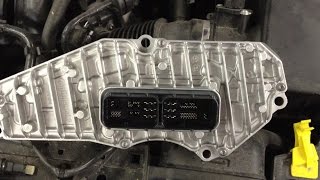
- TCM Main Connector (C1750B) — The large, multi-pin connector that plugs into the Transmission Control Module, which is mounted on the side of the transmission case, accessible from the driver's side wheel well.. This is the central connection point for all transmission sensors and actuators. The input speed sensor signal wire runs through this connector. Checking for corrosion, pushed-out pins, or damage here is essential when diagnosing a circuit code.
- Input Speed Sensor Connectors — On the side of the transmission, visible after removing the battery and battery tray. Sensor 'A' (TSS-A) has a grey connector and is below Sensor 'B' (TSS-B), which has a black connector.. These are the direct connection points for the sensors. The wiring harness is known to chafe in this area, so inspecting the wires leading to these connectors is crucial.
Real Owner Repair Stories
- Reddit user /r/FordFocus (2017 Ford Focus 2.0L, 113k miles) — Initial codes P0715, P0716, P0722 (input speed sensor codes) and P02700 (clutch performance). Erratic RPMs and shifting all over the place.
❌ Tried (didn't work) Replaced TCM with a used eBay unit and programmed it with IDS. This did not fix the erratic shifting., Replaced the entire clutch assembly, throwout bearing, and both shift forks with new OEM parts.
✅ What actually fixed it After replacing the clutch components, the user replaced the used eBay TCM with a brand new OEM Ford TCM under the 14M02 warranty program. After programming the new OEM TCM and performing the adaptive learning, the car drove great for 10-15 miles before developing extremely harsh shifts under constant throttle. The final resolution was not posted, but the story highlights that even with new parts, a used TCM can be faulty and that adaptive learning is critical but may not immediately solve all drivability issues. - YouTube user 'Mike Potts' (2012 Ford Focus) — Transmission randomly going into 'limp mode' with a 'Transmission Failure Service Now' message. Erratic behavior like shifting to neutral or skipping gears (e.g., only using 1st, 3rd, 5th).
❌ Tried (didn't work) The user ordered a new TCM, anticipating it was the problem.
✅ What actually fixed it Before installing the new TCM, the user performed the 'ground mod'. This involved removing the airbox, locating the three main ground points (one near the battery, two under the airbox), grinding the paint away from the contact points to expose bare metal, and re-securing the ground wires. This simple procedure is intended to fix the poor grounding design and resolve the intermittent electrical faults plaguing the TCM. The video concludes after the mod, with the test drive outcome pending, but it is presented as a primary, low-cost fix to try before TCM replacement.
OEM Part Supersession History
AE8Z-7Z369-A, -B, -C, -D, -E→AE8Z-7Z369-F— The original TCM design used press-fit pin connections for critical internal components. These connections would fail due to engine and transmission vibration, causing a loss of communication and erratic behavior. The updated/remanufactured modules often feature soldered connections for improved durability.
Heads up: While all versions are physically interchangeable, later software calibrations are required for later model year vehicles. A former Ford technician recommends looking for a used TCM with a 'K05' hardware designator, as these are the latest and most reliable versions.
Model Year Variations Within This Range
- 2012-2014 vs 2015-2018: The input shaft speed sensors on 2012-2014 models use thicker shims (e.g., 3.5mm and 3.2mm) compared to 2015-2018 models (e.g., 2.0mm and 1.5mm). The TCM calibration is different between these two groups to account for this. Using the wrong TCM calibration for the installed transmission hardware can cause shifting issues.
Diagnostic Flowchart
Other Known Issues on This Vehicle
Issues unrelated to this code that are worth knowing about as an owner of this generation:
- Canister Purge Valve (CPV) Failure 🟠 Medium — Very common. Can occur at any mileage. Leads to rough idle, stalling after refueling, and difficulty starting. (Ref: NHTSA Recall 18V735 (Ford 18S32))
- Passenger-Side Engine Mount Collapse 🟠 Medium — Common failure, typically after 60,000 miles. The hydraulic mount leaks and collapses, causing excessive engine vibration to be felt in the cabin, especially at idle.
- Electric Power Steering Rack Failure 🔴 High — Less common but very serious. Can fail suddenly, causing a complete loss of power steering assist and a 'Steering Assist Fault' message. (Ref: Some early models had recalls, but failures persist across the generation.)
- Heater Hose O-Ring Leaks 🟡 Low — A common source of coolant leaks. The O-rings at the firewall connection for the heater hoses degrade over time, causing a slow drip of coolant.
Used vs. New Parts: Buying Guide for This Vehicle
When a used part is the smart pick: A used Input Speed Sensor from a low-mileage donor vehicle is a reasonable choice as it is a simple electronic component. A used Transmission Control Module (TCM) is a significant gamble; it only makes sense if it is a confirmed late-revision part (e.g., 'K05' hardware), comes with a warranty, and you have access to Ford's IDS or FORScan for the required programming. Given the high failure rate of early TCMs, a used part is often just another failure waiting to happen.
Donor-vehicle mileage cap: roughly under 60000 miles for the part to have meaningful remaining life.
What to inspect on the donor part:
- For a TCM, verify the hardware revision if possible. Look for 'K05' or later.
- Check the vehicle history of the donor car to ensure it wasn't salvaged due to a transmission failure.
- Inspect the part for any physical damage, corrosion on the pins, or signs of tampering.
OEM-only on this vehicle (don't cheap out):
- Transmission Control Module (TCM): Due to the complex programming (VIN matching) and extremely high failure rate of the original design, a new OEM part (which should be the latest revision) or a professionally remanufactured unit with soldered connections is strongly recommended over a typical junkyard part.
Aftermarket brands forum-validated for this vehicle:
- Dorman (Remanufactured TCM): Some owners report success with Dorman's remanufactured TCMs, which specifically address the OEM's weak press-fit connectors by soldering them.
Brands owners have reported issues with on this vehicle:
- Unbranded/white-box eBay or Amazon TCMs: These are often just used OEM units pulled from scrap vehicles with no re-work or verification of the internal components. They carry a very high risk of being faulty or failing shortly after installation.
Real Owner Stories
Aggregated from forums and TSBs cited above. Mileages and costs reflect what owners reported in those sources.
2012-2018 Ford Focus 2.0L
Symptoms: Owner received codes P0702, P0785, and P287A and was trying to use the Ford warranty extension letter for the TCM.
What fixed it: The implied fix is a Transmission Control Module (TCM) replacement under Ford's warranty extension program.
Source hint: Reddit r/FordFocus', 'title': 'Ford Focus has a TCM issue but Ford Dealership won\'t fix it, even though I have the recall letter! Help'
2012 Ford Focus 2.0L
Symptoms: Owner described classic TCM failure symptoms including harsh shifts and difficulty engaging gears.
What fixed it: Community members confirmed the likely cause was the Transmission Control Module (TCM).
Source hint: Reddit r/FordFocus', 'title': '2012 auto tramission issue? How much repair/tcm replacement UK?'
2012-2018 Ford Focus 2.0L
Symptoms: Vehicle exhibited general TCM failure symptoms such as harsh shifts and loss of gear engagement.
What fixed it: Cleaning the main body ground points under the airbox to bare metal resolved the symptoms, avoiding a TCM replacement.
Source hint: YouTube Comment', 'url': 'https://www.youtube.com/watch?v=W760pb26ZTw'
Related OBD-II Codes
Frequently Asked Questions
My 2014 Focus has a P0716 code. Is the Transmission Control Module (TCM) repair covered by Ford?
I'm experiencing shuddering on acceleration along with the P0716 code. Is this related to the clutch?
Before I pay for a new TCM, is there a common, inexpensive fix I should try first for P0716?
I'm replacing the input speed sensors myself. Is there anything special I need to know?
My scanner shows codes U0100 and P0606 along with P0716. What does this combination mean?
Helpful Videos




We Have This Part in Stock



The information in this article is provided for general reference and educational purposes only. Vehicle specifications, procedures, and part compatibility can vary by production date, trim level, and region. Always consult your vehicle's factory service manual and verify part numbers before purchasing or performing repairs. Safety-critical components such as airbags, seat belts, and braking systems should be installed by a qualified professional.
- Ford Focus:
- 🎬 Helpful Videos
- 🛍️ Shop This Part
- What's Unique About the 2012-2018 Ford Focus
- Symptoms You May Notice
- Most Likely Causes
- Rare But Worth Checking
- Diagnosis Steps
- Parts You'll Likely Need
- Related Codes That Often Appear With This One
- Technical Service Bulletins (TSBs) & Recalls
- Platform-Specific Known Issues
- Mechanic-Grade Diagnostic Values
- Scan Tool Commands That Help
- Wiring & Ground Locations
- Real Owner Repair Stories
- OEM Part Supersession History
- Model Year Variations Within This Range
- Diagnostic Flowchart
- Other Known Issues on This Vehicle
- Used vs. New Parts: Buying Guide for This Vehicle
- Real Owner Stories
- 2012-2018 Ford Focus 2.0L
- 2012 Ford Focus 2.0L
- 2012-2018 Ford Focus 2.0L
- Related OBD-II Codes
- Frequently Asked Questions
- 🎟️ Get 5% Off