

P0712 on 2012-2018 Ford Focus: Transmission Temp Sensor Causes and Fixes
On a 2012-2018 Ford Focus, P0712 almost always points to a failure of the Transmission Control Module (TCM), a very common problem on this vehicle. The fix is a new TCM, which requires special programming, making it a job for a professional. Check for extended warranty coverage from Ford before paying for repairs.
- P0712 on a 2012-2018 Focus is a strong sign that the Transmission Control Module (TCM) has failed.
- Before paying for any repairs, check with a Ford dealer to see if your vehicle is covered by an extended warranty for the TCM, specifically Customer Satisfaction Program 14M02.
- This is not a simple DIY repair. The replacement TCM must be professionally programmed to the vehicle.
What's Unique About the 2012-2018 Ford Focus
The 2012-2018 Ford Focus with the automatic transmission uses the DPS6 PowerShift, a dry dual-clutch automatic that is infamous for reliability issues. Unlike many cars where a P0712 code might point to a simple, separate sensor, on the Focus, the circuitry for the temperature sensor is integrated directly into the Transmission Control Module (TCM). The TCM itself is the most common point of failure on this transmission, known for internal electrical circuit failures due to bad solder joints or component failure. Therefore, code P0712 on a Focus is a very strong indicator of a faulty TCM, a well-documented and widespread problem that led to class-action lawsuits and multiple extended warranty programs from Ford.
Symptoms You May Notice
- Check Engine Light is on
- Transmission warning light illuminated on the dashboard
- Harsh, erratic, or delayed gear shifts
- Vehicle enters 'limp mode' (stuck in a low gear)
- Shuddering or hesitation on acceleration
- Transmission may refuse to shift or engage from Park
- A 'Transmission Hot, Wait 5 Minutes' message may appear, even if the car is cold.
- Incorrect torque converter clutch operation
- Replacing the entire transmission. While the DPS6 has mechanical issues (like clutches and forks), the P0712 code is almost always an electronic issue. Replacing the whole transmission without first addressing the TCM will not solve the problem.
- Assuming it's just a simple, cheap sensor. On this vehicle, the sensor's function is integrated into the expensive TCM, which is the more likely failure point.
Most Likely Causes
- Faulty Transmission Control Module (TCM) 🔴 High Probability The DPS6 transmission's TCM is a notoriously high-failure part. 🎬 Watch this walkaround of common TCM faults and issues. Internal circuit boards and solder joints are known to fail due to heat and vibration, causing a variety of electrical faults, including P0712. The original design used compliant pin connections that could loosen over time; later and remanufactured versions often have soldered connections for better durability.
How to confirm: After verifying the external wiring is intact, the diagnosis points to the TCM. A professional scan tool may show other TCM-related codes (like U0100, P0606) which further condemn the module. A live data reading of -40°F for transmission temperature is a classic sign of this internal short.
Typical fix: Replace the Transmission Control Module. The new module must be programmed to the vehicle using Ford's IDS software.
Est. part cost: $400-$900 for a new or pre-programmed module. - Damaged Wiring Harness or Connector 🟡 Medium Probability The wiring harness leading to the TCM can chafe against the chassis or other components, causing wires to short to ground. The main ground strap from the battery to the chassis is a known weak point and can cause a host of electrical issues if corroded or loose. The connectors can also accumulate moisture and corrode, leading to poor connections.
How to confirm: Visually inspect the entire wiring harness running from the transmission to the TCM for any signs of chafing, melting, or broken wires. Unplug the connectors and check for corroded, bent, or backed-out pins. Specifically check the main battery ground connection to the body for corrosion or looseness.
Typical fix: Repair the damaged section of the wiring harness or replace the connector pigtail. Clean or replace corroded ground connections.
Est. part cost: $20-$150
Diagnosis Steps
- Connect a professional OBD-II scanner and confirm P0712 is active. Check for any other transmission or communication codes (e.g., U-codes, P0606).
- View the live data stream for the Transmission Fluid Temperature (TFT) sensor. A reading of -40°F or another extreme, unchanging low temperature confirms the circuit low fault.
- Visually inspect the main transmission wiring harness and the two large connectors at the TCM (C1750B). Look for any signs of chafing, melting, corrosion, or loose pins.
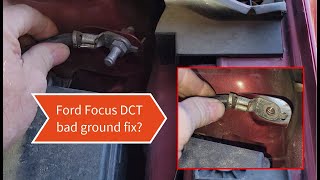
- Pay special attention to the main battery ground strap and the grounds located under the airbox (G102, G104) for looseness or corrosion. Many owners perform a 'ground mod' by sanding paint off the chassis contact point to ensure a better connection. 🎬 See how to perform the ground strap modification fix.
- If wiring damage is found, repair it, clear the codes, and re-test.
- If the wiring appears to be in perfect condition, the cause is almost certainly a faulty Transmission Control Module (TCM).
- IMPORTANT: Before paying for a repair, contact a Ford dealership with your VIN to check for any applicable extended warranty programs (like Customer Satisfaction Program 14M02) that may cover the cost of TCM replacement. Be aware that dealers may require their own diagnosis and may be reluctant to perform the repair if they cannot replicate the fault, as some owners have reported.
Parts You'll Likely Need
- Transmission Control Module (TCM)
(OEM #AE8Z-7Z369-F (supercedes AE8Z-7Z369-B, AE8Z-7Z369-D, AE8Z-7Z369-E))— This is the brain of the transmission and the most common failure point on the 2012-2018 Focus. The circuitry that processes the temperature sensor signal fails internally.
Trusted brands: Motorcraft (Ford OEM), Dorman (Remanufactured)
OEM price range: $600-$900
Aftermarket price range: $400-$700
Related Codes That Often Appear With This One
- U0100 — This code means 'Lost Communication with ECM/PCM'. It frequently appears alongside other TCM codes when the module is failing internally and communication is interrupted.
- P0606 — This code indicates an internal failure within the PCM or TCM. It is a strong indicator that the control module itself is the root cause of the problem and was specifically added in a software update to help diagnose bad TCMs.
- P0713 — This is the opposite code, 'TFT Sensor Circuit High'. While less common, seeing intermittent faults between P0712 and P0713 points to a failing sensor circuit or unstable wiring.
Technical Service Bulletins (TSBs) & Recalls
- TSB 15-0121: Addresses intermittent loss of power or no-start conditions accompanied by various DTCs (including U0100 and P0606), with the primary action being to replace and reprogram the TCM.
- TSB 16-0129: Supersedes earlier TSBs and addresses no-start, no engagement, or loss of power with DTC P0606 and U-codes, pointing to TCM failure.
- TSB 16-0044: Links P0606 with DPS6 transmission issues and TCM replacement.
Platform-Specific Known Issues
- Ford has issued multiple warranty extensions and customer satisfaction programs for the DPS6 transmission's TCM. Customer Satisfaction Program 14M02 extended coverage on the TCM for some vehicles to 10 years or 150,000 miles. This program was updated several times to include more model years and clarify repair procedures. Owners should always check with a Ford dealer to see if their specific vehicle is covered before authorizing repairs, though some owners report difficulty getting the repair covered without a persistent, dealer-verified fault.
Mechanic-Grade Diagnostic Values
- TFT Sensor Circuit Resistance — expected: Approximately 2.5 kΩ at 20°C (68°F). Resistance will decrease as temperature increases.. Failure: A reading significantly different from the expected value at a known temperature, or an open/short circuit reading, indicates a fault in the sensor circuit within the TCM.
- TFT Sensor Signal Voltage — expected: A variable voltage that corresponds to temperature, typically within a 0.5V to 4.5V range. Higher voltage when cold, lower voltage when hot.. Failure: A constant voltage reading near 0V (typically below 0.1V) indicates a short to ground and will trigger P0712.
- TCM Power Supply Voltage at Connector C1750 — expected: Greater than 10.5 volts with the ignition on.. Failure: Voltage below 10.5V indicates a problem with the power supply circuit, fuse, or battery, which must be fixed before condemning the TCM.
Scan Tool Commands That Help
- Ford IDS (Integrated Diagnostic System): Module Programming — This is required when installing a brand new TCM. A new module may not communicate with the vehicle at all until it is programmed with the vehicle's specific calibration file using IDS.
- Ford IDS (Integrated Diagnostic System): TCM Adaptive Learning / Clutch System Test — After a new TCM is installed and programmed, this procedure must be run. It allows the TCM to learn the clutch engagement points and shift fork travel limits. Failure to perform this step will result in poor shifting and potential damage.
- Ford IDS (Integrated Diagnostic System): Clear Transmission Adaptive Tables — This function is used to erase the learned shift strategies from the old module. It's a mandatory first step before starting the new adaptive learning process to ensure no corrupt data is carried over.
Wiring & Ground Locations
- TCM Main Connector (C1750B) — On the Transmission Control Module itself, which is mounted to the side of the transmission case, under the air filter housing.. This is the main connection point for all power, ground, and sensor signals for the TCM. The TFT sensor circuit pins (9 and 13) are located here, and this is where a technician would test for voltage and resistance to confirm an internal TCM fault.
- G102 / G104 — On the chassis frame rail, located underneath the air filter housing assembly on the driver's side of the engine bay.. These are critical chassis ground points for the transmission and engine electronics. Ford's factory paint on the chassis can create a poor connection here, leading to various electrical faults that can mimic a failed TCM. Cleaning the paint from under the ground lug (a 'ground mod') is a common fix recommended by owners.
- Main Battery Ground — The main negative battery cable connects to a post on the driver's side strut tower area.. This is the primary ground for the entire vehicle. Corrosion or looseness here can cause widespread, intermittent electrical problems, including issues with the TCM. The connection point is often painted from the factory, which can impede a solid ground connection.
Real Owner Repair Stories
- Reddit user in r/FordFocus (2014 Ford Focus SE) — Transmission issues requiring a new TCM.
❌ Tried (didn't work) Waiting for the OEM part from Ford, which was on backorder for months.
✅ What actually fixed it Purchased a Dorman 609-031 remanufactured TCM. A user provided detailed DIY installation instructions, noting that with the Dorman part, it may self-learn after driving, but performing the clutch learning routines with FORScan software is the better method. - Reddit user in r/FordFocus (Ford Focus (year not specified)) — TCM failure.
❌ Tried (didn't work) Purchased a cheap, 'rebuilt' TCM from Amazon, described as an old part spray-painted silver. It was installed and programmed but failed the next day (no reverse).
✅ What actually fixed it The user was in the process of returning the failed Amazon part and had ordered a Dorman unit from a reputable auto parts retailer, hoping for a better outcome. This story serves as a caution against low-quality online parts. - Reddit user in r/FordFocus (Ford Focus (year not specified)) — TCM failure with parts on national backorder.
❌ Tried (didn't work) Waiting for Ford to supply the OEM part.
✅ What actually fixed it The user had a Dorman remanufactured TCM installed and programmed by a Ford dealership. The total cost was around $600, and the car was running without issues afterward.
OEM Part Supersession History
AE8Z-7Z369-B, AE8Z-7Z369-D, AE8Z-7Z369-E→AE8Z-7Z369-F— Ford has released multiple revisions of the TCM to address reliability issues. The -F revision is the latest OEM service part.
Heads up: While all are for the DPS6, the latest revision (-F) is recommended for any replacement.
Model Year Variations Within This Range
- 2012-2014 vs 2015-2018: The TCM calibration is different between these year groups due to a physical change in the thickness of the shims used on the input shaft speed sensors. A 2012-2014 transmission uses thicker shims (approx. 3.2-3.5mm) and requires the older calibration, while a 2015-2018 transmission uses thinner shims (approx. 1.5-2.0mm) and needs the newer calibration. Swapping a transmission between these groups requires reprogramming the TCM with the correct calibration for the installed hardware.
- 2017-2018: Vehicles from the 2017 and 2018 model years were more likely to be factory-equipped with an updated TCM design that is less prone to the common internal failures seen in earlier models.
Diagnostic Flowchart
Other Known Issues on This Vehicle
Issues unrelated to this code that are worth knowing about as an owner of this generation:
- DPS6 Transmission Clutch Shudder and Failure 🔴 High — Extremely common, often starting as early as 15,000-20,000 miles. Caused by a combination of dry clutch design, clutch dust accumulation, and leaking input shaft seals contaminating the clutches. (Ref: Multiple TSBs and warranty extensions (e.g., 14M01) were issued to address clutch and seal issues.)
- Power Steering Assist Failure 🔴 High — A significant number of owners, particularly in 2012-2014 models, report sudden and complete loss of power steering while driving due to failures in the electronic power steering rack. (Ref: Recall 14S05 was issued for some vehicles to address this.)
- Faulty Canister Purge Valve (EVAP System) 🟠 Medium — Common across 2012-2018 models. A stuck-open purge valve can cause rough idle, stalling after refueling, and difficulty starting. It can also trigger code P1450. (Ref: Recall 18S32 was issued to reprogram the PCM and replace the valve if necessary.)
- Failed Passenger Side Engine Mount 🟠 Medium — The hydraulic passenger-side engine mount is prone to leaking and collapsing, leading to significant vibration felt in the cabin, especially at idle.
- Poor Body Ground Connections 🟡 Low — Corrosion at the main battery ground point on the chassis is common and can cause a wide array of seemingly unrelated electrical gremlins, including transmission shifting issues.
Used vs. New Parts: Buying Guide for This Vehicle
When a used part is the smart pick: A used OEM TCM is almost never a smart choice. The original parts have a fundamental design flaw (press-fit pins) and a high failure rate. Buying a used one from a junkyard means you are likely buying a part that has already failed or is near the end of its life. The only exception might be a very low-mileage unit from a 2017-2018 model, which may have the updated factory design.
Donor-vehicle mileage cap: roughly under 40000 miles for the part to have meaningful remaining life.
What to inspect on the donor part:
- Verify it came from a 2017-2018 model year vehicle if possible.
- Inspect the electrical connector sockets for any corrosion, bent pins, or signs of melting.
- Avoid any units that look like they have been pried open or have sealant squeezed out of the seams, as these are signs of a low-quality, non-professional 'rebuild'.
OEM-only on this vehicle (don't cheap out):
- Transmission Control Module (TCM) - While aftermarket options exist, a new OEM part from Ford (AE8Z-7Z369-F) is the most reliable, albeit expensive and often backordered, choice. It comes with a Ford warranty.
Aftermarket brands forum-validated for this vehicle:
- Dorman (Remanufactured) - Dorman remanufactures the TCM (part 609-031) and claims to fix the original design flaw by soldering the internal connections. Owner experiences are mixed; some report success and long-term reliability, while others have experienced early failures. It is generally considered a viable but potentially risky alternative to a new OEM part, especially when OEM is unavailable.
Brands owners have reported issues with on this vehicle:
- Generic 'Rebuilt' or 'Remanufactured' units from eBay or Amazon - Forum users widely report that these are often just used, failed units that have been cleaned and spray-painted to look new. They frequently fail immediately after installation and programming.
Real Owner Stories
Aggregated from forums and TSBs cited above. Mileages and costs reflect what owners reported in those sources.
2012-2018 Ford Focus
Symptoms: Owner had known TCM failure codes, but the dealership was unable to replicate the issue during their diagnosis.
What fixed it: The dealership refused to replace the TCM under the warranty program and instead quoted the owner for a full transmission replacement.
Source hint: Reddit r/FordFocus - Thread 'Ford Focus has a TCM issue but Ford Dealership won't fix it...'
2011-2019 Ford Fiesta
Symptoms: Owner experienced transmission problems that were identified as being strictly electronic or programming-related, not mechanical failures.
What fixed it: The Transmission Control Module (TCM) was replaced under warranty, but the owner reported that the fix was only temporary, suggesting deeper issues with the replacement part's quality or the vehicle's adaptive learning.
Source hint: Reddit r/FordFiesta - Thread 'Most DPS6 transmission problems are NOT mechanical. They are strictly electronic/program issues!'
Related OBD-II Codes
Frequently Asked Questions
Is the TCM replacement for code P0712 covered by a special warranty on my Focus?
My scanner shows a transmission temperature of -40°F. Does this mean the temperature sensor is bad?
I have codes U0100 and P0606 along with P0712. Are they related?
Can I save money by installing a used TCM from a junkyard?
My Focus is shifting harshly and sometimes shows a 'Transmission Hot' warning when it's cold. Is this part of the P0712 issue?
The dealer won't honor the TCM warranty extension. Why would that be?
Could a bad ground connection cause this P0712 code?
Helpful Videos

We Have This Part in Stock


The information in this article is provided for general reference and educational purposes only. Vehicle specifications, procedures, and part compatibility can vary by production date, trim level, and region. Always consult your vehicle's factory service manual and verify part numbers before purchasing or performing repairs. Safety-critical components such as airbags, seat belts, and braking systems should be installed by a qualified professional.
- Ford Focus:
- 🎬 Helpful Videos
- 🛍️ Shop This Part
- What's Unique About the 2012-2018 Ford Focus
- Symptoms You May Notice
- Most Likely Causes
- Diagnosis Steps
- Parts You'll Likely Need
- Related Codes That Often Appear With This One
- Technical Service Bulletins (TSBs) & Recalls
- Platform-Specific Known Issues
- Mechanic-Grade Diagnostic Values
- Scan Tool Commands That Help
- Wiring & Ground Locations
- Real Owner Repair Stories
- OEM Part Supersession History
- Model Year Variations Within This Range
- Diagnostic Flowchart
- Other Known Issues on This Vehicle
- Used vs. New Parts: Buying Guide for This Vehicle
- Real Owner Stories
- 2012-2018 Ford Focus
- 2011-2019 Ford Fiesta
- Related OBD-II Codes
- Frequently Asked Questions
- 🎟️ Get 5% Off