

P0700 on 2003-2014 Volvo XC90: Transmission Fault Guide to Causes and Fixes
P0700 on a 2003-2014 Volvo XC90 means the transmission computer (TCM) has stored a fault code. It's an informational code, not the root problem. The most common underlying issues are a failing valve body or low/old transmission fluid, often leading to harsh shifting or limp mode. Reading the specific codes from the TCM with a Volvo-specific scanner is required for diagnosis.
- P0700 is not the real problem; it's a message saying the transmission computer has found a problem.
- You MUST use a Volvo-specific scanner to read the detailed codes from the Transmission Control Module (TCM).
- The most likely cause of transmission issues on a 2003-2014 XC90 is a failing valve body, especially if you experience harsh shifting.
- Do not neglect transmission fluid changes. Using the correct fluid (e.g., JWS 3309) is essential.
- This is not a beginner-friendly DIY repair. Diagnosis and repair often require specialized tools and knowledge.
What's Unique About the 2003-2014 Volvo XC90

The first-generation Volvo XC90 used different transmissions depending on the engine. Early T6 models (2.9L twin-turbo inline-6) used a GM-sourced 4T65EV-GT transmission, which was notoriously unreliable and prone to early failure, often before 60,000 miles. Most other models, including the popular 2.5T, V8, and later 3.2, used Aisin-Warner transmissions—either the 5-speed AW55-50/51 or the 6-speed TF-80SC. These Aisin units are well-known for valve body failures, where internal bores and solenoids wear out, causing pressure regulation issues that lead to harsh shifting, shuddering, and solenoid-related fault codes. This valve body issue is one of the most common reasons an XC90 owner will encounter a P0700 code.
Symptoms You May Notice

- Check Engine Light is on
- "Transmission Service Required" or "Anti-skid service required" message on the instrument cluster
- Harsh, jerky, or delayed gear shifts, especially when warm
- Vehicle enters "limp mode" (stuck in one gear)
- Shuddering or vibration at constant speeds
- Flashing gear position indicator arrow on the dash
- Inability to shift into gear
- A loud bang or clunk when shifting between Park, Reverse, and Drive
- Replacing the entire transmission when only the valve body is faulty.
- Clearing the P0700 code without reading the underlying TCM codes, which leads to the problem quickly returning.
- Assuming the TCM is bad when the actual problem is a poor electrical connection, ground, or a faulty brake pedal sensor.
- Replacing solenoids individually when the valve body bores are worn, leading to a temporary or incomplete fix.
Most Likely Causes

- Faulty Transmission Valve Body 🔴 High Probability The Aisin-Warner AW55 and TF-80SC transmissions used in most XC90s are notorious for premature valve body wear. The bores for the solenoid modulator valves wear out, causing hydraulic pressure leaks. This leads to poor pressure control, resulting in harsh shifting (especially the 2-3 upshift and 3-2 downshift), shift flares, and shuddering.
How to confirm: Scan the TCM for specific solenoid or gear ratio error codes (e.g., TCM-002E, TCM-002F). A classic symptom is a harsh shift or "bump" when coming to a stop as the transmission downshifts. The problem is often worse when the transmission fluid is hot.
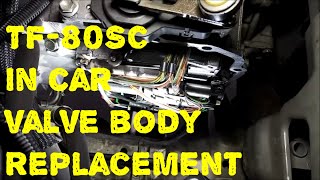
Typical fix: Replace the valve body with a new or remanufactured unit. 🎬 See this walkthrough on replacing the valve body in the car. Remanufactured units from specialists like Sonnax often include oversized valves and sleeves to correct the original design flaw, offering a more durable repair. A TCM software update may also be required after replacement.
Est. part cost: $500-$1200 - Low, Burnt, or Incorrect Transmission Fluid 🟡 Medium Probability Volvo marketed the fluid as "lifetime," which led many owners to neglect fluid changes. Over time, the fluid degrades, loses its viscosity and friction-modifying properties, and becomes contaminated with wear particles. This accelerates wear on the valve body and other components.
How to confirm: Check the transmission fluid level and condition. The fluid should be bright red (or a similar transparent color for synthetic types), not dark brown or black, and should not smell burnt. Most XC90 models lack a dipstick, requiring a specific procedure involving a check/fill plug and monitoring fluid temperature.
Typical fix: Perform a series of drain-and-fills (often called a "Gibbons method" in Vo 🎬 Watch: How to flush your transmission fluid yourself.lvo forums) or a complete fluid flush using a professional machine. It is critical to use only the specified fluid: JWS 3309 for the 5-speed AW55-50/51 and AW-1/JWS 3324 for the 6-speed TF-80SC.
Est. part cost: $100-$300 - Failed Transmission Control Module (TCM) ⚪ Low Probability The TCM is an electronic module located in the engine bay, where it can be susceptible to heat, vibration, and moisture over time. This can lead to internal failures like cracked solder joints or component failure, causing communication errors or erratic behavior.
How to confirm: If a Volvo-specific scan tool cannot communicate with the TCM, it's a strong indicator of module failure. Other modules on the CAN bus may also report a loss of communication with the TCM (e.g., CEM-1A64). Check for corrosion on the TCM connector pins.
Typical fix: Replace the TCM. A new module from Volvo requires software programming. Alternatively, services like XeMODeX can repair the original unit or transfer the programming from the old unit to a working used one, making it plug-and-play.
Est. part cost: $200-$1200 - Faulty Shift Solenoids ⚪ Low Probability Solenoids are electromechanical valves within the valve body that control fluid flow for gear changes. They can fail electrically (open or short circuit) or mechanically (sticking). While they are part of the valve body, individual failures can occur.
How to confirm: The TCM will store a specific code pointing to the faulty solenoid circuit (e.g., P0750 for Shift Solenoid A). The solenoid's resistance can be tested with a multimeter after removing the transmission pan and valve body cover.
Typical fix: Replace the individual solenoid. However, since accessing the solenoids requires significant labor (removing the valve body), and other solenoids or the valve body itself may be worn, replacing the entire valve body assembly is often a more reliable and cost-effective long-term repair.
Est. part cost: $50-$150 per solenoid
Rare But Worth Checking
- Faulty Brake Pedal Position Sensor:
- Failed Neutral Safety Switch (PNP Switch):
- Transmission Software Issues:
Diagnosis Steps

- Confirm the P0700 code is present in the Engine Control Module (ECM) using a standard OBD-II scanner.
- CRITICAL: Use a Volvo-specific scan tool (like VIDA/DiCE) or a high-end professional scanner to connect to the Transmission Control Module (TCM).
- Record all fault codes stored in the TCM. These codes (e.g., TCM-002F, solenoid codes) will point to the specific problem.
- Check the transmission fluid level and condition. This requires a specific procedure as there is no dipstick. The fluid temperature must be within a specific range (typically 50°C-60°C) when checking the level via the overflow plug.
- Inspect the TCM connectors and wiring harness for any signs of corrosion, damage, or moisture, particularly in the engine bay box where the ECM and TCM are housed.
- Based on the specific TCM codes, perform targeted tests. This may include checking solenoid resistance, monitoring live data from speed sensors, or testing the brake pedal position sensor circuit.
- If communication with the TCM is not possible, verify power and ground to the module before condemning the TCM itself.
Parts You'll Likely Need
- Transmission Valve Body
(OEM #30713189 (AW55-50), 31259456 (TF-80SC Gen 1))— This is the most common point of failure on the Aisin-Warner transmissions in these XC90s, causing a wide range of shifting problems.
Trusted brands: Aisin (OEM), Sonnax (for rebuilt kits/upgrades), RevMax
OEM price range: $900-$1500
Aftermarket price range: $500-$1200 (Remanufactured) - Transmission Fluid
(OEM #1161640 (JWS 3309), 31256774 (AW-1))— Old, degraded fluid is a primary cause of transmission issues. Using the correct fluid type is critical for proper operation and longevity.
Trusted brands: Volvo Genuine, Aisin (JWS 3309 / Type T-IV for 5-speed), Idemitsu (TLS for JWS 3309), Mobil 3309
OEM price range: $20-$25 per quart
Aftermarket price range: $8-$15 per quart - Transmission Control Module (TCM) — Can fail due to heat or moisture, causing communication errors or erratic behavior. It is the brain of the transmission.
Trusted brands: Bosch (OEM supplier), Xemodex (for remanufacturing/programming services)
OEM price range: $800-$1200
Aftermarket price range: $200-$600 (Used/Remanufactured)
Related Codes That Often Appear With This One
- P07xx — Any code in the P07xx range (e.g., P0730 Incorrect Gear Ratio, P0740 Torque Converter Clutch, P0751 Shift Solenoid 'A' Performance) is a specific transmission fault stored in the TCM that causes the P0700 to be set in the ECM.
- ECM-9400 — This Volvo-specific code points to a fault in the Brake Pedal Position Sensor circuit. A faulty sensor can cause the TCM to behave erratically and set a P0700 code.
- CEM-1A64 — This code, stored in the Central Electronic Module (CEM), indicates a loss of communication with the Transmission Control Module (TCM). This often points to a failing TCM or a wiring issue on the CAN bus network.
Platform-Specific Known Issues
- There are no specific recalls for the P0700 code or common transmission failures on the 2003-2014 XC90. However, Volvo has issued numerous Technical Service Bulletins (TSBs) related to transmission software updates that can address certain shift quality issues. For example, TSB 43-0039 (US16761.1.12) addresses 2-3 flares and harsh downshifts on AW55-50 equipped vehicles via a software update. It's always worth checking with a dealer to see if any software updates apply to your vehicle's VIN and symptoms.
Mechanic-Grade Diagnostic Values
- AW55-50SN Shift/Lockup Solenoid Resistance (S1-S5) — expected: 11 to 16 Ohms at 20°C (68°F). Failure: A reading outside this range (open circuit or short) indicates a failed solenoid coil.
- AW55-50SN Linear Solenoid Resistance (SLT, SLU, SLS) — expected: 5.0 to 5.6 Ohms at 20°C (68°F). Failure: A reading outside this range suggests an electrical fault in the solenoid. An open circuit reading for the SLS solenoid specifically can correspond to a TCM-0113 code.
- TF-80SC Solenoid Resistance (All Linear Solenoids) — expected: 5 to 7 Ohms between the two pins. Failure: A reading outside this range, or any continuity between a pin and the solenoid body, indicates the solenoid must be replaced.
- Transmission Fluid Temperature for Level Check — expected: 50°C to 60°C (122°F to 140°F). Failure: Checking the fluid level outside this temperature range will result in an incorrect fluid level, which can cause shifting problems. This value must be read with a capable scan tool.
Hidden / Shadow Codes Worth Checking
- TCM-002F: Lock-up function, slipping or not engaged. This is a very common Volvo-specific code stored in the TCM that points directly to a problem with the torque converter lock-up system, often caused by a worn valve body or faulty SLU solenoid. (see via Volvo VIDA/DiCE or equivalent professional-grade scanner.)
- TCM-0113: Pressure solenoid SLS, signal missing. This indicates an open circuit for the SLS (Shift Pressure Control) linear solenoid, which could be the solenoid itself, the wiring harness, or an internal TCM fault. (see via Volvo VIDA/DiCE or equivalent professional-grade scanner.)
- CEM-1A64: Communication with the transmission control module (TCM) Signal missing. This code in the Central Electronic Module (CEM) is a strong indicator that the TCM is failing, has lost power/ground, or there is a break in the CAN bus wiring. (see via Volvo VIDA/DiCE or equivalent professional-grade scanner.)
Scan Tool Commands That Help
- Volvo VIDA: Resetting the transmission fluid counter — This must be performed after a transmission fluid change. The TCM adjusts shift parameters based on calculated fluid degradation over time. Resetting the counter tells the TCM the fluid is new, preventing harsh shifts that can occur when new fluid is used with old fluid shift strategies.
- Volvo VIDA: Control module adaptation (TCM Adaptation) — This procedure should be performed after replacing the valve body or the entire transmission. It puts the TCM into a fast-learning mode to adapt to the new hydraulic characteristics of the replacement parts. Failure to perform adaptation can result in persistently poor shift quality.
- Volvo VIDA: Read Transmission Oil Temperature — This live data value is essential for correctly checking the transmission fluid level. The level must be checked via the overflow plug when the fluid is at a specific temperature (typically 50-60°C), and VIDA is the most accurate way to monitor this.
Wiring & Ground Locations

- TCM Location (AW55-50/51) — For most models (2.5T, early V8), the TCM is located in the black electronics box in the engine bay, near the base of the windshield on the driver's side, alongside the ECM.. This location is prone to heat and moisture, which can damage the module or corrode its connectors, leading to communication errors (P0700) or other faults.
- TCM Location (TF-80SC) — On later models with the 6-speed TF-80SC transmission (later V8, 3.2L), the TCM is mounted directly on top of the transmission valve body cover, under the air filter housing.. This location subjects the module to more intense vibration and heat directly from the transmission, increasing the risk of failure. It also means a valve body replacement often involves disturbing the TCM.
- Engine Bay Ground Points — Key grounding points for the engine management system are located on the inner fenders and near the strut towers. The main vehicle ground is the negative battery terminal, which can be in the trunk on some XC90s.. A poor ground connection to the TCM or ECM can cause a wide range of erratic electrical issues, including setting a P0700 code. Checking and cleaning main grounds is a crucial diagnostic step for any communication fault.
- Engine Wiring Harness Loom — The wiring harness runs across the top of the engine and around the transmission. The plastic conduit becomes brittle with age and heat.. As the protective loom disintegrates, wires for the transmission sensors and solenoids can chafe against the engine or other components, causing intermittent shorts or open circuits that trigger TCM faults.
Real Owner Repair Stories
- Volvo Forums user (2001 Volvo S40 1.9T (Uses a similar Aisin transmission and TCM logic)) — P0700 error code, occasional hesitation to shift into the final gear.
❌ Tried (didn't work) Initial diagnosis with a generic scanner only showed P0700.
✅ What actually fixed it The owner inspected and cleaned the TCM's electrical connectors with electronics cleaner. This resolved the connection issue and the code did not return.
OEM Part Supersession History
Various (e.g., 9480761 for 2003-2004 models)→Various (e.g., 30751946)— Internal revisions and updates by Volvo to improve reliability.
Heads up: TCMs are software-specific to the vehicle's engine, transmission type, and options. A used TCM must come from an identical donor vehicle or the software from the original module must be cloned to the replacement. Services like XeMODeX perform this cloning.AW55-50SN Valve Body (OEM)→Sonnax P89740-4 (Remanufactured)— The original valve body bores wear out. Sonnax remanufactured units are rebuilt with oversized valves and sleeves to create a more durable, long-lasting repair that corrects the original design flaw.
Heads up: Ensure the correct valve body is ordered based on the casting marks ("B" or "C") and solenoid configuration of the original unit.TF-80SC Valve Body (OEM)→Sonnax P39740-2 (Remanufactured)— Similar to the AW55, the TF-80SC valve body suffers from wear. Sonnax rebuilds and tests the solenoids and installs updated valves to restore proper hydraulic function.
Model Year Variations Within This Range
- 2003-2005 (T6 models): These models used a GM 4T65E transmission, which has entirely different failure modes, solenoids, and internal components compared to the Aisin-Warner units in all other models. P0700 causes on these are more likely related to pressure control (PC) solenoids and torque converter clutch issues specific to the GM design.
- 2003-2006 (approx.): Primarily used the 5-speed Aisin AW55-50/51 transmission. Diagnosis focuses on JWS 3309 fluid, AW55-specific solenoid resistance values, and the TCM located in the engine bay electronics box.
- 2006-2014 (approx.): Phased in the 6-speed Aisin TF-80SC transmission, especially with V8 and 3.2L engines. This transmission requires AW-1/JWS 3324 fluid and has a different valve body, solenoid design, and a TCM mounted directly on the transmission case.
Diagnostic Flowchart
Other Known Issues on This Vehicle
Issues unrelated to this code that are worth knowing about as an owner of this generation:
- Angle Gear Collar Sleeve Failure (AWD Models) 🔴 High — Very common, especially on vehicles over 100k miles. The splines on the sleeve connecting the transmission to the angle gear wear out, resulting in a complete loss of all-wheel drive.
- Differential Electronic Module (DEM) Failure (AWD Models) 🟠 Medium — Common failure. The module is mounted on the rear differential and is prone to failure from water intrusion, corrosion, or internal electronic faults, causing loss of AWD and an 'Anti-Skid Service Required' message.
- V8 Balance Shaft Bearing Failure (2005 Models) 🔴 High — Specific to early 2005 V8 models (B8444S engine). A non-lubricated, sealed bearing for the balance shaft was susceptible to water intrusion (especially from engine washing), leading to rust and failure. Failure can cause the timing chain to break, resulting in catastrophic engine damage. (Ref: A Technical Journal was issued to dealers, but no official recall.)
- GM 4T65E Transmission Failure (T6 Models) 🔴 High — Extremely common on 2003-2005 T6 models. These transmissions often failed prematurely (under 100k miles) due to various internal weaknesses, separate from the Aisin transmission issues.
- Clogged PCV/Breather System (5-Cylinder Turbo) 🟠 Medium — Common maintenance item, typically requires service every 70-100k miles. A clogged system increases crankcase pressure, forcing oil past seals (like the rear main seal) and causing leaks.
- Upper Engine Mount / Strut Tower Mount Failure 🟡 Low — Very common wear item. The rubber in the upper engine torque mount and the front strut spring seats degrades and cracks over time, causing clunking noises over bumps and excess engine movement.
Used vs. New Parts: Buying Guide for This Vehicle
When a used part is the smart pick: A used transmission assembly from a low-mileage, rear-ended donor vehicle can be a cost-effective alternative to a full rebuild, especially if the failure is catastrophic internal damage beyond the valve body. Used sensors like the PNP switch or brake pedal sensor are also generally safe bets.
Donor-vehicle mileage cap: roughly under 80000 miles for the part to have meaningful remaining life.
What to inspect on the donor part:
- Verify the donor vehicle's mileage and check its VIN history for accidents or flood damage.
- For a complete transmission, ask for a video of the donor car running and driving, if possible.
- Inspect the transmission fluid from the donor unit. If it's dark black, burnt-smelling, or full of metal, avoid it.
- For electronic modules like the TCM, inspect connectors for any signs of corrosion, bent pins, or water intrusion.
OEM-only on this vehicle (don't cheap out):
- Transmission Software: Only a Volvo dealer or specialist with a VIDA subscription can load official, vehicle-specific software.
- Neutral Safety Switch (PNP Switch): Aftermarket versions are known to have high failure rates; Genuine Volvo or OEM is highly recommended for reliability.
Aftermarket brands forum-validated for this vehicle:
- Valve Body: Sonnax is the most reputable source for remanufactured valve bodies that correct original design flaws.
- TCM Repair/Cloning: XeMODeX is a well-regarded service for repairing failed TCMs or cloning the software to a replacement unit, making it plug-and-play.
- Transmission Fluid: Mobil ATF 3309 (for AW55) and Idemitsu TLS-LV (for TF-80SC/AW-1) are widely used and trusted alternatives to more expensive dealer fluid.
Brands owners have reported issues with on this vehicle:
- Unbranded, generic solenoid kits from online marketplaces can have inconsistent quality control and may fail prematurely. It is often better to buy a complete, tested valve body assembly.
Real Owner Stories
Aggregated from forums and TSBs cited above. Mileages and costs reflect what owners reported in those sources.
2005 Volvo XC90 V8
Symptoms: Owner experienced issues related to the balance shaft bearing failure, which is a known concern for the Yamaha-sourced V8 engine in this model year.
What fixed it: The forum discussion focuses on diagnosing and addressing the balance shaft bearing failure to prevent catastrophic engine damage.
Source hint: SwedeSpeed Forums: V8 balance shaft failures??
Early Volvo XC90 T6
Symptoms: High failure rate and catastrophic transmission issues specifically associated with the GM-sourced 4T65E gearbox.
What fixed it: Discussion regarding the high failure rates of the GM 4T65E transmission used in these specific T6 models.
Source hint: Volvo Owners Club Forum: 4T65EV/GT Failures
Volvo XC90
Symptoms: 'Anti-skid needs servicing' message appearing on the instrument cluster.
What fixed it: Diagnostic process led to the identification and replacement/programming of a failed Differential Electronic Module (DEM).
Source hint: Volvo Owners Club Forum: DEM failure problem
Related OBD-II Codes
Frequently Asked Questions
My 2003-2014 Volvo XC90 is showing 'Anti-skid service required' along with the P0700 code. Are these related?
Is there a software update for the harsh 2-3 gear shifts on my AW55-50 equipped XC90?
I've heard the XC90 transmission fluid is 'lifetime.' Do I really need to change it to fix P0700?
Can I use any transmission fluid for my 2003-2014 XC90?
My XC90 has a flashing gear position arrow and is stuck in one gear. What does this mean?
Can the TCM be repaired instead of replaced to save money?
Helpful Videos


We Have This Part in Stock




The information in this article is provided for general reference and educational purposes only. Vehicle specifications, procedures, and part compatibility can vary by production date, trim level, and region. Always consult your vehicle's factory service manual and verify part numbers before purchasing or performing repairs. Safety-critical components such as airbags, seat belts, and braking systems should be installed by a qualified professional.
- Volvo XC90:
- 🎬 Helpful Videos
- 🛍️ Shop This Part
- What's Unique About the 2003-2014 Volvo XC90
- Symptoms You May Notice
- Most Likely Causes
- Rare But Worth Checking
- Diagnosis Steps
- Parts You'll Likely Need
- Related Codes That Often Appear With This One
- Platform-Specific Known Issues
- Mechanic-Grade Diagnostic Values
- Hidden / Shadow Codes Worth Checking
- Scan Tool Commands That Help
- Wiring & Ground Locations
- Real Owner Repair Stories
- OEM Part Supersession History
- Model Year Variations Within This Range
- Diagnostic Flowchart
- Other Known Issues on This Vehicle
- Used vs. New Parts: Buying Guide for This Vehicle
- Real Owner Stories
- 2005 Volvo XC90 V8
- Early Volvo XC90 T6
- Volvo XC90
- Related OBD-II Codes
- Frequently Asked Questions
- 🎟️ Get 5% Off