

OBD-II Code P0660: Intake Manifold Tuning Valve Control Circuit/Open (Bank 1)
What P0660 means, why it triggers, and how to fix it
- P0660 indicates a broken electrical connection (an 'open' circuit) in the Intake Manifold Tuning Valve system, requiring a multimeter for proper diagnosis.
- Always verify the valve's electrical connector is firmly plugged in and check the dedicated 10A to 20A circuit fuse before buying replacement parts.
- A failed tuning valve disrupts engine airflow, causing a 5% to 10% drop in fuel economy, rough idling, and sluggish acceleration.
- Fix this code within 1 to 3 months to prevent the resulting rich air-fuel mixture from destroying your catalytic converter, a repair costing upwards of $1,500.
What Does P0660 Mean?

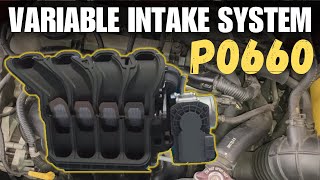
P0660 indicates the Powertrain Control Module (PCM) detects a broken electrical connection (an 'open' circuit) in the Intake Manifold Tuning Valve on engine bank 1. This valve controls flaps that change the length of the intake air passages to optimize engine performance and fuel efficiency. An 'open' circuit means electricity cannot flow, typically caused by a disconnected plug, a severed wire, or a burnt-out internal motor inside the valve actuator.
Technical definition: Intake Manifold Tuning (IMT) Valve Control Circuit/Open Bank 1. The Powertrain Control Module (PCM) detects a break (open circuit) in the electrical control circuit for the intake manifold tuning valve on engine bank 1.
Can I Drive With P0660?
yes_but_not_recommended. You can drive short distances, but we strongly advise against it. Driving with P0660 causes reduced engine performance, poor fuel economy, and rough idling that risks stalling in traffic. Ignoring this code forces an improper air-fuel mixture that destroys the catalytic converter within months, turning a $200 repair into a $2,000 replacement.
Common Causes

- Connector Unplugged from Prior Service (Common) — The code frequently triggers because a technician accidentally left the electrical connector to the tuning valve unplugged during a previous repair, oil change, or inspection. Always verify this simple mistake first.
- Faulty Intake Manifold Tuning Valve Solenoid/Actuator (Very Common) — The electronic solenoid or motor operating the tuning valve is the most frequent mechanical failure point. Internal windings burn out, the motor seizes, or plastic components crack from heat and vibration, severing the electrical circuit.
- Wiring or Connector Damage (Common) — The wiring harness and connectors leading to the tuning valve endure extreme engine heat and vibration. Wires break, fray, or corrode, and connector pins become loose or bent, physically interrupting the electrical signal.
- Blown Fuse or Faulty Relay (Less Common) — A dedicated fuse protects the tuning valve's control circuit. A blown fuse or a failed relay instantly cuts power to the circuit, triggering the open circuit code.
- Stuck or Carbon-Clogged Intake Runner Flaps (Less Common) — Carbon deposits build up inside the intake manifold, physically jamming the runner flaps. When the valve's motor tries to force the stuck flaps open, it overheats and burns out the internal control circuit.
- Faulty Powertrain Control Module (PCM) (Rare) — The internal driver circuit inside the PCM that sends the ground signal to the valve fails. The PCM then incorrectly reports this internal failure as an open circuit in the external valve system.
Symptoms
- Check Engine Light On — The PCM immediately illuminates the Check Engine Light upon detecting the open circuit.
- Reduced Engine Performance — The engine feels sluggish, hesitates during acceleration, and suffers a noticeable loss of power at specific RPM ranges.
- Poor Fuel Economy — Inefficient airflow management forces the engine to consume 5% to 10% more fuel than normal.
- Rough Idle or Stalling — The engine idles erratically, fluctuates in RPM, or stalls entirely, particularly during cold starts or when stopping at a light.
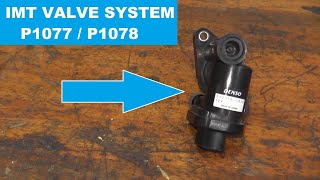
- Loud Clicking or Buzzing from Engine Bay — A distinct clicking or buzzing noise emits from the intake manifold as the valve actuator repeatedly tries and fails to operate. 🎬 Watch: How to test and replace a faulty IMT valve.
Diagnostic Flowchart

Tap your situation to follow the diagnostic path that matches what you're seeing on this code.
Common Fixes & Costs
- Replace Intake Manifold Tuning Valve / Solenoid 🎬 Watch: Step-by-step replacement for Dodge and Chrysler 3.5L engines. — Parts: $50-$150, Labor: $100-$200, ~1.0 hr book time (DIY)
- Repair Wiring or Replace Connector Pigtail — Parts: $10-$30, Labor: $100-$200, ~1.5 hr book time (Intermediate)
- Clean Intake Manifold and Runner Flaps — Parts: $20-$50, Labor: $250-$450, ~3.5 hr book time (Professional)
- Replace Intake Manifold Assembly — Parts: $300-$800, Labor: $250-$450, ~4.0 hr book time (Professional)
- Replace Powertrain Control Module (PCM) — Parts: $600-$1200, Labor: $150-$250, ~1.5 hr book time (Professional)
DIY vs Professional
- Replace Intake Manifold Tuning Valve / Solenoid — Beginner:
Tools: Basic socket set, screwdrivers, multimeter. - Repair Wiring or Replace Connector Pigtail — Beginner:
Tools: Wire strippers, crimpers, heat shrink tubing, heat gun. - Clean or Replace Intake Manifold — Beginner:
Tools: Extensive socket set, torque wrench, scrapers, new gaskets.
Used vs. New Parts: Buying Guide
When a used part is worth it: Only for a simple, externally mounted solenoid on a high-mileage vehicle where budget is the absolute priority.
Donor-vehicle mileage cap: roughly under 80000 miles for the part to have meaningful remaining life.
Donor quality checklist:
- Verify the donor vehicle was not scrapped for an engine fire or electrical flood damage.
- Inspect the plastic housing for hairline cracks and the connector pins for green corrosion.
- Match the part number exactly; manufacturers frequently change solenoid resistance values between model years.
Decision logic:
- If The part is integrated into the intake manifold and requires 3+ hours of labor to replace. → Buy new OEM. The labor cost is too high to risk installing a used part that might fail next month.
- If The new aftermarket part costs under $100. → Buy new. The peace of mind and warranty outweigh the $40 savings of a used part.
- If The part is a simple, external solenoid on a vehicle over 150,000 miles. → A tested, used part from a low-mileage donor is an acceptable budget option.
Warranty tradeoff: Used parts offer a 30-day replacement warranty (no labor coverage). New aftermarket parts offer 1-year warranties. OEM parts carry 1-2 year warranties.
Worst-case if a used part fails: $300 if a used integrated manifold fails, forcing you to pay for the replacement part and repeat 4 hours of labor.
What Happens If You Wait — Timeline
- 0-1 month: Check Engine Light illuminates. Minor hesitation during acceleration and a slight drop in fuel economy occur. (MPG impact: 0-5%% · Added cost: $0)
- 1-3 months: Engine feels noticeably sluggish. Rough idling becomes frequent, especially on cold starts. Fuel economy drops significantly. (MPG impact: 5-10%% · Added cost: $50-$100 in wasted fuel)
- 3-6 months: Improper airflow forces the engine to run rich. Excess fuel begins fouling spark plugs and overheating the catalytic converter. (MPG impact: 10-15%% · Added cost: $150 for spark plug replacement.)
- 6+ months: Sustained high temperatures melt the catalytic converter's internal honeycomb, creating a massive exhaust blockage. The vehicle stalls frequently and fails emissions. (MPG impact: 15-25%% · Added cost: $1500+ for catalytic converter replacement.)
Cost of Not Fixing It
- Short-Term (0-1 month): Noticeable drop in fuel economy, poor acceleration, and rough idling. The engine may stall at stoplights. (Added cost: $20-$50 per month in wasted fuel.)
- Medium-Term (1-6 months): The incorrect air-fuel mixture forces the engine to run rich, dumping unburned fuel into the exhaust and overheating the catalytic converter. (Added cost: $1200-$2500 for premature catalytic converter replacement.)
- Long-Term (6+ months): Persistent misfires cause heavy carbon buildup on intake valves and foul the spark plugs, requiring deep engine cleaning. (Added cost: $500-$1000 for spark plugs, coil packs, and walnut blasting.)
Diagnosis Steps
- Read Codes & Verify Connector
Use an OBD-II scanner to confirm P0660. Immediately perform a visual inspection of the Intake Manifold Tuning Valve. Ensure the electrical connector is firmly plugged in and inspect the immediate wiring for obvious breaks or rat damage.
Tools: OBD-II Scanner, Flashlight (Beginner) - Check Fuses and Relays
Consult the owner's manual to locate the fuse for the intake manifold runner control circuit. Pull the fuse and inspect it for a broken filament. Replace if blown; if it blows again immediately, you have a short circuit.
Tools: Owner's Manual, Fuse Puller (Beginner) - Test Solenoid Resistance (Ohms)
Unplug the connector from the tuning valve. Set a multimeter to Ohms (Ω) and touch the probes to the two pins on the solenoid. A reading of 'OL' (over-limit) or infinite resistance confirms the internal coil is broken and the valve must be replaced. Normal resistance is typically 10-60 Ω depending on the vehicle.
Tools: Digital Multimeter (Intermediate) - Test for Power at the Connector
Turn the ignition to 'Key On, Engine Off' (KOEO). Set the multimeter to DC Volts. Probe the supply pin on the disconnected wiring harness. You must see battery voltage (12.0V - 12.6V). Zero volts indicates a broken wire or blown fuse upstream.
Tools: Digital Multimeter (Intermediate) - Command Valve with a Scan Tool
Plug in a bi-directional scan tool and command the IMT valve to open and close. Listen for a click from the actuator. If the valve has power (Step 4) but does not click when commanded, the actuator is dead.
Tools: Bi-directional Scan Tool (Advanced) - Perform a Circuit Continuity Test
Disconnect the battery. Unplug the PCM connector and the valve connector. Test continuity on both the power and ground wires between the two plugs. Resistance must be under 1.0 Ω. High resistance or 'OL' confirms a broken wire in the harness.
Tools: Digital Multimeter, Vehicle Wiring Diagram (Advanced) - Analyze Control Signal with a Lab Scope
Connect a lab scope to the control (ground) wire. When the PCM commands the valve, you must see a square wave pattern as the PCM pulses the ground. A flat line proves the PCM driver is dead, requiring PCM replacement.
Tools: Automotive Oscilloscope (Lab Scope) (Professional)
When This Code Triggers (Freeze-Frame Conditions)
- Engine Coolant Temp: 180-200°F (82-93°C) (The PCM typically runs the electrical self-test only after the engine reaches full operating temperature.)
- RPM: 1500-3000 RPM (The fault is detected when the PCM commands the valve to switch states during steady cruising or light acceleration.)
- Engine Load: 30-60% (The test runs under moderate engine load, consistent with normal highway driving.)
- Vehicle Speed: 35-60 mph (56-97 kph) (The code frequently sets during sustained city or highway cruise conditions.)
Related Codes
- P0661 — Intake Manifold Tuning Valve Control Circuit Low. Indicates a short to ground. P0660 is a broken wire (open); P0661 is a wire touching the chassis (short).
- P0662 — Intake Manifold Tuning Valve Control Circuit High. Indicates a short to power. A wire is improperly receiving voltage when it shouldn't be.
- P0171 — System Too Lean (Bank 1). A failed tuning valve allows unmetered air into the engine at idle, creating a lean condition. Fix P0660 first to resolve P0171.
- P2004 — Intake Manifold Runner Control Stuck Open. A mechanical code. The physical jam (P2004) often causes the electrical motor to burn out, triggering P0660. Address the mechanical jam before replacing the burnt electrical part.
Climate & Environmental Factors
- Extreme Cold: Moisture inside the intake manifold freezes, locking the runner flaps in place. When the engine starts, the actuator motor strains against the ice, overheating and severing its internal electrical circuit.
How to Talk to a Mechanic About This Code
Say this: "I have a P0660 code for the intake manifold tuning valve circuit. I need a diagnostic that specifically tests the valve's solenoid resistance and checks the wiring harness for power and ground before we replace any parts."
This proves you know P0660 is an electrical code. It forces the technician to perform a proper circuit diagnosis rather than blindly swapping a $200 part when the real issue is a $2 broken wire.
Avoid saying:
- 'Just fix whatever's wrong'
- 'My check engine light is on, can you look at it?'
- 'Go ahead and replace the tuning valve'
Questions to ask before authorizing the repair:
- Did you test the resistance of the solenoid itself? What was the Ohm reading?
- Did you confirm there is battery voltage at the connector with the key on?
- If you recommend a new valve, how did you confirm the wiring harness is intact?
Where to Take It: Dealer vs Independent vs Chain
- Dealer:
Best for: Vehicles under powertrain warranty, Complex, integrated intake manifold designs (common in European cars)
Downsides: Highest labor rate, May default to replacing the entire $800 intake manifold when only the actuator failed (Typical cost: +50% vs. baseline) - Independent Shop:
Best fit. P0660 is a routine electrical diagnostic job. A trusted independent shop is the most cost-effective choice.
Best for: Out-of-warranty vehicles, Diagnosing common electrical faults (bad solenoid, broken wire)
Downsides: Diagnostic skill varies; vet shops by ASE electrical certifications (Typical cost: +0% vs. baseline) - Chain Shop:
Avoid for initial diagnosis. They frequently miss wiring issues and push unnecessary fuel system cleanings.
Best for: Simple part swaps where you have already diagnosed the issue yourself
Downsides: Technicians often lack deep electrical training and replace parts without confirming the root cause. (Typical cost: -10% vs. baseline)
When to Walk Away From the Repair
If the estimated repair cost exceeds 40% of the car's private-party value, seriously consider selling the vehicle.
- Car worth $4000, fix is $300: Fix it. This is a standard repair cost and a small fraction of the car's value.
- Car worth $3000, fix is $1400: Walk away. The repair requires replacing the entire intake manifold, approaching half the car's value. Get a second opinion, but prepare to sell.
What Scan Tool You Need for This Code

Minimum: A code reader that displays the fault code and freeze-frame data.
A $20 reader only gives you the code. It cannot command the valve to open and close. Without bi-directional control, you are guessing whether the valve or the wiring is dead.
Budget: KINGBOLEN Ediag Elite (~$70) — Offers full-system diagnostics and limited bi-directional control to command the IMT valve on some vehicles without a subscription.
Mid-range: Foxwell NT510 Elite (~$180) — Provides robust bi-directional control to command the intake tuning valve. This is the critical step to separate a part failure from a wiring failure.
Professional: Autel MaxiCOM MK808S (~$450) — Offers reliable bi-directional control for nearly all makes, fast live data graphing, and a professional interface for serious DIYers.
Rent vs buy: Auto parts stores loan basic code readers for free. Buy a bi-directional scanner only if you plan to perform advanced diagnostics yourself.
How to Clear the Code After You Fix It
- Connect an OBD-II scan tool and clear the P0660 code.
- Start the engine and let it idle for 3 minutes to ensure the code does not immediately return.
- Perform a complete drive cycle to reset the vehicle's emissions readiness monitors.
Drive cycle (~30 minutes): Start the engine cold and idle for 3 minutes. Drive in stop-and-go traffic for 10 minutes. Accelerate smoothly to 55 mph and maintain a steady speed on the highway for 15 minutes. Coast to a stop without braking hard.
Readiness monitors affected: Catalyst Monitor, Evaporative System (EVAP) Monitor, Oxygen (O2) Sensor Monitor
Before emissions retest: drive at least 50 miles to fully set monitors.
Watch out for:
- Disconnecting the battery clears the code but resets all readiness monitors to 'Not Ready', guaranteeing an emissions test failure.
- If the root cause (like a broken wire) wasn't fixed, the code will return the moment the PCM attempts to activate the valve.
Will This Fail Emissions / State Inspection?
Yes — this code typically fails an OBD-II emissions inspection.
- California: An active P0660 code is an automatic smog check failure. All OBD-II readiness monitors must read 'Ready' to pass, requiring a complete drive cycle after repairs.
- New York: The NYS DMV emissions inspection relies on an OBD-II scan. P0660 results in an automatic failure.
- Texas: In emissions-testing counties (Harris, Dallas, Travis), an illuminated Check Engine Light is an automatic failure. You must repair the vehicle and clear the code to pass.
Most Commonly Affected Vehicles
- Mazda 3 / 6 / Protege5 (2003-2012) — The vacuum (VICS) and electric (VTCS) solenoids fail frequently, often melting internally. A highly common cause of P0660 on these models.
- Dodge / Chrysler Charger, Magnum, 300, Avenger (2006-2010) — The Manifold Tuning Valve (MTV) on the 3.5L V6 engine is a notorious failure point located on the passenger side of the intake.
- Ford Focus / Fusion / Escape (2003-2012) — The plastic intake manifold runner control (IMRC) assembly cracks, or the actuator motor burns out. Often located at the difficult-to-reach rear of the manifold.
- Chevrolet Cruze / Sonic (2011-2016) — The 1.8L Ecotec engine suffers from actuator failures. GM often requires replacing the entire intake manifold as the actuator is not sold separately.
- Hyundai / Kia Santa Fe, Accent, Sedona (2000-2016) — Points to a faulty Variable Intake System (VIS) valve. TSBs suggest inspecting the actuator linkage for physical binding before replacing electrical parts.
- Nissan Altima / Maxima / Quest (2002-2008) — The power valve control solenoid is a known weak point on the VQ35DE V6 engine.
- Volvo S40 / V50 (2004-2010) — The 2.4i 5-cylinder engine suffers from broken link arms on the actuator motor, usually requiring full intake manifold replacement.
- Saab 9-3 / 9-5 (2001-2009) — On diesel models, this code points to a break in the 'swirl throttle' circuit, disabling both the runner control and the EGR system.
Manufacturer-Specific Notes
- Mazda: A P0660 code for the VICS/VTCS solenoid may store in the computer without illuminating the Check Engine Light, as Mazda does not always classify it as a primary emissions fault.
- Chrysler/Dodge: A TSB for the 3.5L V6 engine suggests intermittent electrical faults in the MTV circuit can sometimes be resolved with a PCM software update (reflash) rather than replacing the valve.
- Ford: On Duratec engines, the plastic linkage arms connecting the actuator to the manifold flaps frequently break, causing a loud rattling noise alongside the electrical code.
- Saab: Saab refers to the intake runner control as the 'swirl throttle.' A P0660 fault automatically disables the EGR valve as a safety measure, severely impacting drivability.
Real Owner Stories
2005 Mazda 3 1.6L with severe shifting problems
The car threw code P0660 and experienced violent, delayed shifts at high RPMs. Two mechanics recommended a full transmission replacement.
What they tried:
- Ignored the transmission advice and focused on the P0660 code.
- Inspected the intake manifold and discovered it was the wrong part.
Outcome: A previous owner installed an intake manifold from a 1.5L engine, which only uses one IMTV solenoid. The 1.6L computer was looking for two solenoids, triggering the open circuit code and throwing the transmission into limp mode. Installing the correct manifold fixed everything.
Lesson: An incorrect part from a prior repair causes bizarre electrical codes. Always verify part compatibility, and never assume a transmission is dead until engine codes are cleared.
2007 Dodge Magnum 3.5L with intermittent Check Engine Light
The Check Engine Light flashed intermittently for P0660 before staying on permanently alongside codes P2017 and P2078.
What they tried:
- Replaced the Manifold Tuning Valve (MTV), but the code immediately returned.
- Performed a continuity check on the wiring harness using a multimeter.
Outcome: The owner found two wires inside a 14-pin connector that had rubbed bare and shorted together. Splicing in a new section of wire permanently resolved all three codes.
Lesson: Do not blindly replace the valve. Electrical codes paired together almost always point to a damaged wiring harness. A $20 multimeter saves hundreds in unneeded parts.
2003 Mazda Protege stalling after a dead battery
After draining and recharging the battery, the car barely started, stalled frequently, and threw a P0660 code.
What they tried:
- Replaced coil packs and spark plugs, assuming an ignition issue.
- Tested the battery and alternator, which passed.
Outcome: The root cause was a faulty VICS solenoid (Mazda's tuning valve), a notorious failure point on this model. The dead battery was a coincidence. Replacing the $50 solenoid fixed the stalling.
Lesson: Coincidences happen. On vehicles with known common failures, investigate the specific component the code points to before chasing unrelated theories.
How to Prevent This Code From Triggering
- Use Top-Tier fuel with detergents (Every fill-up) — High-quality gasoline prevents the heavy carbon buildup that physically jams the intake runner flaps and burns out the tuning valve motor.
- Perform periodic intake system cleaning (Every 40,000 miles) — Chemical spray cleaners or walnut blasting removes existing carbon deposits, ensuring the runner flaps move freely without straining the electrical actuator.
- Apply dielectric grease to the connector (During any service near the intake manifold) — A dab of dielectric grease on the electrical seal blocks moisture intrusion, preventing the corrosion that causes open circuits.
Frequently Asked Questions
What is 'Bank 1'?
Bank 1 is the side of the engine containing cylinder #1. On an inline four-cylinder engine, there is only one bank. On a V6 or V8, check your service manual to identify which side houses the first cylinder.
Can I just clean the valve instead of replacing it?
Cleaning only helps if carbon buildup is physically jamming the flaps (usually indicated by code P2004). P0660 is an electrical code, meaning the internal coil or wiring is broken and requires replacement.
Is the Intake Manifold Tuning Valve the same as an IMRC?
Yes. Manufacturers use different names—IMRC, Swirl Control Valve, Variable Intake System (VIS), or Power Valve—to describe the exact same system.
What is the most common misdiagnosis for P0660?
Immediately replacing the tuning valve without testing the circuit. Technicians frequently waste money on new parts when the actual culprit is a blown 10-amp fuse or a chewed wire.
Can a bad battery or alternator cause P0660?
A weak charging system causes erratic voltage, sometimes triggering false codes. Test your battery and alternator if you have multiple electrical codes. Otherwise, focus directly on the tuning valve circuit.
I replaced the valve, but the code came back. What now?
The problem lies in the wiring harness between the valve and the PCM. You must perform continuity and voltage drop tests to locate the broken wire.
How do I clear the P0660 code?
Use an OBD-II scanner to erase the code after completing the repair. Disconnecting the battery works but resets all emissions monitors, causing an automatic failure if you need an inspection soon.
Key Takeaways
- P0660 indicates a broken electrical connection (an 'open' circuit) in the Intake Manifold Tuning Valve system, requiring a multimeter for proper diagnosis.
- Always verify the valve's electrical connector is firmly plugged in and check the dedicated 10A to 20A circuit fuse before buying replacement parts.
- A failed tuning valve disrupts engine airflow, causing a 5% to 10% drop in fuel economy, rough idling, and sluggish acceleration.
- Fix this code within 1 to 3 months to prevent the resulting rich air-fuel mixture from destroying your catalytic converter, a repair costing upwards of $1,500.
Helpful Videos


The information in this article is provided for general reference and educational purposes only. Vehicle specifications, procedures, and part compatibility can vary by production date, trim level, and region. Always consult your vehicle's factory service manual and verify part numbers before purchasing or performing repairs. Safety-critical components such as airbags, seat belts, and braking systems should be installed by a qualified professional.
- 🎬 Helpful Videos
- What Does P0660 Mean?
- Can I Drive With P0660?
- Common Causes
- Symptoms
- Diagnostic Flowchart
- Common Fixes & Costs
- DIY vs Professional
- Used vs. New Parts: Buying Guide
- What Happens If You Wait — Timeline
- Cost of Not Fixing It
- Diagnosis Steps
- When This Code Triggers (Freeze-Frame Conditions)
- Related Codes
- Climate & Environmental Factors
- How to Talk to a Mechanic About This Code
- Where to Take It: Dealer vs Independent vs Chain
- When to Walk Away From the Repair
- What Scan Tool You Need for This Code
- How to Clear the Code After You Fix It
- Will This Fail Emissions / State Inspection?
- Most Commonly Affected Vehicles
- Manufacturer-Specific Notes
- Real Owner Stories
- 2005 Mazda 3 1.6L with severe shifting problems
- 2007 Dodge Magnum 3.5L with intermittent Check Engine Light
- 2003 Mazda Protege stalling after a dead battery
- How to Prevent This Code From Triggering
- Frequently Asked Questions
- What is 'Bank 1'?
- Can I just clean the valve instead of replacing it?
- Is the Intake Manifold Tuning Valve the same as an IMRC?
- What is the most common misdiagnosis for P0660?
- Can a bad battery or alternator cause P0660?
- I replaced the valve, but the code came back. What now?
- How do I clear the P0660 code?
- Key Takeaways
- 🎟️ Get 5% Off