

OBD-II Code P0645: A/C Clutch Relay Control Circuit
What P0645 means, why it triggers, and how to fix it
- Code P0645 indicates an electrical fault in the A/C relay control circuit, meaning your compressor is likely mechanically sound but not receiving power.
- Replacing the A/C clutch relay is the most common fix, costing under $30 and taking less than 5 minutes to swap in the fuse box.
- Driving with a P0645 code is safe for the engine, but the disabled A/C system reduces windshield defroster effectiveness by up to 50% in humid conditions.
- Never authorize a $500+ compressor replacement for this code without first verifying the mechanic tested the $15 relay and the 15-amp A/C fuse.
What Does P0645 Mean?

P0645 means your car's Powertrain Control Module (PCM) found an electrical problem in the circuit that turns your air conditioning compressor on and off. The computer sends a low-current signal to the A/C clutch relay, which powers the high-current electromagnet for the A/C compressor clutch. When the computer detects an abnormal signal—like an open circuit, a short to ground, or a short to power—it sets the code and immediately disables the A/C system to prevent electrical damage.
Technical definition: The SAE/OBD-II definition for code P0645 is "A/C Clutch Relay Control Circuit". This indicates the Powertrain Control Module (PCM) or Body Control Module (BCM) detected a fault in the control circuit for the A/C clutch relay. The PCM monitors the voltage on the control side of the circuit. When it grounds the circuit to activate the relay, it expects the voltage to drop to near zero. If the voltage remains high or behaves erratically, the code sets.
Can I Drive With P0645?
Yes. Driving with a P0645 code will not cause engine or transmission damage, but your air conditioning will not work. This becomes a safety issue in climates where the A/C is necessary for the windshield defroster to effectively clear fog, as the A/C system dehumidifies the air. Impaired visibility significantly increases driving risk.
Common Causes

- Faulty A/C Clutch Relay (Very Common) — The relay is an electrical switch that fails from age, heat, and repeated use. This is the most frequent cause of a P0645 code, as the internal coil burns out or the switch contacts fail.
- Blown Fuse or Fusible Link (Common) — A blown fuse for the A/C circuit cuts power to the relay and immediately triggers this code. Fuses blow because of an underlying short circuit in the wiring or a failing compressor clutch coil.
- Damaged or Corroded Wiring/Connectors (Common) — Wires in the engine bay are exposed to heat, vibration, and moisture. Insulation rubs off on engine components, causing a short circuit, or connectors at the relay, BCM, or compressor corrode, creating an open circuit.
- Faulty A/C Compressor Clutch Coil (Less Common) — The electromagnet that engages the compressor clutch develops an internal short or open. This changes the electrical load on the circuit, which the PCM detects, triggering the P0645 code. A healthy coil has a resistance between 2 and 5 ohms.
- Poor Ground Connection (Less Common) — The A/C clutch circuit relies on a solid ground connection. A loose, corroded, or broken ground strap for the engine or chassis creates high resistance, causing intermittent operation and triggering the code.
- Defective A/C Pressure Switch (Less Common) — A faulty pressure switch sends an incorrect signal to the PCM. While this typically sets codes P0530-P0534, in some systems it leads the PCM to disable the A/C clutch relay, indirectly causing P0645 as a secondary fault.
- Low Battery Voltage (Rare) — A weak battery causes the overall system voltage to drop below the threshold required for the relay to activate properly (typically 9-10V). The PCM interprets this low voltage as a fault and sets P0645.
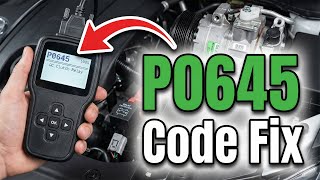
- Faulty Control Module (PCM, BCM, TIPM) (Rare) — The internal driver circuit within the Powertrain Control Module (PCM) or Body Control Module (BCM) that controls the A/C relay fails. Consider this only after exhaustively testing wiring, relays, fuses, and grounds. 🎬 Watch: A complete troubleshooting and repair guide for code P0645
Symptoms

- A/C blows warm or hot air — The A/C compressor clutch is not engaging, so the refrigerant is not circulating to cool the air.
- Check Engine Light is on — The PCM illuminates the Malfunction Indicator Lamp (MIL) on the dashboard to alert the driver of the fault.
- No 'click' sound when A/C is turned on — Normally, a distinct click sounds from the engine bay when the A/C compressor clutch engages. The absence of this sound indicates the clutch is not receiving power.
- A/C system works intermittently or 'chatters' — A loose connection, failing relay, or poor ground causes the A/C to work intermittently or rapidly cycle on and off, heard as a 'chatter' or 'buzzing' sound from the compressor.
- Blinking A/C indicator light — On some vehicles, the light on the A/C button blinks to indicate a fault within the climate control system, in addition to the Check Engine Light.
Diagnostic Flowchart
Tap your situation to follow the diagnostic path that matches what you're seeing on this code.
Common Fixes & Costs
- Replace A/C Clutch Relay — Parts: $15-$45, Labor: $0-$65, ~0.2 hr book time (DIY)
- Replace Blown Fuse — Parts: $1-$5, Labor: $0, ~0.1 hr book time (DIY)
- Repair Damaged Wiring or Connectors — Parts: $10-$50, Labor: $125-$350, ~1.5 hr book time (Intermediate)
- Replace A/C Compressor Clutch Assembly or Full Compressor — Parts: $150-$500, Labor: $250-$500, ~2.8 hr book time (Professional)
- Replace A/C Pressure Switch — Parts: $20-$60, Labor: $100-$200, ~1.2 hr book time (Professional)
Used vs. New Parts: Buying Guide
When a used part is worth it: For a simple A/C relay, buying new is always recommended. For an expensive A/C compressor, a used unit from a low-mileage, accident-damaged vehicle is a cost-effective option for older vehicles where a new compressor is a large percentage of the car's value.
Donor-vehicle mileage cap: roughly under 70000 miles for the part to have meaningful remaining life.
Donor quality checklist:
- Verify the donor vehicle's mileage and ensure it was not scrapped due to engine or electrical failure.
- Inspect the part for physical damage, corrosion, or leaking oil (for compressors).
- Match the part number exactly; A/C systems are very specific.
Decision logic:
- If The faulty part is a relay or fuse → Always buy new. The cost saving is negligible and the risk of a used part failing is not worth it.
- If The faulty part is an A/C compressor and the vehicle is over 10 years old or 150K miles → A used compressor from a reputable salvage yard is a reasonable choice to save money.
- If The vehicle is newer and under 100K miles → Buy a new OEM or high-quality aftermarket compressor to ensure longevity and warranty coverage.
Warranty tradeoff: Used parts typically come with a 30-90 day warranty covering only the part. New aftermarket parts offer 1-year to limited lifetime warranties. New OEM parts offer the best warranty, especially when installed by a dealer.
Worst-case if a used part fails: $400-$800 if a used compressor fails after installation, requiring repeating the expensive labor and system recharge process.
What Happens If You Wait — Timeline
- 0-1 month: Code P0645 sets, the Check Engine Light illuminates, and the PCM disables the A/C system. The only symptom is a lack of cold air. (MPG impact: 0%% · Added cost: $0)
- 1-6 months: An intermittent short causes strange electrical behaviors (like a buzzing relay or flickering lights) or a slow battery drain when the vehicle is off. (MPG impact: 0%% · Added cost: $0 - $250 (Cost of a new battery if drained completely))
- 6-12 months: Continued exposure to moisture and vibration worsens the connection. An intermittent fault becomes a permanent open or short circuit, requiring a complex wiring harness repair. (MPG impact: 0%% · Added cost: $125 - $350 (Cost for a wiring harness repair instead of a simple relay swap))
- 12+ months: A persistent, unprotected short circuit in the control wire overloads and destroys the driver circuit inside the Powertrain Control Module (PCM). (MPG impact: 0%% · Added cost: $800 - $2000+ (Cost for PCM/ECU replacement and programming))
Cost of Not Fixing It
- Short-Term (0-3 months): No air conditioning, which is a significant comfort and potential safety issue (defroster performance). No direct mechanical damage occurs. (Added cost: Negligible)
- Medium-Term (3-12 months): An underlying short circuit that caused the P0645 code leads to a drained battery or damage to other components on the same circuit. (Added cost: $150-$400 (New battery or minor electrical repair))
- Long-Term (1+ year): An intermittent short to power or ground eventually damages the expensive Powertrain Control Module (PCM) driver that controls the relay. (Added cost: $800-$2000+ (PCM replacement and programming))
Diagnosis Steps

- Inspect A/C Fuses and Relay (Swap Test)
Locate the under-hood fuse box. Check the fuse labeled for the A/C. If blown, replace it. Swap the A/C relay with an identical relay from a non-essential system (like the horn) and see if the A/C works.
Tools: Owner's manual, fuse puller (Beginner) - Listen for the A/C Clutch Engagement
With the engine running, have a helper turn the A/C on and off. Stand near the front of the engine and listen for a 'click' from the A/C compressor pulley. If there is no click, the clutch is not getting power.
Tools: None (Beginner) - Visually Inspect Wiring and Connectors
Look at the wiring going to the A/C compressor, the A/C relay, and associated control modules. Search for frayed insulation, burn marks, or green/white corrosion on the connectors. Ensure all connectors are securely plugged in.
Tools: Flashlight (Beginner) - Test for Voltage at the A/C Compressor Clutch
Unplug the electrical connector at the A/C compressor. With the engine running and A/C turned on, use a multimeter to check for battery voltage (12-14 volts) at the connector. If voltage is present but the clutch doesn't engage, the clutch coil is bad. If no voltage is present, the problem is upstream.
Tools: Multimeter (Intermediate) - [PRO TIP] Test A/C Compressor Clutch Coil Resistance
Disconnect the A/C compressor clutch connector. Set your multimeter to measure resistance (Ohms). Measure the resistance between the two pins on the compressor side. A good clutch coil reads between 2 and 5 Ohms. A reading of 'OL' (Open Loop) or near zero Ohms confirms a bad clutch coil.
Tools: Multimeter (Advanced) - Test the A/C Clutch Relay Socket
Remove the A/C relay. Use a multimeter and a wiring diagram to check the relay socket terminals. You should find constant power (pin 30), switched power (pin 86), the PCM control wire (pin 85), and the output to the clutch (pin 87). This determines if power reaches the relay and if the PCM sends the signal.
Tools: Multimeter, vehicle-specific wiring diagram (Advanced) - [PRO TIP] Test PCM Control Signal with a Test Light
Remove the A/C relay. Connect a 12V test light clip to the battery positive terminal. Probe the relay socket terminal corresponding to the PCM control wire (usually pin 85). Have a helper turn the A/C on and off. The test light should turn on when the PCM commands the relay. If not, suspect a PCM driver or wiring issue.
Tools: 12V test light, vehicle-specific wiring diagram (Advanced) - [PRO TIP] Check Control Circuit Voltage at PCM
Using a multimeter, back-probe the A/C clutch relay control circuit pin at the PCM connector. With the key on and A/C commanded ON, the voltage should drop to near 0 volts. If the voltage stays high (above 1V), the PCM driver is faulty. If it drops to zero but the relay doesn't activate, there is an open in the control wire.
Tools: Multimeter, vehicle-specific wiring diagram, back-probe pins (Advanced) - [PRO TIP] Analyze Scan Tool Live Data
Use a bi-directional scan tool to monitor A/C-related Parameter IDs (PIDs). Watch 'A/C Request Signal' and 'A/C Relay Command'. If the request is 'Yes' but the command is 'Off', the PCM is inhibiting activation due to another input. If the command is 'On' but the A/C doesn't work, the fault is in the control circuit.
Tools: Bi-directional scan tool (Advanced) - Check A/C Pressure Switch Signal
If the pressure switch is faulty, it prevents the PCM from activating the A/C relay. Testing requires a wiring diagram and multimeter to check for the correct signal to the PCM. A scan tool can also view the pressure reading data.
Tools: Multimeter, vehicle-specific wiring diagram, Bi-directional scan tool (Advanced)
When This Code Triggers (Freeze-Frame Conditions)
- Engine Coolant Temp: 180-210°F (Engine at normal operating temperature.)
- RPM: 700-1200 (Engine at idle or low RPM, shortly after A/C was requested.)
- Battery Voltage: >10.4 Volts (The PCM is monitoring the circuit with sufficient system voltage.)
- A/C Request Signal: ON (The driver pressed the A/C button, commanding the system to activate.)
Related Codes
- P0646 — Means 'A/C Clutch Relay Control Circuit Low'. It sets when the PCM detects a constant low voltage or short to ground on the control circuit. Test the control wire at the relay socket: P0646 shows near 0 volts, whereas P0645 (open circuit) shows no reading.
- P0647 — Means 'A/C Clutch Relay Control Circuit High'. It sets when the PCM tries to ground the circuit to turn the relay ON but detects the voltage remains high. This indicates a short to a power source.
- P0530-P0534 — Related to the A/C refrigerant pressure sensor circuit. P0645 points to a fault in the command circuit (wiring/relay), while P053x codes point to a fault in the sensor input circuit. A P053x fault prevents the PCM from trying to engage the clutch.
- P06A0 — Means 'A/C Clutch Control Circuit Range/Performance'. Similar to P0645 but sets when the circuit performance is intermittent or erratic, rather than a hard fault like an open or short.
Climate & Environmental Factors
- High Heat & Humidity: In hot and humid climates, the A/C system runs more frequently. This increases the cycles on the A/C clutch relay and compressor, accelerating wear and making electrical failures more likely. Humidity also promotes corrosion in connectors.
- Cold Climates / Road Salt: In regions using road salt, corrosive spray compromises wiring insulation and electrical connectors for the A/C compressor and relay. This corrosion creates high resistance or short circuits, triggering a P0645 code.
How to Talk to a Mechanic About This Code
Say this: "I have a P0645 code and my A/C is not working. I'd like to schedule a diagnostic appointment. I've already checked the fuse and swapped the A/C relay with the horn relay, and the problem persists. Please focus on testing the control circuit from the PCM to the relay and the power circuit from the relay to the compressor clutch."
This signals you are an informed customer who performed basic troubleshooting. It directs the technician to perform specific, logical diagnostic steps for a P0645, rather than starting from scratch or jumping to expensive conclusions like replacing the compressor.
Avoid saying:
- 'My A/C isn't working, can you fix it?' (too vague, invites a high bill)
- 'Just replace the A/C compressor.' (You are asking for an expensive and unnecessary repair)
- 'My check engine light is on.' (Doesn't provide the specific code, which is the most important starting point)
Questions to ask before authorizing the repair:
- What was the result of the voltage test at the A/C compressor connector?
- Did you test the PCM's command signal at the relay socket? Was it providing a ground when the A/C was on?
- If you are recommending a compressor replacement, can you show me the resistance reading for the clutch coil? It should be between 2-5 ohms.
- What is the warranty on the parts and labor for this repair?
Where to Take It: Dealer vs Independent vs Chain
- Dealer:
Recommended if you suspect a known TSB applies or if an independent shop has been unable to diagnose an intermittent electrical fault.
Best for: Vehicles still under warranty., Known manufacturer-specific issues covered by a Technical Service Bulletin (TSB), like Ford BCM connector problems or Chrysler TIPM failures., Complex electrical issues where a factory wiring schematic is essential.
Downsides: Highest labor rates and parts costs., Quicker to replace an entire module (like a TIPM) rather than attempting a more targeted, cheaper repair. (Typical cost: +50% vs. baseline) - Independent Shop:
Best fit for most P0645 situations. A good independent shop handles over 90% of the potential causes for this code efficiently and cost-effectively.
Best for: Out-of-warranty vehicles where cost is a factor., Diagnosing and fixing the most common causes of P0645, such as a bad relay, damaged wiring, or a faulty clutch coil., Building a long-term relationship with a mechanic who knows your vehicle's history.
Downsides: Diagnostic capabilities vary; ensure the shop has a good reputation for electrical work., Lacks access to the very latest TSBs or manufacturer-specific software tools. (Typical cost: +0% vs. baseline) - Chain Shop:
Use with caution. Acceptable if you already diagnosed a bad relay yourself and just need it replaced. Avoid for initial diagnosis of a P0645 code, as misdiagnosis is common.
Best for: Simple, clear-cut repairs like replacing an accessible, externally-mounted A/C relay.
Downsides: Technician skill varies dramatically., Lacks the advanced diagnostic tools and experience for complex electrical troubleshooting beyond simple part swaps., Inclined to upsell unnecessary services. (Typical cost: -10% vs. baseline)
When to Walk Away From the Repair
If the estimated repair cost exceeds 50% of your car's private-party value, seriously consider not doing the repair.
- Car worth $4000, fix is $2000: Walk away. The repair cost is 50% of the car's value. This is likely a PCM or TIPM replacement, and it's not worth investing that much in an older vehicle.
- Car worth $15000, fix is $350: Fix it. This is a common repair cost for a wiring or connector issue and is well below the threshold.
- Car worth $2500, fix is $1500: Walk away. The repair cost is 60% of the car's value. It makes no financial sense to proceed.
What Scan Tool You Need for This Code
Minimum: A basic code reader that reads and clears codes and views live data for the 'A/C Request' and 'A/C Relay Command' PIDs.
A $20 reader only gives you the code 'P0645'. It cannot show you if the PCM is actually commanding the relay on, which is critical information. Seeing the live data confirms if the fault is in the command side or the execution side of the circuit.
Budget: BlueDriver Pro (~$100) — Connects to your smartphone, reads the P0645 code, provides repair reports based on a database of fixes, and displays essential live data PIDs like 'A/C Request Signal'. It provides a strong idea of the problem before going to a shop.
Mid-range: Foxwell NT510 Elite (~$180) — Offers bidirectional control. This allows you to manually command the A/C relay on and off directly from the scan tool. If you command it 'on' and the A/C works, you know the entire power circuit is good and the issue is with the PCM or its inputs.
Professional: Autel MaxiCOM MK808S / MK808BT (~$450-550) — Provides full bidirectional control to activate the relay, reads all manufacturer-specific codes, and views detailed live data streams in graphs. It accesses the climate control module directly and runs specific self-tests, offering the same capability as a professional shop's tool.
Rent vs buy: For a one-time P0645 diagnosis, renting a basic code reader from a parts store is insufficient as it lacks live data and bidirectional features. If you are a DIYer, buying a midrange tool with bidirectional control (like the Foxwell) offers the best value and is invaluable for future electrical diagnostics.
How to Clear the Code After You Fix It
- Use an OBD-II scan tool to clear the diagnostic trouble codes.
- Start the engine and turn the A/C system on and off several times, listening for the clutch click.
- Perform a complete OBD-II drive cycle to ensure all readiness monitors run.
Drive cycle (~20 minutes): After clearing the code, start the engine from cold and let it idle for 2-3 minutes. Drive in stop-and-go traffic for 5-10 minutes. Drive at a steady highway speed (55-65 mph) for 5-10 minutes. During the drive, cycle the A/C on and off multiple times. Allow the vehicle to cool down completely and repeat if necessary.
Readiness monitors affected: Comprehensive Component Monitor (CCM)
Before emissions retest: drive at least 50 miles to fully set monitors.
Watch out for:
- Clearing the code without fixing the underlying electrical fault causes the code to return immediately.
- Not allowing the engine to cool completely before starting the drive cycle prevents certain monitors from running.
- Disconnecting the battery clears the code but resets all readiness monitors, requiring a longer drive cycle to prepare for an emissions test.
Will This Fail Emissions / State Inspection?
Yes — this code typically fails an OBD-II emissions inspection.
- California: An illuminated Check Engine Light results in an automatic smog check failure. The underlying issue must be repaired, the code cleared, and all OBD-II readiness monitors set to 'Ready' before a re-test passes.
- New York: The New York State vehicle inspection includes an On-Board Diagnostics (OBD-II) check. A P0645 code and the associated Check Engine Light causes the vehicle to fail the emissions portion of the inspection.
- Texas: In the 17 Texas counties requiring emissions testing, a vehicle with an active P0645 code fails the OBD-II portion of the annual inspection.
Most Commonly Affected Vehicles
- Ford Focus (2012-2016) — Commonly experiences P0645 due to a faulty A/C clutch relay (R11 in the under-hood fuse box) or wiring issues. A Ford TSB specifically links this code to an inoperative A/C.
- Ford Taurus, Flex, Lincoln MKT/MKZ (2012-2016) — A known issue, addressed by TSB SSM-45815, points to a failing A/C clutch relay as the primary cause. On the Taurus, the relay is part number 8T2T-14B192-AA and fuse #62 is involved.
- Ford Explorer, Lincoln Aviator (2020-2023) — Multiple TSBs (SSM 51380, 50811) warn the cause is a spread or pushed-out terminal in a connector at the Body Control Module (BCMC), not a faulty component.
- Chevrolet / GMC Silverado, Sierra, Acadia (2007-2013) — Problems typically relate to the A/C relay, wiring harness chafing against engine components, or issues with the A/C control module. A visual inspection of the harness loom is critical.
- Jeep Wrangler (JK) (2007-2018) — The code on these models traces back to a bad A/C pressure sensor or a wiring issue within the harness. Intermittent functionality is a common complaint.
- Honda Civic, Accord (2006-2015) — Owners frequently report P0645 caused by a failed A/C clutch relay (often a blue Omron or black Mitsuba relay) or a worn-out A/C compressor clutch coil that goes out of resistance specification.
- Hyundai i10, Elantra (2010-2016) — Commonly triggered by an open in the A/C relay control circuit or a poor connection at the relay or ECM. Technicians check for continuity between the ECM and the relay socket first.
- Toyota Corolla (2009-2013) — The A/C magnetic clutch relay is a common failure point leading to the P0645 code. It is located in the engine bay fuse box and is an easy DIY swap.
Manufacturer-Specific Notes
- Ford: On models like the Focus, Fusion, and Taurus, TSB SSM-45815 points directly to the A/C clutch relay. For newer Explorers (2020+), TSB SSM 51380 warns against replacing the BCM, pointing to a known terminal issue in a wiring connector.
- General Motors (Chevy/GMC): The wiring harness to the A/C compressor is routed in a way that makes it prone to rubbing against engine components or the frame, leading to chafed wires and short circuits. A thorough visual inspection of the entire harness length is required.
- Chrysler/Jeep/Dodge: The A/C clutch relay is integrated into the Totally Integrated Power Module (TIPM). A failure of this internal relay requires a complex internal repair of the TIPM by a specialist or a full replacement of the entire module, rather than a simple relay swap.
- Subaru: The air gap of the A/C compressor clutch increases over time due to wear. If the gap becomes too large, the electromagnet cannot engage the clutch, leading to an intermittent P0645. The fix involves removing shims to reduce the air gap.
Real Owner Stories
2012 Ford Focus - The Classic Relay Fix
A/C suddenly stopped working and the Check Engine Light came on. The owner confirmed code P0645 with a basic scanner.
What they tried:
- Checked the A/C fuse (F27, 15A), which was good.
- Located the A/C clutch relay (position R11 in the under-hood fuse box).
- Swapped the A/C relay with the identical horn relay to test the theory.
Outcome: The A/C clutch immediately engaged and started working with the horn relay installed. The original A/C relay was confirmed faulty. A new relay was purchased for $15, solving the problem instantly.
Lesson: Always swap the A/C relay with a known-good, identical relay from a non-essential system (like the horn) before buying parts. It is a zero-cost, five-minute diagnostic step that provides a definitive answer.
2016 Ford Explorer - A Confusing Intermittent Fault
P0645 code was present, but the A/C failed intermittently. Swapping the relay had a strange, temporary effect.
What they tried:
- Swapped the A/C relay with the horn relay. The A/C strangely started working only after the horn was honked.
- The owner noted that a year prior, gear oil was accidentally spilled near the fuse box and battery area.
- The bizarre behavior pointed away from a simple failed relay and towards a wiring or connection issue.
Outcome: The root cause was corrosion and a poor connection in the fuse box stemming from the earlier oil spill. The strange interaction with the horn circuit proved the problem was within the power distribution box itself.
Lesson: Bizarre, intermittent electrical behavior that ignores logical part swaps points to a deeper issue like a corroded connector, a bad ground, or a fault inside a fuse box. On newer Explorers (2020+), this code is caused by a known terminal issue at the Body Control Module connector, per TSB SSM 51380.
2010 Dodge Ram - The Dreaded TIPM Failure
A/C stopped working, triggering code P0645. On many Chrysler, Dodge, and Jeep vehicles, the A/C relay is soldered inside the Totally Integrated Power Module (TIPM).
What they tried:
- A visual inspection of wiring and fuses revealed no obvious issues.
- Testing confirmed the PCM was sending the command, but the relay inside the TIPM was not activating the compressor circuit.
Outcome: The internal A/C relay within the TIPM failed. The owner had two options: a full TIPM replacement (costing over $1,000) or sending the original TIPM to a specialist for repair ($250). The specialist replaced the internal relays, correcting the root cause without reprogramming.
Lesson: If you own a Chrysler, Dodge, or Jeep, a P0645 code indicates a fault inside the TIPM. Before agreeing to a $1,000+ replacement, research TIPM repair services that fix the internal relay for a fraction of the cost.
How to Prevent This Code From Triggering
- Inspect and Protect Wiring Harnesses (Annually or during oil changes) — Engine vibration causes wiring looms to rub against sharp metal edges. Visually inspect the A/C compressor harness for chafing, secure it with zip ties, and replace brittle plastic conduit with new split-loom tubing to prevent shorts.
- Apply Dielectric Grease to Connectors (During any related repair) — Applying a small amount of dielectric grease to the A/C compressor connector and relay socket seals out moisture and oxygen, preventing the corrosion that causes high resistance and open circuits.
- Keep Battery Terminals and Grounds Clean (Annually) — A stable electrical system relies on clean, tight connections. Corrosion on battery terminals or main chassis grounds causes low or unstable voltage, triggering electrical fault codes like P0645.
Frequently Asked Questions
What's the most common mistake when diagnosing P0645?
The most common and costly mistake is immediately replacing the A/C compressor. This code flags an electrical circuit fault, not a mechanical failure. Always diagnose the cheap electrical parts—fuses, relays, and wiring—first.
My mechanic says I need a new compressor. Should I get a second opinion?
Yes. While a failed compressor clutch coil causes P0645, it is far less common than a simple relay or wiring issue. Ask the mechanic to show you the failed electrical test for the clutch coil (typically 2-5 ohms) before authorizing a $500+ repair.
Can I just replace the A/C relay to fix P0645?
Yes, replacing the A/C relay is often the definitive fix. It is inexpensive and easy to do, making it the best first step after checking the fuse. Swap the A/C relay with an identical one for a different system (like the horn) to see if the problem moves.
Will clearing the P0645 code make my A/C work again?
No. Clearing the code only turns off the Check Engine Light temporarily. The PCM will immediately re-run its diagnostic test, detect the electrical fault, and disable the A/C system again.
Why did my A/C stop working at the same time the Check Engine Light came on?
When the PCM detects the P0645 fault in the A/C control circuit, it intentionally shuts down power to the A/C clutch to prevent electrical fires or module damage. This causes the A/C to stop working and the Check Engine Light to illuminate simultaneously.
Can low refrigerant cause a P0645 code?
No, low refrigerant causes the A/C pressure switch to report a low-pressure condition, setting a pressure-related code (like P0530). P0645 triggers only when the PCM attempts to engage the compressor but detects a physical electrical fault in the relay's control circuit.
What is the difference between the control circuit and the load circuit?
The 'control circuit' is a low-amperage path the PCM uses to activate the relay's internal electromagnet. The 'load circuit' is a high-amperage path carrying actual power to the compressor clutch. Code P0645 specifically flags a failure in the low-amperage control circuit monitored by the PCM.
Key Takeaways
- Code P0645 indicates an electrical fault in the A/C relay control circuit, meaning your compressor is likely mechanically sound but not receiving power.
- Replacing the A/C clutch relay is the most common fix, costing under $30 and taking less than 5 minutes to swap in the fuse box.
- Driving with a P0645 code is safe for the engine, but the disabled A/C system reduces windshield defroster effectiveness by up to 50% in humid conditions.
- Never authorize a $500+ compressor replacement for this code without first verifying the mechanic tested the $15 relay and the 15-amp A/C fuse.
Helpful Videos


The information in this article is provided for general reference and educational purposes only. Vehicle specifications, procedures, and part compatibility can vary by production date, trim level, and region. Always consult your vehicle's factory service manual and verify part numbers before purchasing or performing repairs. Safety-critical components such as airbags, seat belts, and braking systems should be installed by a qualified professional.
- 🎬 Helpful Videos
- What Does P0645 Mean?
- Can I Drive With P0645?
- Common Causes
- Symptoms
- Diagnostic Flowchart
- Common Fixes & Costs
- Used vs. New Parts: Buying Guide
- What Happens If You Wait — Timeline
- Cost of Not Fixing It
- Diagnosis Steps
- When This Code Triggers (Freeze-Frame Conditions)
- Related Codes
- Climate & Environmental Factors
- How to Talk to a Mechanic About This Code
- Where to Take It: Dealer vs Independent vs Chain
- When to Walk Away From the Repair
- What Scan Tool You Need for This Code
- How to Clear the Code After You Fix It
- Will This Fail Emissions / State Inspection?
- Most Commonly Affected Vehicles
- Manufacturer-Specific Notes
- Real Owner Stories
- 2012 Ford Focus - The Classic Relay Fix
- 2016 Ford Explorer - A Confusing Intermittent Fault
- 2010 Dodge Ram - The Dreaded TIPM Failure
- How to Prevent This Code From Triggering
- Frequently Asked Questions
- What's the most common mistake when diagnosing P0645?
- My mechanic says I need a new compressor. Should I get a second opinion?
- Can I just replace the A/C relay to fix P0645?
- Will clearing the P0645 code make my A/C work again?
- Why did my A/C stop working at the same time the Check Engine Light came on?
- Can low refrigerant cause a P0645 code?
- What is the difference between the control circuit and the load circuit?
- Key Takeaways
- 🎟️ Get 5% Off