

P0627 on 2018-2024 Lincoln Navigator: Fuel Pump Circuit Fault Causes & Fixes
On 2018-2024 Navigators with the 3.5L EcoBoost, P0627 is almost always caused by a poor electrical connection at the Fuel Pump Control Module (FPCM), located on the driver's side frame rail above the spare tire. Before buying any parts, inspect and reseat the FPCM connector, designated as C433/C4033 in service manuals, and check the nearby frame ground points G403 and G406. This simple check is mandated by multiple Ford TSBs and often resolves all symptoms.
- For a 2018-2024 Lincoln Navigator, P0627 is most likely an electrical connection issue, not a failed part.
- Before any other diagnosis, lower the spare tire and inspect the main connector on the Fuel Pump Control Module (FPCM) on the driver's side frame rail.
- Check the associated ground wires (G403/G406) on the frame for tightness and corrosion.
- This issue often triggers a cluster of codes including P025A, P00C6, and U0109; their presence further points to the FPCM connection as the root cause.
- Do not replace the fuel pump or FPCM unless the wiring, connector, and grounds have been proven to be in perfect condition.
What's Unique About the 2018-2024 Lincoln NAVIGATOR
For this specific generation of Lincoln Navigator and its platform mates (Ford Expedition, F-150), Ford has issued multiple Special Service Messages (SSMs) and Technical Service Bulletins (TSBs) pointing to a common, specific failure point. Unlike a generic P0627 that could be the pump or relay, on these vehicles, the issue is frequently an intermittent or poor connection at the FPCM harness connector (C433/C4033) or its ground points (G403/G406). Technicians are specifically advised by Ford to check these connections for corrosion, pushed-out pins, or looseness before replacing expensive components like the fuel pump or the FPCM itself, as a simple connector reseat often resolves the problem.
🎬 Watch: How to fix common connector issues and stalling.Diagnostic Flowchart
Tap your situation to follow the diagnostic path that matches what you're seeing on this vehicle.
Symptoms You May Notice
- Engine cranks but does not start
- Engine stalls intermittently, sometimes while driving at speed
- Engine may start briefly and then die
- Long crank time before the engine starts
- Noticeable loss of power or sluggish acceleration
- Illuminated Check Engine Light (MIL).
- Rough running or engine hesitation.
- Replacing the in-tank fuel pump without first inspecting the FPCM connector and grounds. This is a costly and labor-intensive repair that often fails to fix the P0627 code on these Navigators.
- Replacing the Fuel Pump Control Module (FPCM) when the actual problem is just a loose connection or bad ground. This is a common mistake that wastes money on an unnecessary part.
Most Likely Causes
- Poor Connection at Fuel Pump Control Module (FPCM) 🔴 High Probability As documented in Ford TSBs SSM 52483, 50841, and 51306, the FPCM connector is a known weak point. Its location on the frame rail exposes it to moisture and road salt, leading to corrosion. Vibration can also cause the connector to become partially disconnected or cause terminal pins to push out.
How to confirm: Lower the spare tire to access the FPCM on the driver's side frame rail. Carefully disconnect, inspect, and reseat the FPCM connector, specifically identified as C433 or C4033. Look for green/white powder (corrosion), moisture, or pins that have backed out of the connector housing.
Typical fix: Often, simply unplugging and firmly reconnecting the connector will fix the issue. If pins are corroded, they should be cleaned with electrical contact cleaner. Applying dielectric grease to the connector seal before reconnecting can prevent future moisture intrusion. If the connector or pins are damaged, the connector pigtail will need to be replaced.
Est. part cost: $0-$80 - Loose or Corroded Ground Connection 🟡 Medium Probability The same TSBs that identify the connector issue also call out the FPCM's ground points as a potential cause. A poor ground prevents the module from operating correctly, triggering the same codes.
How to confirm: While inspecting the FPCM, locate the specified ground points G403 and G406 on the frame. Check that the bolts are tight and that the contact surfaces are clean and free of corrosion or rust.
Typical fix: Remove the ground bolt, clean the contact surfaces of the terminal and the frame with a wire brush to bare metal, and securely re-tighten the bolt. Applying a dielectric grease can prevent future corrosion.
Est. part cost: $0-$5 - Failed Fuel Pump Control Module (FPCM) ⚪ Low Probability While the module can fail, it is far less common than the connection issues. It is often replaced unnecessarily.
How to confirm: This should only be suspected after the connector and grounds are confirmed to be in perfect condition. Diagnosis requires using a multimeter to verify proper power and ground signals are entering the module and that the module is sending the correct voltage signal out to the fuel pump, according to the factory service manual.
Typical fix: Replace the FPCM. The module is typically mounted to the frame rail with two bolts. The OEM part number is JL1Z-9D370-B.
Est. part cost: $70-$150 - Faulty Fuel Pump Relay ⚪ Low Probability The system uses a relay, but it is not a common failure point for this specific code on this platform compared to the FPCM wiring.
How to confirm: Locate the fuel pump relay in the vehicle's fuse box (Battery Junction Box). You can test it by swapping it with an identical relay from a non-critical circuit (like the horn) and seeing if the problem is resolved.
Typical fix: Replace the faulty relay with a new one.
Est. part cost: $15-$40
Rare But Worth Checking
- Failed In-Tank Fuel Pump: While a possible cause for a P0627 code in general, on this specific vehicle it is much less likely than the wiring issues. This should only be considered after all circuit checks (connector, grounds, module) have been performed.
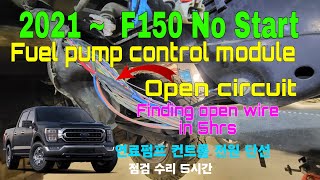
- Damaged Wiring Harness: Physical damage to the wiring harness between the PCM and the FPCM can cause an open circuit. A user on an F-150 forum with similar codes traced the issue to an open wire in the harness along the frame rail. This is rare but possible if the vehicle has been in an accident or has had other underbody work done.
- Faulty Powertrain Control Module (PCM): This is extremely rare. The PCM is the last component to suspect after all other parts of the circuit have been thoroughly tested and ruled out.
Diagnosis Steps
- Scan the PCM for P0627 and any other related codes (U0109, P025A, P008A, etc.). Note all codes present.
- Lower the spare tire to gain clear access to the driver's side rear frame rail.
- Locate the Fuel Pump Control Module (FPCM) and its main electrical connector, designated C433 or C4033. 🎬 See a technician diagnose these specific fuel circuit codes.
- Visually inspect if the connector is fully seated and if the locking tab is engaged.
- Disconnect the FPCM connector. Inspect both the harness side and the module side for bent, pushed-out, or corroded pins (look for white or green crust). Check for any signs of water intrusion inside the connector.
- If corrosion is found, clean the connector terminals with electronic contact cleaner and a small brush. If pins are damaged, the pigtail may need replacement.
- Apply a small amount of dielectric grease to the connector seal to prevent future moisture intrusion and firmly reconnect it. Ensure the locking tab clicks securely into place.
- Inspect the FPCM ground connections (G403 and G406) on the frame rail. Ensure they are clean, tight, and free of rust. It is best to remove the bolt, clean the surfaces to bare metal, and re-tighten.
- Clear the DTCs with a scan tool and start the vehicle. Perform a test drive, including some bumps if possible, to see if the code returns.
- If the code returns, check the fuel pump relay in the Battery Junction Box by swapping it with a known good relay of the same type.
- If the issue persists, perform advanced electrical tests on the FPCM circuit for proper voltage and ground signals as per the factory service manual to isolate a fault in the wiring, the FPCM, or the in-tank pump itself.
Parts You'll Likely Need
- FPCM Connector Pigtail
(OEM #GU5Z-14S411-TA (Motorcraft WPT-1293))— If the connector itself or the terminal pins are damaged or corroded beyond cleaning, a new pigtail will need to be spliced into the harness. This is the correct repair for a damaged connector, not replacing the whole module.
Trusted brands: Motorcraft, Dorman
OEM price range: $40-$80
Aftermarket price range: $30-$60 - Fuel Pump Control Module
(OEM #JL1Z-9D370-B)— This part is often misdiagnosed and replaced when the issue is wiring-related. It should only be replaced after confirming the wiring, connector, and grounds are perfect.
Trusted brands: Motorcraft (OEM)
OEM price range: $70-$150
Aftermarket price range: $50-$120
Related Codes That Often Appear With This One
- U0109 — This code means 'Lost Communication With Fuel Pump Control Module'. It directly points to the same electrical connection problem identified in the TSBs as the cause for P0627 and is the most common companion code.
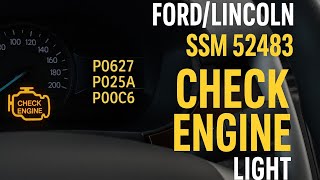
- P025A — This code, for 'Fuel Pump Module 'A' Control Circuit/Open', is often triggered alongside P0627 as they both relate to the FPCM circuit. TSB SSM 52483 lists them together.
- P025B — This code, for 'Fuel Pump Module 'A' Control Circuit Range/Performance', is also part of the group of codes mentioned in the TSB related to FPCM connectivity issues.
- P00C6 — This code for 'Fuel Rail Pressure Too Low - Engine Cranking' is a direct symptom of the fuel pump not activating, which is the result of the P0627 fault. It is cited in the same TSB.
- P008A — This code for 'Low Pressure Fuel System Pressure - Too Low' is another symptomatic code caused by the fuel pump control circuit failure and is listed in the relevant TSBs.
Technical Service Bulletins (TSBs) & Recalls
- SSM 52483: Illuminated Malfunction Indicator Lamp (MIL) With DTCs P0627, P025A, P025B, P00C6, P008A And/Or U0109 In The PCM - Fuel Pump Circuit Diagnostic Tips.
- SSM 50841: Illuminated Malfunction Indicator Lamp With DTCs P0627, P025A, P025B, P00C6, P008A And/Or U0109.
- SSM 51306: Illuminated Malfunction Indicator Lamp (MIL) With DTCs P0627, P025A, P025B, P00C6, P008A and/or U0109 stored in the powertrain control module (PCM).
Platform-Specific Known Issues
- Owner Experience: Intermittent Stall Fixed by Reseating Connector: Multiple owners across Navigator, Expedition, and F-150 forums report experiencing intermittent stalling, especially after driving in rain or through car washes. The vehicle may run fine for days, then suddenly stall and refuse to restart. In many documented cases, the owner or a technician was able to permanently resolve the issue by simply locating the FPCM above the spare tire, disconnecting the main harness, cleaning it with contact cleaner, adding dielectric grease, and reconnecting it securely.
- Dealer Repair Following TSB: Owners who take their vehicle to a dealer for this issue often report that the fix involves the technician referencing the relevant TSB (like SSM 52483). The work order typically states 'Inspected and cleaned FPCM connector and ground G403/G406 per TSB'. This confirms that the official repair procedure prioritizes the connection points over component replacement.
Mechanic-Grade Diagnostic Values
- Low-Pressure Fuel System Pressure (at Schrader valve or via scan tool PID) — expected: Approximately 72-80 psi on the low-pressure side for EcoBoost models.. Failure: Pressure that is significantly below spec or drops intermittently indicates a fuel delivery problem.
- FPCM Power Supply Voltage at Connector C433, Pin 1 — expected: Battery voltage (~12V) with Key On.. Failure: 0V indicates an open circuit in the power supply wire from the fuse box. This is a critical test before condemning the module.
- FPCM Ground Circuit Continuity at Connector C433 — expected: Near 0 ohms of resistance between the ground pin(s) and a clean chassis ground point.. Failure: High or infinite resistance (OL) indicates a bad ground connection, a common cause of this code.
- Fuel Pump Current Draw — expected: 4-8 amperes, depending on system demand.. Failure: Excessively high current can indicate a failing pump motor, while very low or no current suggests an open circuit or failed pump.
Scan Tool Commands That Help
- Ford IDS (Integrated Diagnostic Software): FPCM/Fuel Pump Activation Test (Bidirectional Control) — Use this after visual inspection fails to find an issue. This command allows the technician to manually turn the fuel pump on and off via the scan tool. If the pump runs with this command, it proves the FPCM, pump, and wiring from the FPCM to the pump are functional, pointing the diagnosis towards the PCM or the command circuit from the PCM to the FPCM.
- FORScan or similar advanced OBD-II scanner: Monitor Fuel System PIDs — For intermittent issues, monitoring specific PIDs during a drive can reveal the fault. Key PIDs include: 'FP_CTRL' (Fuel Pump Control Duty Cycle), 'FPM_VOLT' (Fuel Pump Monitor Voltage), and 'LP_PRES' (Low-Side Fuel Pressure). A sudden drop-out or erratic reading in these values corresponding with a symptom points to the FPCM circuit.
- Ford IDS (Integrated Diagnostic Software): Module Programming > Programmable Module Installation (PMI) — This function is required only if the Fuel Pump Control Module (FPCM) is replaced. The new module must be configured to the vehicle's specific parameters to function correctly.
Wiring & Ground Locations
- C433 / C4033 — The main 6-pin electrical connector at the Fuel Pump Control Module (FPCM), located on a frame crossmember above the spare tire on the driver's side.. This is the single most common failure point. TSBs SSM 52483, 50841, and 51306 all point to intermittent connections, corrosion, or pushed-out pins within this connector as the primary cause for P0627.
- G403 / G406 — The primary chassis ground points for the FPCM, located on the frame rail near the module itself.. A loose or corroded ground at these points will prevent the FPCM from operating correctly and can cause P0627 and the common companion code U0109 (Lost Communication With FPCM).
- C433 - Pin 1 (Power) — Pin 1 of the FPCM connector C433.. This pin supplies battery voltage to the FPCM. A voltage test at this pin is a critical diagnostic step. No voltage here indicates a problem upstream, such as a blown fuse (check fuse #50 in the engine bay fuse box) or a break in the power wire.
- C433 - FPM Circuit (Fuel Pump Monitor) — One of the pins on the C433 connector (pin number varies, consult a specific wiring diagram).. The FPCM sends a diagnostic signal back to the PCM on this circuit to report the status of the fuel pump. A fault on this wire can trigger P0627 as the PCM believes there is a control circuit issue.
Real Owner Repair Stories
- Aggregated from multiple forum and video reports for Ford platform-mates (F-150, Expedition, Transit) (2018-2022 Ford F-150/Expedition with 3.5L EcoBoost) — Vehicle would intermittently crank but not start, or would stall while driving at low speeds. The issue was more frequent after heavy rain or in high humidity. Codes P0627 and U0109 were present.
❌ Tried (didn't work) Replacing the fuel pump relay., Clearing the codes, which would cause them to return within a day or two.
✅ What actually fixed it The owner lowered the spare tire to access the Fuel Pump Control Module (FPCM) on the frame rail. Upon disconnecting the main connector (C433/C4336), visible green and white corrosion was found on several pins. The owner cleaned the pins on both the harness and module side with electrical contact cleaner and a small wire brush, applied dielectric grease to the seal, and reconnected it firmly until it clicked. The nearby ground bolt (G401/G403) was also removed, the contact points sanded to bare metal, and re-tightened. The codes were cleared and did not return, resolving the no-start and stalling issues.
Model Year Variations Within This Range
- 2018-2024: While the fundamental cause of P0627 on the Navigator is consistent (FPCM circuit), connector and ground designators may vary slightly across the broader Ford platform. For the Navigator/Expedition, TSBs specifically call out connector C433/C4033 and ground G403. The related F-150 uses connector C4336 and ground G401. This information is useful for cross-referencing repair stories from other forums.
- 2018-2024: The 2018+ 3.5L EcoBoost engine uses a dual fuel injection system (both port and direct injection). P0627 and the associated FPCM relate to the low-pressure side of this system, which feeds the high-pressure mechanical pump. A failure here will starve the entire system of fuel.
Helpful Videos
Used OEM Parts in Stock


New Aftermarket Parts Available


The information in this article is provided for general reference and educational purposes only. Vehicle specifications, procedures, and part compatibility can vary by production date, trim level, and region. Always consult your vehicle's factory service manual and verify part numbers before purchasing or performing repairs. Safety-critical components such as airbags, seat belts, and braking systems should be installed by a qualified professional.
- Lincoln NAVIGATOR:
- 🎬 Helpful Videos
- 🛍️ Shop This Part
- What's Unique About the 2018-2024 Lincoln NAVIGATOR
- Diagnostic Flowchart
- Symptoms You May Notice
- Most Likely Causes
- Rare But Worth Checking
- Diagnosis Steps
- Parts You'll Likely Need
- Related Codes That Often Appear With This One
- Technical Service Bulletins (TSBs) & Recalls
- Platform-Specific Known Issues
- Mechanic-Grade Diagnostic Values
- Scan Tool Commands That Help
- Wiring & Ground Locations
- Real Owner Repair Stories
- Model Year Variations Within This Range
- 🎟️ Get 5% Off