

P0627 on 2020-2024 Lincoln Aviator: Fuel Pump 'A' Control Circuit Fixes
On a 2020-2024 Lincoln Aviator, code P0627 is most often caused by a poor electrical connection at the Fuel Pump Control Module (FPCM), located on the driver's side frame rail near the spare tire. Before replacing any parts, inspect and clean the FPCM connector (C4033) and ground G407, as highlighted in multiple manufacturer TSBs.
- P0627 on a 2020-2024 Aviator is almost always an electrical connection issue, not a bad fuel pump.
- Before buying parts, your first step is to inspect, clean, and re-seat the FPCM connector (C4033) and check its ground (G407).
- This code is often accompanied by other codes like P025A and U0109; their presence strongly suggests the known TSB-documented wiring issue.
- Do not drive the vehicle extensively, as the engine could stall at any time, creating a safety risk.
What's Unique About the 2020-2024 Lincoln AVIATOR
For this specific generation of Lincoln Aviator and its Ford Explorer platform-mate, the P0627 code is strongly linked to a known electrical connection issue. The Fuel Pump Control Module (FPCM) is located on the driver's side frame rail, often above the spare tire, where it is exposed to road salt, moisture, and vibration. This vulnerability is the primary reason Ford has issued multiple Technical Service Bulletins (TSBs) acknowledging that intermittent disconnects at the FPCM connector are a common cause for this code, often appearing with a cluster of other fuel system and communication codes. This makes it much more likely to be a wiring or connector problem than a failed fuel pump.
Diagnostic Flowchart
Tap your situation to follow the diagnostic path that matches what you're seeing on this vehicle.
Symptoms You May Notice
- Check Engine Light illuminated
- Engine cranks but does not start
- Engine starts and then immediately stalls
- Stalling while driving
- Noticeable loss of power or engine hesitation
- Long crank time before starting
- Replacing the in-tank fuel pump before thoroughly inspecting the FPCM connector and ground connections. The TSBs strongly indicate the problem is usually in the control circuit wiring, not the pump itself.
Most Likely Causes
- Poor Connection at Fuel Pump Control Module (FPCM) 🔴 High Probability This is a well-documented issue acknowledged by the manufacturer in multiple Technical Service Bulletins (SSM 52482, SSM 51306, SSM 50841). The FPCM's location on the driver's side frame rail exposes its connector (C4033) to the elements, leading to corrosion, pushed-out pins, or an intermittent connection.
How to confirm: Locate the FPCM on the driver's side frame rail, near the spare tire area. Visually inspect the FPCM connector C4033 for pushed-out pins, corrosion, or looseness. Also, check the nearby chassis ground connection at point G407 for corrosion or looseness. A 'wiggle test' on the harness while the engine is running can often trigger the stall, confirming the bad connection.
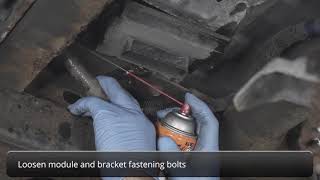
Typical fix: Disconnect the connector, clean the pins and terminals with electrical contact cleaner, apply dielectric grease to the seal, and ensure the connector is fully seated with a click. 🎬 Watch: How to fix the fuel pump connector and clear codes. If pins are damaged, the connector pigtail may need to be replaced.
Est. part cost: $0-$50 - Failed Fuel Pump Control Module (FPCM) 🟡 Medium Probability
How to confirm: If the wiring and connections are confirmed to be good, the FPCM is the next logical component to test. This often requires a bi-directional scan tool to command the pump on and monitor the module's response. The module should only be replaced after the connector and ground are ruled out.
Typical fix: Replace the Fuel Pump Control Module.
Est. part cost: $100-$250 - Failed In-Tank Fuel Pump ⚪ Low Probability While less common than the wiring issue for this specific code, some 2021-2023 Aviator models were part of a recall for faulty low-pressure fuel pumps that could cause stalling. However, P0627 specifically points to a control circuit fault, making the pump itself a less likely cause.
How to confirm: After ruling out all control circuit issues (wiring, connector, ground, FPCM), test for fuel pressure at the rail. If the pump receives power but does not run or produces low pressure, the pump has likely failed.
Typical fix: Replace the in-tank fuel pump assembly.
Est. part cost: $300-$600
Rare But Worth Checking
- Blown Fuse: Always a good first check. TSB SSM 52483 for the related Navigator platform mentions checking Fuse #28 in the engine compartment power distribution box. Check your owner's manual for the specific fuse related to the fuel pump control module.
- Damaged Wiring Harness: Beyond the connector, the wiring itself can be damaged. TSB 52482 specifically advises inspecting inline connections C1147 and C3136 for being fully seated and damage-free. Chafing against the frame or road debris damage can also cause an open circuit.
- Powertrain Control Module (PCM) Fault: This is the least likely cause. The PCM should only be suspected after all other possibilities, including all wiring, connectors, grounds, and modules, have been thoroughly tested and ruled out.
Diagnosis Steps
- Scan the PCM for all stored trouble codes. Note if P0627 is accompanied by any of the codes listed in the TSBs (U0109, P025A, P025B, P00C6, P008A).
- Safely raise the vehicle and locate the Fuel Pump Control Module (FPCM) on the driver's side frame rail, often near the spare tire area.
- Perform a thorough visual inspection of the wiring harness and connector C4033 at the FPCM. Look for loose connections, pushed-out pins, or signs of corrosion (green or white powder).
- Locate and inspect the FPCM chassis ground connection at point G407, which is near the FPCM. Ensure it is clean, tight, and free of corrosion.
- If the engine runs, perform a 'wiggle test' by gently moving the wiring harness at the FPCM. If the engine stumbles or stalls, the intermittent connection is confirmed.
- If the visual inspection reveals no obvious faults, disconnect the FPCM connector, clean it with electrical contact cleaner, and apply a small amount of dielectric grease to the seal before reconnecting securely.
- Per TSB 52482, inspect inline connectors C1147 and C3136 to ensure they are fully seated and free of damage.
- Check the fuse for the fuel pump circuit in the engine bay power distribution box.
- If the code persists, use a multimeter to check for power, ground, and signal continuity at the FPCM connector according to the vehicle's wiring diagram.
- If the control circuit wiring is confirmed to be intact, the FPCM itself is the next most likely suspect. The in-tank fuel pump is the least likely cause.
Parts You'll Likely Need
- Fuel Pump Control Module (FPCM)
(OEM #FU5Z-9D370-B (Verify with VIN))— If cleaning the connector and checking the ground doesn't resolve the issue, the module itself may have failed. It is the second most likely cause after a bad connection.
Trusted brands: Motorcraft
OEM price range: $150-$250
Aftermarket price range: $100-$180 - FPCM Connector Pigtail
(OEM #WPT-1775 (Example, verify for C4033))— If the connector or its pins are damaged beyond cleaning or re-seating, replacing the connector pigtail is necessary to ensure a solid connection.
Trusted brands: Motorcraft
OEM price range: $40-$80
Aftermarket price range: $25-$50
Related Codes That Often Appear With This One
- U0109 — 'Lost Communication With Fuel Pump Control Module' points directly to the same electrical circuit or FPCM failure that causes P0627. Seeing these two codes together is a very strong indicator of the FPCM connector issue.
- P025A — This code, 'Fuel Pump Module 'A' Control Circuit/Open', is often stored with P0627 and is mentioned in the same TSBs, pointing to the same FPCM connector issue.
- P025B — 'Fuel Pump Module 'A' Control Circuit Range/Performance' is another related code mentioned in the TSBs.
- P00C6 — 'Fuel Rail Pressure Too Low - Engine Cranking' can occur as a direct result of the fuel pump not activating due to the P0627 fault.
- P008A — 'Low Pressure Fuel System Pressure - Too Low' is also a direct symptom of the fuel pump failing to operate.
Technical Service Bulletins (TSBs) & Recalls
- SSM 52482: Advises checking FPCM harness connector C4033 and ground G407 for intermittent disconnects or damage when P0627 and other fuel codes are present.
- SSM 51306: Recommends checking for an intermittent or partial disconnect of the FPCM harness on 2018-2023 models.
- SSM 50841: An earlier version of the bulletin with similar advice for 2018-2022 models, pointing to an intermittent/partial disconnect at the FPCM.
Platform-Specific Known Issues
- TSB SSM 52482: For 2020-2024 Explorer/Aviator, this bulletin advises that when P0627 and/or related codes are present, diagnosis should focus on checking the FPCM connector C4033, ground G407, and inline connections C1147 and C3136 for pushed-out pins, damage, or loose/corroded connections before replacing any parts.
- TSB SSM 51306 & SSM 50841: These earlier bulletins cover a wider range of Ford/Lincoln vehicles, including the 2020-2022 Aviator, and point to the same root cause: an intermittent or partial disconnect of the harness to the FPCM.
- Recall 19S49: Some 2020 Aviator models were recalled for a vapor fuel line that could chafe against the liquid fuel line, potentially causing a leak. While this does not directly cause code P0627, it highlights a known fuel system vulnerability on early models.
Mechanic-Grade Diagnostic Values
- FPCM Control Circuit Voltage (Key On) — expected: 12V - 14.5V. Failure: No voltage present when commanded, or voltage over 15V.
- Continuity between PCM and FPCM connector — expected: Near 0 ohms. Failure: Infinite resistance (OL), indicating an open circuit.
- In-tank Fuel Pump DC Resistance — expected: Approximately 0.2–5 ohms (varies by application, factory spec is best). Failure: Infinite resistance (OL) indicates an open winding in the pump motor.
Scan Tool Commands That Help
- Ford IDS (or equivalent professional scanner): FPCM Activation Test / Bidirectional Control — After verifying basic wiring integrity, this command allows the technician to directly order the FPCM to turn the fuel pump on. If the pump runs with the command, it confirms the FPCM and pump are functional, pointing the diagnosis back towards the PCM or the command wiring.
- Ford IDS (or equivalent professional scanner): FPCM Circuit Continuity Test — This function can be used to check for shorts or opens in the FPCM wiring harness from the scan tool.
Wiring & Ground Locations
- G407 — Near the Fuel Pump Control Module (FPCM) on the driver's side frame rail.. This is the primary ground for the FPCM. TSBs 52482 and 50841 specifically call for inspecting this ground for looseness or corrosion, as a poor ground will interrupt module operation and trigger P0627 and U0109.
- C4033 — The main harness connector at the Fuel Pump Control Module (FPCM).. This is the most common failure point identified in all related TSBs. It is exposed to the elements, leading to corrosion, pushed-out pins, or intermittent connections that directly cause the P0627 open circuit fault.
- C1147 and C3136 — Inline harness connectors between the PCM and the FPCM.. TSB 52482 advises inspecting these connectors to ensure they are fully seated and free of damage as part of a comprehensive circuit diagnosis, as a disconnect here would also cause an open circuit.
- VE518 / VE225 — These are circuit designators for wires within the harness leading to connector C4033.. TSB 52482 specifically identifies the 'fuel pump monitor (VE518)' and 'fuel pump control (VE225)' circuits as the ones to check for pin damage or push-outs, providing extreme detail for a technician performing a pin-level inspection.
Helpful Videos
Used OEM Parts in Stock

New Aftermarket Parts Available


The information in this article is provided for general reference and educational purposes only. Vehicle specifications, procedures, and part compatibility can vary by production date, trim level, and region. Always consult your vehicle's factory service manual and verify part numbers before purchasing or performing repairs. Safety-critical components such as airbags, seat belts, and braking systems should be installed by a qualified professional.
- Lincoln AVIATOR:
- 🎬 Helpful Videos
- 🛍️ Shop This Part
- What's Unique About the 2020-2024 Lincoln AVIATOR
- Diagnostic Flowchart
- Symptoms You May Notice
- Most Likely Causes
- Rare But Worth Checking
- Diagnosis Steps
- Parts You'll Likely Need
- Related Codes That Often Appear With This One
- Technical Service Bulletins (TSBs) & Recalls
- Platform-Specific Known Issues
- Mechanic-Grade Diagnostic Values
- Scan Tool Commands That Help
- Wiring & Ground Locations
- 🎟️ Get 5% Off