

OBD-II Code P0627: Fuel Pump 'A' Control Circuit / Open
What P0627 means, why it triggers, and how to fix it
- Code P0627 indicates a severed electrical connection to the fuel pump, causing an immediate engine stall or a crank-no-start condition.
- Never replace the fuel pump first; over 70% of P0627 codes stem from a $20 faulty relay, a blown fuse, or a corroded ground wire.
- On 2009-2024 Ford trucks, inspect the frame-mounted Fuel Pump Driver Module (FPDM) for aluminum corrosion before testing any other component.
- Stop driving immediately if this code appears, as sudden highway stalling poses a severe crash risk and towing costs less than replacing a lean-damaged catalytic converter.
What Does P0627 Mean?

The Powertrain Control Module (PCM) detected a break ('open') in the fuel pump's electrical circuit. The PCM cannot control the fuel pump, cutting off fuel to the engine and causing an immediate stall or no-start condition.
Technical definition: The SAE/OBD-II definition for P0627 is "Fuel Pump 'A' Control Circuit / Open". This indicates the PCM or Fuel Pump Control Module detected an open circuit when attempting to energize the fuel pump relay or directly command the in-tank fuel pump. The 'A' refers to the primary fuel pump control circuit.
Can I Drive With P0627?
No — Do Not Drive. Do not drive. This fault causes sudden, unannounced engine stalling, creating a major highway safety hazard. Intermittent open circuits also risk wiring overheating and catalytic converter damage from lean fuel conditions.
Common Causes

- Damaged or Corroded Wiring/Connectors (Very Common) — Frayed, broken, or corroded wires in the fuel pump circuit are the leading cause. Ford has issued multiple Technical Service Bulletins (TSBs) for F-150 and Transit models pointing to poor connections at the Fuel Pump Control Module (FPCM) connector (C4336). 🎬 Watch: How to replace the FPCM on a Ford F-150.
- Faulty Fuel Pump Driver Module (FPDM/FPCM) (Common) — This module controls fuel pump speed. It frequently fails from corrosion due to its location on the frame near the spare tire, where it is exposed to road salt and moisture.
- Faulty Fuel Pump Relay (Common) — The fuel pump relay is a small electrical switch that controls power to the pump. It fails from age, internal shorts, or burned contacts, preventing power delivery.
- Blown Fuel Pump Fuse (Common) — A fuse in the fuel pump circuit blows due to a momentary voltage spike or a failing component drawing too much current. If a new fuse blows immediately, a persistent short circuit exists.
- Poor Ground Connection (Common) — The fuel pump and its control module rely on a solid chassis ground. A loose or corroded ground wire interrupts the circuit. This is a known issue on Ford trucks where the ground point (G401) is exposed to the elements.
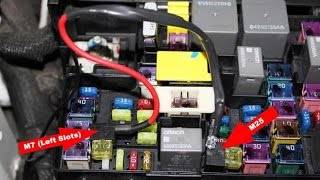
- Faulty Totally Integrated Power Module (TIPM) (Less Common) — On 2005-2014 Chrysler, Dodge, and Jeep vehicles, the fuel pump relay is integrated inside the TIPM (main fuse box). This non-serviceable relay fails frequently, requiring TIPM repair or replacement. 🎬 See how to test and bypass a faulty TIPM relay.
- Failed Fuel Pump (Less Common) — The electric motor inside the fuel pump can fail, creating an internal open circuit. This is often preceded by a whining noise from the fuel tank for several weeks.
- CAN Bus Communication Fault (Rare) — Damaged Controller Area Network (CAN) bus wiring prevents the fuel pump module from receiving PCM commands, triggering a P0627.
- Faulty Powertrain Control Module (PCM) (Very Rare) — The internal driver circuit within the PCM that controls the fuel pump relay can fail. Suspect this only after ruling out all other wiring and module issues.
Symptoms
- Engine cranks but will not start — The starter turns the engine over, but it will not fire because no fuel is reaching the cylinders.
- Engine stalls unexpectedly — The engine starts and runs briefly, then suddenly dies while driving. This is a significant safety hazard.
- No humming sound from the fuel tank — When turning the key to 'On' (without starting), the normal 2-second fuel pump priming hum is absent.
- Check Engine Light is on — The PCM illuminates the Malfunction Indicator Lamp immediately upon detecting the open circuit.
- Reduced engine power and hesitation — During intermittent failures, inconsistent fuel delivery causes the vehicle to feel sluggish and hesitate during acceleration.
Diagnostic Flowchart

Tap your situation to follow the diagnostic path that matches what you're seeing on this code.
Common Fixes & Costs
- Replace Fuel Pump Relay
— Parts: $15-$45, Labor: $40-$60, ~0.2 hr book time
(DIY)
General (Multi-Fit): OEM Varies (e.g., Ford: 8T2T-14B192-AA) (Alt: {"brand": "Standard Motor Products", "part_number": "RY612", "price_comparison": "More affordable"}) - Replace Fuel Pump Driver Module (FPDM/FPCM)
— Parts: $60-$150, Labor: $75-$150, ~0.6 hr book time
(Intermediate)
Ford F-150 (2009-2014): OEM 9L3Z-9D370-B (Alt: {"brand": "Dorman", "part_number": "590-001", "price_comparison": "More affordable"}) - Repair Damaged Wiring or Connectors — Parts: $10-$50, Labor: $125-$300, ~1.0 hr book time (Intermediate)
- Replace Totally Integrated Power Module (TIPM)
— Parts: $500-$1000, Labor: $150-$300, ~1.5 hr book time
(Professional)
Dodge Ram 1500 (2013-2014): OEM 68243267AB (Alt: {"brand": "Dorman", "part_number": "599-905 (Remanufactured)", "price_comparison": "More affordable"}) - Replace Fuel Pump Assembly
— Parts: $250-$800, Labor: $300-$600, ~3.2 hr book time
(Professional)
Jeep Grand Cherokee (2011-2015): OEM 5145589AF (Alt: {"brand": "Bosch", "part_number": "69834", "price_comparison": "Comparable to OEM"})
Used vs. New Parts: Buying Guide
When a used part is worth it: Used or remanufactured electronic modules (TIPM or FPDM) are cost-effective for older vehicles where new OEM parts are prohibitively expensive.
Donor-vehicle mileage cap: roughly under 80000 miles for the part to have meaningful remaining life.
Donor quality checklist:
- Verify the donor vehicle was not scrapped for electrical or fuel system issues.
- Avoid parts from vehicles in the 'Rust Belt' as corrosion is the primary failure mode for frame-mounted modules.
- Match the part number exactly to avoid reprogramming issues.
Decision logic:
- If The part is a simple relay or fuse → buy new; the cost savings for used is negligible.
- If The part is an electronic module (FPDM, TIPM) and the vehicle is over 10 years old → purchase a rebuilt module with a warranty to balance cost and reliability.
- If The part is the in-tank fuel pump assembly → always buy new. The fuel pump is a wear item with significant labor costs, making used parts a poor investment.
Warranty tradeoff: Used parts typically include a 30-90 day warranty. Rebuilt modules carry 1-year to lifetime warranties. New aftermarket parts offer 1-3 year warranties.
Worst-case if a used part fails: $300-$800 if a used electronic module fails after installation, requiring repeat labor and a second replacement part.
What Happens If You Wait — Timeline
- 0-1 month (Intermittent): The code appears after a cold start and disappears. You notice occasional longer crank times or momentary hesitation during acceleration. (MPG impact: 0-2%% · Added cost: $0)
- 1-3 months (Frequent Intermittent): The engine begins stalling unexpectedly but restarts after a few tries. The crank-no-start issue becomes frequent, especially after the vehicle is warm. (MPG impact: 2-5%% · Added cost: $150-$300 for a potential tow.)
- 3+ months (Hard Failure): The intermittent open circuit becomes permanent. The engine cranks but will not start. The fuel pump makes no priming sound. (MPG impact: 100% (vehicle is undrivable)% · Added cost: $150-$300 for a guaranteed tow.)
- Driven with intermittent fault for 6+ months: Repeated lean fuel conditions cause overheating of the catalytic converter, leading to internal damage. (MPG impact: 5-15% (during operation)% · Added cost: $1200-$2800 for catalytic converter replacement.)
Cost of Not Fixing It
- Immediate: High risk of being stranded. The engine cranks but will not start, or stalls unexpectedly while driving, creating a major safety hazard. (Added cost: $150-$300 for a tow.)
- 0-1 month: Intermittent faults cause the engine to run lean, resulting in reduced fuel economy, hesitation, and misfires. (Added cost: $20-$50 in wasted fuel.)
- 1-6 months: Consistently running a lean condition overheats the engine and catalytic converter, causing permanent internal damage. (Added cost: $1200-$2800 for catalytic converter replacement.)
Diagnosis Steps
- Scan for Codes and Review Freeze Frame Data
Use an OBD-II scanner to confirm P0627. Look for related codes like U0109 (Lost Communication With FPCM), which points directly to a module issue rather than the pump. Review freeze-frame data to identify engine conditions when the fault triggered.
Tools: OBD-II Scanner (Beginner) - Listen for the Fuel Pump
Have a helper turn the ignition key to the 'On' position while you listen at the fuel tank cap. A 2-second hum is normal. Silence confirms the pump is not receiving power.
Tools: A quiet environment, a helper (Beginner) - Check the Fuel Pump Fuse and Relay
Locate the fuel pump fuse and relay in the fuse box. Visually inspect the fuse. Swap the fuel pump relay with an identical non-essential relay (like the horn). If the car starts, the original relay is dead.
Tools: Owner's manual, fuse puller or pliers (Beginner) - Inspect the FPCM/FPDM and its Connector
On trucks and SUVs, locate the fuel pump module on the frame rail above the spare tire. Disconnect it and inspect the connector and pins for green/white corrosion, bent pins, or melted plastic.
Tools: Flashlight, safety glasses, basic hand tools (Intermediate) - Check FPCM/FPDM Power and Ground
With the key on, probe the FPCM connector using a multimeter. Check for battery voltage (11.5-12.5V) on the power supply wire. Check resistance between the ground pin and the chassis; it must be under 1 ohm. Zero voltage means an upstream fuse/relay issue; high resistance means a bad ground.
Tools: Multimeter, vehicle-specific wiring diagram (Advanced) - Bypass the Control Module to Test the Pump
Use jumper wires to bypass the FPCM or relay and send 12V directly to the fuel pump. If the pump runs, the pump is good, and the fault is isolated to the control circuit (wiring, relay, or module).
Tools: Jumper wires, wiring diagram (Professional) - Test Fuel Pump Resistance
Disconnect the fuel pump and measure resistance across its terminals. Normal resistance is 0.2 to 3.0 ohms. Infinite resistance (OL) confirms the internal motor winding is broken, requiring pump replacement.
Tools: Multimeter, wiring diagram (Advanced) - Perform a Voltage Drop Test
With the circuit connected and the pump commanded on, measure voltage between the battery positive post and the power feed pin at the pump connector. A reading above 0.5V indicates excessive resistance in the power wire. Repeat for the ground side; readings above 0.2V indicate a bad ground.
Tools: Multimeter, vehicle-specific wiring diagram, scan tool (optional) (Advanced) - Check Fuel Pressure
Connect a fuel pressure gauge to the engine's fuel rail Schrader valve. With Key On, Engine Off (KOEO), pressure should build to spec (typically 40-65 PSI). Zero pressure confirms the pump is not running.
Tools: Fuel pressure gauge kit (Advanced) - Analyze the FPCM Control Signal
Connect an oscilloscope to the FPCM control signal wire from the PCM. During cranking, look for a Pulse Width Modulated (PWM) square wave signal. A flat line indicates a broken wire or a faulty PCM driver.
Tools: Oscilloscope, vehicle-specific wiring diagram (Professional)
When This Code Triggers (Freeze-Frame Conditions)
- Engine State: Key On or Cranking (The code sets immediately when the PCM attempts to prime the fuel pump before the engine starts.)
- Vehicle Speed: Any, including 0 mph (An intermittent open circuit causes stalling at any speed, from idle to highway cruising.)
- Engine RPM: Any (The fault is not RPM-dependent; it occurs during cranking (200-300 RPM) or steady driving.)
- Fuel System Status: Open Loop (The fault is typically detected before the engine warms up enough to enter closed-loop fuel control.)
Related Codes
- P0628 — Means 'Fuel Pump Control Circuit Low' (short to ground). P0627 is a break in the wire, while P0628 means the wire is improperly touching the vehicle's chassis.
- P0629 — Means 'Fuel Pump Control Circuit High' (short to voltage). The circuit is receiving power when it shouldn't be, unlike P0627 which is a loss of connection.
- U0109 — Means 'Lost Communication With Fuel Pump Control Module'. Frequently appears with P0627 on Ford vehicles. Diagnose U0109 first; fixing the communication issue resolves P0627.
- P025A — Means 'Fuel Pump Module Control Circuit/Open'. Identical to P0627 in practical terms. Ford TSBs group P0627 and P025A together for the same FPDM wiring issue.
Climate & Environmental Factors
- Road Salt and Humidity: Salt spray and moisture accelerate corrosion of frame-mounted components like the Ford FPDM and chassis ground connections. The aluminum casing corrodes against the steel frame, destroying the internal circuit board.
- Cold Weather: Hairline cracks in solder joints on fuel pump relays or control modules separate when cold, creating an open circuit. As the component warms, the metal expands, restoring contact and making the problem difficult to diagnose.
- Heat: High ambient temperatures increase electrical resistance in wiring, exacerbating pre-existing conditions like a failing fuel pump motor or weak relay. Chrysler TIPM relay failures are heavily linked to heat generation.
How to Talk to a Mechanic About This Code
Say this: "I have a crank-no-start condition and my scanner shows a P0627 code, 'Fuel Pump Control Circuit Open'. I'd like to book a diagnostic appointment. Please test the fuel pump relay, the control module, and the associated wiring for power and ground before quoting me for a new fuel pump."
This signals to the shop that you understand P0627 is a circuit fault, not a failed pump. It directs them to perform a proper electrical diagnosis first, preventing them from defaulting to the most expensive part replacement.
Avoid saying:
- 'My car won't start, I think it's the fuel pump.'
- 'Just fix whatever's wrong, my check engine light is on.'
- 'My friend said to replace the fuel pump.'
Questions to ask before authorizing the repair:
- Did you test the fuel pump relay and fuse?
- Did you check for 12V power and a good ground at the fuel pump control module connector?
- If you are recommending a fuel pump, did you confirm it fails to run when given direct power?
- Can you show me the corroded connector or broken wire that you found?
- What is the warranty on the recommended parts and labor?
Where to Take It: Dealer vs Independent vs Chain
- Dealer:
Recommended only if the vehicle is under warranty or has a complex, manufacturer-specific fault like the TIPM requiring dealer-level programming.
Best for: Vehicles under warranty., Known complex issues like a Chrysler/Dodge/Jeep TIPM replacement requiring programming., Very new vehicles where independent shops lack updated service information.
Downsides: Highest labor rates, typically 1.5-2x more than an independent shop., May prefer replacing an entire module rather than attempting a known wiring repair. (Typical cost: +50% vs. baseline) - Independent Shop:
Best fit for most cases. A reputable independent shop with strong electrical diagnostic skills offers the best balance of expertise and value.
Best for: Out-of-warranty vehicles where cost is a factor., Diagnosing common electrical faults like P0627, as experienced technicians have seen this issue many times.
Downsides: Shop quality varies. Look for ASE-certified technicians specializing in electrical diagnostics. (Typical cost: +0% vs. baseline) - Chain Shop:
AVOID for P0627 diagnosis. The risk of misdiagnosis and being sold an expensive, incorrect repair is high.
Best for: Simple, routine maintenance like oil changes or tire rotations.
Downsides: Technician skill varies dramatically., Lacks advanced diagnostic tools or experience for complex electrical troubleshooting., Highly likely to misdiagnose P0627 as a bad fuel pump. (Typical cost: -10% vs. baseline)
When to Walk Away From the Repair
If the estimated repair cost exceeds 50% of the car's private-party value, sell or trade it in.
- Car worth $4000, fix is $2200: Walk away. The repair cost is over 50% of the car's value. It is not a sound financial decision.
- Car worth $12000, fix is $1400: Fix it. The repair cost is well below the 50% threshold and is a reasonable investment.
- Car worth $3000, fix is $750: Borderline, but likely worth fixing. The cost is 25% of the value. Get a second opinion and check for other needed repairs before proceeding.
What Scan Tool You Need for This Code
Minimum: A code reader that displays live data streams for the fuel pump control module and checks for related codes like U0109.
A $20 code reader only tells you P0627 is present. To properly diagnose this, you must see if the control module receives power and ground, and ideally, command the pump on and off to verify circuit integrity.
Budget: BlueDriver Pro Scan Tool (~$100) — Reads and clears the code, provides freeze-frame data, and displays live data PIDs. Lacks bidirectional control.
Mid-range: Foxwell NT710 / NT809 (~$250) — Offers bidirectional control to command the fuel pump relay or module on and off. This is the most crucial feature for a DIYer to confirm circuit integrity.
Professional: Autel MaxiCOM MK900-BT / MK808S (~$450-700) — Full bidirectional control of the fuel pump and related components. Accesses manufacturer-specific codes and provides advanced graphing capabilities.
Rent vs buy: A free rental scanner from an auto parts store lacks bidirectional control. Buying a mid-range scanner with active test capabilities is a worthwhile investment that pays for itself with this one repair.
How to Clear the Code After You Fix It
- Reconnect battery if disconnected for repair.
- Use an OBD-II scan tool to select the 'Clear/Erase Codes' function.
- Perform a complete OBD-II drive cycle to allow readiness monitors to run.
Drive cycle (~30 minutes): A generic drive cycle includes a cold start (sit for 8+ hours), 2-3 minutes of idling, 15 minutes of mixed city/highway driving (steady speeds around 55 mph), and at least four 30-second idle periods.
Readiness monitors affected: Catalyst Monitor, Evaporative System Monitor, Oxygen Sensor Monitor
Before emissions retest: drive at least 100 miles to fully set monitors.
Watch out for:
- Disconnecting the battery clears the code but resets all readiness monitors to 'Not Ready', causing an automatic emissions test failure.
- The code returns immediately upon startup if the underlying open circuit was not properly repaired.
- Failing to drive the vehicle through varied conditions prevents readiness monitors from completing their self-tests.
Will This Fail Emissions / State Inspection?
Yes — this code typically fails an OBD-II emissions inspection.
- California: An illuminated Check Engine Light results in an automatic smog check failure. A complete drive cycle must be performed to set all readiness monitors before re-testing.
- New York: The NYS inspection includes an OBD-II scan. P0627 is an automatic failure. Faults must be repaired, cleared, and readiness monitors set.
- Texas: In emissions-testing counties, an illuminated Check Engine Light is an automatic failure. Drive 50-100 miles after clearing the code to reset readiness monitors.
Most Commonly Affected Vehicles

- Ford F-150, F-250/F-350 Super Duty, Expedition, Transit (2009-2024) — Highly prone to P0627 due to a corroded Fuel Pump Driver Module (FPDM) or wiring issues at connector C4336 or ground G401. Often accompanied by code U0109.
- Dodge / Ram Ram 1500/2500/3500, Grand Caravan (2004-2014) — Frequently suffer from a failed internal fuel pump relay within the Totally Integrated Power Module (TIPM), requiring TIPM replacement or repair.
- Jeep Grand Cherokee, Wrangler (2005-2014) — Affected by the same faulty TIPM with an integrated, non-serviceable fuel pump relay as Dodge and Chrysler vehicles.
- Chevrolet / GMC Silverado, Sierra, Malibu, Cruze (2010-2018) — Issues trace back to a faulty frame-mounted Fuel Pump Control Module (FPCM) exposed to corrosion, or wiring problems within the underhood fuse block.
- Mazda 3, 6, CX-5 (2010-2018) — Utilize a fuel pump control module system similar to Ford's, suffering from module failure or wiring issues.
- Hyundai / Kia Sonata, Elantra, Optima (2011-2019) — Code appears due to failures in the fuel pump relay, the fuel pump assembly, or wiring issues near the tank.
- Subaru Outback, Forester, Impreza (2010-2017) — Linked to a faulty fuel pump controller unit or corroded wiring leading to it, typically located under the rear seat.
- Volkswagen Jetta, Golf, Passat (2008-2016) — Presents as an intermittent, temperature-sensitive problem caused by a hairline crack in a solder joint within the fuel pump relay.
Manufacturer-Specific Notes
- Ford: On F-Series and Transit models, the cause is rarely the fuel pump. TSBs instruct technicians to inspect the FPDM connector (C4336) and ground (G401) for heavy corrosion before replacing parts.
- Dodge / Chrysler / Jeep: The fuel pump relay is soldered into the main fuse box (TIPM) and cannot be replaced individually. When it fails, it requires an expensive replacement or rebuild of the entire TIPM.
- Chevrolet / GM: Problems trace to the Fuel Pump Control Module (FPCM) mounted to the frame, which is highly susceptible to corrosion, causing an open circuit.
- Volkswagen: P0627 manifests as an intermittent no-start condition specifically in cold weather due to a failing fuel pump relay with a cracked solder joint.
Real Owner Stories
2013 Ford F-150 with 110K miles
Truck cranked but would not start intermittently. It eventually became a permanent no-start, throwing code P0627.
What they tried:
- Suspected a bad fuel filter.
- Pulled codes after the hard failure.
Outcome: Replaced the heavily corroded Fuel Pump Driver Module (FPDM) located above the spare tire. The replacement took 10 minutes and the truck started immediately.
Lesson: On Ford trucks, intermittent starting issues that become a hard no-start with code P0627 are almost always the FPDM. Check this $70 part before considering the fuel pump.
2011 Dodge Ram 1500 with 140K miles
Vehicle required multiple key cycles to start, progressing to a permanent crank-no-start with no fuel pump hum.
What they tried:
- Swapped the fuel pump relay with the horn relay.
- Checked the fuel pump fuse.
- Replaced the fuel pump assembly, but the truck still would not start.
Outcome: Discovered the fuel pump relay is integrated into the Totally Integrated Power Module (TIPM). The internal relay failed. Replaced the TIPM with a remanufactured unit for $600, solving the problem.
Lesson: On Dodge/Chrysler/Jeep vehicles, do not buy a fuel pump for a P0627 code until ruling out the common TIPM internal relay failure.
2010 Ford Mustang with aftermarket fuel system
Car with a double fuel pump setup suddenly threw code P0627 and would not start.
What they tried:
- Checked fuse #13.
- Swapped both fuel pumps with known good units.
- Swapped the fuel pump relay in the trunk.
Outcome: Traced the wiring harness from the PCM to the fuel pump controller. Found a section of the harness abraded by road debris, causing an open circuit. Repaired the broken wire to resolve the code.
Lesson: P0627 means a circuit problem, not necessarily a component failure. Perform a thorough visual inspection of the wiring harness before replacing expensive parts.
How to Prevent This Code From Triggering
- Keep the fuel tank above 1/4 full (Always) — The fuel pump relies on surrounding gasoline to cool and lubricate its electric motor. Consistently running on a low tank causes the pump to overheat and fail prematurely.
- Apply dielectric grease to connectors (During any related repair) — For components exposed to the elements, applying non-conductive dielectric grease seals out moisture and oxygen, preventing corrosion that causes open circuits.
- Install FPDM with spacers (Ford) (When replacing the FPDM) — The original FPDM mounts directly to the steel frame, causing galvanic corrosion. Aftermarket kits include rubber spacers to create an air gap, stopping corrosion and extending module life.
- Periodically inspect and clean chassis ground points (Every 2-3 years, especially in the Rust Belt) — A loose or corroded ground is a common cause of an open circuit. Cleaning key ground points to bare metal prevents future electrical issues.
Frequently Asked Questions
Is it safe to drive my car with a P0627 code?
No. The engine will stall unpredictably, creating a severe crash risk at highway speeds. Tow the vehicle to a repair shop immediately.
How much does it cost to fix a P0627 code?
Costs range from $15 for a simple relay to over $1,000 for a full fuel pump replacement. The most common fix—replacing a Ford FPDM—averages $200. Proper electrical diagnosis prevents wasting money on unneeded parts.
I replaced my fuel pump, but the P0627 code is still there. What now?
P0627 designates a control circuit failure, not a mechanical pump failure. The fault lies in the wiring, relay, or control module (FPCM/TIPM). You must trace the voltage from the PCM to the pump to find the break.
What are the most common diagnostic mistakes for P0627?
The biggest mistake is replacing the fuel pump without testing the circuit. Mechanics often overlook blown fuses, corroded ground wires (like Ford's G401), or manufacturer TSBs. Always verify power and ground at the module first.
Can I just bypass the fuel pump relay to fix P0627?
Bypassing the relay with a jumper wire is strictly for temporary diagnostic testing. Leaving it bypassed forces the pump to run continuously, draining the battery and burning out the pump motor. Never use this as a permanent fix.
What is a TIPM and why does it cause P0627?
The Totally Integrated Power Module (TIPM) is the main fuse box in 2005-2014 Chrysler, Dodge, and Jeep vehicles. It contains a non-replaceable internal fuel pump relay that frequently fails. When this relay breaks, it triggers P0627 and requires replacing or rebuilding the entire TIPM.
How do you test a Fuel Pump Driver Module (FPDM)?
Visually inspect the module and connector for heavy corrosion. Use a multimeter to verify 12V power entering the module and less than 1 ohm of resistance on the ground wire. If power and ground are good but the pump won't run, the module is dead.
Can a bad battery cause a P0627 code?
No. While a weak battery causes general electrical gremlins, P0627 specifically requires a complete break (open) in the fuel pump control circuit. Focus your diagnosis on broken wires, dead relays, and corroded modules.
Key Takeaways
- Code P0627 indicates a severed electrical connection to the fuel pump, causing an immediate engine stall or a crank-no-start condition.
- Never replace the fuel pump first; over 70% of P0627 codes stem from a $20 faulty relay, a blown fuse, or a corroded ground wire.
- On 2009-2024 Ford trucks, inspect the frame-mounted Fuel Pump Driver Module (FPDM) for aluminum corrosion before testing any other component.
- Stop driving immediately if this code appears, as sudden highway stalling poses a severe crash risk and towing costs less than replacing a lean-damaged catalytic converter.
Helpful Videos
![Easy Fix for Common Chevy Problem [Fuel Pump Control Module]](https://img.youtube.com/vi/38Xeo1uLBoU/mqdefault.jpg)

The information in this article is provided for general reference and educational purposes only. Vehicle specifications, procedures, and part compatibility can vary by production date, trim level, and region. Always consult your vehicle's factory service manual and verify part numbers before purchasing or performing repairs. Safety-critical components such as airbags, seat belts, and braking systems should be installed by a qualified professional.
- 🎬 Helpful Videos
- What Does P0627 Mean?
- Can I Drive With P0627?
- Common Causes
- Symptoms
- Diagnostic Flowchart
- Common Fixes & Costs
- Used vs. New Parts: Buying Guide
- What Happens If You Wait — Timeline
- Cost of Not Fixing It
- Diagnosis Steps
- When This Code Triggers (Freeze-Frame Conditions)
- Related Codes
- Climate & Environmental Factors
- How to Talk to a Mechanic About This Code
- Where to Take It: Dealer vs Independent vs Chain
- When to Walk Away From the Repair
- What Scan Tool You Need for This Code
- How to Clear the Code After You Fix It
- Will This Fail Emissions / State Inspection?
- Most Commonly Affected Vehicles
- Manufacturer-Specific Notes
- Real Owner Stories
- 2013 Ford F-150 with 110K miles
- 2011 Dodge Ram 1500 with 140K miles
- 2010 Ford Mustang with aftermarket fuel system
- How to Prevent This Code From Triggering
- Frequently Asked Questions
- Is it safe to drive my car with a P0627 code?
- How much does it cost to fix a P0627 code?
- I replaced my fuel pump, but the P0627 code is still there. What now?
- What are the most common diagnostic mistakes for P0627?
- Can I just bypass the fuel pump relay to fix P0627?
- What is a TIPM and why does it cause P0627?
- How do you test a Fuel Pump Driver Module (FPDM)?
- Can a bad battery cause a P0627 code?
- Key Takeaways
- 🎟️ Get 5% Off