

OBD-II Code P0617: Starter Relay Circuit High
What P0617 means, why it triggers, and how to fix it
- Code P0617 indicates high voltage in the starter relay circuit, causing a 100% failure to crank or intermittent starting issues.
- A faulty $20 starter relay is the most common cause, which you can diagnose in 5 minutes by swapping it with the identical horn relay in your fuse box.
- Never replace the $300+ starter motor first; P0617 specifically flags the low-current control circuit, meaning the fault lies in the relay, ignition switch, or wiring.
- Driving with an intermittent P0617 risks a stuck relay that keeps the starter engaged while the engine runs, causing over $1,000 in catastrophic flywheel damage.
What Does P0617 Mean?

P0617 means the Powertrain Control Module (PCM) detects voltage in the starter relay circuit exceeding the manufacturer's specified limit. This circuit takes the low-current signal from the ignition switch to control high-current flow to the starter motor. The PCM sets this code to protect the starting system from excessive voltage, often preventing the engine from cranking as a failsafe.
Technical definition: The official SAE/OBD-II definition is "Starter Relay 'A' Circuit High". The PCM constantly monitors the starter-relay control line. If it registers high voltage when it shouldn't—such as when the key is not in the 'START' position or the engine is already running—it triggers P0617.
🎬 See a quick overview of the P0617 code and its causesCan I Drive With P0617?
Yes, But With Caution. If the car starts, it is safe for short trips. However, the underlying issue causes intermittent or complete no-start conditions, risking stranding. In rare cases, the fault keeps the starter engaged after the engine starts, destroying the starter motor and flywheel. This adds $500-$1500+ in repair costs. The issue will not resolve itself and requires prompt attention.
Common Causes

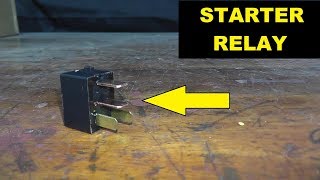
- Faulty Starter Relay (Very Common) — The starter relay's internal contacts weld together from heat or wear, or the internal coil shorts out, causing a continuous high voltage signal. This is the most frequent culprit for P0617. 🎬 Watch: How to test and replace a faulty starter relay
- Shorted or Damaged Wiring (Common) — Wires in the starter relay circuit fray, melt from heat, or corrode. A wire in the control circuit shorting to a power source causes the voltage to spike, triggering the code.
- Faulty Ignition Switch (Common) — The ignition switch sends the initial signal to activate the starter relay. An internal fault in the switch causes it to send continuous or excessive voltage down the line, even after releasing the key from the 'START' position.
- Poor Ground Connection (Common) — A loose, corroded, or broken ground strap for the engine, PCM, or relay harness alters the circuit's reference voltage. This makes a normal voltage signal appear high to the computer because the ground reference is unstable.
- Faulty Neutral Safety Switch / Clutch Position Sensor (Less Common) — These safety switches prevent the engine from cranking unless the vehicle is in Park/Neutral or the clutch is depressed. A fault in one of these switches sends an erroneous high signal to the starter relay circuit.
- Blown Fuse or Fusible Link (Less Common) — While a blown fuse typically causes a 'low' circuit code (P0616), a power surge that precedes the fuse blowing registers in the PCM as a high voltage event, setting P0617.
- Failing Starter Solenoid (Rare) — The starter solenoid is a high-current relay on the starter itself. An internal short in the solenoid sometimes back-feeds voltage into the low-current control circuit, causing a high voltage reading.
- Faulty Powertrain Control Module (PCM) (Rare) — The internal driver circuit within the PCM that controls the starter relay fails, causing it to send a constant high voltage signal or misinterpret the incoming signal. This is the last part to suspect after eliminating all other possibilities.
Symptoms

- Engine will not crank or start — This is the most common symptom. You turn the key or press the start button, and nothing happens, or you hear only a single, sharp click from the relay.
- Intermittent starting issues — The car fails to start several times and then suddenly starts normally. This is caused by a sticking relay or a loose connection, making the problem seem random.
- Engine continues to crank after key is released — A stuck ('welded') relay or faulty ignition switch causes the starter motor to continue running after the engine starts. This creates a loud grinding noise and quickly destroys the starter and flywheel.
- Battery drain when car is off (also visible on scanner) — If the starter relay sticks in a partially closed position, it creates a parasitic draw that slowly drains the battery overnight.
- Check Engine Light is on (also visible on scanner) — The PCM illuminates the Check Engine Light on the dashboard to alert the driver of the detected fault.
Diagnostic Flowchart
Tap your situation to follow the diagnostic path that matches what you're seeing on this code.
Common Fixes & Costs
- Replace Starter Relay — Parts: $15-$50, Labor: $40-$100, ~0.5 hr book time (DIY)
- Repair Wiring or Ground Connection — Parts: $5-$30, Labor: $100-$300, ~2 hr book time (Intermediate)
- Replace Ignition Switch — Parts: $60-$200, Labor: $75-$150, ~1.2 hr book time (Professional)
- Replace Neutral Safety Switch / Clutch Position Sensor — Parts: $40-$150, Labor: $100-$200, ~1.5 hr book time (Intermediate)
- Replace Powertrain Control Module (PCM) — Parts: $600-$1200, Labor: $150-$300, ~2 hr book time (Professional)
DIY vs Professional
- Replace Starter Relay — Beginner:
Tools: Owner's manual, needle-nose pliers. - Repair Wiring or Ground Connection — Beginner:
Tools: Multimeter, wiring diagram, wire strippers, crimpers, heat shrink, wire brush. - Replace Ignition Switch — Beginner:
Tools: Socket set, trim removal tools, screwdriver set, steering wheel puller. - Replace PCM — Beginner:
Tools: Socket set, OEM-level scan tools for programming.
Used vs. New Parts: Buying Guide
When a used part is worth it: For a simple starter relay, buying used rarely makes sense. The part is inexpensive new, and its failure leaves you stranded. A used relay has an unknown history and offers minimal cost savings.
Donor-vehicle mileage cap: roughly under 40000 miles for the part to have meaningful remaining life.
Donor quality checklist:
- Match the part number exactly.
- Ensure there is no visible corrosion on the terminals.
- Avoid if the part comes from a vehicle with known flood or electrical fire damage.
Decision logic:
- If The part is a standard ISO relay costing less than $50 new. → Always buy new. The potential hassle and towing cost from a used part failure far outweigh the small savings.
- If The relay is integrated into an expensive module (like a TIPM or fuse box) costing over $500. → A used module from a low-mileage, accident-damaged vehicle is a cost-effective option, but verify the part number and return policy.
Warranty tradeoff: Used parts typically have a 30-90 day warranty at best. New aftermarket parts often carry a 1-year to limited lifetime warranty. OEM parts also carry a warranty, often for 1 year.
Worst-case if a used part fails: $100-$250 for towing and diagnostic labor if the used part fails shortly after installation.
What Happens If You Wait — Timeline
- Immediate: Code P0617 is set. The most common symptom is an immediate no-start or intermittent no-start condition. The car leaves you stranded without warning. (MPG impact: 0%% · Added cost: $75-$150 for a potential tow.)
- 1-4 weeks: If the fault is a stuck-on relay causing a parasitic draw, the battery weakens. You notice slower cranking, and the battery dies after sitting for 1-3 days. (MPG impact: 0%% · Added cost: $150-$300 for a new battery if the drain completely sulfates the original one.)
- 1-3 months (if worst-case occurs): In the rare scenario where the relay welds completely shut, the starter motor remains engaged after the engine starts, creating a loud grinding noise. (MPG impact: 0%% · Added cost: $300-$700 to replace the destroyed starter motor.)
- Ongoing risk from Stage 3: Continued operation with a stuck-on starter destroys the starter motor and strips the teeth off the engine's flywheel or flexplate ring gear. (MPG impact: 0%% · Added cost: $800-$2000+. This repair requires removing the transmission to replace the flywheel.)
Cost of Not Fixing It
- Immediate: Intermittent no-start or complete failure to start, leaving you stranded. (Added cost: Towing costs ($75-$150).)
- 1-3 Months: A stuck-on starter relay causes parasitic battery drain, leading to a dead battery and requiring a jump start or battery replacement. (Added cost: $150-$300 for a new battery.)
- Ongoing Risk: In a worst-case scenario, the starter relay welds shut, keeping the starter motor engaged while the engine is running. This destroys the starter motor and the engine's flywheel ring gear. (Added cost: $800-$2,000+ for starter and flywheel replacement, as this requires removing the transmission.)
Diagnosis Steps

- Check for Technical Service Bulletins (TSBs)
Search online for any TSBs related to P0617 for your specific make and model. Manufacturers release known fixes for common issues, such as software updates or wiring harness repairs, saving significant diagnostic time.
Tools: Internet access (Beginner) - Inspect Fuses and Swap the Starter Relay
Locate the starter relay in the under-hood fuse box. Check the related fuses for the starting circuit. Swap the starter relay with an identical relay from a non-essential circuit (like the horn or wipers). If the car starts, the relay is bad.
Tools: Owner's manual (Beginner) - Visually Inspect Wiring and Grounds
Inspect all visible wiring between the battery, fuse box, ignition switch, and starter motor. Look for frayed insulation, melted plastic, corrosion, or loose connections. Ensure the main engine and PCM ground straps are clean, tight, and free of corrosion.
Tools: Flashlight, wire brush (Intermediate) - Test Battery and Connections
Ensure the battery is fully charged (12.4V or higher) and the terminals are clean and tight. A weak battery sometimes causes erratic voltage issues.
Tools: Multimeter, battery terminal cleaner (Intermediate) - Test Relay Socket Voltages
Remove the starter relay. Using a multimeter and wiring diagram, identify the pins in the empty socket (typically 30, 85, 86, 87). With the key off, check for voltage. Pin 30 should have constant battery voltage (~12.6V). All others should have 0V. Have a helper turn the key to 'START'. You should see battery voltage on the control side (pin 86) and the power feed (pin 30). If voltage is present on pin 86 when the key is NOT in the start position, you have a short to power or a faulty ignition switch.
Tools: Multimeter, vehicle wiring diagram (Advanced) - Perform a Voltage Drop Test on the Ground Circuit
Set your multimeter to a low DC voltage scale (e.g., 2V). Connect the red lead to the negative battery terminal and the black lead to the starter relay's ground pin in the socket (usually pin 85). Have a helper attempt to crank the engine. A good ground circuit shows a reading of less than 0.2 volts (200mV). A higher reading indicates excessive resistance in the ground path.
Tools: Multimeter (Advanced) - Test Relay Coil and Contact Resistance
With the relay removed, set the multimeter to Ohms (Ω). Test the resistance between the control circuit pins (usually 85 and 86). A good relay coil reads between 50 and 200 Ohms. An 'OL' reading means the coil is open; 0 Ohms means it's shorted. Check the switched contacts (pins 30 and 87) for no continuity (OL). Use jumper wires to apply 12V to pins 85 and 86. The relay should click. While energized, test resistance between pins 30 and 87 again. It should be less than 1 Ohm. If it fails any test, replace it.
Tools: Multimeter, 12V power source (or vehicle battery), jumper wires (Advanced) - Test the Ignition Switch Signal
Back-probe the wire from the ignition switch to the starter relay control circuit (pin 86). The voltage should be approximately 12V only when the key is turned to the 'START' position and 0V otherwise. If voltage is present when it shouldn't be, the ignition switch or its wiring is faulty.
Tools: Multimeter, vehicle wiring diagram (Advanced) - Check Live Data for Specific Thresholds
Using an advanced scan tool, monitor the live data PID for the starter circuit. Many Toyota vehicles set P0617 if the starter signal is ON for over 20 seconds while vehicle speed is above 12 mph. Honda vehicles set the code if the 'Starter Cut Relay Diagnosis' voltage exceeds 3.2V.
Tools: Advanced OBD-II Scan Tool (Advanced) - Test the PCM Output
If the relay, wiring, and ignition switch test good, check the signal from the PCM. Back-probe the relay control wire at the PCM connector to check for voltage. If high voltage is present directly from the PCM when it should be off, and all grounds are verified, the module itself is faulty.
Tools: Multimeter, vehicle wiring diagram (Advanced)
When This Code Triggers (Freeze-Frame Conditions)
- Engine RPM: 1000-2500 RPM (Engine running post-start)
- Vehicle Speed: 15-55 mph (Driving at city or highway speed)
- Engine Coolant Temp: 180-210°F (Engine at normal operating temperature)
- Starter Signal (STA): ON (PCM incorrectly sees starter signal active while driving)
Related Codes
- P0616 — This code means 'Starter Relay Circuit Low'. P0617 indicates high voltage, while P0616 indicates low voltage. Seeing both together points to an intermittent wiring problem or a failing relay fluctuating between open and shorted states.
- P0615 — This is a general 'Starter Relay Circuit Malfunction' code. P0617 is a more specific version of P0615, pointing directly towards checking for shorts to power or a stuck relay.
- P0607 — This code means 'Control Module Performance'. If P0607 appears with P0617, it strongly suggests the problem is with the Powertrain Control Module (PCM) failing an internal self-check.
- P0513 — This code means 'Incorrect Immobilizer Key'. If seen with P0617, it indicates a problem with the vehicle's anti-theft system preventing the starter relay from functioning correctly.
Climate & Environmental Factors
- Humidity and High-Corrosion Environments: This code is prevalent in regions with high humidity or where road salt is used in winter. Moisture accelerates the corrosion of wiring, fuse box terminals, and ground connections. A corroded ground increases resistance and alters circuit reference voltages, leading the PCM to incorrectly interpret a normal signal as 'high'.
- Extreme Cold: Cold weather exacerbates pre-existing issues. A relay with aging internal contacts is more likely to stick in the closed position in very cold temperatures. Cold weather also puts more strain on the starting system, making intermittent electrical faults more apparent.
How to Talk to a Mechanic About This Code
Say this: "I have a P0617 code with an intermittent no-start. I've already swapped the starter relay with no change. I'd like to book a diagnostic appointment to test the starter relay control circuit, specifically checking for a short-to-power, a bad ground, or a faulty ignition switch signal."
This signals you have done basic homework and steers the mechanic away from unnecessarily replacing the starter motor. It focuses their diagnostic time on the more probable electrical components in the control circuit.
Avoid saying:
- 'My car won't start, I think I need a new starter.'
- 'My check engine light is on, can you just fix it?'
- 'Just do whatever you think is best.'
Questions to ask before authorizing the repair:
- If you are recommending a starter replacement, can you confirm you tested for voltage at the starter solenoid 'S' terminal during a crank attempt and it was correct?
- If you are recommending a PCM replacement, can you show me the test results that prove all wiring, grounds, and input signals from the ignition switch are good?
- If you are recommending a wiring repair, can you show me the location of the short or corrosion you found?
- What is the warranty on this specific repair, including both parts and labor?
Where to Take It: Dealer vs Independent vs Chain
- Dealer:
Recommended only if you have a warranty, a known recall, or a complex module issue. Otherwise, an independent shop is more cost-effective.
Best for: Vehicles under warranty., Vehicles with known TSBs or recalls for P0617 (e.g., Jeep PCM recall U87)., Complex, integrated modules like a Chrysler TIPM that require proprietary programming.
Downsides: Highest labor rates., Defaults to replacing an entire assembly (like a fuse box) instead of repairing a single circuit. (Typical cost: +50% vs. baseline) - Independent Shop:
Best fit for most P0617 scenarios. A good independent shop efficiently diagnoses and repairs the most common causes without the high overhead of a dealer.
Best for: Out-of-warranty vehicles where cost is a factor., Diagnosing common electrical faults like bad relays, wiring shorts, or faulty ignition switches.
Downsides: Quality varies; look for shops with ASE-certified technicians specializing in electrical diagnostics. (Typical cost: +0% vs. baseline) - Chain Shop:
AVOID for initial diagnosis. Their business model is not suited for complex electrical troubleshooting.
Best for: Simple, known fixes like a battery replacement or if you have already self-diagnosed a bad, easily accessible relay.
Downsides: Technician skill varies widely., Not equipped for in-depth electrical circuit tracing, leading to a high risk of misdiagnosis and upselling expensive parts like the starter motor. (Typical cost: -10% vs. baseline)
When to Walk Away From the Repair
If the estimated repair cost exceeds 50% of the car's private-party value, seriously consider selling or trading it in instead of repairing it.
- Car worth $3000, fix is $1500: Walk away. A $1500 PCM replacement on a $3000 car is a poor investment, as other age-related repairs are likely imminent.
- Car worth $12000, fix is $450: Fix it. A $450 repair for a wiring issue or ignition switch is well below the threshold and restores full function to a valuable vehicle.
- Car worth $4000, fix is $2200: Walk away. If the worst-case scenario of a destroyed starter and flywheel occurs, the repair cost is too high relative to the car's value.
What Scan Tool You Need for This Code

Minimum: A basic code reader that retrieves powertrain codes (P-codes) and clears the Check Engine Light.
A basic $20 reader only tells you the code exists. It cannot view live data, which is crucial for seeing if the starter signal is stuck 'ON' or if circuit voltage is abnormal. Without live data, you are guessing at the cause.
Budget: BlueDriver Pro (~$100) — Connects to your smartphone and provides live data graphing. This allows you to monitor the 'Starter Signal' PID to see if it's active when it shouldn't be, helping distinguish between a faulty switch and a wiring short.
Mid-range: Foxwell NT510 Elite (~$180) — Offers manufacturer-specific codes and data, which is more precise than generic OBD-II. It includes some bi-directional controls to test components.
Professional: Autel MaxiCOM MK808 / TopDon Phoenix Nano (~$500-700) — These professional-level tablet scanners provide full bidirectional control to actively test circuits. They are required for programming a new PCM to the vehicle's VIN and security system.
Rent vs buy: Many auto parts stores read your code for free. However, for a proper diagnosis of P0617, you need to see live data. Buying a budget pick like the BlueDriver Pro is a worthwhile investment that costs less than one hour of diagnostic labor at a shop.
How to Clear the Code After You Fix It
- Use an OBD-II scan tool to clear the P0617 code.
- Ensure the fuel tank is between 30% and 70% full.
- Perform a complete drive cycle to allow readiness monitors to run.
Drive cycle (~30 minutes): After an 8-hour cold soak, start the engine and idle for 2-3 minutes. Drive for 15-20 minutes with a mix of steady highway speeds (55-60 mph for at least 5 minutes) and stop-and-go city driving with several idle periods.
Readiness monitors affected: Catalyst Monitor, Oxygen (O2) Sensor Monitor, EVAP System Monitor, Comprehensive Component Monitor
Before emissions retest: drive at least 50 miles to fully set monitors.
Watch out for:
- Simply clearing the code will not fix the underlying electrical fault; the code returns immediately if the repair was not successful.
- Disconnecting the battery clears the code but resets all readiness monitors to 'Not Ready', causing an automatic emissions test failure.
- Not driving long enough or under the right conditions to complete the drive cycle leaves monitors 'Not Ready'.
Will This Fail Emissions / State Inspection?
Yes — this code typically fails an OBD-II emissions inspection.
- California: An illuminated Check Engine Light from code P0617 is an automatic failure. After repair, a full drive cycle must be completed to set all readiness monitors before a re-test is possible.
- New York: NYS vehicle inspection includes an OBD-II scan. An active P0617 code and illuminated MIL result in an automatic failure.
- Texas: In the 17 counties requiring emissions testing, an illuminated Check Engine Light is an automatic failure. After repair, drive 50-100 miles to set the readiness monitors before passing inspection.
Most Commonly Affected Vehicles
- Ford F-150, Focus, Fusion (2013-2018) — Often related to a faulty starter relay or corrosion in the fuse box (Battery Junction Box). On some Focus/Fusion models, a wiring harness issue near the transmission is a known cause.
- Hyundai Elantra, Sonata (2017-2020) — These models set P0617 due to software glitches. Hyundai has issued several TSBs for ECM updates to address various electrical issues. Always check for software updates before replacing hardware.
- Jeep Cherokee, Grand Cherokee (2014-2019) — Known for issues where a bad ground connection or faulty starter relays trigger P0617. For 2018-2019 models, check for NHTSA recall U87 / 18V-524, which involves a faulty PCM voltage regulator.
- Honda Civic, Accord, Fit, Pilot, CR-V (2011-2022) — The code is defined as 'Starter Cut Relay Diagnosis Circuit High Voltage'. It is caused by a faulty relay circuit board, shorted wiring, or a PCM that needs a software update.
- Chrysler/Dodge Town & Country, Grand Caravan, Ram Trucks (2008-2016) — These vehicles have electrical issues where the fuse box, known as the Totally Integrated Power Module (TIPM), is a common source of relay-related faults.
- Chevrolet/GMC Silverado, Sierra, Volt, Malibu (2016-2020) — A faulty ignition switch is a known cause. TSB 17-NA-305 notes that on some 2016-2018 Malibu models, condensation from the wireless charger cooling duct drips onto a converter connector, causing a short.
- Toyota Camry, various models (2007-2021) — The ECM has specific logic to set P0617 if it detects the starter signal is ON for more than 20 seconds while the vehicle is moving at a speed over 12 mph, pointing directly to a stuck relay or ignition switch.
- Subaru BRZ, Forester (2013-2022) — Owners report P0617 is often resolved by a simple starter relay swap in the engine bay fuse box.
Manufacturer-Specific Notes
- Honda: Honda refers to this as 'Starter Cut Relay Diagnosis Circuit High Voltage'. The diagnostic procedure requires checking for a voltage threshold above 3.2V.
- Toyota: The ECM sets P0617 if it detects the starter signal is ON for more than 20 seconds while the vehicle is moving at a speed over 12 mph, indicating a stuck-on relay or ignition switch.
- General Motors (Chevrolet/GMC): TSB 17-NA-305 identifies a cause on 2016-2018 Malibu models where condensation from the wireless device charging port's cooling duct drips onto the DC/DC converter connector, causing a short.
- Jeep/Chrysler/Dodge: The starter relay is integrated into the Totally Integrated Power Module (TIPM). Check for recall U87 / NHTSA 18V-524 for 2018-2019 models, as a faulty PCM is replaced for free.
- Hyundai: For models like the Elantra and Sonata, check for open service campaigns related to ECM software updates. Applying a software patch resolves erroneous electrical fault codes without parts replacement.
Real Owner Stories
2019 Jeep Cherokee with 65k miles
Car suddenly wouldn't start, just a single click. Check engine light came on with P0617.
What they tried:
- Owner tried jump-starting the vehicle with no success.
- Swapped the starter relay (K1) with the horn relay in the under-hood fuse box.
Outcome: The Jeep started immediately after swapping the relays. The owner purchased a new OEM relay for $30. The code was cleared and did not return.
Lesson: Always try the simplest, cheapest fix first. A 5-minute relay swap saves a towing fee and diagnostic charge.
2017 Honda CR-V with intermittent no-start
Vehicle intermittently failed to crank. Code P0617 was stored.
What they tried:
- A mechanic suspected the starter and quoted $600.
- Owner sought a second opinion at a dealership. The technician found a TSB related to PCM software.
Outcome: The dealership performed a PCM software update. The issue was resolved for $150 in labor.
Lesson: Don't immediately replace expensive parts like the starter. Software glitches cause phantom electrical codes. Always check for TSBs and software updates first.
2014 Ford F-150 with battery drain and P0617
The truck's battery died after sitting for a day. After a jump start, the check engine light showed P0617.
What they tried:
- Owner replaced the battery, but the drain continued.
- A shop performed a parasitic draw test and isolated the draw to the starter relay circuit.
Outcome: The starter relay was internally shorted and stuck, causing a continuous small current draw. Replacing the relay fixed both the drain and the code for $250.
Lesson: P0617 manifests as a parasitic battery drain if the relay is stuck in a partially closed state. If you have a no-start and a dead battery, suspect the relay.
2018 Jeep Grand Cherokee with P0617 and P0607
Vehicle would not start and displayed P0617 and P0607 (Control Module Performance).
What they tried:
- The owner checked fuses and relays, which were good.
- Took the vehicle to a dealer due to the P0607 code.
Outcome: The dealership identified NHTSA recall U87 / 18V-524. A voltage regulator in the PCM failed. The PCM was replaced and reprogrammed free of charge.
Lesson: If P0617 is accompanied by P0607, the PCM is the likely culprit. Always check for recalls and TSBs when multiple codes appear together.
How to Prevent This Code From Triggering
- Periodically Clean Battery Terminals and Ground Connections (Every 12 months) — Corrosion on battery terminals and ground points increases resistance, destabilizing the electrical system's ground reference. Cleaning these points ensures a solid, low-resistance connection.
- Apply Dielectric Grease to Relay Terminals and Connectors (Whenever a relay or connector is serviced) — Dielectric grease blocks moisture, salt, and dirt from entering electrical connections, preventing corrosion that causes high-resistance faults and shorts.
- Perform Regular Visual Inspection of Wiring Harnesses (Every 24 months) — Checking for wires rubbing against sharp metal edges or resting on hot exhaust components prevents shorts-to-power. Securing loose harnesses with zip ties is highly effective.
- Ensure Fuse Box Lid is Secure and Sealed (After any under-hood service) — If the fuse box lid is not fully latched, water enters and causes widespread corrosion on relays and fuse terminals, leading to multiple electrical failures.
Frequently Asked Questions
Can I fix P0617 myself?
Yes, in many cases. The most common fix is replacing the starter relay, a simple plug-and-play part in the fuse box. You can test this in minutes by swapping it with an identical relay.
Is P0617 a serious code?
It is moderately serious. While it won't damage your engine while driving, it prevents your car from starting and leaves you stranded. Address it promptly to avoid being stuck.
What's the most common mistake when diagnosing P0617?
The most common misdiagnosis is immediately replacing the starter motor. P0617 points to a problem in the control circuit (relay, wiring, ignition switch), not the starter itself. Always test the simpler, cheaper components first.
Can a bad battery cause P0617?
It is unlikely but possible. P0617 indicates a high voltage condition, whereas a weak battery causes low voltage. However, a battery with an internal short or a faulty alternator voltage regulator sometimes causes a voltage spike that triggers the code.
What's the difference between a starter relay and a starter solenoid?
The starter relay is a small, low-current switch in the fuse box activated by your key. It sends a small electrical signal to the starter solenoid. The starter solenoid is a large, high-current switch on the starter motor that handles the massive current needed to spin the engine.
My car clicks but won't start. Is it the battery or P0617?
A weak battery usually causes a rapid clicking sound. A single, sharp click indicates a starter relay or solenoid issue related to P0617. Test the battery voltage first (it should be above 12.4V), and if good, scan for trouble codes.
Will clearing the code fix the problem?
No. Clearing the code only erases the fault from the PCM's memory. Because P0617 is a hard electrical fault, the code returns immediately the next time you try to start the car.
Key Takeaways
- Code P0617 indicates high voltage in the starter relay circuit, causing a 100% failure to crank or intermittent starting issues.
- A faulty $20 starter relay is the most common cause, which you can diagnose in 5 minutes by swapping it with the identical horn relay in your fuse box.
- Never replace the $300+ starter motor first; P0617 specifically flags the low-current control circuit, meaning the fault lies in the relay, ignition switch, or wiring.
- Driving with an intermittent P0617 risks a stuck relay that keeps the starter engaged while the engine runs, causing over $1,000 in catastrophic flywheel damage.
Helpful Videos

The information in this article is provided for general reference and educational purposes only. Vehicle specifications, procedures, and part compatibility can vary by production date, trim level, and region. Always consult your vehicle's factory service manual and verify part numbers before purchasing or performing repairs. Safety-critical components such as airbags, seat belts, and braking systems should be installed by a qualified professional.
- 🎬 Helpful Videos
- What Does P0617 Mean?
- Can I Drive With P0617?
- Common Causes
- Symptoms
- Diagnostic Flowchart
- Common Fixes & Costs
- DIY vs Professional
- Used vs. New Parts: Buying Guide
- What Happens If You Wait — Timeline
- Cost of Not Fixing It
- Diagnosis Steps
- When This Code Triggers (Freeze-Frame Conditions)
- Related Codes
- Climate & Environmental Factors
- How to Talk to a Mechanic About This Code
- Where to Take It: Dealer vs Independent vs Chain
- When to Walk Away From the Repair
- What Scan Tool You Need for This Code
- How to Clear the Code After You Fix It
- Will This Fail Emissions / State Inspection?
- Most Commonly Affected Vehicles
- Manufacturer-Specific Notes
- Real Owner Stories
- 2019 Jeep Cherokee with 65k miles
- 2017 Honda CR-V with intermittent no-start
- 2014 Ford F-150 with battery drain and P0617
- 2018 Jeep Grand Cherokee with P0617 and P0607
- How to Prevent This Code From Triggering
- Frequently Asked Questions
- Can I fix P0617 myself?
- Is P0617 a serious code?
- What's the most common mistake when diagnosing P0617?
- Can a bad battery cause P0617?
- What's the difference between a starter relay and a starter solenoid?
- My car clicks but won't start. Is it the battery or P0617?
- Will clearing the code fix the problem?
- Key Takeaways
- 🎟️ Get 5% Off