

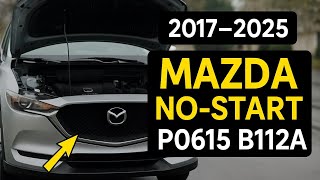
P0615 on 2017-2024 Mazda CX-5: Starter Relay Circuit Malfunction Causes and Fixes
On a 2017-2024 Mazda CX-5, code P0615 almost always points to a no-start condition caused by water leaking into an electrical connector (C-04) behind the dashboard. This is a known issue covered by Mazda Service Alert SA-014-25 (and its predecessor SA-051/20). The leak often occurs after a windshield replacement or tinting. The fix involves cleaning and sealing the corroded connector, a low-cost DIY repair. Mazda has stated repairs for this are not covered under warranty.
- P0615 on a 2017-2024 CX-5 is most likely not a bad starter; it's an electrical issue.
- Before buying any parts, inspect connector C-04 behind the driver's kick panel for water damage, as this is a known Mazda issue (Service Alert SA-014-25).
- This repair is likely not covered by warranty if the leak was caused by aftermarket windshield or tint work.
- If the connector is dry and clean, the next step is to test the starter relay by swapping it with an identical one.
- The fix is often cheap and simple: cleaning the connector with electrical cleaner and sealing it with dielectric grease.
What's Unique About the 2017-2024 Mazda CX-5

The 2017-2024 Mazda CX-5 is uniquely prone to this code due to a specific water leak issue. Mazda issued Service Alert SA-014-25 (and the earlier SA-051/20) which identifies that water can enter and corrode a key electrical connector (C-04) located behind the driver's side kick panel. This often happens after a windshield replacement (due to poor sealing) or aftermarket window tinting, where water used in the process drips down into the dash. Even clear UV-blocking film can cause this leak. This specific, well-documented issue is the most common reason for P0615 on this vehicle, often accompanied by code B112A:12.
Diagnostic Flowchart

Tap your situation to follow the diagnostic path that matches what you're seeing on this vehicle.
Symptoms You May Notice

- Engine will not crank or start
- A single click sound when pressing the start button, but no cranking.
- Intermittent no-start condition, which may seem random at first.
- Check Engine Light is on
- Key fob may not be recognized or security light flashes.
- Replacing the battery: A no-start condition often leads people to assume the battery is dead. While a weak battery can cause electrical issues, the specific P0615 code points to the starter circuit, not the battery's state of charge.
- Replacing the starter motor: Owners may replace the entire starter motor when the actual problem is a cheap relay or a corroded connector that isn't allowing the signal to reach it. This is a common diagnostic error.
Most Likely Causes

- Water Intrusion and Corrosion at Connector C-04 🔴 High Probability As documented in Mazda Service Alert SA-014-25 and SA-051/20, the location of this connector behind the dash makes it vulnerable to water dripping down after a windshield replacement or tinting. Mazda explicitly notes that repairs for this concern are not covered under warranty.
How to confirm: Remove the driver's side kick panel and locate connector C-04. 🎬 Watch: How to find and fix the corroded C-04 connector. It is typically a large, white, multi-pin connector located above the dead pedal area. Inspect the connector and its wiring harness for signs of moisture, or a classic white/green crusty residue indicating corrosion on the pins.
Typical fix: Disconnect the battery. Unplug the connector, clean the pins and housing thoroughly with electrical contact cleaner and a small brush. Let it dry completely, then apply dielectric grease to the connector housing to seal it from future moisture before reconnecting. The source of the water leak must also be found and addressed.
Est. part cost: $10-$25 - Faulty Starter Relay 🟡 Medium Probability
How to confirm: Locate the starter relay in the engine compartment fuse box. Swap it with an identical relay from a non-critical circuit (like the horn) and see if the car starts. If it does, the relay is bad. These are often 12V 4-pin relays.
Typical fix: Replace the starter relay. 🎬 See this quick walkthrough on changing Mazda CX-5 fuses and relays. A common type is the G4A-1A-E 12VDC relay.
Est. part cost: $15-$40 - Damaged Wiring or Blown Fuse ⚪ Low Probability
How to confirm: Visually inspect the wiring between the battery, fuse box, and starter for any breaks, chafing, or corrosion. Use a multimeter to check for continuity. Check the starter-related fuses in the fuse box.
Typical fix: Repair the damaged section of wiring or replace the blown fuse.
Est. part cost: $5-$50
Rare But Worth Checking
- Faulty Starter Motor/Solenoid: While less common for this specific code, if the relay and wiring are confirmed to be good and sending power, the starter itself could have failed.
- Faulty Powertrain Control Module (PCM) or Start Stop Unit: This is very rare. All other possibilities, especially the TSB-related water leak and the starter relay, should be exhaustively ruled out before considering the PCM as the cause.
- Faulty Brake Light Switch: In one documented case, a faulty brake light switch prevented the car from recognizing the brake pedal was depressed, leading to an intermittent no-start. The owner noted the brake pedal felt hard to press when the no-start occurred. This was resolved by replacing the switch, even though the brake lights appeared to be working correctly.
Diagnosis Steps
- Scan for trouble codes. Note if P0615 is present, especially if paired with B112A:12.
- Check the battery. Ensure it is fully charged and the terminals are clean to eliminate it as a variable.
- CRITICAL STEP: Locate and inspect connector C-04. Remove the driver's side kick panel and look above the dead pedal for a large, white electrical connector. Disconnect it and check thoroughly for any signs of water damage, green or white corrosion, or bent pins, as per TSB SA-014-25.
- If corrosion is found, clean the connector pins and housing with electrical contact cleaner and a small brush. Allow it to dry completely, apply dielectric grease to the seal, and reconnect.
- If the connector is clean, locate the starter relay in the engine bay fuse box. Swap it with a known good, identical relay (e.g., from the horn circuit) to test if the relay is the fault.
- If the vehicle still doesn't start, use a multimeter to check for voltage at the starter solenoid's signal wire when the start button is pressed. If voltage is present, the starter motor is likely faulty. If no voltage is present, there is an open or short in the wiring between the relay and the starter.
- Inspect all related fuses in both the engine and passenger compartment fuse boxes.
- Consider the brake light switch. If the no-start is intermittent, pay attention to the feel of the brake pedal. If it feels hard to depress during a no-start event, the switch could be the culprit.
Parts You'll Likely Need
- Electrical Contact Cleaner and Dielectric Grease — This is required to fix the most common cause: a corroded electrical connector as described in the Mazda Service Alert.
Trusted brands: CRC, Permatex
Aftermarket price range: $10-$25 - Starter Relay — If the connector is clean, a failed relay is the next most likely component to cause this specific circuit malfunction code.
Trusted brands: Omron (G4A-1A-E-12VDC), Denso, Bosch
OEM price range: $25-$50
Aftermarket price range: $15-$40 - Fuse and Relay Center
(OEM #KD45-66-760A)— In rare cases of extensive corrosion or electrical damage, the entire engine compartment fuse and relay block may need replacement. This part fits 2017-2024+ models.
Trusted brands: Genuine Mazda
OEM price range: $150-$250
Related Codes That Often Appear With This One
- B112A:12 — This code for 'IG2 relay circuit malfunction' is also mentioned in Service Alert SA-014-25 and SA-051/20. It is often triggered by the exact same water intrusion issue at connector C-04.
Technical Service Bulletins (TSBs) & Recalls
- SA-014-25: Describes a no-start/no-crank condition with DTC P0615:12 or B112A:12 caused by water contamination/corrosion at an electrical connector.
- SA-051/20: An earlier version of the service alert that provides explicit detail on the cause, noting that water from windshield tinting or poor windshield sealing runs down behind the dashboard to connector C-04. It also states these repairs are not covered by Mazda's warranty.
Platform-Specific Known Issues
- Connector C-04 Water Intrusion: A known water leak path can cause corrosion on connector C-04 behind the driver's side dash, leading to a no-start condition and codes P0615 and B112A. This is documented in Mazda Service Alert SA-014-25 and its predecessor SA-051/20. The leak is often triggered by recent windshield replacement or tinting. Mazda has stated this repair is not covered by vehicle warranty.
Mechanic-Grade Diagnostic Values
- Starter Relay Control Circuit Voltage (at Start Stop Unit Terminal 1D) — expected: 0 V. Failure: Voltage reading above 0 V with the ignition off indicates a short to power.
- Starter Relay Coil Resistance — expected: Typically 70-160 Ohms for a 12V automotive relay.. Failure: A reading of infinite resistance (open circuit) or near-zero resistance (short circuit) indicates a faulty relay coil.
- Starter No-Load Test Current Draw — expected: 95 A or less. Failure: Current draw significantly higher than 95A suggests a fault within the starter motor itself.
Hidden / Shadow Codes Worth Checking
- P0615:11: Starter relay circuit malfunction - Circuit voltage below threshold. (see via Professional scan tools or Mazda M-MDS.)
- P0615:12: Starter relay circuit malfunction - General circuit malfunction. This is the most common sub-code and is cited in TSB SA-014-25. It triggers a fail-safe that inhibits engine start. (see via Most OBD-II scanners, professional tools, or Mazda M-MDS.)
- P0615:13: Starter relay circuit malfunction - Circuit open. (see via Professional scan tools or Mazda M-MDS.)
- P0615:16: Starter relay circuit malfunction - Circuit voltage below threshold. This can be triggered by a weak or failing battery. (see via Professional scan tools or Mazda M-MDS.)
Scan Tool Commands That Help
- Mazda M-MDS (Mazda Modular Diagnostic System): Clear DTC / DTC Inspection — Required after performing a repair to clear the P0615 code from the Start Stop Unit and PCM to re-enable the starting system. The fail-safe function may remain active until the code is cleared.
- Mazda M-MDS (Mazda Modular Diagnostic System): Self-Test — To retrieve all Diagnostic Trouble Codes (DTCs) from all vehicle modules, which is crucial as P0615 can be accompanied by codes in the BCM or PCM.
- High-end bidirectional scanners (e.g., LAUNCH, Autel): Active Test / Actuator Test (e.g., Fuel Pump Test, Cooling Fan Test) — While a direct 'Starter Relay Test' may not be available, these tools can activate other relays and components to help verify the integrity of the electrical system and rule out broader module communication issues.
Wiring & Ground Locations
- Connector C-04 — Behind the driver's side kick panel, above the dead pedal area. It is a large, white, multi-pin connector.. This is the primary failure point identified in Mazda Service Alert SA-014-25. Water intrusion here causes corrosion that disrupts the starter relay circuit, triggering P0615.
- Starter Relay (Control Circuit Pins) — In the engine compartment fuse box. The control side of the relay is typically Pin A (power from Start Stop Unit) and Pin E (ground from PCM).. Technicians must test these specific pins for power and ground signals to diagnose if the fault is with the relay, the wiring, or the control modules (Start Stop Unit/PCM).
- Start Stop Unit Terminal 1D — This is the pin on the Start Stop Unit that sends the power signal to the starter relay (Pin A).. This is the origin point of the control power for the starter relay. A diagnostic flowchart from Mazda specifies checking for an open or short in the harness between this pin and the relay.
- PCM Terminal 2AZ — This is the pin on the Powertrain Control Module (PCM) that provides the ground signal to the starter relay (Pin E) for SKYACTIV-G engines.. This is the origin point of the ground control for the starter relay. A lack of ground signal from this pin when starting is commanded points to a PCM or wiring issue.
Real Owner Repair Stories
- Reddit user on r/CX5 (2017 Mazda CX-5) — Intermittent no-start, code P0615 ('Starter Relay 'A' Circuit... Circuit Open').
❌ Tried (didn't work) Initially suspected the common C-04 connector corrosion, but that was not the issue., Brake lights were confirmed to be working, so the brake switch was initially ruled out.
✅ What actually fixed it The problem was a faulty brake light switch. The owner noticed the brake pedal felt hard to depress during the no-start events. Replacing the switch resolved the intermittent no-start, even though the brake lights had appeared functional. - Reddit user on r/MazdaCX30 (2022 Mazda CX-30 (similar electrical architecture)) — Hard starts with codes P0615-16 (Starter Relay 'A' Circuit - Circuit Voltage Below Threshold) and U0401-68.
❌ Tried (didn't work) Attempting to start the car multiple times.
✅ What actually fixed it The root cause was a failing battery. A battery test confirmed it was bad, and replacing it under warranty resolved the codes and starting issues. This shows that low system voltage can trigger a P0615 sub-code. - ScannerDanner Forum user (2018 Mazda CX-5) — No crank, no start.
❌ Tried (didn't work) Manually jumping the starter relay would make the engine crank but not start, indicating fuel/ignition was still disabled., Testing showed no power at Pin A and no ground at Pin E of the starter relay socket during a start attempt.
✅ What actually fixed it The diagnosis pointed to a faulty Body Control Module (BCM). A specific wire (pink) from the BCM to the Start Stop Unit (Pin 2D) was supposed to have power with the ignition on but was dead. This lack of input power to the Start Stop Unit prevented it from ever sending the start signal to the relay.
Helpful Videos

We Have This Part in Stock



The information in this article is provided for general reference and educational purposes only. Vehicle specifications, procedures, and part compatibility can vary by production date, trim level, and region. Always consult your vehicle's factory service manual and verify part numbers before purchasing or performing repairs. Safety-critical components such as airbags, seat belts, and braking systems should be installed by a qualified professional.
- Mazda CX-5:
- 🎬 Helpful Videos
- 🛍️ Shop This Part
- What's Unique About the 2017-2024 Mazda CX-5
- Diagnostic Flowchart
- Symptoms You May Notice
- Most Likely Causes
- Rare But Worth Checking
- Diagnosis Steps
- Parts You'll Likely Need
- Related Codes That Often Appear With This One
- Technical Service Bulletins (TSBs) & Recalls
- Platform-Specific Known Issues
- Mechanic-Grade Diagnostic Values
- Hidden / Shadow Codes Worth Checking
- Scan Tool Commands That Help
- Wiring & Ground Locations
- Real Owner Repair Stories
- 🎟️ Get 5% Off