

OBD-II Code P0611: Fuel Injector Control Module Performance
The Ultimate Guide to What P0611 Means, Why It Triggers, and How to Fix It
- Code P0611 indicates the Fuel Injector Control Module (FICM) is failing to deliver the required 48 volts to the fuel injectors, causing severe misfires and hard cold starts.
- Always load-test both batteries and verify the alternator outputs 13.7-14.7V before replacing the FICM, as low system voltage is the primary killer of these modules.
- Use an advanced scan tool to monitor the FICM_MPWR PID; a voltage drop below 45 volts while cranking confirms the module's internal power supply has failed.
- Do not drive with a flashing Check Engine Light, as the resulting raw fuel dump destroys the catalytic converter or DPF, adding $1,500 to $3,000 to your repair bill.
What Does P0611 Mean?

Code P0611 means the Powertrain Control Module (PCM) detects a performance failure in the Fuel Injector Control Module (FICM). The FICM is a dedicated computer, common on diesel engines, that generates the high voltage (typically 48V) needed to fire the fuel injectors. When it fails, the engine starves for fuel, causing severe drivability issues.
Technical definition: The SAE/OBD-II definition for P0611 is "Fuel Injector Control Module Performance". This indicates the PCM or another control module detects an internal performance error, voltage anomaly, or communication failure within the FICM.
Can I Drive With P0611?
Yes, But With Caution. You can drive short distances, but you will experience stalling, rough running, and poor acceleration. Diagnose it immediately to prevent being stranded. Driving with a severe misfire (flashing check engine light) quickly destroys your catalytic converter or diesel particulate filter (DPF), adding $1,500 to $3,000 to the final repair cost.
Common Causes

- Failing Fuel Injector Control Module (FICM) (Very Common) — The FICM is the most frequent failure point. The internal power supply board degrades from constant engine heat and vibration, dropping the voltage output below the required 48V.
- Low or Unstable Battery Voltage (Common) — The FICM requires stable input voltage. Weak batteries or a failing alternator starve the FICM, triggering P0611 and eventually destroying the module's internal electronics.
- Faulty FICM Power Relay (Common) — The relay supplying main power to the FICM fails, causing intermittent voltage drops or preventing the module from turning on entirely.
- Wiring and Connector Issues (Common) — Chafed wires or corroded connectors interrupt power or data signals. Duramax engines frequently suffer from harness chafing near the alternator bracket, shorting the CAN bus.
- Faulty Fuel Injectors (Less Common) — A shorted fuel injector coil draws excessive current, overloading and permanently damaging the FICM's internal driver for that specific cylinder.
- Improper Programming (Rare) — A newly installed FICM requires VIN-specific programming. Missing or incorrect software causes communication errors and triggers a permanent P0611.
Symptoms

- Hard Start or No Start (Especially Cold) — The engine cranks extensively before starting, or fails to start entirely. This is the classic hallmark of a failing FICM power supply dropping below 45V in cold weather.
- Rough Idle and Stalling — The engine runs unevenly, shakes violently, or stalls when stopped at a traffic light.
- Severe Power Loss — The vehicle feels sluggish, hesitates under throttle, and cannot accelerate normally under load.
- Flashing Check Engine Light — A flashing Check Engine Light indicates a severe, active misfire dumping raw fuel into the exhaust system.
- Visible Exhaust Smoke — Incorrect injector timing causes incomplete combustion, resulting in heavy black smoke (rich) or white smoke (unburnt fuel) on startup. 🎬 Watch: Common symptoms of a failing Powerstroke FICM
Diagnostic Flowchart

Tap your situation to follow the diagnostic path that matches what you're seeing on this code.
Common Fixes & Costs
- Replace the Fuel Injector Control Module (FICM) — Parts: $700-$1200, Labor: $150-$300, ~2.0 hr book time (Intermediate)
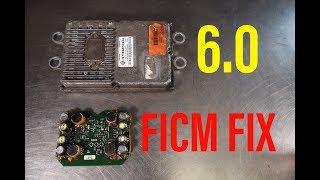
- Repair the FICM Power Supply 🎬 Watch: Step-by-step guide to testing and replacing the power supply — Parts: $150-$300, Labor: $150-$300, ~2.0 hr book time (Intermediate)
- Replace Batteries and Alternator — Parts: $400-$800, Labor: $150-$250, ~1.5 hr book time (DIY)
- Replace the FICM Power Relay — Parts: $20-$40, Labor: $0-$50, ~0.1 hr book time (DIY)
- Repair Damaged Wiring or Connectors — Parts: $50-$150, Labor: $200-$500, ~3.0 hr book time (Professional)
Used vs. New Parts: Buying Guide
When a used part is worth it: A used FICM carries significant risk and only makes sense if the vehicle is very old and the budget is extremely tight.
Donor-vehicle mileage cap: roughly under 60000 miles for the part to have meaningful remaining life.
Donor quality checklist:
- Verify the donor vehicle was not scrapped due to electrical failure.
- Match the part number exactly (4-pin vs 7-pin Ford FICMs are not interchangeable).
- Inspect connectors for burnt pins or corrosion.
Decision logic:
- If Budget is the primary concern → Use a professional repair service to rebuild your original module's power board. This avoids reprogramming costs.
- If Reliability is most important → Buy a high-quality remanufactured unit pre-programmed to your VIN with a lifetime warranty.
Warranty tradeoff: Used parts have a 30-day warranty. Remanufactured units offer 1-year to lifetime warranties.
Worst-case if a used part fails: 1000 if a used part fails, requiring repeat labor and a second replacement module.
What Happens If You Wait — Timeline
- 0-1 month: Code P0611 is stored. Symptoms are subtle, limited to slightly longer crank times on cold mornings. (MPG impact: 0-5%% · Added cost: $0-50 in wasted fuel)
- 1-3 months: Hard starting when cold becomes consistent. The engine idles roughly for the first minute and suffers noticeable power loss. (MPG impact: 5-10%% · Added cost: $50-150 in wasted fuel)
- 3-6 months: Severe drivability issues. The engine stalls at idle, misfires audibly, and produces heavy smoke. The Check Engine Light flashes. (MPG impact: 10-20%% · Added cost: $1500-3000 (imminent damage to the Catalytic Converter or DPF from raw fuel))
- 6+ months: Catastrophic failure. The vehicle becomes a crank-no-start. Low voltage has likely damaged the fuel injector spool valves. (MPG impact: N/A (vehicle won't run)% · Added cost: $3000-7000+ (FICM + DPF + 8 new injectors + tow))
Cost of Not Fixing It
- 0-1 month: Increased fuel consumption and hard starting, creating a safety hazard in traffic. (Added cost: 50-150)
- 1-6 months: Severe misfires dump raw fuel into the exhaust, overheating and destroying the catalytic converter or DPF. (Added cost: 1500-3000)
- 6+ months: Prolonged low FICM voltage destroys the fuel injectors. The vehicle becomes a no-start requiring a tow. (Added cost: 3000-7000)
Diagnosis Steps
- Scan for All Trouble Codes
Use an OBD-II scanner to read all stored codes. Always diagnose communication codes (U0105) or relay codes (P0612) before condemning the FICM. If P0611 appears with all eight injector low-circuit codes (P0261-P0284), the FICM power supply is dead.
Tools: OBD-II Scanner (Beginner) - Load Test Batteries and Alternator
Test battery voltage; it must be 12.6V+ with the engine off. The alternator must produce 13.7-14.7V running. Perform a dedicated load test on both batteries. A weak charging system is the primary killer of FICMs.
Tools: Multimeter, Battery Load Tester (Beginner) - Test the FICM Power Relay
Locate the FICM power relay in the fuse box. Swap it with an identical, non-critical relay (like the horn). If the vehicle starts and runs normally, replace the faulty relay.
Tools: Relay Puller, Multimeter (Beginner) - [PRO TIP] Test FICM Output Voltage (Live Data)
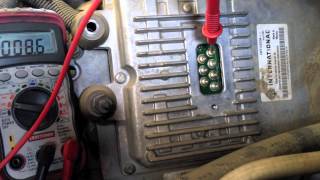
Using an advanced scan tool, monitor the FICM Main Power (FICM_MPWR) PID. With the key on, engine off (KOEO), it must hold 47-49V. During cranking, it must never drop below 45V. A drop below 45V confirms the internal power supply has failed.
Tools: Advanced Scan Tool (Advanced) - Perform an Injector Buzz Test
Command an injector buzz test via a bi-directional scan tool. Listen for sharp, uniform clicks from all injectors. Weak or silent injectors indicate a failed FICM driver, bad wiring, or a dead injector coil.
Tools: Advanced Bi-Directional Scan Tool (Advanced) - Visually Inspect Wiring and Grounds
Inspect the wiring harness for chafing, especially against metal brackets (common on Duramax). Unplug the FICM and check for bent pins, burnt plastic, or moisture intrusion. Verify engine ground straps are tight and corrosion-free.
Tools: Flashlight, Inspection Mirror (Intermediate) - Check Injector Coil Resistance
If specific injectors fail the buzz test, disconnect their harness and measure coil resistance. Ford 6.0L coils should read 0.4-0.6 ohms. A shorted coil (near zero ohms) overloads and destroys the FICM.
Tools: Multimeter (Advanced) - Analyze CAN Bus Communication
If FICM voltage is perfect but a U0105 code persists, tap the CAN high/low wires with an oscilloscope. A distorted waveform confirms a wiring short or open circuit in the communication network.
Tools: Oscilloscope, Wiring Diagram (Professional)
When This Code Triggers (Freeze-Frame Conditions)
- Engine Coolant Temp: 40-80°F (cold start)
- RPM: 150-250 (during engine cranking)
- FICM Voltage (PID): < 45V (during crank or immediately after starting)
Related Codes
- P0261 - P0284 — Injector circuit low codes. If P0611 appears alongside low codes for all eight cylinders, the FICM power supply is dead. If it appears with only one or two, suspect a bad injector or localized wiring short.
- P0612 — FICM Relay Control circuit. Diagnose this first. A failed relay cuts power to the FICM, triggering P0611 as a secondary symptom.
- U0105 — Lost Communication with FICM. Diagnose this first. Indicates a CAN bus network short or open wire, meaning the PCM cannot talk to the FICM.
- P1378 — FICM System Voltage Low (Ford specific). Confirms the FICM output voltage is below the 45V threshold, requiring module repair or replacement.
Climate & Environmental Factors
- Cold Weather: Cold temperatures severely worsen P0611 symptoms. A weak FICM outputting a borderline 46V when warm drops below the critical 45V threshold in the cold, resulting in a no-start.
- Heat and Vibration: Engine-mounted FICMs suffer from extreme heat cycles and vibration. This degrades internal solder joints and capacitors on the power supply board, causing voltage drops.
- Moisture Intrusion: Damaged FICM seals allow humidity and water to corrode internal circuit boards, creating short circuits and permanent module failure.
How to Talk to a Mechanic About This Code
Say this: "I have a P0611 code. Before assuming the FICM is bad, please load test both batteries, check alternator output, and test the FICM relay. Most importantly, I need the FICM output voltage readings at key-on and while cranking."
This proves you understand the common misdiagnoses. It forces the shop to test the cheap power supply components before selling you a $1,000 module.
Avoid saying:
- 'My truck won't start, just fix it.'
- 'I think I need a new FICM.'
Questions to ask before authorizing the repair:
- What exactly did the FICM voltage drop to during cranking?
- Did both batteries pass a dedicated load test?
- If replacing the FICM, is the new unit pre-programmed to my VIN?
Where to Take It: Dealer vs Independent vs Chain
- Dealer:
A safe but expensive option. Recommended only if under warranty.
Best for: Vehicles under warranty., When a brand-new, OEM-programmed module is required.
Downsides: Highest labor rates., Will default to expensive module replacement rather than offering board repair. (Typical cost: +50% vs. baseline) - Independent Shop:
Best fit, provided you choose an independent shop that specializes strictly in diesel repair.
Best for: Out-of-warranty diesel trucks., Accessing cost-effective repair options like sending the FICM out for board repair.
Downsides: A general auto shop lacks the specific software and knowledge for diesel electronics. (Typical cost: +0% vs. baseline) - Chain Shop:
AVOID for P0611 diagnosis. They are not equipped for this repair.
Best for: Diagnosing and replacing batteries.
Downsides: Technicians lack specialized training for complex diesel modules., High risk of misdiagnosis. (Typical cost: -10% vs. baseline)
When to Walk Away From the Repair
If the total estimated repair cost exceeds 50% of the truck's current private-party value, consider selling it as-is.
- Car worth $8500, fix is $1500: Fix it. The repair is roughly 18% of the vehicle's value.
- Car worth $4500, fix is $3000: Walk away. The repair cost is 66% of the truck's value.
What Scan Tool You Need for This Code
Minimum: A tool that reads manufacturer-specific live data PIDs, specifically FICM voltage (FICM_MPWR).
A $20 code reader only shows the P0611 code. It cannot display live FICM voltage, which is mandatory to confirm if the module is actually failing.
Budget: FORScan software with OBDLink EX adapter (~$80) — The most powerful DIY option for Ford. Reads all FICM voltage PIDs and runs the injector buzz test.
Mid-range: FOXWELL NT510 Elite (~$150) — Offers pre-loaded OEM software to read live data streams including FICM voltage without needing a laptop.
Professional: Autel MaxiCOM MK808 (~$500) — Provides full bidirectional control to command injector buzz tests and offers OEM-level diagnostics for all makes.
How to Clear the Code After You Fix It
- Use an OBD-II scan tool to clear all fault codes.
- Ensure the fuel tank is between 15% and 85% full.
- Perform a complete drive cycle to set readiness monitors.
Drive cycle (~30 minutes): Cold start after sitting 8+ hours. Idle for 3 minutes. Drive at a steady 55 mph for 15 minutes. Perform several accelerations from 40 to 65 mph. Stop and idle in Drive for 2 minutes.
Readiness monitors affected: Comprehensive Component Monitor, Misfire Monitor, Catalyst Monitor
Before emissions retest: drive at least 50 miles to fully set monitors.
Watch out for:
- The code returns immediately if weak batteries or a wiring short were ignored.
- Attempting a drive cycle with less than 1/4 tank of fuel prevents the EVAP monitor from running.
Will This Fail Emissions / State Inspection?
Yes — this code typically fails an OBD-II emissions inspection.
- California: An active Check Engine Light is an automatic failure. A full drive cycle must be completed to set readiness monitors before re-testing.
- Texas: In emissions counties, an illuminated CEL is an automatic failure. You must drive 50-100 miles after clearing the code to set monitors.
Most Commonly Affected Vehicles

- Ford F-250/F-350/F-450/F-550 Super Duty (6.0L) (2003-2007) — Infamous for FICM failures due to engine-mounting heat and vibration. 2003-2004 models use a 7-pin FICM; 2004.5-2007 models use a 4-pin FICM. They are not interchangeable.
- Ford Excursion (6.0L) (2003-2005) — Suffers the exact same high rate of FICM failures as the Super Duty trucks.
- Chevrolet Silverado 2500/3500HD (Duramax LB7/LLY) (2001-2005) — Prone to FICM failure and severe wiring harness chafing against the alternator bracket. Always inspect the harness before replacing the module.
- GMC Sierra 2500/3500HD (Duramax LB7/LLY) (2001-2005) — Shares the identical FICM and wiring harness vulnerabilities as the Silverado.
- Ford E-Series Van (6.0L) (2004-2010) — Experiences P0611, but failures are less frequent because the module is mounted in a cooler location on the firewall.
- Dodge Ram 2500/3500 (5.9L Cummins) (2003-2007) — The ECM integrates the injector driver. P0611 points to an internal ECM fault or a wiring issue in the injector harness passing through the valve cover.
Manufacturer-Specific Notes
- Ford: On 6.0L Powerstrokes, a FICM voltage reading below 45V during cranking definitively condemns the module. Ford TSB 09-24-3 updates the FICM calibration to prevent injector spool valve sticking, which stresses the module.
- Chevrolet/GMC: On Duramax LB7/LLY engines, GM issued TSB 04-06-04-003G regarding the wiring harness chafing against the alternator bracket. This short mimics a dead FICM perfectly. Always inspect this bracket first.
- Dodge/Ram: Cummins engines lack a standalone FICM; the ECM drives the injectors. P0611 requires inspecting the ECM and the specific wiring harness passing through the valve cover gasket.
Real Owner Stories
2005 Ford F-250 6.0L - The Misdiagnosis Merry-Go-Round
Truck had a hard start condition when cold. A shop replaced the FICM twice and the alternator three times based on the P0611 code, but the issue persisted.
What they tried:
- Replaced FICM (twice).
- Replaced alternator (three times).
Outcome: A diesel specialist diagnosed a faulty FICM power relay. Swapping the $20 relay restored full power to the module, fixing the hard start and the charging system issues instantly.
Lesson: Never replace a $1,000 module without testing the $20 relay that powers it. A simple voltage check at the fuse box prevents thousands in wasted parts.
2006 Ford F-350 6.0L - The Slow Decline
Truck ran fine but logged a persistent P0611 code. Over three months, it developed a hard cold start and misfired under heavy load.
What they tried:
- Monitored FICM voltage with a scan tool.
Outcome: Live data showed the main FICM power (FICM_MPWR) dropping to 22V while running. Replacing the FICM restored the voltage to 48V and resolved all drivability symptoms.
Lesson: P0611 is an early warning system. Even if symptoms are mild, a voltage drop below 45V confirms the module is dying and will eventually leave you stranded.
2004.5 GMC Sierra 2500HD LLY Duramax - The Hidden Wiring Rub
Vehicle was a crank-no-start with P0611 and U0105 (Lost Communication) codes. The owner assumed the FICM was dead.
What they tried:
- Scanned for codes.
- Visually inspected the wiring harness.
Outcome: The owner found the main wiring harness rubbed through on the metal alternator bracket, shorting the CAN bus wires. Splicing the wires and adding protective loom fixed both codes without replacing the FICM.
Lesson: On Duramax engines, always inspect the harness near the alternator bracket before buying a FICM. A U0105 code almost guarantees a wiring short, not a module failure.
How to Prevent This Code From Triggering
- Load Test Batteries Annually (Once per year, before winter) — Weak batteries are the #1 killer of FICMs. The module's electronics overheat and fail when input voltage drops below 12.6V.
- Monitor FICM and Battery Voltage (Periodically while driving) — Using an OBD-II monitor allows you to catch battery voltage dropping below 13.5V or FICM voltage dropping below 46V before permanent damage occurs.
- Inspect and Secure Wiring Harnesses (During oil changes) — Prevents the notorious Duramax alternator bracket short and ensures connectors remain seated and waterproof.
Frequently Asked Questions
I replaced the FICM, but the P0611 code came back. What did I miss?
You likely have a persistent low voltage problem from weak batteries or a failing alternator. A new FICM fails quickly if input voltage is unstable. Always load-test the charging system and verify wiring integrity before assuming the new part is defective.
Does a new Fuel Injector Control Module (FICM) need to be programmed?
Yes, a brand-new OEM module from the dealer requires programming with a factory scan tool. However, reputable remanufactured units are often shipped pre-programmed to your VIN for plug-and-play installation. Repairing your original module's power board also bypasses the need for reprogramming.
Can I just replace the batteries to fix a P0611 code?
If your batteries fail a load test, replacing them fixes the root cause of low voltage. However, if the low voltage already permanently damaged the FICM's internal power board, you must replace both the batteries and the module. Always test FICM output voltage after installing new batteries.
What is the difference between repairing and replacing the FICM?
Replacing involves buying a new or remanufactured unit, which is faster but more expensive. Repairing means sending your original module to a specialist to rebuild the failed power supply board. Repairing is cheaper and avoids reprogramming, provided your logic board is still functional.
My Check Engine Light is flashing. What should I do?
A flashing Check Engine Light indicates a severe misfire dumping unburned fuel into the exhaust. This destroys your catalytic converter or DPF in minutes, resulting in a massive repair bill. Pull over safely and turn off the engine immediately.
Can a bad fuel injector cause a P0611 code?
Yes, a fuel injector with an internal short circuit draws excessive current from the FICM. This overloads the specific cylinder's driver circuit inside the module. Eventually, this degrades the entire module's performance and triggers the P0611 code.
Key Takeaways
- Code P0611 indicates the Fuel Injector Control Module (FICM) is failing to deliver the required 48 volts to the fuel injectors, causing severe misfires and hard cold starts.
- Always load-test both batteries and verify the alternator outputs 13.7-14.7V before replacing the FICM, as low system voltage is the primary killer of these modules.
- Use an advanced scan tool to monitor the FICM_MPWR PID; a voltage drop below 45 volts while cranking confirms the module's internal power supply has failed.
- Do not drive with a flashing Check Engine Light, as the resulting raw fuel dump destroys the catalytic converter or DPF, adding $1,500 to $3,000 to your repair bill.
Helpful Videos

The information in this article is provided for general reference and educational purposes only. Vehicle specifications, procedures, and part compatibility can vary by production date, trim level, and region. Always consult your vehicle's factory service manual and verify part numbers before purchasing or performing repairs. Safety-critical components such as airbags, seat belts, and braking systems should be installed by a qualified professional.
- 🎬 Helpful Videos
- What Does P0611 Mean?
- Can I Drive With P0611?
- Common Causes
- Symptoms
- Diagnostic Flowchart
- Common Fixes & Costs
- Used vs. New Parts: Buying Guide
- What Happens If You Wait — Timeline
- Cost of Not Fixing It
- Diagnosis Steps
- When This Code Triggers (Freeze-Frame Conditions)
- Related Codes
- Climate & Environmental Factors
- How to Talk to a Mechanic About This Code
- Where to Take It: Dealer vs Independent vs Chain
- When to Walk Away From the Repair
- What Scan Tool You Need for This Code
- How to Clear the Code After You Fix It
- Will This Fail Emissions / State Inspection?
- Most Commonly Affected Vehicles
- Manufacturer-Specific Notes
- Real Owner Stories
- 2005 Ford F-250 6.0L - The Misdiagnosis Merry-Go-Round
- 2006 Ford F-350 6.0L - The Slow Decline
- 2004.5 GMC Sierra 2500HD LLY Duramax - The Hidden Wiring Rub
- How to Prevent This Code From Triggering
- Frequently Asked Questions
- I replaced the FICM, but the P0611 code came back. What did I miss?
- Does a new Fuel Injector Control Module (FICM) need to be programmed?
- Can I just replace the batteries to fix a P0611 code?
- What is the difference between repairing and replacing the FICM?
- My Check Engine Light is flashing. What should I do?
- Can a bad fuel injector cause a P0611 code?
- Key Takeaways
- 🎟️ Get 5% Off