

P0607 on 2017-2024 Jeep Compass: Control Module Performance Causes and Fixes
On a 2017-2024 Jeep Compass, code P0607 often indicates a software anomaly within the Powertrain Control Module (PCM). The most common and well-documented fix is a software update performed by a Jeep dealership, as specified in multiple Technical Service Bulletins. Before suspecting expensive hardware failure, a software reflash should be the first step, followed by a thorough battery and ground connection check.
- For a 2017-2024 Jeep Compass, P0607 is most likely a software issue, not a failed computer.
- The first and most important diagnostic step is to check with a Jeep dealer for an available PCM software update.
- Before considering an expensive PCM replacement, always have the battery professionally load-tested and inspect all major power and ground connections.
- If your Compass is a 2018 model, check if it is covered by Safety Recall U87 / NHTSA 18V-524 for a potentially faulty PCM.
- This code is serious and can affect drivability; it should be addressed promptly by a professional.
What's Unique About the 2017-2024 Jeep COMPASS
For the second-generation (MP) Jeep Compass, this code is frequently not a hardware failure but a software glitch. Jeep has issued several Technical Service Bulletins (TSBs) for the 2017 model year and newer, acknowledging that a "software anomaly" can trigger P0607. [Bulletin #9003753, Bulletin #18-077-20] This is a critical distinction, as many owners might assume they need an expensive PCM replacement when a much cheaper software update at a dealership is the actual prescribed repair. This pattern is also seen on its platform-mate, the Jeep Renegade.
Diagnostic Flowchart
Tap your situation to follow the diagnostic path that matches what you're seeing on this vehicle.
Symptoms You May Notice
- Check Engine Light (MIL) is on
- Poor or harsh shift quality [Bulletin #18-077-20]
- Lack of vehicle speed [Bulletin #18-077-20]
- Engine stalling or failure to start
- Immediate Autostart after an Autostop event (without releasing the brake) [Bulletin #1806817]
- A clatter or ticking noise from the engine bay at idle [Bulletin #18-077-20]
- Vehicle enters a reduced-power 'limp mode'
- Failed autostart where the engine cranks but does not start, or starts and then stalls [Bulletin #1806817]
- Replacing the PCM without first attempting a software update.
- Replacing other components like throttle bodies or sensors before verifying battery health and ground connections.
- Ignoring associated ABS codes (like C0507) and focusing only on the P0607.
Most Likely Causes
- PCM Software Anomaly 🔴 High Probability Multiple TSBs (#9003753, #1806817, #18-077-20) explicitly state that P0607 can be caused by a software issue that requires a PCM reflash to correct. This is the most common first step in diagnosis.
How to confirm: A Jeep dealer or a shop with a wiTECH scan tool can check the current software calibration of the PCM against the latest available version for the vehicle's VIN.
Typical fix: Reprogramming (reflashing) the Powertrain Control Module with the latest software. This is a labor-only service.
Est. part cost: $0 - Weak or Failing Battery 🟡 Medium Probability Modern control modules are highly sensitive to voltage. A weak battery can cause voltage to drop during startup (below 12.4V), leading the PCM's self-test to fail and trigger a false P0607 code. This is a common issue across many modern vehicles, not just Jeeps.
How to confirm: Perform a load test on the battery. A simple voltage check is often insufficient. Static voltage should be at least 12.4V, and the system should maintain stable voltage above 10V while cranking.
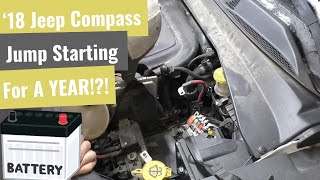
Typical fix: Replace the 12V battery. The Compass uses an AGM battery, which can be more sensitive to deep discharge. 🎬 See how a failing battery causes starting issues on a Compass.
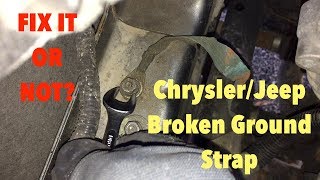
Est. part cost: $150-$350 - Poor Power or Ground Connections 🟡 Medium Probability Loose or corroded battery terminals, main chassis grounds, or the PCM ground strap can create intermittent voltage fluctuations that upset the PCM. One owner of a new Jeep Wrangler (a related platform) reported a P0607 code was resolved by cleaning paint off a factory ground connection bolt to ensure proper bare metal contact. The engine-to-chassis ground strap is another common point of failure. 🎬 Watch: A mechanic shows how to identify a broken ground strap.
How to confirm: Visually inspect and physically check the tightness of all main power and ground cables. Perform a voltage drop test on the PCM's power and ground circuits to find any hidden resistance.
Typical fix: Clean and tighten all ground connections, particularly the battery-to-chassis and engine-to-chassis grounds. Ensure all connections are free of paint and corrosion.
Est. part cost: $0-$20 - Faulty Powertrain Control Module (PCM) ⚪ Low Probability While the code points to the module, actual hardware failure is less common than software or voltage issues. However, a safety recall (U87 / NHTSA 18V-524) was issued for some 2018 Compass models for a faulty voltage regulator chip inside the PCM that could cause stalling, which could also present as a P0607. This confirms a known hardware vulnerability in some units.
How to confirm: This is a diagnosis of exclusion. If a software update, battery replacement, and thorough wiring/ground checks do not resolve the code, the PCM itself is the likely culprit.
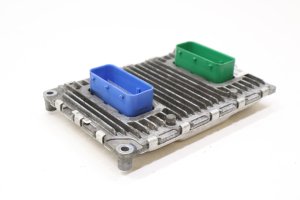
Typical fix: Replace the PCM and program it to the vehicle's VIN. This must be done by a dealer or a specialized shop.
Est. part cost: $500-$1000
Rare But Worth Checking
- Failing Alternator: An alternator providing unstable or low voltage (e.g., below 13.2V when running) can cause the PCM to malfunction and log a P0607 code, mimicking a bad battery.
- Conflicting Wheel Speed Sensor Data: TSB #18-077-20 shows that P0607 can be set alongside wheel speed rationality codes (C0501, C0507, C050D, C0513). In this case, the PCM is flagging its own performance because it's receiving illogical data from another system, which the software update is designed to address. [Bulletin #18-077-20]
Diagnosis Steps
- Scan for all DTCs in all modules. Note any other codes, especially from the ABS or transmission modules.
- Check for applicable TSBs for your vehicle's VIN. Pay close attention to TSBs #18-077-20, #1806817, and #9003753.
- If a software update TSB applies, have a dealer or qualified shop perform the PCM reflash. This is the most probable solution and should be the first repair attempt.
- Thoroughly test the battery and charging system. Ensure battery voltage is stable and above 12.4V at rest and that the alternator maintains 13.5V-14.5V when running. Perform a load test, not just a voltage check.
- Inspect all main power and ground connections. Check the negative battery terminal to the chassis, the engine block ground strap, and the PCM connectors for tightness and corrosion. A common issue on Jeeps is a painted-over ground bolt that needs to be cleaned to bare metal.
- If wheel speed codes are present, understand that TSB #18-077-20 addresses this combination with a software update, so the reflash should still be the primary fix.
- If all other steps fail, suspect an internal PCM hardware failure. Check if your VIN is covered by recall U87 / NHTSA 18V-524 for certain 2018 models. If not covered, the PCM will need to be replaced.
Parts You'll Likely Need
- Powertrain Control Module (PCM) Software Update — This is not a physical part, but a service. It is the most common fix for P0607 on this platform, as documented by multiple manufacturer TSBs.
Trusted brands: Mopar (via dealership)
OEM price range: $150-$300 (Labor for reflash)
Aftermarket price range: N/A - Powertrain Control Module (PCM)
(OEM #68342095AA, 68377457AB (Example part numbers for 2018 models, VIN specific))— If software updates and electrical checks fail, the module itself has likely failed internally and requires replacement. Some 2018 models were recalled for this part due to a faulty internal voltage regulator.
Trusted brands: Mopar
OEM price range: $700-$1200
Aftermarket price range: $400-$800 (Remanufactured)
Related Codes That Often Appear With This One
- C0501 — As per TSB #18-077-20, a 'Left Front Wheel Speed Signal Rationality' fault can occur with P0607.
- C0507 — As per TSB #18-077-20, a 'Right Front Wheel Speed Signal Rationality' fault can occur with P0607.
- C050D — As per TSB #18-077-20, a 'Left Rear Wheel Speed Signal Rationality' fault can occur with P0607.
- C0513 — As per TSB #18-077-20, a 'Right Rear Wheel Speed Signal Rationality' fault can occur with P0607.
- P061A — TSB #18-077-20 also lists 'Level 2 Torque Performance' as a code that can be set along with P0607, fixed by the same PCM software update.
Technical Service Bulletins (TSBs) & Recalls
- 18-077-20: Addresses P0607 with poor shift quality and wheel speed codes, fixed by a PCM update.
- 1806817: Addresses P0607 with Auto Start/Stop issues, fixed by a PCM update. [Bulletin #1806817]
- 9003753: Notes that P0607 can be caused by a software anomaly. [Bulletin #9003753]
- U87 / 18V-524: Safety recall for faulty PCM in certain 2018 models.
Platform-Specific Known Issues
- TSB #9003753 notes that a MIL-on condition with P0607 may be due to a software anomaly. [Bulletin #9003753]
- TSB #1806817 links P0607 to problems with the Auto Start/Stop system, where the fix is a software update. [Bulletin #1806817]
- TSB #18-077-20 connects P0607 with poor shift quality, engine clatter, and wheel speed sensor rationality codes, again pointing to a PCM software update as the solution.
- Safety Recall U87 / NHTSA 18V-524 was issued for some 2018 Jeep Compass models due to a faulty voltage regulator chip in the PCM that could cause stalling and required PCM replacement.
Mechanic-Grade Diagnostic Values
- PCM Power Supply Voltage (Key On) — expected: 12.2 V ± 0.5 V. Failure: Voltage below this range indicates a power supply issue (battery, wiring) before the PCM.
- PCM Ground Circuit Resistance — expected: < 0.1 Ω. Failure: Resistance higher than 0.1 Ω indicates a poor ground connection, which can cause floating voltages and module errors.
- Charging System Voltage (Engine Running) — expected: 13.5V - 14.5V. Failure: Voltage outside this range indicates a failing alternator, which can cause the PCM to log performance codes due to unstable power.
Scan Tool Commands That Help
- wiTECH 2.0: PCM Reflash/Programming — Used to install the latest manufacturer software to fix known anomalies causing P0607, or to program a new/blank PCM to the vehicle.
- wiTECH 2.0: Check PCM VIN — After installing a new or used PCM, this function is used to write the vehicle's correct VIN into the module, which is required for it to communicate with other modules.
- wiTECH 2.0: Learn ETC (Electronic Throttle Control) — After a PCM replacement or reflash, this procedure recalibrates the throttle body to ensure correct throttle response.
- wiTECH 2.0 / Aftermarket: PCM Replace Function (in WCM/RFH) — When installing a used PCM, this security function is required to sync the immobilizer information between the Wireless Control Module (WCM) / Radio Frequency Hub (RFH) and the replacement PCM, allowing the engine to start. This often requires a PIN code.
Wiring & Ground Locations
- PCM Case Ground — The metal housing of the Powertrain Control Module itself.. The PCM case is intentionally grounded to the vehicle body/chassis to shield it from Radio Frequency Interference (RFI) and Electromagnetic Interference (EMI). A poor case ground can allow electrical noise to interfere with the processor, potentially causing a P0607. It must be bolted firmly to a clean, bare metal surface.
- TCM Power Feed (Violet/Red Wire) — In the wiring harness that runs between the radiator and the transmission, near the driver's side of the engine bay.. This wire, which runs from fuse F24 in the underhood fuse box to the Transmission Control Module (TCM), is in a location prone to corrosion. If it breaks, the TCM loses power, causing a U0101 code. The PCM may then log a P0607 because it cannot control the powertrain without communicating with the TCM.
- G104 - Main Engine Ground — On some Jeep platforms, this is a ground strap from the firewall to the side of the engine block, often near the dipstick tubes.. This is a critical ground point for multiple components, including sensors whose data the PCM relies on. While the exact location on a Compass may vary, corrosion at the main engine-to-chassis or firewall ground is a common Jeep issue that can cause widespread electrical problems, including module performance codes.
Real Owner Repair Stories
- Mustafa Jafar H (YouTube) (2018 Jeep Compass) — No crank, no start, gear indicator not showing on the dash, multiple communication codes including U0101 (Lost Communication with TCM).
❌ Tried (didn't work) Checking all fuses in the underhood and interior fuse boxes; all were good.
✅ What actually fixed it A corroded and broken violet/red wire in the harness between the radiator and transmission was found. This wire supplied power from fuse F24 to the TCM. Repairing this single wire restored power to the TCM, re-established communication, and allowed the vehicle to start, clearing all codes.
OEM Part Supersession History
68342095AA→68342095AB— Part revision or update by the manufacturer.
Model Year Variations Within This Range
- 2018: Certain 2018 Jeep Compass models built between August 30, 2017, and June 27, 2018, were subject to Safety Recall U87 / NHTSA 18V-524. These vehicles may have a PCM with a faulty internal voltage regulator chip, which can cause stalling or a no-start condition. The only remedy is PCM replacement.
Helpful Videos

We Have This Part in Stock



The information in this article is provided for general reference and educational purposes only. Vehicle specifications, procedures, and part compatibility can vary by production date, trim level, and region. Always consult your vehicle's factory service manual and verify part numbers before purchasing or performing repairs. Safety-critical components such as airbags, seat belts, and braking systems should be installed by a qualified professional.
- Jeep COMPASS:
- 🎬 Helpful Videos
- 🛍️ Shop This Part
- What's Unique About the 2017-2024 Jeep COMPASS
- Diagnostic Flowchart
- Symptoms You May Notice
- Most Likely Causes
- Rare But Worth Checking
- Diagnosis Steps
- Parts You'll Likely Need
- Related Codes That Often Appear With This One
- Technical Service Bulletins (TSBs) & Recalls
- Platform-Specific Known Issues
- Mechanic-Grade Diagnostic Values
- Scan Tool Commands That Help
- Wiring & Ground Locations
- Real Owner Repair Stories
- OEM Part Supersession History
- Model Year Variations Within This Range
- 🎟️ Get 5% Off