

P0606 on 2007-2011 GMC Yukon Denali: ECM/PCM Processor Fault Causes and Fixes
On a 2007-2011 GMC Yukon Denali, the P0606 code indicates an internal processor fault in the Engine Control Module (ECM/PCM). The most common fix is replacing the ECM. Before replacement, it's crucial to rule out a weak battery, faulty alternator, or poor ground connections, as these can also trigger the code. Owners and technicians strongly advise cleaning and tightening all major ground straps, especially the engine-to-firewall and frame grounds, before condemning the expensive computer.
- P0606 is a critical code indicating a likely failure of the main Engine Control Module (PCM). Do not continue to drive the vehicle.
- Before replacing the expensive PCM, you MUST first test the battery under load and inspect all primary power and ground connections for corrosion or looseness.
- If you have a crank-no-start condition with P0606, investigate the camshaft position sensor circuit first, as per GM TSB #17-NA-132.
- PCM replacement is not a simple plug-and-play repair. The new module must be professionally programmed to your vehicle's VIN and security system.
What's Unique About the 2007-2011 Gmc YUKON DENALI
For the third-generation (2007-2014) GMC Yukon and its GM GMT900 siblings (like the Chevy Tahoe/Suburban and Cadillac Escalade), the P0606 code is a well-documented issue that often points directly to a failing Engine Control Module (ECM), specifically the ACDelco E38 model used in many of these trucks. While external factors like bad grounds or low voltage can trigger it, these trucks are known for the ECM itself being the root cause after years of heat cycles and electrical stress. GM has also issued technical bulletins about this family of codes, acknowledging that internal module faults can occur. [⭐ MANUFACTURER TSB — highest authority] A key difference for this platform is the high probability that the code is falsely triggered by poor ground connections, a weak battery, or a faulty charging system, making thorough electrical diagnosis essential before replacing the ECM.
Diagnostic Flowchart
Tap your situation to follow the diagnostic path that matches what you're seeing on this vehicle.
Symptoms You May Notice
- Check Engine Light is on
- "Reduced Engine Power" message displayed on the dash
- Engine stalling or shutting off while driving, sometimes triggered by bumps in the road.
- No-start or crank-no-start condition, may be accompanied by a single click.
- Erratic or harsh transmission shifting
- Unstable or rough idle
- Multiple other warning lights (ABS, Traction Control) may illuminate simultaneously
- Gauges on the instrument cluster behaving erratically or dropping to zero.
- Radio and other interior electronics may flash or act strangely.
- Replacing the throttle body. While throttle body issues can cause a 'Reduced Engine Power' message, they typically set different codes. P0606 is an internal module fault, not a component fault.
- Replacing various sensors (O2, MAP, etc.). A failing PCM can misinterpret data from good sensors, leading to other codes. If P0606 is present, the PCM's health and its electrical supply should be the primary focus.
- Immediately replacing the ECM. This is the most common and expensive mistake. Due to the high frequency of electrical issues on this platform, the battery, alternator, and all ground connections MUST be thoroughly tested and cleaned first.
Most Likely Causes
- Internal ECM/PCM Failure 🔴 High Probability The ACDelco E38 ECM used in these trucks can fail after years of exposure to heat and electrical stress, making it the most common cause once external factors are eliminated. This is often considered the 'last resort' diagnosis after all other electrical possibilities are exhausted.
How to confirm: This is diagnosed by exclusion. After confirming that battery voltage, charging system, and all power/ground connections to the ECM are good, the module itself is condemned. A professional may use a scan tool to monitor ECM voltage PIDs 🎬 Watch: How to diagnose an ECM processor error to look for internal drops.
Typical fix: Replace the Engine Control Module (ECM) and have it programmed by a dealer or qualified shop with the correct OEM software and vehicle VIN.
Est. part cost: $250-$500 - Poor ECM/PCM Power or Ground Connections 🔴 High Probability Corroded, loose, or damaged ground straps and power feeds are a very common issue on trucks of this age, leading to intermittent voltage drops that can trigger a P0606. Key problem areas on the GMT900 platform include the ground strap from the engine block to the firewall and frame grounds located behind the front wheels, which are exposed to road splash.
How to confirm: Visually inspect and physically tug on all major ground straps. Key locations to check are G103 (front of passenger side cylinder head), G104 (rear of driver's side cylinder head), and the main engine-to-firewall strap (G108). Perform a voltage drop test on the ground circuit to identify high resistance that isn't visually apparent.
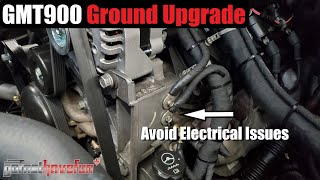
Typical fix: Clean all grounding points to bare metal, re-secure tightly, and apply dielectric grease 🎬 See this guide on upgrading your GM truck grounds to prevent future corrosion. Replace any frayed or broken ground straps. The braided engine-to-firewall strap is a common part to fail.
Est. part cost: $10-$75 - Low Battery Voltage or Failing Alternator 🟡 Medium Probability GMT900 control modules are highly sensitive to voltage. A weak battery that drops voltage significantly during cranking can cause the ECM to incorrectly flag an internal fault before the engine even starts. A failing alternator can produce voltage spikes or insufficient voltage, confusing the module.
How to confirm: Perform a load test on the battery (a simple voltage check is not enough). With the engine running, check alternator output with a multimeter; it should be stable and between 13.5 and 14.5 volts. Check for hidden corrosion within the battery cable insulation by feeling for brittle or swollen sections.
Typical fix: Replace the weak battery and/or the faulty alternator. Clean or replace corroded battery cable ends.
Est. part cost: $150-$400
Rare But Worth Checking
- Faulty Camshaft Position Sensor Circuit: Per GM TSB #17-NA-132, an open in the camshaft position sensor circuit can cause a P0606 to set during a crank-no-start condition *instead* of the appropriate cam sensor code. The ECM aborts the start before the correct code can be logged. This is a critical misdiagnosis to avoid.
- Aftermarket Engine Tuning: If the ECM has been reprogrammed with an aftermarket 'tune,' a bad or corrupted software flash can cause internal processor conflicts and trigger a P0606 code.
- Short in a Sensor or Actuator Circuit: A shorted sensor (e.g., coolant temp sensor) or actuator can sometimes feed back improper voltage to the ECM, causing it to report an internal fault. Unplugging the suspect sensor might cause the P0606 to clear, indicating the external component is the true cause.
Diagnosis Steps
- Check for other Diagnostic Trouble Codes (DTCs). If many unrelated codes are present, it strengthens the case for a faulty PCM or a major power/ground issue.
- Perform a comprehensive battery and charging system test. Ensure the battery can hold a load and the alternator output is stable and correct (13.5-14.5V).
- Visually inspect and clean all major power and ground connections. This includes battery terminals, battery-to-chassis grounds, and engine-to-chassis ground straps. On the GMT900 platform, pay special attention to the grounds on the frame behind the front wheels, the strap from the engine to the firewall (G108), and grounds on the cylinder heads (G103, G104).
- If a crank-no-start condition exists, thoroughly inspect the camshaft position sensor and its wiring harness for damage, as outlined in TSB #17-NA-132, before condemning the ECM.
- Using a wiring diagram, verify that the ECM is receiving proper voltage and has a solid ground connection at its connector pins. Check for pushed-out or corroded pins in the ECM connectors.
- If an aftermarket tune is installed, flash the ECM back to the stock GM calibration to see if the fault clears.
- If all power, grounds, and external circuits check out, the ECM is highly likely to be faulty and requires replacement.
Parts You'll Likely Need
- Engine Control Module (ECM/PCM)
(OEM #12597121)— This is the most common cause of a P0606 code on this vehicle after all external electrical issues have been ruled out. The code directly indicates an internal failure of this component. This part number has been superseded by 12603892.
Trusted brands: ACDelco, GM Genuine Parts
OEM price range: $300-$500
Aftermarket price range: $200-$400 - Engine Ground Strap
(OEM #19434466)— The ground strap between the firewall and engine (G108/G104) is a frequent failure point, causing intermittent voltage drops that can trigger a P0606 code.
Related Codes That Often Appear With This One
- P0601 — Indicates 'Internal Control Module Memory Check Sum Error.' Like P0606, this points to a fatal internal PCM fault. [⭐ MANUFACTURER TSB — highest authority]
- P0604 — Indicates 'Internal Control Module Random Access Memory (RAM) Error.' This is another code indicating a critical internal processing failure within the PCM. [⭐ MANUFACTURER TSB — highest authority]
- P069E — Indicates 'Fuel Pump Control Module Requested MIL Illumination.' A user on a Reddit forum reported this code alongside P0606, suggesting a potential link where a failing primary module (PCM) can cause secondary modules to report errors.
Technical Service Bulletins (TSBs) & Recalls
- 05-06-04-060A: Information on control module Diagnostic Trouble Code(s) (DTC)(s) P0601, P0602, P0603, P0604, P0606, P062F, P06F3, P1621 which can be shared in multiple modules. [⭐ MANUFACTURER TSB — highest authority]
- 17-NA-132: Warns technicians not to replace the ECM for a P0606 during a crank-no-start condition until the camshaft position sensor circuit has been inspected, as it can be the true cause.
Platform-Specific Known Issues
- The provided NHTSA TSB #05-06-04-060A confirms that P0606 is part of a family of internal control module fault codes that GM has identified, indicating this is a known potential issue. [⭐ MANUFACTURER TSB — highest authority]
- A separate TSB (#17-NA-132) highlights a specific scenario where a faulty camshaft position sensor circuit can incorrectly cause a P0606 code during a no-start event, leading to misdiagnosis.
- Owner forums for GMT900 trucks are filled with stories of P0606 being resolved by cleaning ground connections, particularly the main engine-to-firewall strap and frame grounds, after being quoted for an ECM replacement.
Mechanic-Grade Diagnostic Values
- ECM Power and Ground Circuit Voltage Drop — expected: Less than 0.2V (200mV). Failure: A reading greater than 0.2V indicates excessive resistance in the power feed or ground connection that needs to be located and repaired.
- Battery Voltage (Key Off, Engine Off) — expected: 12.4V to 12.6V. Failure: A reading below 12.4V indicates a discharged state, and a reading below 12.0V suggests a bad battery that requires a load test.
- Charging System Voltage (Engine Running at Idle) — expected: 13.5V to 14.5V. Failure: Voltage that is unstable, below 13.2V, or above 15.0V points to a fault in the alternator or its connections.
- 5-Volt Sensor Reference Voltage — expected: 5.0 Volts at the sensor connector with the key on. Failure: Missing or incorrect voltage can indicate a wiring issue or an internal ECM fault. If the 5V reference returns after unplugging a sensor, that sensor is likely shorted internally.
Scan Tool Commands That Help
- GDS2 / Tech2: Module Replacement and Programming — This factory-level scan tool is required after replacing the ECM to load the vehicle's specific VIN, security information, and software calibration. Failure to program the new module will result in a no-start condition.
- GDS2 / Tech2: Crankshaft Position Variation Relearn — After replacing or reprogramming the ECM, this procedure must be performed to synchronize the ECM with the crankshaft position sensor's signal to prevent misfire codes and ensure accurate engine timing.
Wiring & Ground Locations
- G103 — On the front of the passenger side (right) cylinder head.. This is a primary engine and ECM ground point. Corrosion or looseness here can cause unstable voltage to the ECM, triggering a P0606.
- G104 — On the rear of the driver's side (left) cylinder head.. This is another critical ECM ground, often connected to the firewall via a braided strap (G108). This strap is a very common failure point due to heat and vibration, causing intermittent P0606 codes.
- G108 — On the firewall in the left rear corner of the engine compartment, serving as the attachment point for the ground strap from G104.. This is the chassis-side connection for the critical engine-to-body ground. Corrosion at this point can defeat the entire purpose of the ground strap.
- ECM Connector X1, Pin 19 — At the main E38 ECM connector, wire is typically Pink (PK).. This is the Ignition 1 Voltage input. A voltage drop test should be performed on this circuit to ensure the ECM is receiving a clean, stable voltage when the key is on.
- ECM Connector X1, Pin 20 — At the main E38 ECM connector, wire is typically Red/White (RD/WH).. This is the main Battery Positive Voltage feed. This pin should have constant battery voltage. Any resistance or voltage drop here can starve the ECM and trigger a P0606.
- ECM Ground Pins — Multiple pins on the ECM connectors, typically with Black (BK) wires.. The ECM is grounded through multiple pins in its connectors, which are bundled and attached to the engine block at locations like G103 and G104. It is not sufficient to just ground the case; the pins themselves must have a clean path to ground.
Real Owner Repair Stories
- GMTNation forum user (2008 GMC Sierra (GMT900 platform)) — In very cold weather, experienced a 'click, click, click' no-start condition. After a jump start, the truck went into limp mode with code P0606.
❌ Tried (didn't work) Cleaning the badly corroded positive battery cable terminal initially seemed to work, but the problem returned.
✅ What actually fixed it The owner discovered the positive post on the old battery was physically loose and moving back and forth. Replacing the battery with a new one resolved the starting issues, high voltmeter readings, and cleared the P0606 code.
"I Checked Everything" — The Actual Cause
- Multiple owners on forums have reported chasing P0606 after confirming battery and alternator are good and visually inspecting grounds. The root cause was later found to be hidden corrosion inside the main battery cables. The insulation looked fine, but the copper strands inside were corroded, creating high resistance that could only be found with a voltage drop test or by replacing the cables.
OEM Part Supersession History
12597121→12603892— Standard part revision and update by the manufacturer.Multiple (E38 Family)→Varies— The ACDelco E38 ECM has many service numbers that may be compatible or superseded.
Heads up: Part number 12603892 is a known replacement for 12589297 and 19210738 on 2007 models. Other compatible service numbers for the E38 family include 12612384, 12625455, and 12633238. Always verify compatibility with the vehicle's VIN.
Model Year Variations Within This Range
- 2007-2008: These model years primarily used the 6.2L L92 V8 engine.
- 2009: The engine was updated to the L9H, which added E85 FlexFuel capability. This requires a different ECM software calibration.
- 2010-2011: The engine was updated to the L94, which kept FlexFuel capability and added Active Fuel Management (AFM), also known as Displacement on Demand (DOD). This adds complexity to the engine and ECM software.
Helpful Videos
Used OEM Parts in Stock



New Aftermarket Parts Available

The information in this article is provided for general reference and educational purposes only. Vehicle specifications, procedures, and part compatibility can vary by production date, trim level, and region. Always consult your vehicle's factory service manual and verify part numbers before purchasing or performing repairs. Safety-critical components such as airbags, seat belts, and braking systems should be installed by a qualified professional.
- Gmc YUKON DENALI:
- 🎬 Helpful Videos
- 🛍️ Shop This Part
- What's Unique About the 2007-2011 Gmc YUKON DENALI
- Diagnostic Flowchart
- Symptoms You May Notice
- Most Likely Causes
- Rare But Worth Checking
- Diagnosis Steps
- Parts You'll Likely Need
- Related Codes That Often Appear With This One
- Technical Service Bulletins (TSBs) & Recalls
- Platform-Specific Known Issues
- Mechanic-Grade Diagnostic Values
- Scan Tool Commands That Help
- Wiring & Ground Locations
- Real Owner Repair Stories
- "I Checked Everything" — The Actual Cause
- OEM Part Supersession History
- Model Year Variations Within This Range
- 🎟️ Get 5% Off